Maximum Access PointsDifferent
C9800-L-C-K9
250 (500 with Performance license)
CW9800L
500

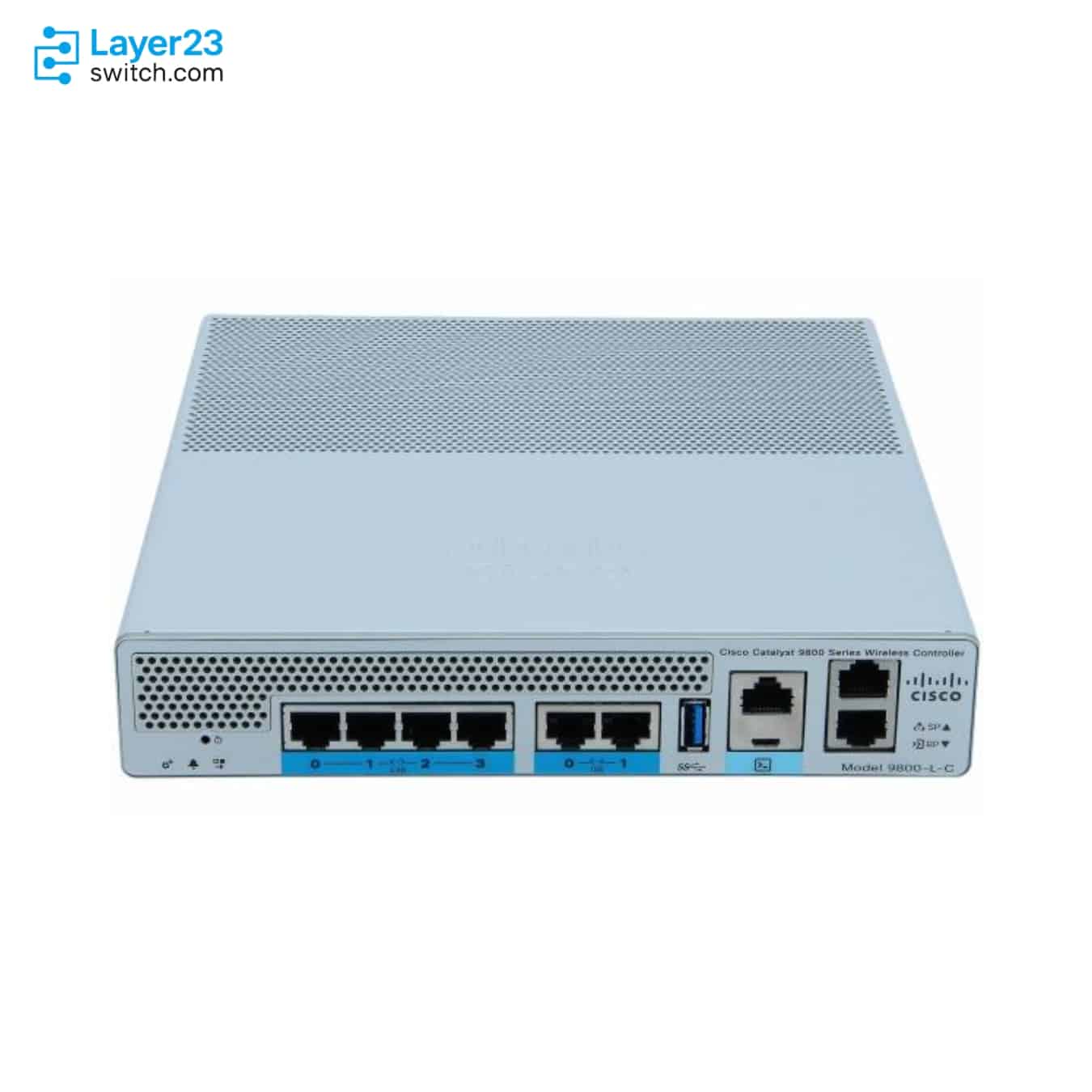
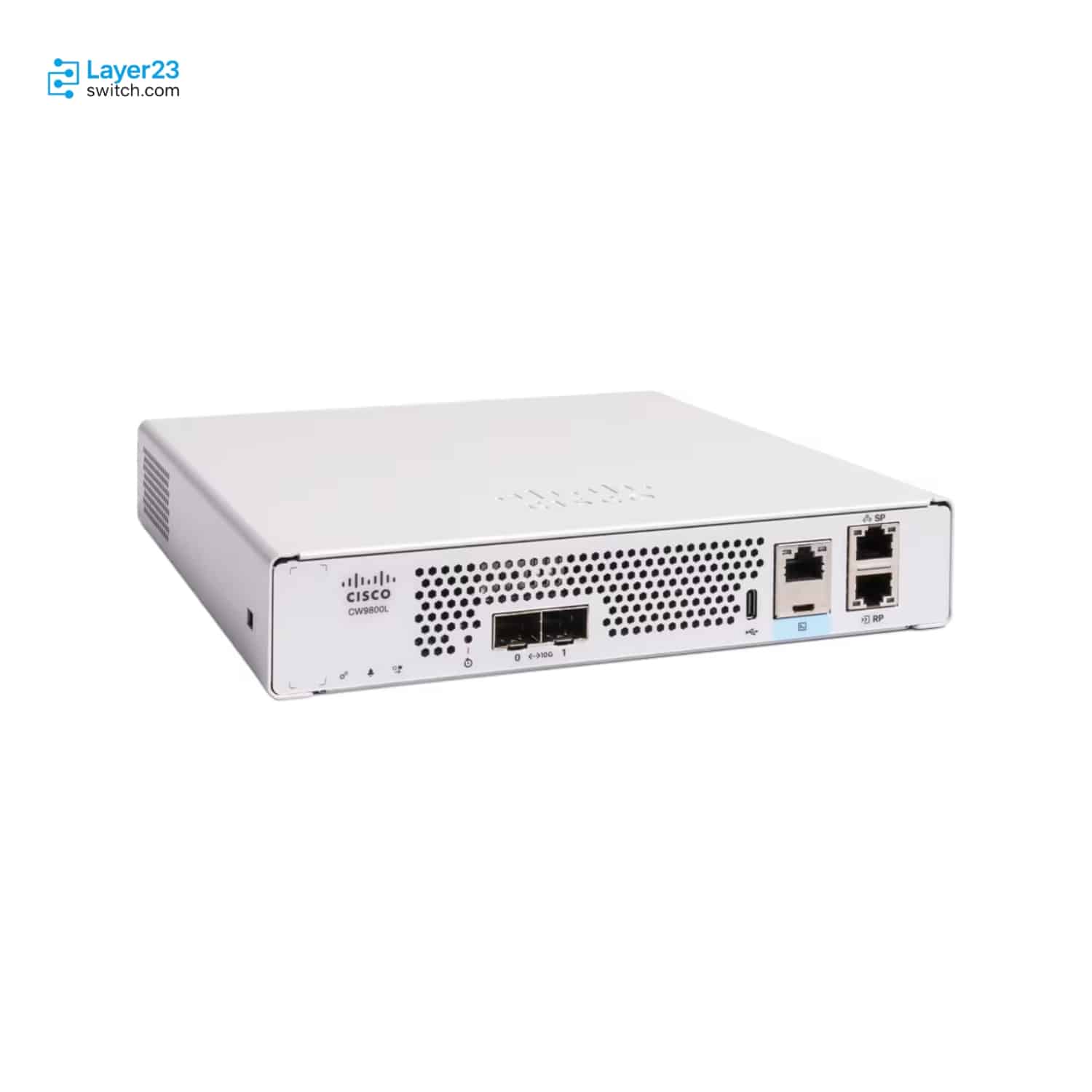
The CW9800L reaches 500 access points and 10,000 clients without a license, while the C9800-L-C-K9 needs the Performance license for that scale. The CW9800L also adds a redundant power option. Choose the C9800-L-C-K9 when the uplink must be multigigabit copper, because the CW9800L has only SFP+ ports.
Start with the specifications that decide whether a model fits, whether they differ or not. Each card says if the values are the same.
250 (500 with Performance license)
500
5,000 (10,000 with Performance license)
10,000
5 Gbps (10 Gbps with Performance license)
10 Gbps
Wi-Fi 5 Wave 2, Wi-Fi 6/6E and Wi-Fi 7 APs; 2.4, 5 and 6 GHz
Wi-Fi 5 Wave 2, Wi-Fi 6/6E and Wi-Fi 7 APs; 2.4, 5 and 6 GHz
From Cisco IOS XE 17.15.2, with Multi-Link Operation and 320 MHz channels in 6 GHz
From its first release (Cisco IOS XE 17.18.2), with Multi-Link Operation and 320 MHz channels in 6 GHz
2 x 1/2.5/5/10G RJ-45; 4 x 1/2.5G RJ-45
2 x 1/10G SFP+
The CW9800L supports 500 access points out of the box, so neither unit of an HA pair needs a Performance license. The CW9800L also runs up to 10 dB quieter and accepts the optional CW9800L-RPS= redundant power kit.
The C9800-L-C-K9 uplinks over two 1/2.5/5/10G RJ-45 ports, so it needs no optics. The CW9800L has only SFP+ ports, and its only copper option, the GLC-TE module, runs at 1G.
The CW9800L needs Cisco IOS XE 17.18.2 or later and cannot back up a C9800-L-C-K9 in a stateful switchover pair. Wi-Fi 7 alone is no reason to switch: the C9800-L-C-K9 runs Wi-Fi 7 access points from 17.15.2.
Send your port, performance, license, quantity or deployment requirements. A CCIE-level network engineer will review the shortlist and help identify the better-fit Product ID.
| Comparison parameter | ||
|---|---|---|
| Product ID | C9800-L-C-K9 | CW9800L |
| Product and ordering | ||
| Product Type | Cisco Catalyst 9800-L (Copper Uplink) Wireless Controller | Cisco CW9800L Wireless Controller |
| Scale and performance | ||
| Maximum Access Points | 250 (500 with Performance license) | 500 |
| Maximum Clients | 5,000 (10,000 with Performance license) | 10,000 |
| Maximum Throughput | 5 Gbps (10 Gbps with Performance license)Cisco measures the 10 Gbps with 1374-byte packets; IMIX traffic stays at 5 Gbps. | 10 Gbps |
| Performance License | Optional LIC-C9800L-PERF (perpetual)Raises the limits to 500 APs, 10,000 clients and 10 Gbps; both units of an HA pair need the license. | Not applicable |
| Maximum Site Tags | Not published by Cisco | 250 |
| Maximum FlexConnect APs per Site | Not published by Cisco | 400 |
| Maximum WLANs | 4,096 | 4,096 |
| Maximum VLANs | 4,096 | 4,096 |
| Wi-Fi and software | ||
| Wi-Fi Standards and Bands | Wi-Fi 5 Wave 2, Wi-Fi 6/6E and Wi-Fi 7 APs; 2.4, 5 and 6 GHz6 GHz (Wi-Fi 6E) access points need Cisco IOS XE 17.7.1 or later. | Wi-Fi 5 Wave 2, Wi-Fi 6/6E and Wi-Fi 7 APs; 2.4, 5 and 6 GHz |
| Wi-Fi 7 Support | From Cisco IOS XE 17.15.2, with Multi-Link Operation and 320 MHz channels in 6 GHzWi-Fi 7 WLANs need WPA3; from Cisco IOS XE 17.15.3 a WLAN that does not meet the Wi-Fi 7 requirements runs as 802.11ax. Each access point model has its own minimum release. | From its first release (Cisco IOS XE 17.18.2), with Multi-Link Operation and 320 MHz channels in 6 GHzWi-Fi 7 WLANs need WPA3; from Cisco IOS XE 17.15.3 a WLAN that does not meet the Wi-Fi 7 requirements runs as 802.11ax. Each access point model has its own minimum release. |
| Operating System | Cisco IOS XE | Cisco IOS XE |
| Minimum Software Release | Cisco IOS XE 16.12.1 | Cisco IOS XE 17.18.2 |
| Deployment Modes | Centralized, FlexConnect and fabric (SD-Access) | Centralized, FlexConnect and fabric (SD-Access) |
| Ports and interfaces | ||
| Uplink Ports | 2 x 1/2.5/5/10G RJ-45; 4 x 1/2.5G RJ-45 | 2 x 1/10G SFP+ |
| HA Redundancy Ports | 1 x RJ-45 | 1 x RJ-45 |
| Management Ports | 1 x RJ-45 service port | 1 x RJ-45 service port |
| Console Ports | 1 x RJ-45 console; 1 x micro-USB console | 1 x RJ-45 console; 1 x micro-USB console |
| USB Ports | 1 x USB 3.0 | 1 x USB 3.0 Type-C |
| High availability and power | ||
| Stateful Switchover (SSO) | Supported (1:1 active-standby) | Supported (1:1 active-standby) |
| N+1 Redundancy | Supported | Not published by Cisco |
| Default Power Supply | 110 W external AC adapter (C9800-AC-110W) | 110 W external AC adapter (C9800-AC-110W) |
| Power Redundancy | No redundant power supply optionA redundant supply is a CW9800L-only option (Cisco 9800 Series FAQ). | Optional CW9800L-RPS= redundant power kit |
| Maximum Power Consumption | 86.9 WMeasured with a 4.5 W USB load. | 90 WMeasured with a 4.5 W USB load. |
| Heat Dissipation | 296.4 BTU/h | 307.2 BTU/h |
| Physical and environmental | ||
| Form Factor | 1RU, half-widthTwo units can be installed side by side in a standard 19-inch rack. | 1RU, half-widthTwo units fit on the CW9800L-RMNT 1RU shelf when neither uses the redundant power supply. |
| Dimensions (H × W × D) | 40.2 × 215.9 × 230.1 mm | 40.2 × 216 × 234.7 mm |
| Weight | 1.79 kg | 2.1 kg |
| Operating Temperature | 0 to 40 °C | 0 to 40 °C |
| Operating Humidity | 5% to 95% | 5% to 95% |
| Operating Altitude | Up to 3,000 m (10,000 ft) | Up to 3,048 m (10,000 ft)Rated at 30 °C. |
| Warranty | 1-year limited hardware warranty | 1-year limited hardware warranty |
“Not published by Cisco” and “Not listed” indicate that a confirmed direct comparison is unavailable. These rows are not counted as confirmed differences.
Use the exact Product ID when requesting a quote, because suffixes can identify different licenses, regions or configurations. Open an available product page for details and pricing, or request a project quote from our team.
Browse all Cisco wireless controllers