Maximum Access PointsSame
C9800-80-K9
6,000
CW9800H2
6,000

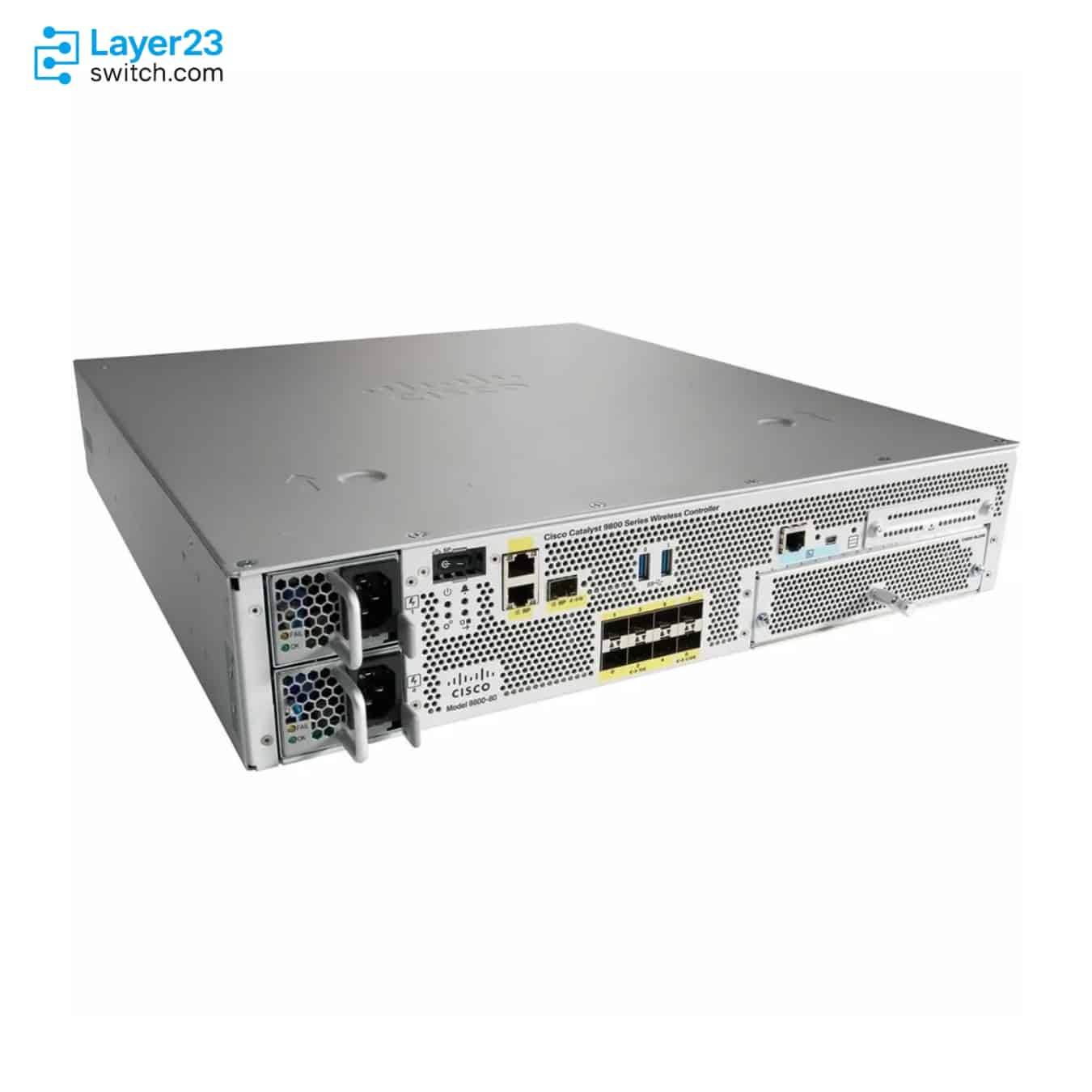
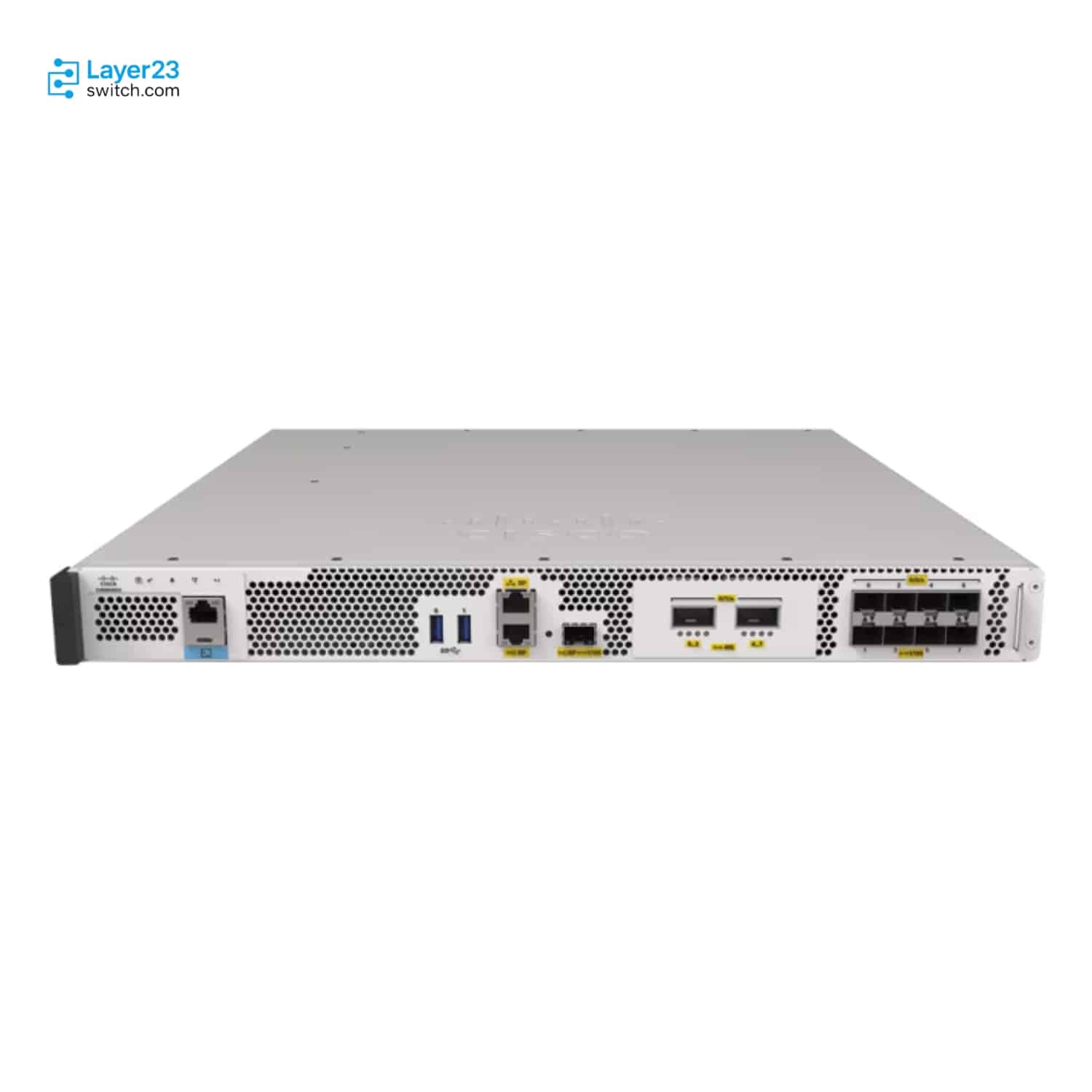
The CW9800H2 is one of the two replacements Cisco names for the C9800-80-K9. The CW9800H2 keeps the same access point and client limits in one rack unit instead of two, with fixed 40G QSFP uplinks in place of the module bay. A 100G link has no match on the CW9800H1 or CW9800H2.
Start with the specifications that decide whether a model fits, whether they differ or not. Each card says if the values are the same.
6,000
6,000
64,000
64,000
80 Gbps
100 Gbps
Wi-Fi 5 Wave 2, Wi-Fi 6/6E and Wi-Fi 7 APs; 2.4, 5 and 6 GHz
Wi-Fi 5 Wave 2, Wi-Fi 6/6E and Wi-Fi 7 APs; 2.4, 5 and 6 GHz
From Cisco IOS XE 17.15.2, with Multi-Link Operation and 320 MHz channels in 6 GHz
From Cisco IOS XE 17.15.2, with Multi-Link Operation and 320 MHz channels in 6 GHz
6 x 10G SFP+; 2 x 1/10G SFP+
8 x 1/10G SFP+; 2 x 40G QSFP
The CW9800H2 takes 40G QSFP optics on built-in ports, so no uplink module is needed. It keeps the C9800-80-K9's access point and client limits, and its throughput rises from 80 to 100 Gbps. Each site can hold 300 FlexConnect access points against 100.
The CW9800H1, the other replacement Cisco names, has four 25G SFP28 ports in place of the two QSFP ports and is otherwise identical. A link on the C9800-80-K9's 100G module has no direct equivalent on either model.
Stateful switchover pairs only identical hardware, so both units of a C9800-80-K9 pair move to the CW9800H2 together, and a CW9800H2 cannot back up a CW9800H1. The CW9800H2 needs Cisco IOS XE 17.14.1 or later; confirm the release supports every access point model in service.
Send your port, performance, license, quantity or deployment requirements. A CCIE-level network engineer will review the shortlist and help identify the better-fit Product ID.
| Comparison parameter | ||
|---|---|---|
| Product ID | C9800-80-K9 | CW9800H2 |
| Product and ordering | ||
| Product Type | Cisco Catalyst 9800-80 Wireless Controller | Cisco Catalyst CW9800H2 Wireless Controller |
| Scale and performance | ||
| Maximum Access Points | 6,000 | 6,000 |
| Maximum Clients | 64,000 | 64,000 |
| Maximum Throughput | 80 Gbps | 100 Gbps |
| Maximum Site Tags | 6,000 | 6,000 |
| Maximum FlexConnect APs per Site | 100 | 300 |
| Maximum WLANs | 4,096 | 4,096 |
| Maximum VLANs | 4,096 | 4,096 |
| Wi-Fi and software | ||
| Wi-Fi Standards and Bands | Wi-Fi 5 Wave 2, Wi-Fi 6/6E and Wi-Fi 7 APs; 2.4, 5 and 6 GHz6 GHz (Wi-Fi 6E) access points need Cisco IOS XE 17.7.1 or later. | Wi-Fi 5 Wave 2, Wi-Fi 6/6E and Wi-Fi 7 APs; 2.4, 5 and 6 GHz |
| Wi-Fi 7 Support | From Cisco IOS XE 17.15.2, with Multi-Link Operation and 320 MHz channels in 6 GHzWi-Fi 7 WLANs need WPA3; from Cisco IOS XE 17.15.3 a WLAN that does not meet the Wi-Fi 7 requirements runs as 802.11ax. Each access point model has its own minimum release. | From Cisco IOS XE 17.15.2, with Multi-Link Operation and 320 MHz channels in 6 GHzWi-Fi 7 WLANs need WPA3; from Cisco IOS XE 17.15.3 a WLAN that does not meet the Wi-Fi 7 requirements runs as 802.11ax. Each access point model has its own minimum release. |
| Operating System | Cisco IOS XE | Cisco IOS XE |
| Minimum Software Release | Cisco IOS XE 16.10.1 | Cisco IOS XE 17.14.1 |
| Deployment Modes | Centralized, FlexConnect and fabric (SD-Access) | Centralized, FlexConnect and fabric (SD-Access) |
| Ports and interfaces | ||
| Uplink Ports | 6 x 10G SFP+; 2 x 1/10G SFP+Ports Te0/0/6 and Te0/0/7 also take 1G SFPs; the other six run at 10G only. | 8 x 1/10G SFP+; 2 x 40G QSFP |
| Modular Uplinks | Optional module: 18 x 1G SFP, 10 x 10G SFP+, 1 x 40G QSFP, 2 x 40G QSFP or 1 x 100GC9800-18X1GE, C9800-10X10GE, C9800-1X40GE, C9800-2X40GE or C9800-1X100GE; like the controller, the modules are no longer sold. | Not applicable |
| HA Redundancy Ports | 1 x RJ-45; 1 x 1G SFPSFP redundancy port optics: GLC-LH-SMD or GLC-SX-MMD. | 1 x RJ-45; 1 x 1/10G SFPSFP redundancy port optics: GLC-SX-MMD, GLC-LH-SMD, SFP-10G-SR, SFP-10G-SR-S, SFP-10G-LR or SFP-10G-LR-S. |
| Management Ports | 1 x RJ-45 service port | 1 x RJ-45 service port |
| Console Ports | 1 x RJ-45 console; 1 x mini-USB console | 1 x RJ-45 console; 1 x micro-USB console |
| USB Ports | 2 x USB 3.0 | 2 x USB 3.0 |
| High availability and power | ||
| Stateful Switchover (SSO) | Supported (1:1 active-standby) | Supported (1:1 active-standby) |
| N+1 Redundancy | Supported | Supported |
| Default Power Supply | Dual 1,100 W AC or 950 W DC power supplies | Dual 750 W AC or 950 W DC power supplies |
| Power Redundancy | 1+1 with dual AC or DC power supplies | 1+1 with dual AC or DC power supplies |
| Maximum Power Consumption | 600 WWith uplink modules installed. | 500 W |
| Heat Dissipation | 2,047 BTU/h | 1,706 BTU/h |
| Physical and environmental | ||
| Form Factor | 2RU | 1RU |
| Dimensions (H × W × D) | 88.1 × 439.4 × 520.7 mm | 43.9 × 444.5 × 504.7 mm |
| Weight | 14.29 kg | 9.3 kg |
| Operating Temperature | 0 to 40 °C; 0 to 50 °C short term | 0 to 40 °C; 0 to 50 °C short term |
| Operating Humidity | 10% to 90%; 5% to 90% short term | 10% to 90%; 5% to 90% short term |
| Operating Altitude | Up to 3,000 m (10,000 ft) | Up to 3,000 m (10,000 ft) |
| Warranty | 1-year limited hardware warranty | 1-year limited hardware warranty |
“Not published by Cisco” and “Not listed” indicate that a confirmed direct comparison is unavailable. These rows are not counted as confirmed differences.
Use the exact Product ID when requesting a quote, because suffixes can identify different licenses, regions or configurations. Open an available product page for details and pricing, or request a project quote from our team.
Browse all Cisco wireless controllers