Cisco Catalyst 8000 Router Comparison: C8200 vs C8300 vs C8500
Cisco Catalyst 8000 Series routers are Cisco enterprise WAN edge platforms for SD-WAN, secure branch routing, cloud access, and high-performance edge deployments. The main hardware families are Catalyst 8200, Catalyst 8300, and Catalyst 8500, with C8000V used for virtual or cloud-based edge deployments.
In simple terms, choose Catalyst 8200 for small branches, Catalyst 8300 for modular mid-size branches, Catalyst 8500 for high-performance aggregation or cloud edge, and C8000V for virtual routing in cloud or software-defined environments.
If you are comparing Cisco Catalyst 8000 routers for a real project, do not choose only by price or model name. The right platform depends on branch size, WAN bandwidth, SD-WAN design, licensing, NIM or service module needs, optics, encrypted throughput, and future growth.

Quick Answer: Which Cisco Catalyst 8000 Router Should You Choose?
For most branch and WAN edge projects, Cisco Catalyst 8000 selection starts with site size and performance requirements.
| Need | Best Catalyst 8000 Direction |
|---|---|
| Small branch / lower cost | C8200L or C8200 |
| Small branch with some modularity | C8200-1N-4T |
| Mid-size branch / modular router | C8300 |
| 1G WAN branch replacement | C8300-1N1S-6T |
| 10G branch uplinks | C8300-1N1S-4T2X or C8300-2N2S-4T2X |
| Module-heavy branch | C8300-2N2S series |
| High-performance aggregation | C8500 |
| Cloud or virtual edge | C8000V |
| ISR 4000 replacement | C8200 / C8300 / C8500 depending on old ISR model |
The fastest rule is:
Use C8200 for small branches, C8300 for modular branch routing, C8500 for high-performance edge or aggregation, and C8000V for virtual or cloud deployments.
If you are replacing older ISR routers, this article focuses on choosing the Catalyst 8000 platform. For old-to-new ISR model mapping, see our ISR 4000 to Catalyst 8000 replacement guide.
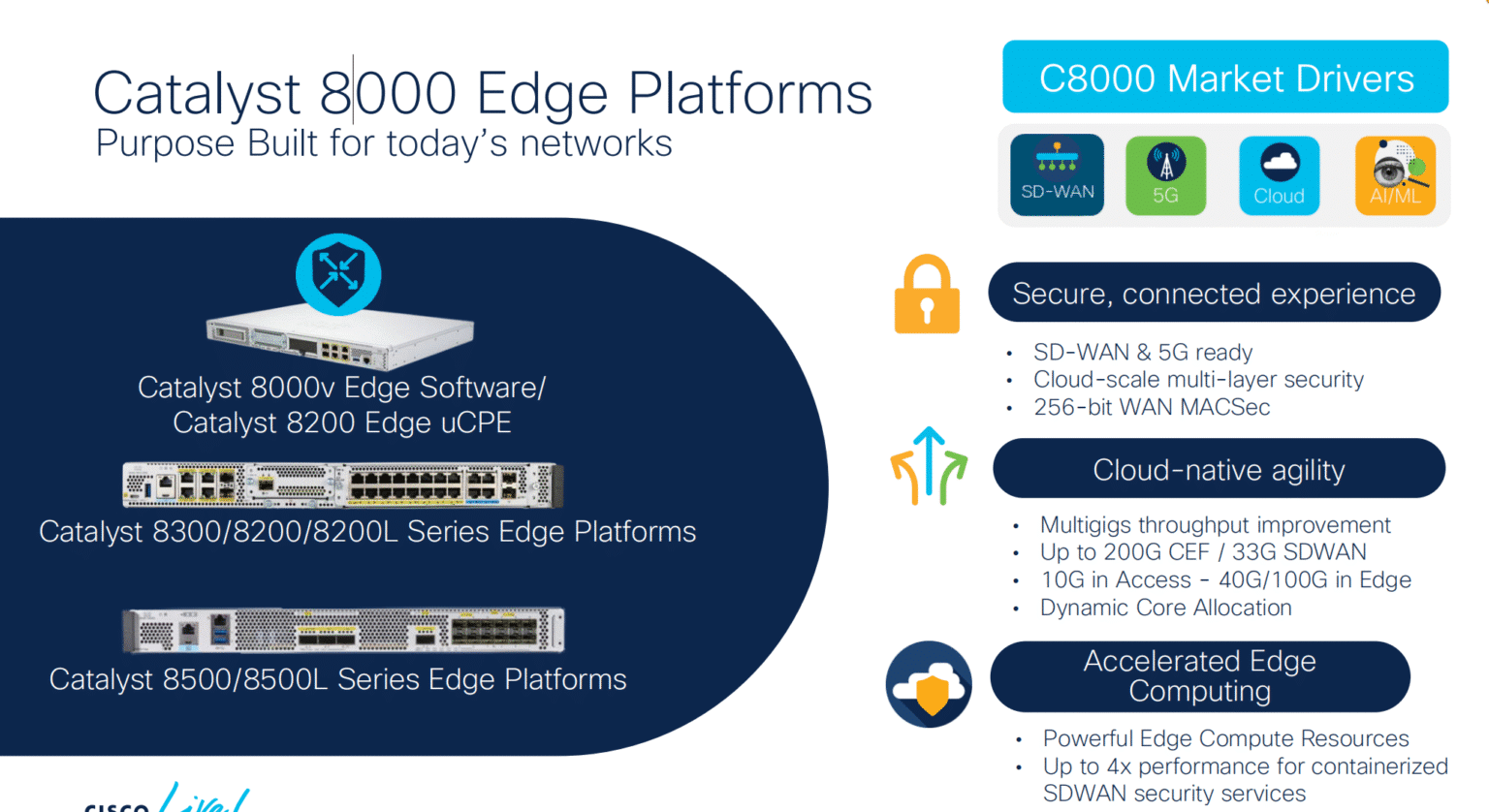
Image placement: keep the existing “Catalyst 8000 Edge Platforms” image here, directly after the quick answer table.
Need to compare exact Product IDs? Use the Cisco router comparison for side-by-side specifications.
What Is the Cisco Catalyst 8000 Series?
Cisco Catalyst 8000 Series routers are enterprise edge platforms designed for modern WAN, SD-WAN, cloud access, secure branch connectivity, and high-performance routing. They are commonly used in branch offices, regional hubs, data center edge, cloud edge, and virtual WAN deployments.
The Catalyst 8000 family is not one router. It includes several platform types:
| Platform Family | Role |
|---|---|
| Catalyst 8200 | Small and midsize branch WAN edge |
| Catalyst 8300 | Modular branch and mid-size WAN edge |
| Catalyst 8500 | High-performance edge, aggregation, cloud edge |
| Catalyst 8000V | Virtual router for cloud and software environments |
The key value of Catalyst 8000 is that it gives enterprises a newer edge platform for routing, SD-WAN, cloud connectivity, security services, and WAN modernization. For many businesses, it is also the natural direction when refreshing older ISR 4000 branch routers.
However, Catalyst 8000 selection is not as simple as “8200 is small, 8300 is medium, 8500 is large.” You also need to consider interface speed, module slots, encryption, license model, SD-WAN mode, optics, and lifecycle requirements.
Image placement: keep the existing “Cisco Catalyst 8000 serial routers” image at the end of this section.
Catalyst 8200 vs 8300 vs 8500: Main Differences
The most important difference between Catalyst 8200, 8300, and 8500 is not only performance. It is the type of site each platform is designed to serve.
| Series | Best For | Key Difference | Avoid If |
|---|---|---|---|
| Catalyst 8200 / 8200L | Small and midsize branches | Compact branch WAN edge with lower cost | You need many modules, 10G-heavy design, or larger edge capacity |
| Catalyst 8300 | Mid-size branch, modular WAN edge | More modularity, NIM/SM options, stronger service flexibility | You need 40G/100G aggregation or very high-performance edge |
| Catalyst 8500 | High-performance edge, hub, aggregation | Higher port density and performance for larger edge sites | You only need a simple branch router |
| Catalyst 8000V | Virtual/cloud edge | Software router for cloud or virtual deployments | You need physical branch interfaces |
Catalyst 8200: Small Branch WAN Edge
Catalyst 8200 is the right starting point when the site is a small or midsize branch with moderate WAN requirements. It is commonly considered for sites that need reliable routing, SD-WAN readiness, VPN, and branch connectivity without heavy module expansion.
Choose Catalyst 8200 when:
- The site is a small branch or office.
- WAN bandwidth is moderate.
- Budget is important.
- Interface requirements are simple.
- You do not need many NIM or service module options.
- You are replacing a lighter branch router.
Catalyst 8200 is often a better fit than C8300 when the branch does not need much expansion or high-throughput service density.
Catalyst 8300: Modular Branch Router
Catalyst 8300 is usually the most flexible branch platform in the Catalyst 8000 family. It is commonly used for mid-size branches, ISR 4331 / ISR 4351 replacement projects, module-heavy sites, and branches that need more interface flexibility.
Choose Catalyst 8300 when:
- You need NIM or service module expansion.
- You need 10G uplinks.
- You are replacing ISR4331, ISR4351, or ISR4431.
- The site has voice, LTE, WAN modules, or other branch services.
- You need more headroom than C8200.
- The branch may grow over the next few years.
For many enterprise buyers, C8300 is the safest choice when the branch is too important or too complex for a small router, but not large enough to justify C8500.
Catalyst 8500: High-Performance Edge and Aggregation
Catalyst 8500 is not a normal small-branch router. It is better suited for higher-performance edge, aggregation, regional hub, cloud edge, or large enterprise WAN deployments.
Choose Catalyst 8500 when:
- The site needs higher throughput.
- You need high-density 10G, 40G, or 100G connectivity.
- The router acts as a regional hub or aggregation edge.
- You are replacing a larger ISR or ASR-style edge role.
- You need stronger cloud edge or SD-WAN aggregation capacity.
- The site is closer to a data center or large WAN edge than a normal branch.
If the site is only a small office, C8500 is usually overkill. If the site is carrying large-scale encrypted traffic or acting as a hub, C8500 may be the correct direction.
Cisco Catalyst 8000 Router Models Compared
A real Catalyst 8000 selection usually happens at the model level, not only the series level. The table below gives a practical buying-oriented comparison of common Catalyst 8000 router models.
| Model | Series | Typical Role | Interface / Expansion Direction | Best Fit |
|---|---|---|---|---|
| C8200L-1N-4T | 8200L | Entry branch edge | Compact branch platform with fixed 1G WAN direction | Small branch, cost-sensitive replacement |
| C8200-1N-4T | 8200 | Small branch edge | 1 NIM direction with more flexibility than 8200L | Branch edge with moderate modular needs |
| C8300-1N1S-6T | 8300 | Modular branch router | 1 NIM + 1 service module direction | ISR4331 / ISR4351 replacement, 1G WAN branch |
| C8300-1N1S-4T2X | 8300 | 10G branch edge | 10G uplink direction | ISR4331 / ISR4431 replacement, 10G branch uplinks |
| C8300-2N2S-4T2X | 8300 | Larger modular branch | More NIM / service expansion | Module-heavy branch or regional edge |
| C8500L-8S4X | 8500L | High-performance WAN edge | 1G / 10G mix | High-end branch or hub edge |
| C8500-12X | 8500 | Aggregation edge | 10G-focused edge | High-throughput enterprise edge |
| C8500-12X4QC | 8500 | Large aggregation edge | 10G plus 40G / 100G direction | Large enterprise or cloud edge |
| C8500-20X6C | 8500 | High-density edge | High-density 1/10GE plus 40/100GE direction | Large enterprise, service provider, or aggregation edge |
| C8000V | Virtual | Cloud / virtual WAN edge | Software-based deployment | Public cloud, virtual edge, SD-WAN cloud architecture |
C8200L-1N-4T vs C8200-1N-4T
C8200L is usually the lower-cost, lighter branch direction. C8200 gives more flexibility and is better when the site may need stronger branch services or modular expansion.
| Choice | Best For |
|---|---|
| C8200L-1N-4T | Small branch, lower cost, simpler WAN edge |
| C8200-1N-4T | Small branch that needs more flexibility or modularity |
If your branch is small and stable, C8200L may be enough. If you are planning a longer lifecycle or expect growth, C8200 may be safer.
C8300-1N1S-6T vs C8300-1N1S-4T2X
This is one of the most common Catalyst 8300 buying decisions.
| Choice | Best For |
|---|---|
| C8300-1N1S-6T | Mostly 1G WAN, branch services, balanced budget |
| C8300-1N1S-4T2X | 10G uplinks, more headroom, stronger future-proofing |
If the site only needs 1G WAN today and has no clear 10G requirement, C8300-1N1S-6T may be enough. If the site will use 10G uplinks or needs more growth room, C8300-1N1S-4T2X is usually the better direction.
C8300-2N2S-4T2X vs C8500
This comparison matters when the site is no longer a simple branch.
Use C8300-2N2S-4T2X when you still need a modular branch platform with more slots and flexibility. Use C8500 when the site is closer to a high-performance edge, hub, or aggregation role.
Image placement: keep the existing “Cisco Catalyst 8300 Series Edge Platforms” image near this C8300 model discussion.

How to Choose: C8200, C8300, C8500 or C8000V?
The right Catalyst 8000 router depends on how the site is used. A small retail branch, a bank branch, a regional WAN hub, and a cloud edge deployment should not use the same selection logic.
How Large Is the Site?
For small branches, start with C8200L or C8200. For mid-size branches, start with C8300. For high-performance edge or aggregation, start with C8500.
| Site Type | Recommended Direction |
|---|---|
| Small branch | C8200L / C8200 |
| Medium branch | C8300 |
| Large branch | Higher C8300 models |
| Regional hub | C8500 |
| Cloud edge | C8500 / C8000V depending on design |
| Virtual WAN edge | C8000V |
Do You Need Modular NIM or Service Module Expansion?
If the branch only needs basic WAN routing, C8200 may be enough. If the branch needs NIMs, voice modules, LTE / 5G options, service modules, or interface expansion, C8300 is usually the better direction.
This is one of the most important real-world differences between C8200 and C8300.
Do You Need 10G, 40G, or 100G Interfaces?
Interface speed can quickly change the right platform.
| Interface Need | Better Direction |
|---|---|
| Mostly 1G WAN | C8200 or C8300-1N1S-6T |
| 10G branch uplinks | C8300-1N1S-4T2X / C8300-2N2S-4T2X |
| High-density 10G | C8500 |
| 40G / 100G edge | C8500 higher models |
Do not choose a lower platform if the site is moving to 10G WAN soon. A cheaper router can become expensive if it forces another upgrade later.
Are You Replacing ISR 4000?
If the Catalyst 8000 router is replacing ISR 4000, check the current ISR model, modules, WAN bandwidth, licensing, and services before choosing the new platform.
For a full old-to-new model mapping, see our ISR 4000 to Catalyst 8000 replacement guide.
Is This SD-WAN or Traditional Routing?
Catalyst 8000 can be used in SD-WAN, SD-Routing, or more traditional routing deployments, but licensing and ordering must match the intended mode.
Before purchasing, confirm:
- Will the router run SD-WAN?
- Will it run autonomous / traditional routing?
- Which license level is required?
- Which Smart Account will own the licenses?
- Is a support term required?
- Is high encrypted throughput required?
For licensing details, see our Cisco C8000 DNA ordering guide.
Do You Need Physical Hardware or Virtual Edge?
Choose physical hardware when you need branch interfaces, local WAN links, NIMs, optics, or on-site routing.
Choose C8000V when you need a virtual router for cloud, virtual WAN, or software-based edge deployments.
| Deployment Type | Better Direction |
|---|---|
| Physical branch router | C8200 / C8300 |
| Regional edge / aggregation | C8500 |
| Cloud or virtual router | C8000V |
| Hybrid SD-WAN | Physical Catalyst 8000 + C8000V depending on design |
Catalyst 8000 Licensing and Ordering Notes
Catalyst 8000 purchasing is not just about the chassis. A complete order may include the platform, software license, subscription term, optics, cables, NIMs, support, and Smart Account information.
If you only quote the chassis, the project may still be incomplete.
| Buying Item | Why It Matters |
|---|---|
| Chassis model | Determines hardware platform and expansion direction |
| License type | Determines routing, SD-WAN, and feature entitlement |
| Subscription term | Affects budget and support planning |
| Throughput / HSEC | Important for encrypted traffic and VPN-heavy sites |
| NIM / modules | Determines interface and service expansion |
| Optics / cables | Needed for 10G / 40G / 100G links |
| Power and accessories | Important for deployment readiness |
| Support contract | Needed for enterprise lifecycle planning |
| Smart Account | Required for license ownership and activation |
License Planning Questions
Before requesting a quote, prepare answers to these questions:
- Will the router run SD-WAN or traditional routing?
- Do you need Cisco DNA or Catalyst Routing licensing?
- What license term is required?
- Which Smart Account should receive the licenses?
- Do you need HSEC or higher encrypted throughput?
- Do you need support or Smart Net coverage?
- Will the router be deployed in a branch, hub, cloud edge, or virtual environment?
For more detailed ordering guidance, use the Cisco C8000 DNA ordering guide together with your target platform selection.
Why License Planning Matters
Two Catalyst 8000 quotes can look similar at the hardware level but be very different in real deployment value. The difference may come from subscription term, license tier, Smart Account ownership, support coverage, or whether required optics and modules are included.
For B2B buyers, the safest approach is to build a complete BOM instead of buying only the chassis.
Common Buying Mistakes When Choosing Catalyst 8000
Catalyst 8000 selection mistakes usually happen when the buyer treats the router like a simple hardware SKU. In real deployments, the platform, license, interfaces, modules, optics, and support plan must match the project.
Mistake 1: Quoting the Chassis Only
A chassis-only quote may miss licenses, optics, cables, NIMs, power options, and support. This can delay deployment or create a second purchasing round.
Mistake 2: Choosing by Raw Throughput Only
Throughput matters, but so do encrypted throughput, SD-WAN features, security services, and interface speed. A router that looks sufficient on paper may not be enough when VPN, security, and application services are enabled.
Mistake 3: Ignoring 10G or 100G Growth
A branch that uses 1G today may need 10G later. A regional edge may need 40G or 100G capability. Choosing a lower model without planning for uplink growth can shorten the lifecycle of the router.
Mistake 4: Choosing C8200 When the Site Needs C8300 Modularity
C8200 is a good small-branch platform, but it is not the right answer for every branch. If the site needs more modules, voice support, expansion, or higher WAN growth, C8300 may be safer.
Mistake 5: Forgetting NIM, Voice, LTE or 5G Requirements
Many branch routers are not only routing traffic. They may support voice, LTE backup, WAN circuits, serial interfaces, or special modules. Those requirements must be checked before selecting the replacement.
Mistake 6: Not Deciding SD-WAN vs Traditional Routing Before Purchase
Deployment mode affects ordering, licensing, configuration, support, and operations. Decide this before the quote is finalized.
Mistake 7: Not Preparing a Complete BOM
A complete Catalyst 8000 BOM should include:
- Router chassis
- License and term
- NIMs or modules
- Optics and cables
- Power requirements
- Support coverage
- Smart Account details
- SD-WAN or routing mode
If you are preparing a Catalyst 8000 project BOM, collect the target model, WAN bandwidth, interface requirements, module list, license term, support needs, and deployment mode before requesting a quote. This helps avoid mismatched hardware and incomplete orders.
FAQ About Cisco Catalyst 8000 Routers
What is Cisco Catalyst 8000?
Cisco Catalyst 8000 is a family of enterprise WAN edge platforms used for branch routing, SD-WAN, secure cloud access, aggregation edge, and virtual edge deployments. The main platform families include Catalyst 8200, Catalyst 8300, Catalyst 8500, and C8000V.
Is Cisco Catalyst 8000 a router?
Yes. Cisco Catalyst 8000 platforms are enterprise routers and edge platforms. They are commonly used for WAN routing, SD-WAN, cloud connectivity, VPN, branch edge, and aggregation edge designs.
What is the difference between Catalyst 8200 and 8300?
Catalyst 8200 is better for small and midsize branches with simpler WAN edge needs. Catalyst 8300 is more modular and better for mid-size branches, ISR 4331 / 4351 replacement, 10G uplinks, modules, and more service flexibility.
What is the difference between C8300 and C8500?
C8300 is usually a modular branch router for mid-size or larger branches. C8500 is better for high-performance edge, regional hub, cloud edge, or aggregation deployments that need higher throughput and higher interface density.
Does Catalyst 8000 support SD-WAN?
Yes. Catalyst 8000 platforms are commonly used in Cisco SD-WAN deployments, but ordering and licensing should match the intended deployment mode. Confirm SD-WAN, SD-Routing, or traditional routing requirements before purchasing.
Does Catalyst 8000 require a license?
Yes, Catalyst 8000 projects typically require license planning. Buyers should confirm the required license type, term, Smart Account, support coverage, routing or SD-WAN mode, and whether encrypted throughput requirements affect the order. See the Cisco C8000 DNA ordering guide for more details.
What is C8000V?
C8000V is the virtual member of the Catalyst 8000 family. It is used when the WAN edge or router function needs to run in a virtual or cloud environment instead of on physical branch hardware.
Final Recommendation: How to Choose the Right Catalyst 8000 Router
The best Cisco Catalyst 8000 router is not always the highest model. It is the platform that matches your real deployment: WAN bandwidth, SD-WAN mode, license term, interface speed, module requirements, encrypted throughput, support expectations, and future growth.
For businesses comparing Catalyst 8200, 8300, 8500, or C8000V for a real project, Layer23-Switch can support Cisco router sourcing, optics, modules, licenses, and enterprise network hardware supply for global B2B deployments. If you already have a target model or existing ISR configuration, send your WAN bandwidth, module list, license needs, and deployment mode to request a practical Catalyst 8000 recommendation.