
Your cart is currently empty!
Cisco’s Digital Network Architecture (DNA) Licensing model is central to simplifying software activation and lifecycle management for enterprise routing.
With the Catalyst 8000 family (C8200, C8300, C8500, and C8500L), Cisco unified the routing license model into a predictable and flexible system that balances perpetual and subscription-based components.
What Is Cisco DNA Licensing?
Cisco DNA Licensing defines how software features and management capabilities are activated.
It consists of two key layers:
- Network Stack License (Perpetual):
Permanent base license enabling IOS XE routing features (DMVPN, GETVPN, FlexVPN, etc.). - DNA Stack License (Subscription):
Time-based (3-, 5-, or 7-year) subscription unlocking enhanced capabilities such as SD-WAN, Cisco DNA Center, and advanced analytics.
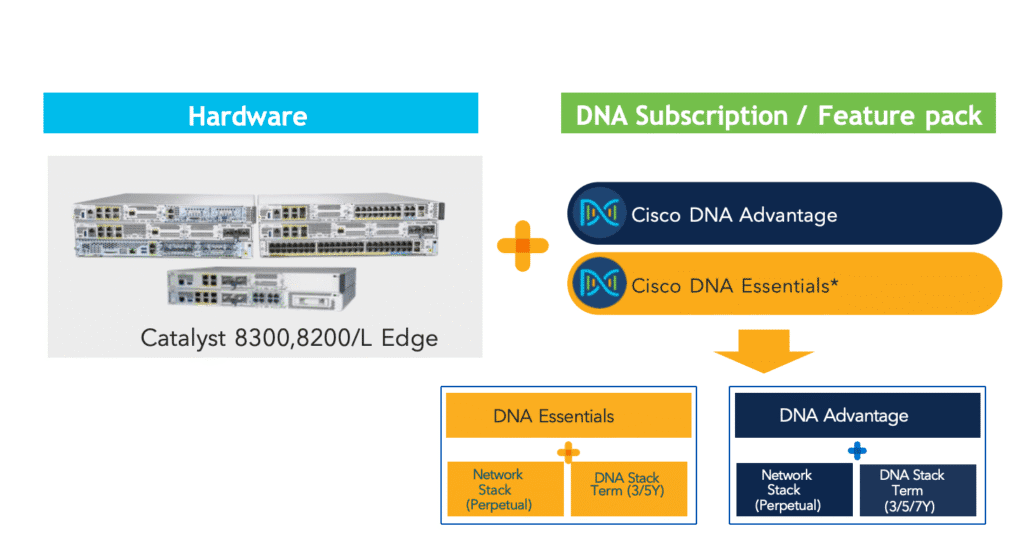
In short, the Network Stack provides the foundation, and the DNA Stack delivers intelligence, automation, and centralized control.
Cisco DNA Essentials vs DNA Advantage
|
Feature Category |
DNA Essentials |
DNA Advantage |
|---|---|---|
|
Routing Features |
Standard routing, basic security, automation |
Full SD-WAN suite, segmentation, advanced security, analytics |
|
Controller Support |
Limited or none |
Full (Cisco DNA Center / vManage) |
|
Subscription Term |
3Y / 5Y |
3Y / 5Y / 7Y |
|
Renewal Requirement |
Optional |
Required for controller access |
|
Recommended For |
Traditional routing environments |
SD-WAN and enterprise edge deployments |
DNA Essentials suits stable routing needs with minimal management overhead,
while DNA Advantage targets dynamic SD-WAN environments that demand policy-based control and real-time monitoring.
Network Stack vs DNA Stack
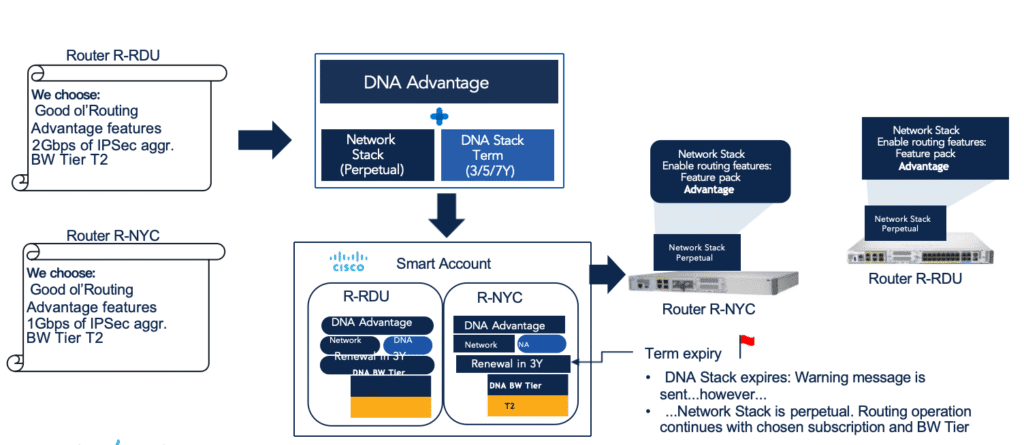
Each Catalyst 8000 router includes a perpetual Network Stack license.
When your DNA Stack subscription expires, routing continues — but controller functions (like vManage or DNA Center) are disabled.
Example Scenario:
- Router: C8200-1N1S-6T
- License: DNA Advantage 3Y + Network Stack T2
- After 3 years: DNA Center access stops, but routing keeps working.
This separation ensures uninterrupted routing while allowing organizations to scale DNA capabilities as needed.
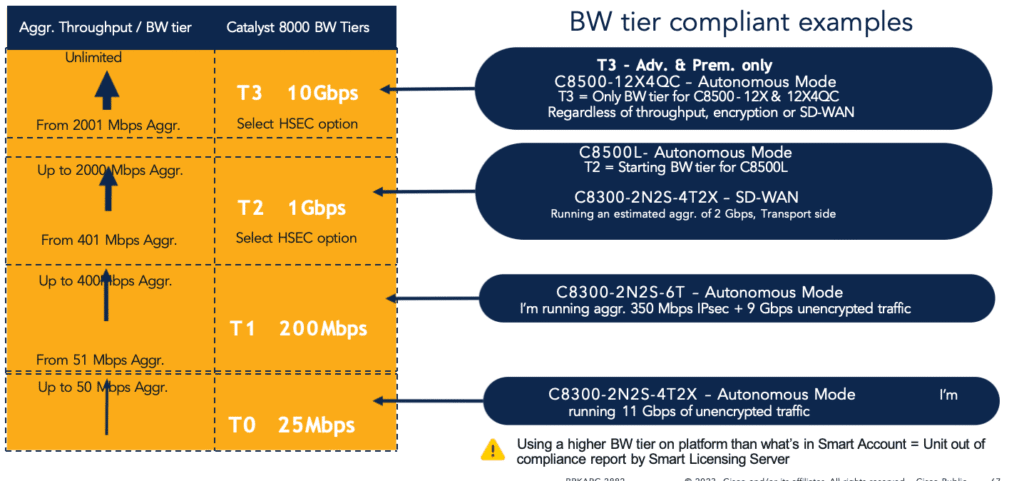
Bandwidth Tiers (T0 – T3)
|
Tier |
Typical Platforms |
Supported Bandwidth |
HSEC Requirement |
|---|---|---|---|
|
T0 |
C8200-1N1S-6T / C8300-1N1S-4T |
≤250 Mbps |
None |
|
T1 |
C8200 / C8300 mid-range |
≤500 Mbps |
Optional |
|
T2 |
C8500L-12X4QC |
≤1 Gbps |
HSEC required |
|
T3 |
C8500-12X / 20X6C |
>1 Gbps |
HSEC required |
Tip: Always select the lowest applicable bandwidth tier that meets your encrypted (IPsec) throughput requirements.
For throughput above 250 Mbps, an HSEC license must be activated.
Autonomous vs SD-WAN Mode
Catalyst 8000 routers operate in two modes, each influencing DNA license behavior:
1. Autonomous Mode
- Traditional routing (no SD-WAN)
- Operates with perpetual Network Stack
- DNA subscription adds visibility, not mandatory for function
2. Controller (SD-WAN) Mode
- Managed through Cisco vManage
- Requires active DNA subscription
- Subscription term (3Y / 5Y / 7Y) defines controller entitlement validity
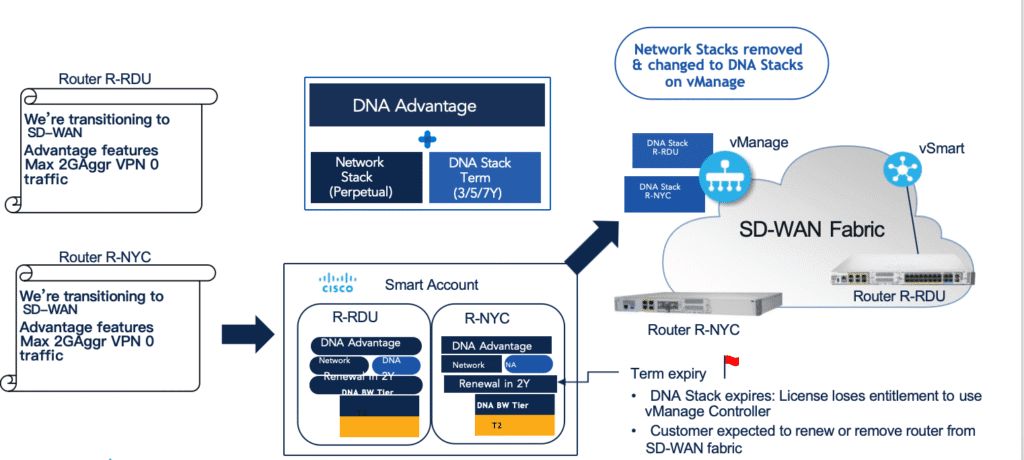
If you switch from autonomous routing to SD-WAN later, renew your DNA Stack license to regain controller access.
License Portability and Migration
Cisco DNA subscriptions can migrate between platforms through Smart Licensing:
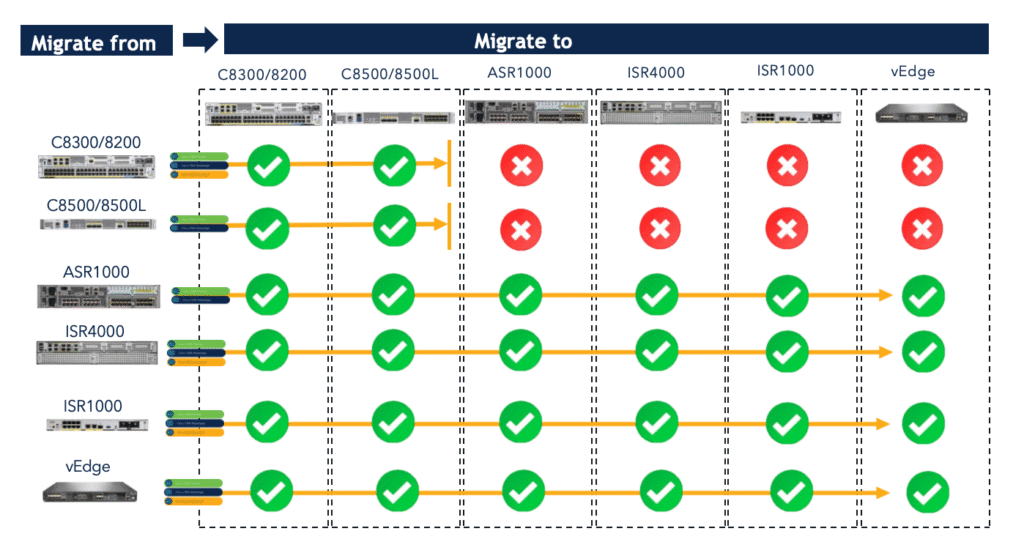
|
Migrate From |
Migrate To |
|---|---|
|
ISR 4000 / ISR 1000 |
C8200 / C8300 |
|
ASR 1000 |
C8500 / C8500L |
|
vEdge |
C8300 / C8500 |
This flexibility protects prior investments and simplifies upgrade paths.
How to Choose the Right Cisco DNA License
To ensure compliance and full functionality:
- Determine operation mode: SD-WAN or traditional routing
- Select license type: DNA Essentials or Advantage
- Decide term: 3Y, 5Y, or 7Y (Advantage supports 7Y)
- Calculate bandwidth: Aggregate IPsec or SD-WAN traffic ÷ 2
- Add HSEC license if traffic >250 Mbps
Proper sizing avoids out-of-compliance reports from Smart Licensing.
Cisco DNA License Selection Guide
Choosing the right Cisco DNA License depends on network design, bandwidth, and management model.
Here’s a practical guide based on real-world deployment types:
|
Deployment Scenario |
Recommended License |
Bandwidth Tier |
Term |
Notes |
|---|---|---|---|---|
|
Small branch router with static routing |
DNA Essentials |
T0 |
3Y |
Simple configuration, no controller |
|
Medium site using VPN or IPsec tunnels |
DNA Advantage |
T1 |
5Y |
Include HSEC if >250 Mbps |
|
Enterprise SD-WAN edge site |
DNA Advantage |
T2 |
5Y or 7Y |
vManage integration, controller mode |
|
High-performance data center edge |
DNA Advantage |
T3 |
7Y |
Required for >1 Gbps encrypted traffic |
|
Migration from ISR/ASR |
DNA Advantage |
Match old tier |
3Y or 5Y |
License portability supported |

