Cisco Firewall Comparison: Which Cisco Secure Firewall Series Should You Choose?
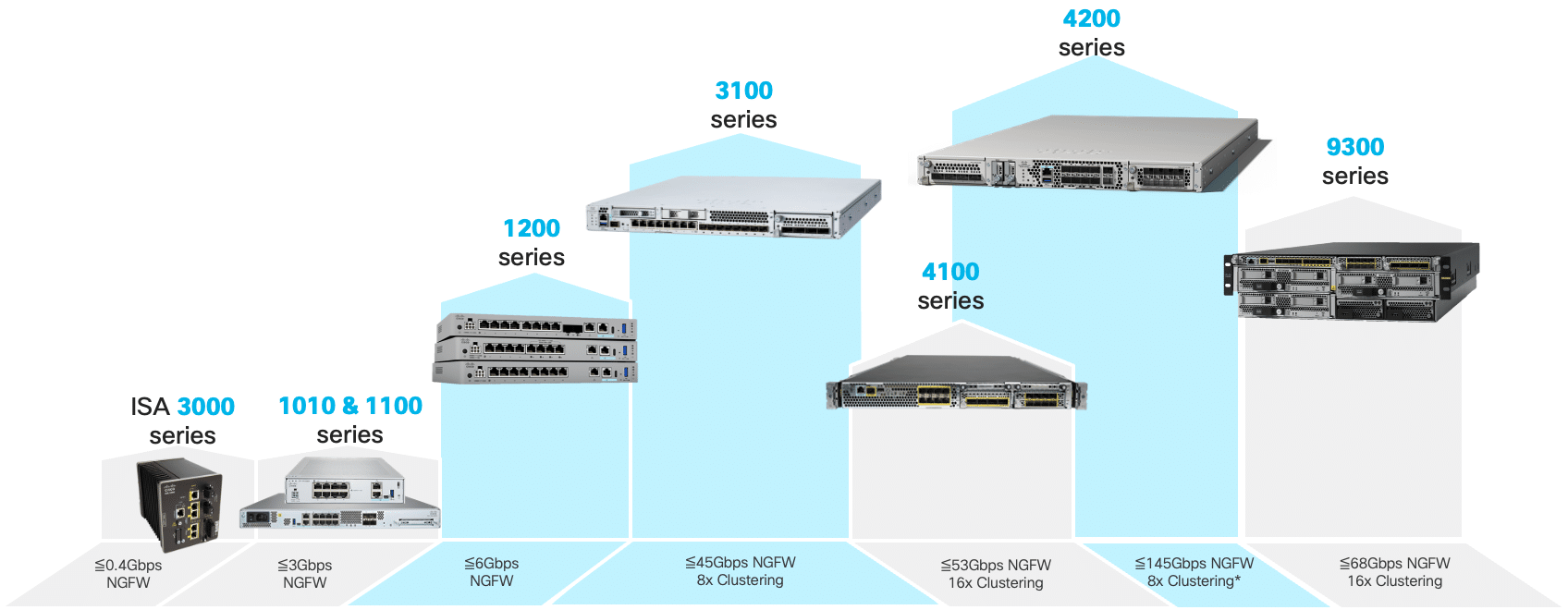
If you are comparing Cisco firewalls for a branch office, distributed enterprise, or refresh project, the fastest way to narrow the decision is this: start with the role of the site, then check growth risk, then decide whether you need a branch-class platform, a stronger enterprise-edge platform, or a higher-tier option for large campus or data center security. For most standard branch deployments, Cisco Secure Firewall 1200 is the best starting point. If the environment is larger, more security-intensive, or more likely to grow, the decision usually moves upward. Higher-tier platforms only become relevant when the design is clearly beyond normal branch scope.
Cisco’s current firewall portfolio supports that progression. Cisco positions the Secure Firewall 1200 Series for distributed enterprise branches and smaller sites. Cisco documentation also shows that Firepower 1000 and 2100 remain part of real operational and support paths, while 3100 sits higher in the product stack for more demanding enterprise use cases. That makes Cisco firewall comparison less about memorizing model lists and more about making the right platform-class decision early.
This guide is built around the real buying question behind the keyword: not “Which Cisco firewall is best overall?” but “Which Cisco firewall class best fits my site, growth expectations, and operating model over the next lifecycle?”
Cisco Firewall Comparison Quick Answer
For a standard branch office, Cisco Secure Firewall 1200 is usually the best starting point because Cisco explicitly positions it for branch offices and smaller sites.
For larger branches, regional offices, or growth-oriented enterprise edge environments, the right decision often moves to a higher class, especially when VPN demand, encrypted traffic, segmentation, and long-term headroom matter more. Cisco’s current product and support documentation places Secure Firewall 3100 above branch-class entry platforms and alongside higher-scale enterprise deployment paths.
If your shortlist is built around older Firepower families rather than the newer 1200-led path, the practical next step is a direct comparison of Firepower 1000, 2100, and 3100 on a dedicated page. That is usually the cleaner path for installed-base refreshes, branch expansion, and mid-tier enterprise edge projects. Cisco’s own documentation continues to group Firepower 1000 and 2100 with Secure Firewall 3100 in current software and operational references.
If the environment is already moving into large campus edge or data center-facing security, then higher-tier platforms such as 4200 should enter the discussion.
Once you have chosen the platform class, browse Cisco firewall models by exact Product ID.
Cisco Firewall Comparison by Deployment Type
| Deployment Type | Best Starting Point | Why It Usually Fits | What Often Changes the Decision |
|---|---|---|---|
| Small branch office | Cisco Secure Firewall 1200 | Right-sized for branch offices and smaller sites | More users, more VPN, more inspection, or role expansion |
| Growth branch | Move up from branch-class entry platforms | More lifecycle headroom for traffic, policy, and expansion | Site begins acting like a regional edge location |
| Regional office | Enterprise-edge class | Better aligned with heavier branch and medium-enterprise growth | More segmentation, more encrypted traffic, more operational complexity |
| Large campus edge or data center perimeter | Higher-tier platforms | Better suited to larger-scale performance and resiliency needs | Project is no longer primarily a branch design |
| Legacy refresh project | Depends on platform plus migration path | Hardware and software transition both matter | Existing ASA/Firepower footprint changes the right next step |
This is the simplest way to use a Cisco firewall comparison page. First identify the type of site you are protecting. Then decide whether the bigger risk is oversizing the firewall or outgrowing it too early.
What Is the Best Cisco Firewall for Branch Offices?
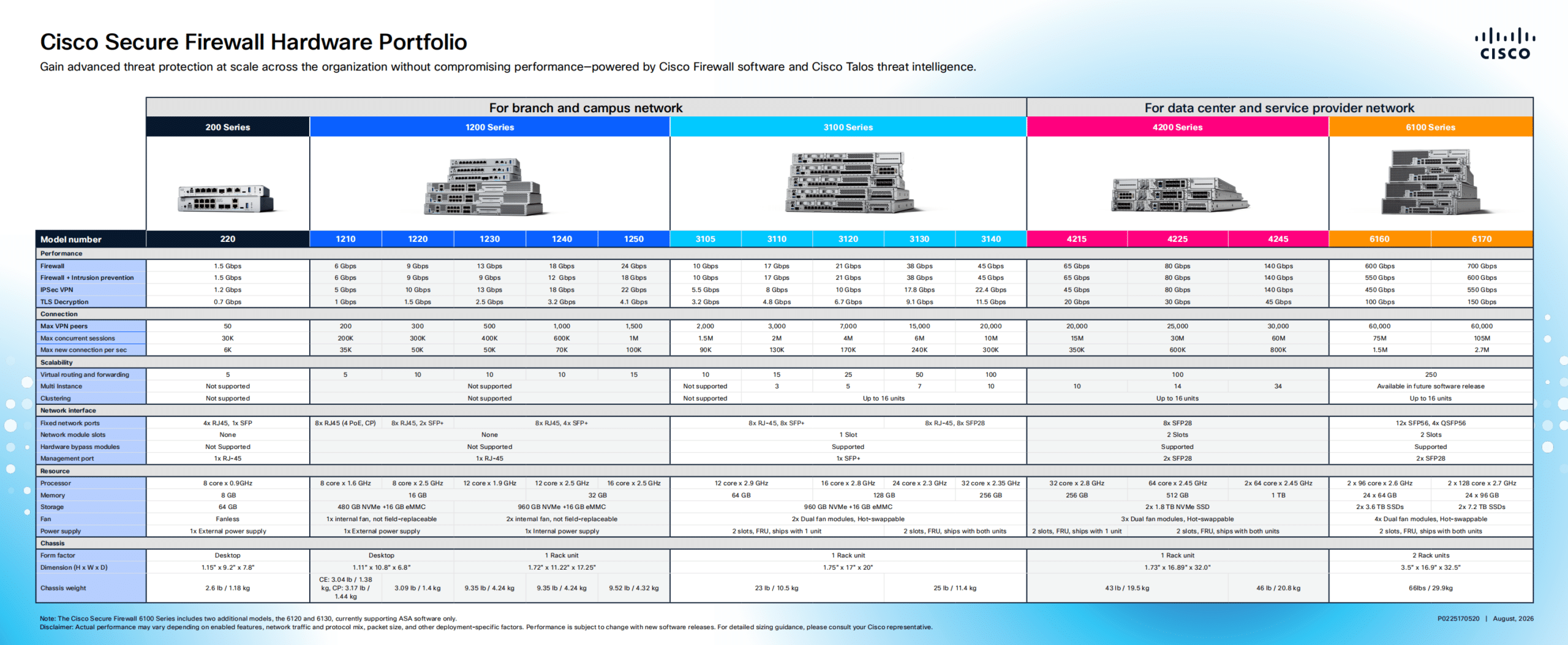
For most standard branch office deployments, Cisco Secure Firewall 1200 is the best starting point. Cisco’s official positioning is clear: the 1200 Series is designed to connect and protect the distributed enterprise, extending security policy and threat inspection to branch offices and smaller sites. Cisco’s current product page also presents it as a compact firewall for enterprise branches.
That makes 1200 the right answer when the site has moderate user density, predictable edge traffic, normal VPN needs, and no strong sign that it will soon become a heavier regional node. In those cases, the better decision is usually to right-size the branch instead of treating it like a future large-edge deployment.
Where go wrong is assuming that every branch should immediately be sized like a larger enterprise edge site. That often leads to oversizing. A branch can still be strategically important and still fit cleanly inside a branch-class design.
At the same time, not every site labeled “branch” is truly branch-sized. Once the site carries heavier encrypted traffic, stronger VPN demand, more segmentation, or greater growth uncertainty, the shortlist usually needs to move upward.
You can also browse:
Cisco Firepower 1000 Series
Cisco Firepower 3100 Series
How to Evaluate Firepower Shortlists for Branch and Edge Projects
If your shortlist is centered on older Firepower branch and enterprise-edge platforms, the most useful next step is not another broad overview. It is a dedicated comparison page built specifically around that shortlist.
That is because looking at Firepower 1000, 2100, and 3100 usually have a narrower question than “What is Cisco’s firewall portfolio?” They are trying to decide which family best fits a branch refresh, which one still makes sense in a current enterprise-edge design, whether a mid-tier installed-base path is still viable, and when moving higher makes more sense for lifecycle planning. Cisco’s current software and platform references continue to group Firepower 1000 and 2100 alongside Secure Firewall 3100 in active documentation, which is exactly why that shortlist remains commercially relevant.
Use this next-step article when your shortlist is already focused there:
Cisco Firepower 1000 vs 2100 vs 3100
When Moving Up Makes More Sense
A higher firewall class becomes the better long-term choice when the site is no longer a simple branch in practical terms, even if it is still called one internally.
That usually includes larger branch offices, regional sites, heavier security inspection needs, stronger VPN demand, more internal segmentation, or a higher chance that the site becomes more strategically central over time. Cisco’s current documentation and support references place Secure Firewall 3100 within that higher-growth path, including support in current template, management, ASA, and troubleshooting documentation.
Larger branch or regional office
If the site supports more users, more applications, or more internal security zones than a normal branch, a step-up platform is often the cleaner lifecycle choice.
Growth-focused branch
If the site is expected to scale in traffic, encrypted inspection, or business importance, more headroom early can be safer than a redesign later.
Standardization around stronger branch platforms
Some enterprises prefer to standardize around a smaller number of approved platform classes. In those environments, the better decision is often driven by operating model and lifecycle consistency, not only day-one sizing.
Refresh where the installed firewall role was already heavier than branch-level work
If the current firewall was already doing more than standard branch edge duty, forcing the replacement back into a lower class is often the wrong move.
When Higher-Tier Cisco Firewall Platforms Enter the Conversation
Higher-tier Cisco firewall platforms become relevant when the project is no longer mainly about branch sizing, lifecycle headroom, or distributed enterprise growth.
That usually means large campus edge, major regional aggregation, or data center-facing security. Cisco’s current clustering, management, and support documentation for the 3100/4200 path reflects these higher-scale deployment patterns, including multi-instance, clustering, and larger operational scope.
For most readers searching Cisco firewall comparison, that is not the first decision. The first decision is still whether the environment belongs in a branch-class design, a growth-oriented enterprise-edge design, or a higher-tier enterprise architecture.
For the upper-bound comparison, read:
Cisco Firewall 3100 vs 4200
ASA vs FTD: Separate the Software Decision From the Platform Decision
One of the biggest reasons Cisco firewall comparison pages become confusing is that they mix hardware family selection and software transition into the same conversation.
They are related, but they are not the same decision.
If you are planning a new deployment, the first question is usually the right platform class for the site. If you are replacing an older ASA environment, the project becomes more complex because migration, policy behavior, compatibility, software mode, and operational change all matter alongside the hardware refresh. Cisco’s current ASA compatibility and operations documentation still shows that ASA planning remains relevant across Firepower 1000, Secure Firewall 1200, Firepower 2100, Secure Firewall 3100, and Secure Firewall 4200.
The practical rule is simple:
- For new deployments, choose the right firewall family first.
- For legacy ASA environments, evaluate migration as a separate design concern.
Read next:
Cisco ASA vs FTD Differences
Cisco ASA to FTD Migration Guide
Does the Management Model Matter?
Yes. In many environments, it matters more than first expect.
Cisco’s 1200 documentation makes this especially clear: the platform supports centralized management through FMC, on-box management through FDM, and cloud-based management through Security Cloud Control. That means a smaller standalone branch may be fine with a simpler local operating model, while a multi-site enterprise environment may benefit much more from centralized policy control and operational consistency.
So the right question is not only “Which firewall has enough performance?” It is also “How will we operate this firewall over time?”
A practical rule:
- In smaller standalone branch environments, management may remain a secondary factor.
- In larger multi-site enterprise environments, management can materially affect the right design and the right platform choice.
Read next:
Cisco FirePower FDM vs FMC
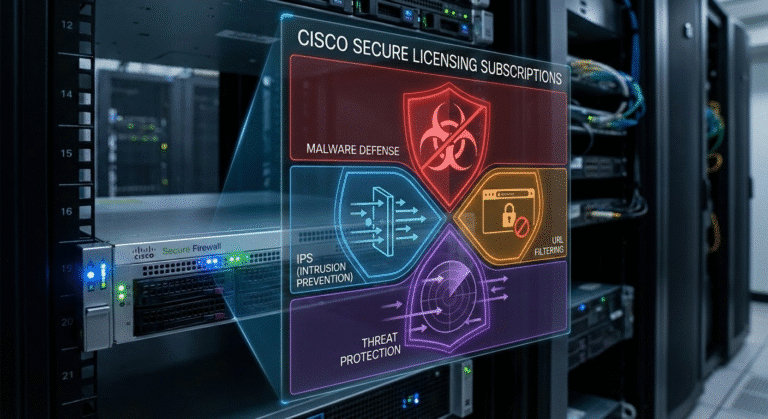
Cisco Firewall Licenses
Cisco Firewall Selection Framework for Enterprise Branches
If you want the fastest serious selection method, evaluate the project in this order.
1. Site role
Is this a standard branch, a growth branch, or a regional edge site?
2. Traffic profile
Is the traffic pattern ordinary office traffic, or is it likely to become inspection-heavy, VPN-heavy, or encryption-heavy?
3. Growth risk
Will the site probably remain stable, or is it likely to grow beyond its current branch profile?
4. Operational model
Will the firewall be managed mostly as a standalone appliance, or as part of a larger policy-driven environment?
5. Migration path
Is this a net-new firewall design, or a legacy ASA refresh that changes the software and management conversation?
In most real projects, the decision is not “Which Cisco firewall is best overall?” It is “Which Cisco firewall class best fits this site over the next lifecycle period?”
Cisco Firewall Comparison by Common Enterprise Scenarios
Small branch office
If the site is a straightforward branch with standard edge security needs, start with 1200.
Legacy Firepower shortlist
If you are evaluating older Firepower product families for branch and enterprise-edge use cases, move into the dedicated shortlist comparison instead of trying to infer that choice from a broad head-term article.
Growth-oriented branch
If the site may grow in users, VPN demand, encrypted traffic, or inspection requirements, the safer long-term path is usually a higher class.
Regional office
If the site is still called a branch internally but already behaves like a heavier regional edge location, do not size it like a small office.
Large enterprise edge
If the design is already beyond branch scope, higher-tier Cisco firewall platforms should enter the evaluation.
Our Practical Recommendation
For most, the cleanest process is not to compare every Cisco firewall model at once.
Instead, reduce the decision in this order:
- First, decide whether the site is truly a branch or already a larger edge role.
- Second, decide whether the bigger risk is oversizing the platform or outgrowing it too soon.
- Third, separate hardware family selection from migration and management planning.
- Fourth, if your shortlist is specifically built around Firepower 1000, 2100, and 3100, move into the dedicated shortlist comparison instead of forcing that whole decision into the pillar page.
- If the site is clearly a normal branch, start with 1200.
- If the site is larger, more strategic, or more likely to outgrow a branch-class platform, move up.
- If your project sits in the older Firepower series decision path, compare those families directly on the dedicated page.
- That is the most practical way to use a Cisco firewall comparison page without wasting time on the wrong shortlist.
Next-step pages:
Cisco Firepower 1000 vs 2100 vs 3100
Cisco Firewall 3100 vs 4200
Cisco ASA vs FTD Differences
Cisco FirePower FDM vs FMC
ASA to FTD Migration Guide
You can also browse:
Cisco Firepower 1000 Series
Cisco Firepower 2100 Series
Cisco Firepower 3100 Series
Cisco Firewall Licenses
Layer23-Switch can help you narrow the right Cisco firewall family based on branch size, growth expectations, and migration path before you spend time on the wrong models.

FAQ
What is the best Cisco firewall for a branch office?
For most standard branch office deployments, Cisco Secure Firewall 1200 is the best starting point because Cisco positions it for branch offices and smaller sites. If the branch is larger, more security-intensive, or more likely to grow quickly, the right decision usually moves to a higher class.
What should I compare if I am choosing between older Firepower families?
Use a dedicated shortlist comparison page. Firepower 1000, 2100, and 3100 often represent a real shortlist for branch refresh, enterprise edge, and installed-base transition projects, so they are better compared directly than loosely summarized inside a broad overview article.
Is a higher-tier Cisco firewall too much for a normal branch?
In many cases, yes. Higher-tier Cisco firewall platforms are usually more relevant for large campus edge, regional hub, or data center-class environments than for a normal enterprise branch.
Should I choose ASA or FTD for a new deployment?
For new Cisco firewall deployments, the better starting point is usually to choose the right hardware family first. ASA vs FTD becomes more important in migration and legacy refresh projects.
Does FDM vs FMC matter when choosing a Cisco firewall?
Yes. For smaller standalone branches, it may be a secondary issue. For multi-site enterprise environments, centralized management can materially affect the right platform and the right operating model. Cisco documents FDM, FMC, and Security Cloud Control as management options for the 1200 Series.