What is the Difference Between LX and LH SFP Modules?
If you are procuring transceivers for a network upgrade, you have likely encountered a confusing mix of acronyms. One of the most common questions we get from network engineers and procurement managers is: “What is the difference between LX and LH modules?”
You might see “LX” on one datasheet, “LH” on another, and confusingly, “LX/LH” on many Cisco SFP labels.
Are they the same? Can you use them interchangeably?
In this guide, we will break down the technical differences between 1000BASE-LX and 1000BASE-LH, and explain exactly which one you need for your Cisco switches and routers.

The Short Answer
1000BASE-LX is an official industry standard (IEEE) for Gigabit Ethernet over fiber, while 1000BASE-LH is a vendor-specific term (primarily used by Cisco) for “Long Haul.”
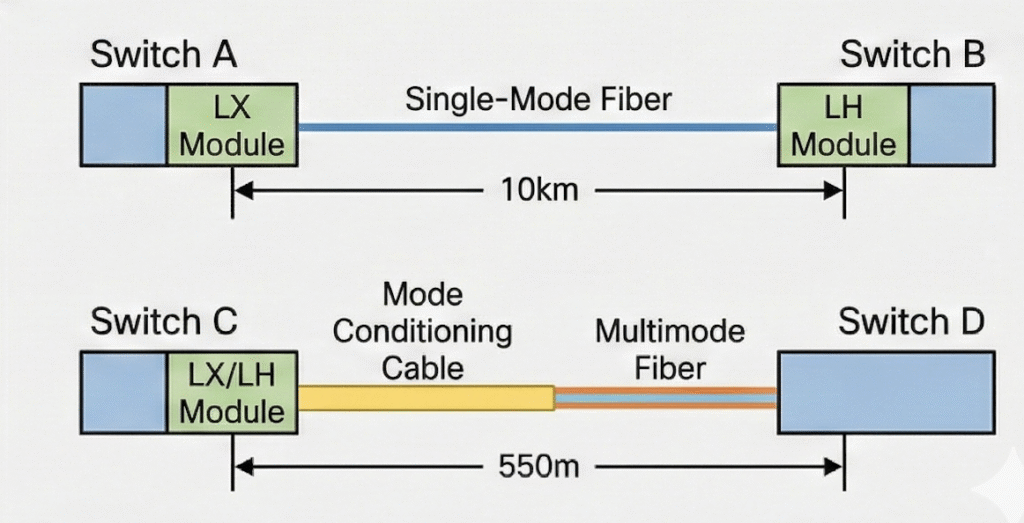
However, in the context of standard Gigabit SFP modules (like the Cisco GLC-LH-SMD), LX and LH are functionally identical. They both operate at the 1310nm wavelength and support transmission distances of up to 10km on single-mode fiber.
What is 1000BASE-LX?
LX stands for Long Wavelength. It is part of the IEEE 802.3z standard, which governs Gigabit Ethernet.
- Standard: IEEE 802.3z
- Wavelength: 1310nm
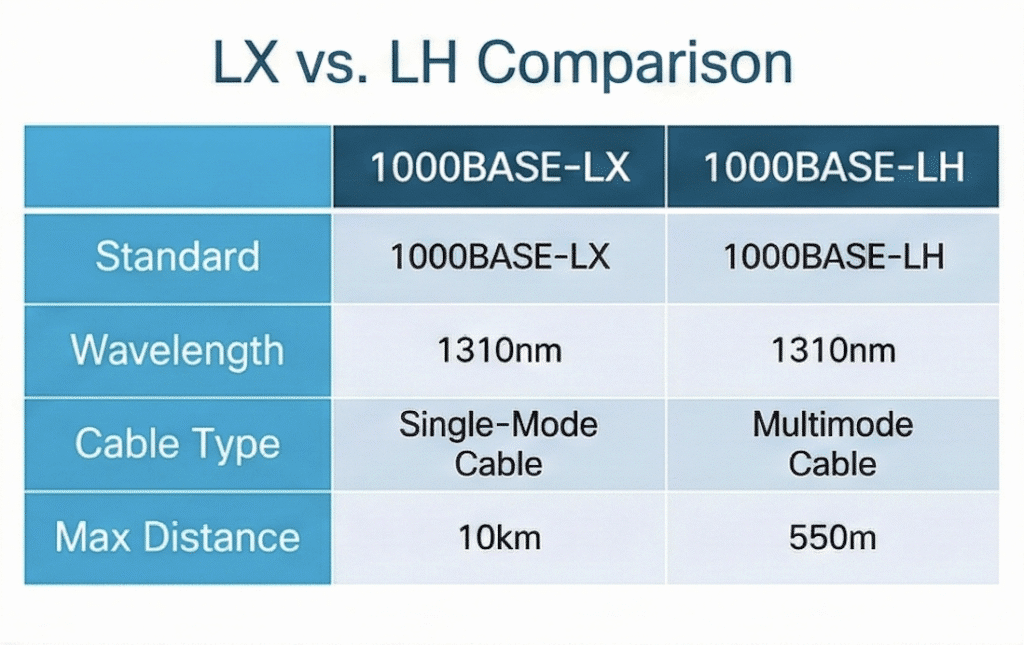
- Fiber Type: Designed for Single-Mode Fiber (SMF), but compatible with Multimode Fiber (MMF) using a specific patch cable.
- Distance: Up to 10km (6.2 miles) on SMF.
Because it is an IEEE standard, any networking device that claims “1000BASE-LX” compliance must meet these specifications. It is the universal standard for “short to medium” range fiber uplinks.
What is 1000BASE-LH?
LH stands for Long Haul. Unlike LX, 1000BASE-LH is not an IEEE standard. It is a proprietary term used by networking vendors—most notably Cisco—to describe modules that match or exceed the LX standard.
- Standard: Vendor Proprietary (Non-IEEE)
- Wavelength: 1310nm
- Fiber Type: Single-Mode Fiber (SMF).
- Distance: Typically 10km to 20km, depending on the vendor.
Wait, if they both do 1310nm and 10km, why does the term “LH” exist?
Historically, vendors created “LH” modules to signal that their optics were higher quality or capable of slightly longer distances than the baseline LX standard required. However, over time, the two terms have merged in the 1G market.
Comparison Table: LX vs. LH
|
Feature |
1000BASE-LX |
1000BASE-LH |
|---|---|---|
|
Full Name |
Long Wavelength |
Long Haul |
|
Governing Body |
IEEE 802.3z (Standard) |
Vendor Defined (e.g., Cisco) |
|
Wavelength |
1310nm |
1310nm |
|
Max Distance (SMF) |
10km |
10km – 70km (Context dependent*) |
|
Connector Type |
LC Duplex |
LC Duplex |
|
Fiber Compatibility |
SMF & MMF (w/ adapter) |
SMF |
Note: While some vendors use “LH” for 40km or 70km, in the Cisco 1G SFP ecosystem, LH almost always refers to the 10km specification.
The Cisco Scenario: Understanding “GLC-LH-SMD”
If you are buying for Cisco equipment, you are likely looking at the GLC-LH-SMD (or the older GLC-LH-SM).
You will notice that Cisco labels these modules as “1000BASE-LX/LH”.
Why? Cisco combined the terms to indicate maximum compatibility. The GLC-LH-SMD module is fully compliant with the IEEE 1000BASE-LX standard, ensuring it works with any standard LX device from other brands. However, Cisco retains the “LH” branding to maintain legacy consistency with their older product lines.
Key Takeaway for Buyers: If your datasheet asks for “LX” and you buy a Cisco “LH” module (like the GLC-LH-SMD), it will work perfectly. They are compatible.
Can I Use LX/LH Modules on Multimode Fiber?
Both LX and LH modules are designed for Single-Mode Fiber (9/125 micron). However, many older buildings are wired exclusively with Multimode Fiber (OM1 or OM2).
You can use LX/LH modules on multimode fiber to achieve distances up to 550 meters, but there is a catch: you must use a Mode Conditioning Patch Cable (MCP).
If you plug a standard multimode patch cord into an LX/LH module, you may experience “Differential Mode Delay” (DMD), which causes errors and link flaps. The MCP cable conditions the laser launch to ensure a stable connection.
Which One Should You Buy?
When choosing between LX and LH, the decision usually comes down to equipment compatibility rather than technical specs:
- For Generic/Mixed Networks: If you need a standard 10km connection, look for 1000BASE-LX. It is the safe, standard choice.
- For Cisco Networks: You should purchase the GLC-LH-SMD. It covers both bases (LX and LH) and provides DDM (Digital Diagnostics Monitoring) capabilities.
FAQ
-
Are 1000BASE-LX and 1000BASE-LH compatible with each other?
Yes, absolutely. Since they both operate at the same 1310nm wavelength and use the same transmission protocol, you can connect a 1000BASE-LX module on one end of a fiber link to a 1000BASE-LH module on the other end without any issues.
-
What does the “SMD” mean in Cisco GLC-LH-SMD?
The “SM” stands for Single-Mode. The “D” stands for DOM (Digital Optical Monitoring) or DDM. This feature allows the switch to monitor real-time parameters like optical output power, optical input power, temperature, and voltage. It is the modern, upgraded version of the older
GLC-LH-SM. -
Can I use a 1000BASE-LX/LH module for distances shorter than 10km?
Yes. Unlike high-power long-range modules (like ZR modules that reach 80km), LX/LH modules do not typically require an optical attenuator for short distances (e.g., connecting two switches in the same rack). However, it is always good practice to check the optical receive power to ensure you are not saturating the receiver.
-
Is 1000BASE-LX single-mode or multimode?
1000BASE-LX is primarily designed for Single-Mode Fiber (SMF) to reach distances up to 10km. However, it can support Multimode Fiber (MMF) for shorter distances (up to 550m) if you use a Mode Conditioning Patch cable to prevent signal degradation.
-
What is the difference between LX and ZX modules?
The difference lies in distance and wavelength. LX runs at 1310nm for distances up to 10km. ZX runs at 1550nm and is designed for long-haul transmission up to 70km or 80km. You cannot connect an LX module directly to a ZX module.
Looking for Reliable Cisco SFP Modules?
Don’t let compatibility issues slow down your network deployment. We stock a full range of Cisco-compatible GLC-LH-SMD and 1000BASE-LX modules, rigorously tested for performance and reliability.