RTMP vs RTSP: A Complete Guide to Choosing the Right Streaming Protocol
RTMP vs RTSP As live-streaming and on-demand video become ubiquitous, the choice of streaming protocol plays a major role in latency, control, compatibility and viewer experience. Two long-standing options are RTSP (Real-Time Streaming Protocol) and RTMP (Real-Time Messaging Protocol). Both handle audio and video streams, yet they were designed for different tasks and environments. This guide combines insights from top-ranking articles and our own experience to help you decide which protocol suits your project.
What is a streaming protocol?
Streaming protocols define the set of rules and procedures for breaking down large media files into small packets that can be transmitted over the internet. These protocols ensure that audio and video data arrive in the correct order, and they often include mechanisms for controlling playback, synchronising audio and video, and recovering from packet loss. Understanding how a protocol works gives insight into its strengths and limitations.
What is RTSP?
RTSP stands for Real-Time Streaming Protocol. It was designed to control media servers in communication and entertainment systems. RTSP sends control commands such as play, pause and record over TCP, while delegating the actual media transfer to RTP/RTCP over UDP. Because control and data travel separately, RTSP allows a client to ask the server what operations are available and then request the desired stream.
How does RTSP work?
When a client wants to play a video, it sends a sequence of RTSP requests—OPTIONS, DESCRIBE, SETUP and PLAY—to the server. The server replies with the supported commands and stream information. Once the session is set up, audio and video packets flow via RTP/RTCP. This separation lets the client pause, fast-forward or jump to a different timestamp without resetting the connection. However, RTSP relies on a dedicated server and does not support retransmission of lost packets or encryption, and it is not compatible with HTTP.
Pros of RTSP
- Real-time control and segmentation: RTSP provides fine-grained control over media streams. Users can play, pause, record and rewind while the video is still downloading, and the protocol supports segmented streaming.
- Very low latency: Because media packets travel directly via UDP without waiting for acknowledgements, latency can be under two seconds—crucial for security cameras and live sports.
- Customisable transport: RTSP can switch between TCP and UDP depending on network conditions.
Cons of RTSP
- Limited browser support: RTSP is not directly compatible with HTTP and lacks built-in encryption. Playing RTSP streams in a web browser usually requires an intermediate server or transcoding.
- Less popular: RTSP is less widely adopted, which means fewer off-the-shelf players and less community support.
- Complex setup: Deploying RTSP often involves configuring streaming servers, firewalls and NAT traversal, which can be daunting for beginners.
What is RTMP?
RTMP stands for Real-Time Messaging Protocol. It is widely used for low-latency live streaming and for ingesting video into streaming platforms. RTMP was originally created to connect Adobe Flash players to media servers. It runs on top of TCP and maintains a persistent connection so that small chunks of audio and video can be sent in order. Despite the decline of Flash, RTMP remains important as an ingest protocol and is still used by platforms such as YouTube, Facebook and Twitch.
How does RTMP work?
An RTMP session starts with a handshake between the client and server. Once connected, the client sends a connect message and then streams media data in chunks. The server can distribute this data to multiple viewers or transcode it into other protocols like HLS for HTML5 delivery. RTMP uses a single TCP connection (usually on port 1935) to carry both control commands and media, which simplifies firewall traversal.
Pros of RTMP
- Reliability: RTMP uses a three-way handshake and TCP to ensure packets arrive in order, reducing the chance of dropped frames.
- Adaptability and interactivity: RTMP allows viewers to pause, rewind or join a live stream late, similar to a DVR. It also supports text, chat, polls and other interactive elements.
- Low latency: RTMP streams typically have delays of three to five seconds, making them suitable for gaming, auctions and other interactive events.
- Broad compatibility: RTMP is supported by many encoders, players and CDNs, and it is still the ingest protocol for platforms such as YouTube Live and Twitch.
Cons of RTMP
- HTML5 and HTTP incompatibility: RTMP depends on Flash for playback and cannot be streamed directly over HTTP. Streaming to web browsers typically requires conversion to HLS.
- Bandwidth sensitivity: RTMP streams may degrade or stall on low-bandwidth networks.
- Proprietary origins: RTMP was proprietary to Adobe, which limited community contributions and slowed adoption.
RTMP vs RTSP – Key Differences
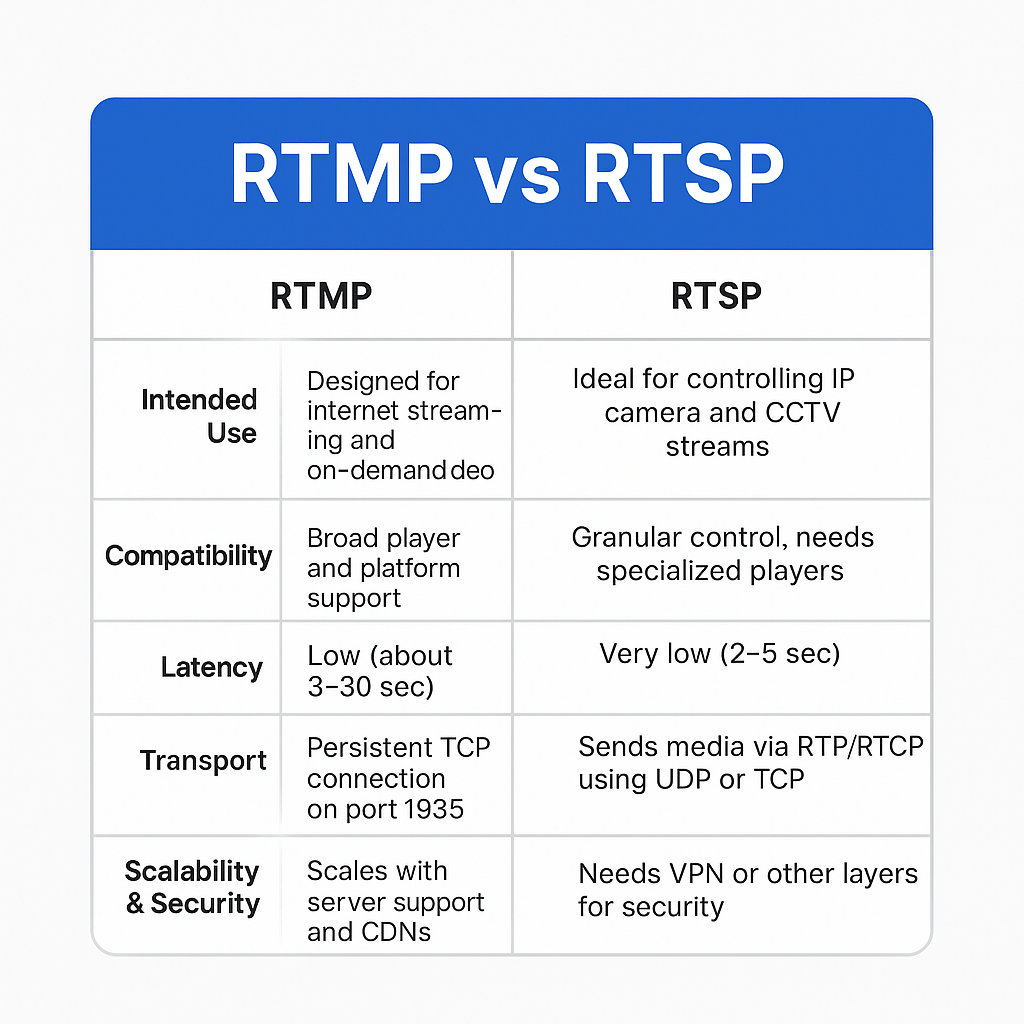
Both RTMP and RTSP are designed for transmitting audio and video, yet they differ in purpose, latency and compatibility. Top industry guides summarise their distinctions:
- Intended use: RTMP is designed for live and on-demand streaming over the internet, whereas RTSP is ideal for controlling and delivering real-time streams from IP cameras and CCTV systems. RTSP emphasises control operations, while RTMP integrates control and media transport.
- Compatibility: RTMP enjoys broad support from players, CDNs and streaming services. RTSP offers granular control but requires specialised players and is often used inside local networks or surveillance systems.
- Latency: RTMP delivers low latency (about 3–30 seconds depending on buffer settings), whereas RTSP can achieve delays as low as 2–5 seconds by bypassing TCP. In general, RTSP is faster but less tolerant of packet loss.
- Transport: RTMP uses a persistent TCP connection on port 1935 and transmits both control and media together. RTSP sends control commands via TCP and media via RTP/RTCP using UDP or TCP.
- Scalability and security: RTMP relies on server support and often pairs with CDNs for scaling. RTSP does not include encryption by default, so secure deployments often combine it with VPNs or other methods.
|
Feature / Aspect |
RTMP (Messaging Protocol) |
RTSP (Streaming Protocol) |
|---|---|---|
|
Primary Use Case |
Live streaming to platforms (YouTube, Twitch, Facebook Live) |
IP cameras, CCTV, real-time monitoring |
|
Transport Layer |
TCP (persistent connection, port 1935) |
Control via TCP; media via RTP/RTCP (UDP/TCP) |
|
Latency |
Low latency (≈3–5 seconds) |
Ultra-low latency (≈2–5 seconds) |
|
Control Features |
Limited (bundled with media stream) |
Rich controls: play, pause, record, fast-forward |
|
Browser/HTTP Support |
Requires conversion to HLS for playback in browsers |
Not supported in browsers natively, needs special players |
|
Compatibility |
Supported by most CDNs, encoders, and live platforms |
Supported mainly by IP cameras, surveillance systems |
|
Scalability |
High—CDN integration available |
Low—best for closed or LAN environments |
|
Security |
Can use RTMPS (encrypted version) |
No built-in encryption; usually paired with VPN/firewall |
|
Ease of Setup |
Relatively simple with CDN or encoder |
More complex (requires server, firewall/NAT configuration) |
|
Best For |
Public live broadcasts, events, gaming, auctions |
Security surveillance, IoT, industrial monitoring |
When to use RTSP
Choose RTSP when you need precise control and ultra-low latency within a controlled environment. IP cameras and CCTV systems typically support RTSP out of the box, making it ideal for security surveillance, video conferencing and industrial monitoring. RTSP is also common in IoT devices such as drones and robots, which require bi-directional control and real-time feedback. If your application runs on a closed network or you can handle the setup complexity, RTSP delivers immediate playback with minimal delay.
When to use RTMP
Select RTMP when your goal is to stream to a large, diverse audience over the internet. Major platforms like YouTube Live, Twitch and Facebook Live still accept RTMP streams for ingest. Because RTMP is compatible with many encoders and CDNs and supports interactive features such as live chat and polling, it is well suited to live events, gaming, auctions and webinars. If you need to deliver stable, low-latency video to viewers around the world, RTMP remains a reliable choice, though you may convert it to HLS for browser playback.
Conclusion
There is no one-size-fits-all answer to the question of RTMP vs RTSP. RTSP excels at real-time control and ultra-low latency in local networks, making it perfect for IP cameras, industrial monitoring and IoT devices. RTMP, on the other hand, offers reliable low-latency delivery and broad compatibility with streaming platforms and CDNs, making it ideal for public live broadcasts and interactive online events. Evaluate your priorities—latency, control, scalability, security and target platforms—and choose the protocol that best serves your audience and application.
FAQ
-
What is the main difference between RTMP and RTSP?
RTMP (Real-Time Messaging Protocol) is mainly used for delivering live video streams to platforms like YouTube, Twitch, and Facebook Live. RTSP (Real-Time Streaming Protocol) is designed for real-time control of media streams, commonly used in IP cameras and CCTV systems.
-
Which has lower latency: RTMP or RTSP?
RTSP typically offers ultra-low latency (2–5 seconds) because it uses RTP over UDP for direct media transfer. RTMP usually delivers low latency (3–30 seconds), but it is slightly slower due to TCP-based transport and buffering.
-
Can I use RTSP in a web browser?
No, RTSP is not natively supported by modern browsers. To play RTSP streams in a browser, you need an intermediate media server or transcoding to HTTP-based protocols like HLS or WebRTC.
-
Why is RTMP still widely used if Flash is deprecated?
Although Flash is obsolete, RTMP remains popular as an ingest protocol for streaming platforms. Many CDNs and live platforms still accept RTMP for input before converting streams into HLS or DASH for browser playback.
-
Which protocol should I choose for my project: RTMP vs RTSP?
Choose RTSP if you need real-time monitoring, security surveillance, or IoT applications with ultra-low latency. Choose RTMP if you need to stream to a global audience through CDNs and live platforms like YouTube Live or Twitch.