Cat5 vs Cat5e vs Cat6 vs Cat6a: Ethernet Cable Comparison 2026
In the digital age, a stable network depends as much on the quality of the cabling as it does on the routers and switches. Many homes and offices still use decades‑old cable runs that limit bandwidth, while newer standards offer multi‑gigabit throughput and better immunity to interference. This guide unpacks the major twisted‑pair Ethernet cable categories — Cat5 vs Cat5e vs Cat6 vs Cat6a — highlighting their capabilities, differences and ideal use cases so you can choose the right option for your next installation.
Understanding Ethernet Cable Categories
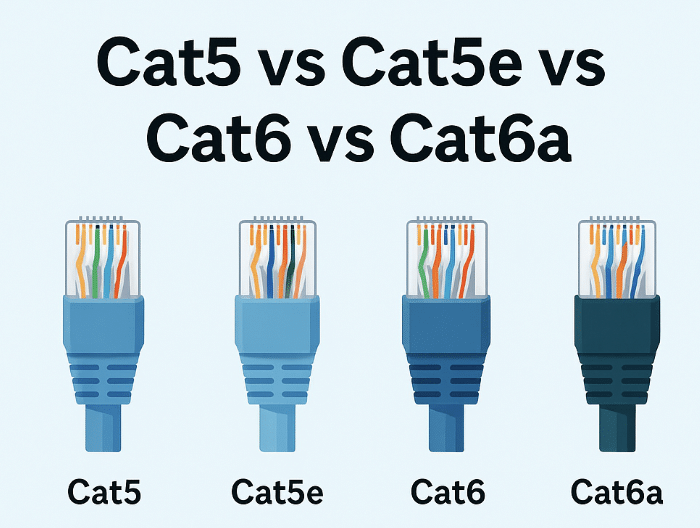
Twisted‑pair Ethernet cables are organised into “Categories,” abbreviated Cat. The number following “Cat” denotes electrical performance — primarily supported speed, frequency (bandwidth) and interference tolerance — rather than the connector style (RJ‑45 is used on all these cables). Lower numbers (Cat5) represent older technology; higher numbers (Cat6a) offer more headroom at a higher price. Below is a concise overview of each category.
Cat5 – obsolete, 100 Mb/s at 100 MHz
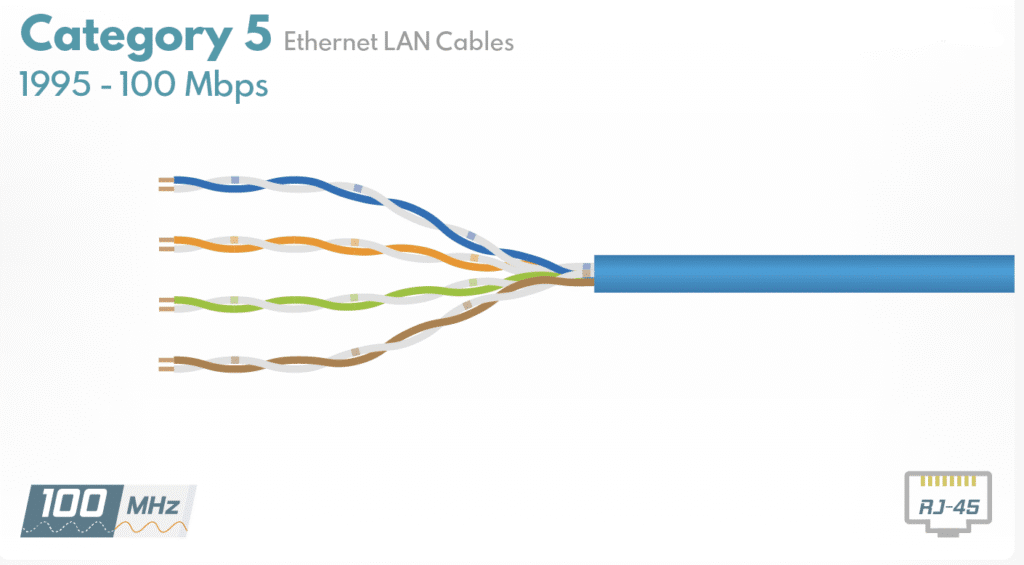
- Speed and bandwidth: Cat5 was designed in the 1990s for Fast Ethernet. It supports speeds up to 100 Mb/s and operates at frequencies up to 100 MHz.
- Use status: While Cat5 once formed the backbone of corporate networks, it is considered obsolete today. Many sources recommend avoiding new installations of Cat5 because the cable cannot handle modern Gigabit or multigigabit applications.
- Suitability: There are no compelling use cases for Cat5 in 2025; upgrading to at least Cat5e ensures a future‑proof path.
Cat5e – enhanced for Gigabit networking
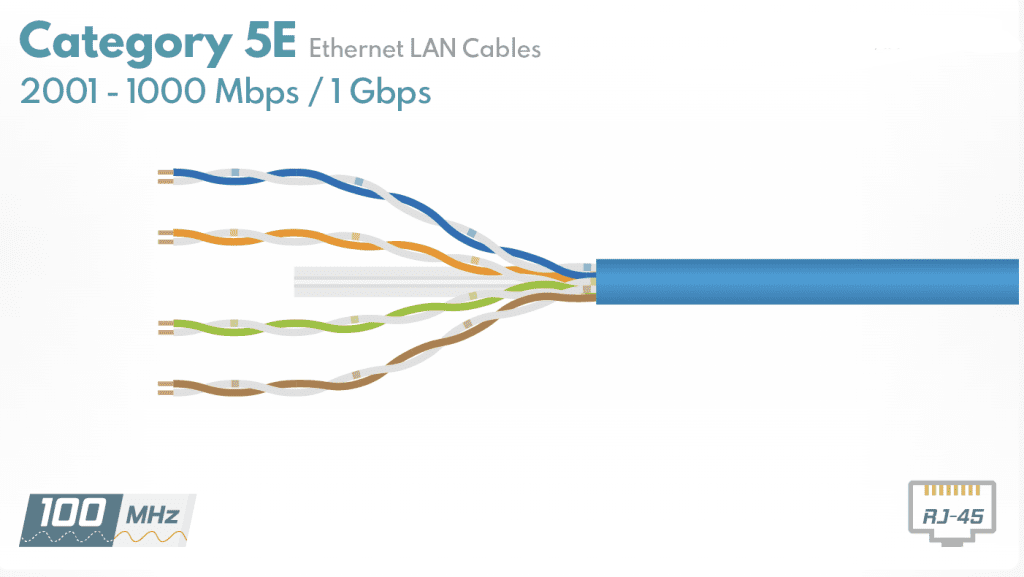
- Improved crosstalk control: Cat5e (“enhanced”) introduced tighter twists and better design to minimise electromagnetic interference. It supports 1 Gb/s (1000 Mb/s) throughput over 100 m and still operates at 100 MHz.
- Residential and budget use: Cat5e’s affordability and flexibility make it suitable for home networks and small offices. Many residential cable runs and IoT devices still rely on Cat5e, which remains adequate for web browsing, streaming and basic file sharing.
- Limitations: The category offers limited headroom for multigigabit standards (2.5 Gb/s, 5 Gb/s) and is not recommended for 10 Gb/s except in very short, controlled runs. It also provides only modest protection against alien crosstalk.
Cat6 – the mainstream gigabit/multigigabit standard
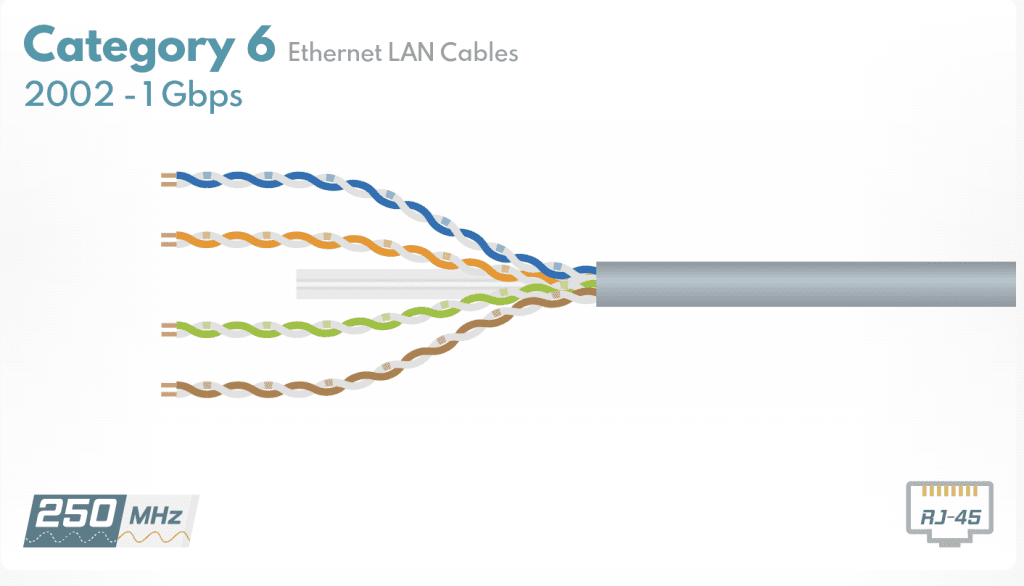
- Higher throughput: Cat6 retains backward‑compatibility with Cat5e but uses thicker conductors (23 AWG vs 24 AWG) and stricter construction. It supports 1 Gb/s up to 100 m and can deliver 10 Gb/s for shorter runs of around 55 m. Its nominal bandwidth is 250 MHz, enabling higher data rates than Cat5e.
- Reduced noise: The tighter twists and optional shielding of Cat6 lower crosstalk and electromagnetic interference. In the Layer23 guide, Cat6 is described as offering stronger EMI resistance and higher throughput compared with Cat5e.
- Ideal environments: Offices, gaming setups and modern home networks benefit from Cat6. It’s well‑suited for Wi‑Fi access point backhauls, short 10 Gb/s connections and networks that may upgrade to 2.5 Gb/s or 5 Gb/s in the near future.
Read More: What is Cat6 Cable
Cat6a – augmented Cat6 for enterprise and data centres
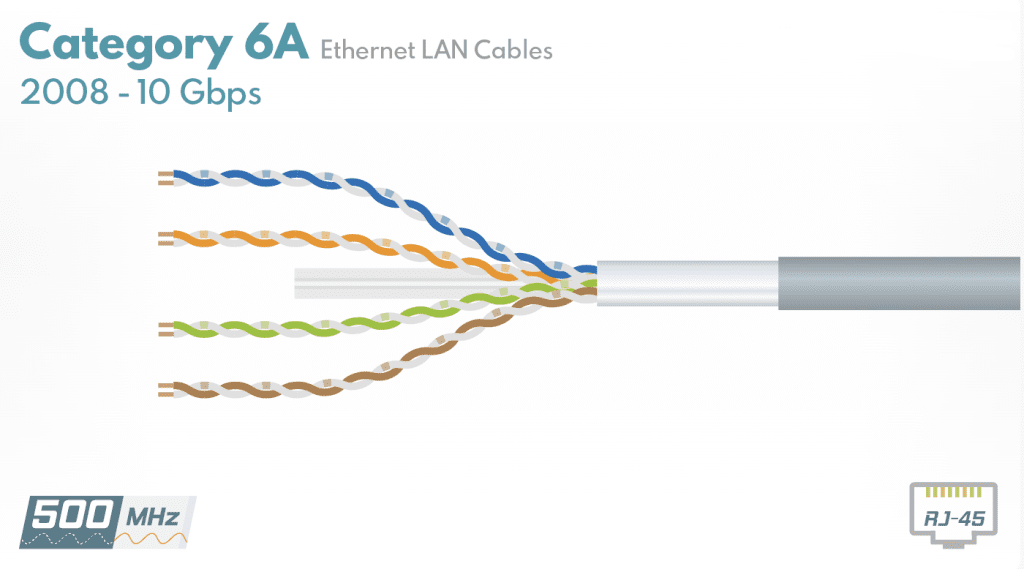
- Full‑distance 10 Gb/s: Cat6a (“augmented”) doubles Cat6’s bandwidth, operating at 500 MHz and delivering 10 Gb/s speeds across the full 100 m channel. This makes Cat6a the entry‑level cable for permanent 10 Gb/s installations.
- Superior shielding: Cat6a cables typically use foil or braided shields on each pair (U/FTP, F/FTP, S/FTP or SF/FTP) to mitigate external electromagnetic noise and alien crosstalk. The additional shielding yields better performance in high‑density cable trays, industrial plants and data centres.
- Best for high‑EMI and PoE: Because of its shielding and thicker conductors, Cat6a maintains performance in high‑EMI environments, supports PoE applications (Wi‑Fi 6/6E/7 access points, IP cameras, VoIP phones) and allows 10 Gb/s links up to 100 m. The trade‑off is a stiffer cable that is slightly more expensive than Cat6.
Cat5 vs Cat5e vs Cat6 vs Cat6a Technical Comparison
1. Speed & throughput
The maximum data rate of each category is the most obvious differentiator. Cat5 is limited to Fast Ethernet (100 Mb/s) and should no longer be used for new installations. Cat5e supports 1 Gb/s at 100 m. Cat6 supports 10 Gb/s only over short runs (~55 m) but maintains 1 Gb/s at 100 m. Cat6a offers 10 Gb/s across the entire 100 m channel with twice the bandwidth (500 MHz). If future upgrades to 2.5 Gb/s, 5 Gb/s or 10 Gb/s are anticipated, Cat6 or Cat6a are prudent choices.
2. Frequency & signal quality
Higher categories support larger frequency ranges, enabling more data to be modulated. Cat5 and Cat5e operate at 100 MHz. Cat6 doubles that to 250 MHz, which reduces crosstalk and supports multigigabit signals. Cat6a doubles it again to 500 MHz, allowing stable transmission of 10 Gb/s over longer distances. Higher frequency also correlates with thicker insulation and heavier shielding, which increases cable diameter and stiffness.
3. Transmission distance & interference resistance
All twisted‑pair categories maintain their rated speeds only within specific distances. Cat5e sustains 1 Gb/s for 100 m but cannot reliably carry 10 Gb/s. Cat6 can achieve 10 Gb/s only up to ~55 m; beyond that, performance drops to 1 Gb/s. Cat6a maintains 10 Gb/s for 100 m thanks to its improved shielding and larger conductor size. Interference resistance is also progressive: Cat6 reduces EMI compared with Cat5e, while Cat6a’s per‑pair and overall shielding mitigate alien crosstalk and make it suitable for high‑EMI environments.
4. Shielding options & construction
Cable construction affects both performance and installation. Cat5e and Cat6 cables are available as U/UTP (unshielded) or STP/FTP (shielded). Layer23 notes several shielding types:
- U/UTP (Unshielded Twisted Pair): four twisted pairs without overall shielding; widely used in homes and offices.
- F/UTP (Foiled Twisted Pair): unshielded pairs wrapped in a single foil; used where basic EMI protection is needed.
- U/FTP (Unshielded Foiled Twisted Pair): each pair shielded with foil but no overall shield, reducing crosstalk while remaining flexible.
- F/FTP or S/FTP: per‑pair shields plus overall foil or braid provide strong protection for high‑EMI industrial or data‑centre environments.
Cat6a cables are frequently supplied in F/FTP, S/FTP or SF/FTP designs to maintain performance at 10 Gb/s. Proper grounding and installation are necessary to realise the benefit of shielded cables.
5. Cost, installation & future‑proofing
Cost increases modestly across categories. Cat5e is the cheapest, while Cat6 typically costs 10–20 % more. Cat6a is slightly more expensive and less flexible due to additional shielding, but it avoids re‑cabling if network demands grow to 10 Gb/s and beyond. Installation considerations include bend radius, connector quality and thermal management for PoE bundles. For PoE++ or high‑power applications, Cat6 and Cat6a dissipate heat better than Cat5e. Also consider building codes: plenum (CMP), riser (CMR) and general (CM) jackets are available across categories.
Comparative Tables
The following tables summarise key metrics across Cat5, Cat5e, Cat6 and Cat6a. The comments column captures nuances such as distance limitations and shielding.
Speed comparison
|
Category |
Typical speed & maximum distance |
Comments |
|---|---|---|
|
Cat5 |
100 Mb/s @ 100 m |
Obsolete; only suitable for legacy 10/100 Mb/s networks. |
|
Cat5e |
1 Gb/s @ 100 m |
Enhanced design reduces crosstalk; supports 2.5/5 Gb/s in limited conditions. |
|
Cat6 |
1 Gb/s @ 100 m; 10 Gb/s @ ≤ 55 m |
Higher bandwidth (250 MHz) and thicker conductors; best value for performance. |
|
Cat6a |
10 Gb/s @ 100 m |
500 MHz bandwidth; robust shielding enables full‑distance 10 Gb/s and excellent PoE performance. |
Frequency (bandwidth) comparison
|
Category |
Frequency band |
Comments |
|---|---|---|
|
Cat5/Cat5e |
100 MHz |
Cat5e improves performance within the same 100 MHz band through tighter twisting. |
|
Cat6 |
250 MHz |
Greater bandwidth reduces crosstalk and supports 10 Gb/s over short distances. |
|
Cat6a |
500 MHz |
Doubled bandwidth allows reliable 10 Gb/s at 100 m and better noise rejection. |
Recommended use cases
|
Category |
Ideal environments |
Comments |
|---|---|---|
|
Cat5e |
Homes, small offices and budget‑constrained installations |
Provides gigabit speeds; recommended for basic internet, streaming and light office use. |
|
Cat6 |
Modern offices, gaming setups, Wi‑Fi AP backhauls |
Supports multigigabit speeds and offers reduced latency; ideal for short 10 Gb/s links and 2.5/5 Gb/s networks. |
|
Cat6a |
Data centres, enterprise networks, high‑EMI or PoE‑heavy environments |
Provides full‑distance 10 Gb/s, strong shielding and superior PoE capability; suited for future‑proofing large networks. |
Selection Guidelines
When deciding which category to deploy, consider both present and future needs:
- Required bandwidth: If your network will not exceed 1 Gb/s for the foreseeable future and budget is tight, Cat5e is sufficient. However, if 2.5/5 Gb/s or 10 Gb/s upgrades are planned, choose at least Cat6.
- Run length and environment: Cat6 provides 10 Gb/s only up to ~55 m. Use Cat6a for longer runs (up to 100 m) or in high‑EMI areas where shielding and crosstalk control are critical.
- Installation complexity: Higher‑category cables are thicker and less flexible. Ensure proper bend radius and use compatible connectors to avoid degrading performance. Shielded cables must be grounded correctly to realise their benefits.
- Budget versus longevity: Cat6 costs only a little more than Cat5e, while Cat6a is slightly more expensive but avoids costly retrofits if your network grows to multigigabit speeds.
Infographic
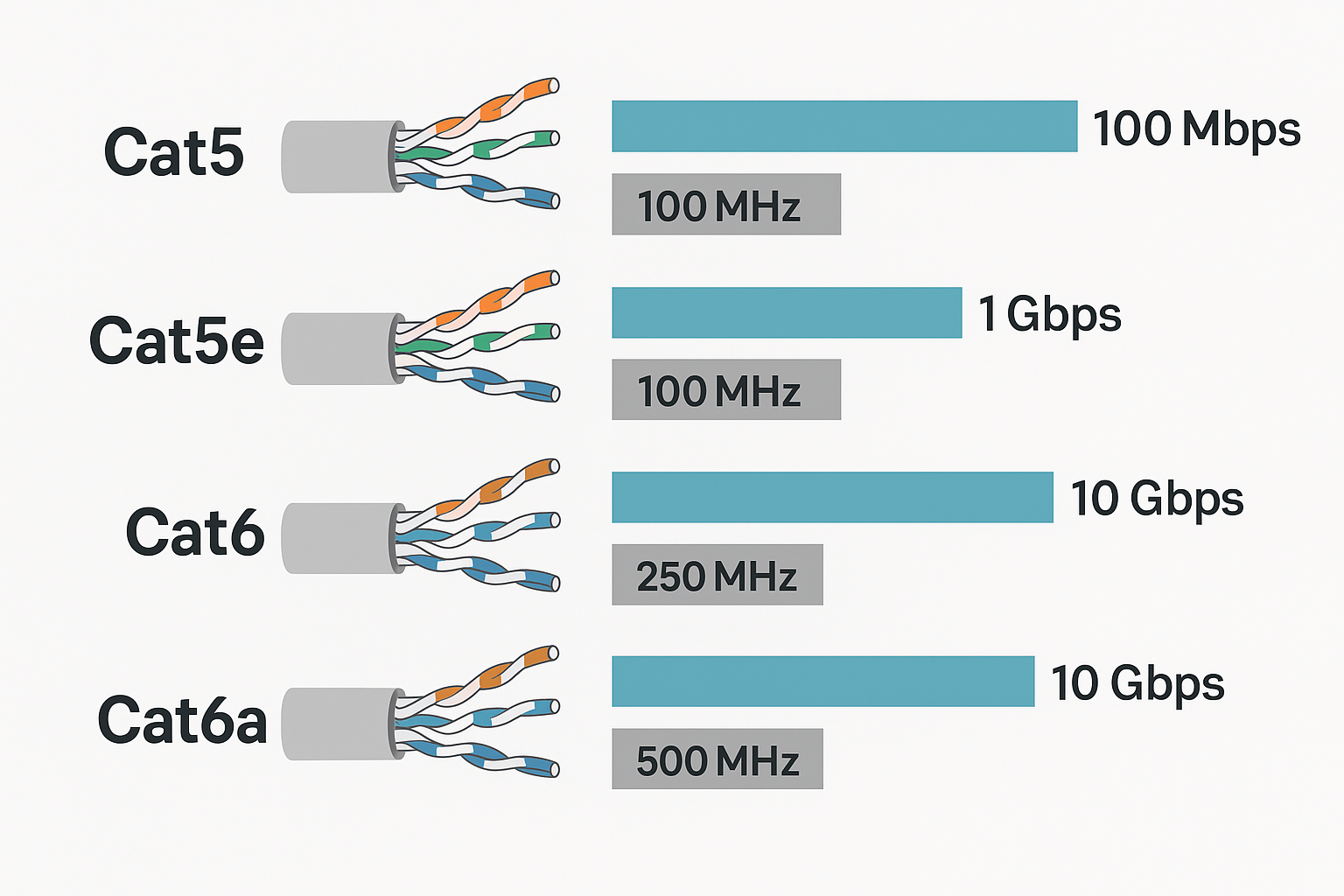
The following infographic visually summarises the relative performance of Cat5, Cat5e, Cat6 and Cat6a cables. It highlights increasing speed and bandwidth capabilities from left to right.
Conclusion
Ethernet cabling is the foundation of every wired network. Investing in the right cable category today can prevent costly upgrades tomorrow. Cat5 should be avoided in new deployments because it is limited to 100 Mb/s. Cat5e remains acceptable for cost‑sensitive, gigabit‑only environments, but its limited headroom makes it less future‑proof. Cat6 delivers a strong balance of performance and cost, supporting multigigabit speeds and reduced crosstalk. For those planning long 10 Gb/s runs, Cat6a provides full‑distance 10 Gb/s and superior interference resistance.
Ultimately, choosing the appropriate category depends on your bandwidth requirements, installation environment and budget. By understanding the differences between Cat5, Cat5e, Cat6 and Cat6a, you can design a network that meets today’s needs while accommodating tomorrow’s advancements.