Cisco DNA Essentials vs Advantage: How to Choose the Right License Tier for Your Project
If you want the broader picture behind Cisco licensing, Smart Accounts, subscription terms, and renewal strategy, start with our Cisco Licensing Ultimate Guide.
Cisco DNA Essentials and Cisco DNA Advantage are not just two feature bundles. For most buyers, they represent two different project paths. The real question is not which tier has more features. The real question is which tier fits your deployment model, automation goals, management plan, and renewal strategy without creating licensing regret later.
That is why this article does not treat Cisco DNA licensing as a feature checklist. It treats it as a buying decision. If you are reviewing a quote, planning a campus rollout, or trying to decide whether Advantage is really worth the cost difference, this page is meant to help you make the right call before the order is placed.

Cisco DNA Essentials vs Advantage at a Glance
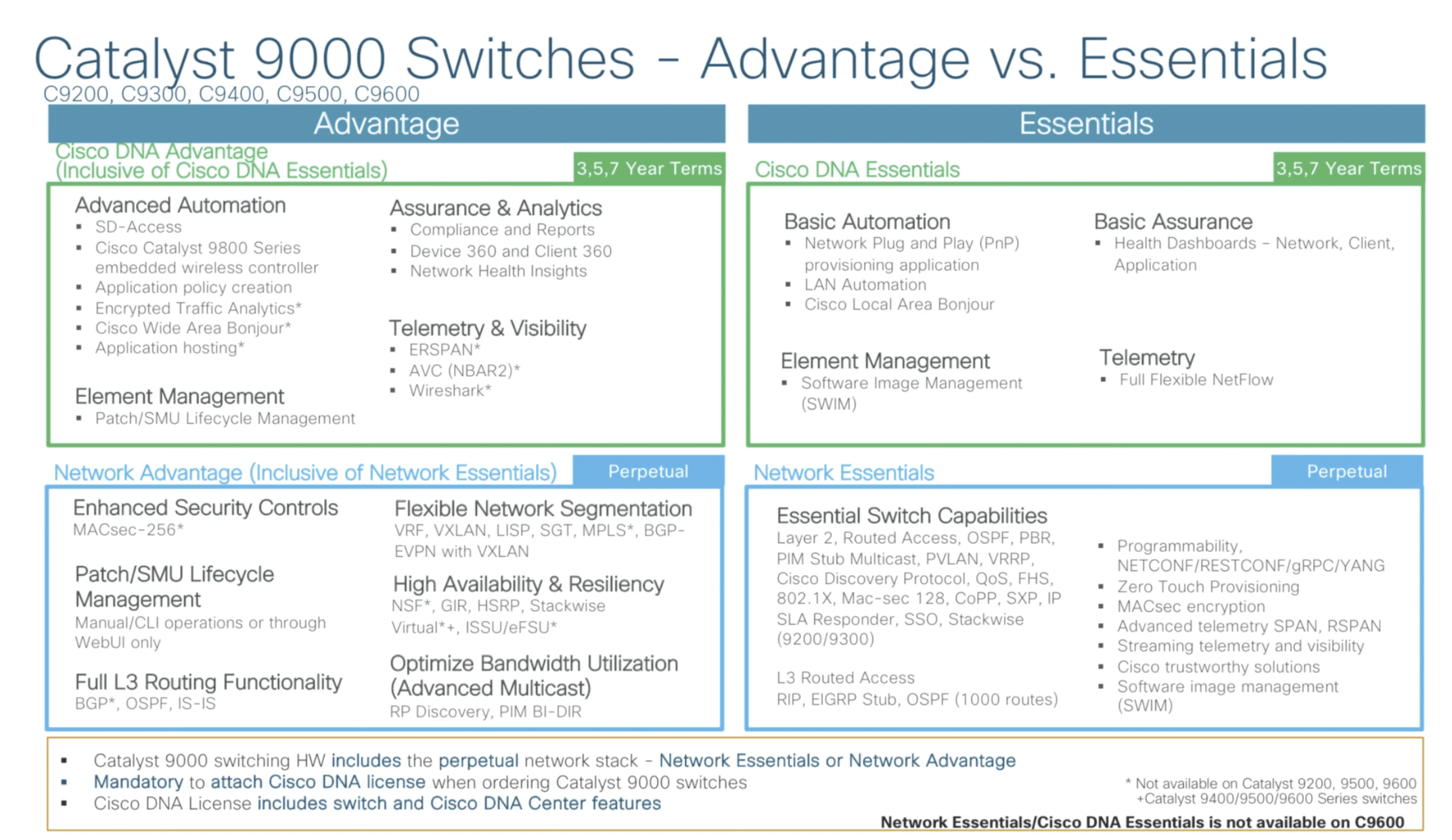
At a high level, Cisco DNA Essentials is usually the better fit for simpler switching projects that need lighter automation and centralized visibility without deeper policy-driven design. Cisco DNA Advantage is designed for projects that need more advanced automation, segmentation, assurance, and long-term flexibility.
| Area | Cisco DNA Essentials | Cisco DNA Advantage | Why It Matters |
|---|---|---|---|
| Typical fit | Simpler campus or access deployments | Broader enterprise campus and more advanced projects | Helps buyers avoid overbuying or underbuying |
| Automation scope | Basic automation and monitoring | Deeper automation and policy-driven workflows | Important if the project will expand over time |
| Segmentation and fabric readiness | More limited | Stronger fit for advanced segmentation and SD-Access-style design | Often a deciding factor in enterprise projects |
| Analytics and assurance | Basic visibility | More advanced assurance and AI-driven analytics | Matters when operations teams want deeper insight |
| Long-term flexibility | Better for simpler needs | Better for projects expected to grow | Reduces mid-project license regret |
| Buyer profile | Budget-sensitive, straightforward rollout | Larger campus, multi-site, or future-focused deployment | Helps align tier choice to real project direction |
That table is useful, but it is still only the start. Most licensing mistakes happen because buyers stop at the table and never ask what the project is actually trying to become.
The Real Buying Question: When Is Essentials Enough and When Is Advantage Worth It?
A lot of buyers begin with the wrong question.
They ask, “What is the difference between Essentials and Advantage?”
That sounds sensible, but it usually leads to shallow comparison and bad procurement decisions. The better questions are:
- Are we buying for a straightforward rollout, or for a network that will become more automated later?
- Will this project stay relatively simple, or is segmentation and policy control likely to matter later?
- Are we only trying to keep cost down, or are we trying to avoid architecture limits over the next three to five years?
- Will we actually use centralized automation and operational workflows, or are we just buying a higher tier because it feels safer?
In practice, that is the real divide between Essentials and Advantage.
Essentials is not a “cheap version” for buyers who do not know better. Advantage is not automatically the right answer just because it includes more. The better tier is the one that matches the project’s operational reality.
Check 1: Choose by Project Scope, Not by “More Features”
The fastest way to choose the wrong tier is to buy based on feature count alone.
When Cisco DNA Essentials Is Usually Enough
DNA Essentials is often enough when the project is straightforward and the buyer is not planning to push deeper into advanced automation, segmentation, or richer operational workflows.
Typical cases include:
- straightforward access-layer campus deployments
- smaller rollouts with limited operational complexity
- budget-sensitive projects where the architecture is expected to remain stable
- environments that want centralized visibility and lighter automation, but not a major platform shift
Essentials makes sense when the business wants a cleaner subscription path without paying for advanced capabilities that may never be used.
When Cisco DNA Advantage Is Usually the Better Fit
DNA Advantage is usually the better fit when the buyer is not just deploying switches, but shaping a longer-term operating model.
That often includes:
- larger enterprise campus rollouts
- projects expected to grow over multiple phases
- environments that will rely more on automation and policy-driven design
- teams that want stronger room to expand without rethinking license strategy later
The point is not that Advantage has “more.” The point is that Advantage is often the safer choice when the project roadmap is broader than the initial day-one scope.
Check 2: Are You Buying for Today’s Deployment or Tomorrow’s Architecture?
This is where many teams make the wrong choice.
The quote is usually built around what the project needs right now. But license regret rarely appears right away. It appears six months later, or during the next rollout phase, when the team realizes the original tier no longer fits the architecture direction.
The Cost of Under-Buying Your License Tier
Under-buying usually feels good at the quote stage. The initial number looks lower. Procurement is happy. The project gets approved more easily.
The problem comes later if the team wants broader automation, stronger segmentation, richer analytics, or a more consistent operating model across multiple sites. What looked like savings early can turn into friction later.
The Cost of Over-Buying for a Simple Rollout
Over-buying creates a different problem. Some buyers choose Advantage simply because they want to “be safe,” even though the environment is simple and unlikely to change much. In that case, they may spend money on capabilities they will not use, which makes the subscription harder to defend at renewal time.
Why License Regret Usually Appears Mid-Project, Not at Quote Stage
This is why tier choice should be driven by roadmap, not just launch scope.
The smartest buyers ask:
- what will this network look like in two years
- what operational model are we moving toward
- are we likely to standardize more sites later
- do we want licensing that leaves room to grow without causing redesign pain
That is the real pricing question. Not just “What costs less today?” but “What costs less over the full project life?”
Check 3: What Project Triggers Usually Push Buyers from Essentials to Advantage?
The easiest way to make this decision is to stop thinking in generic “pros and cons” and start thinking in trigger points.
Catalyst Center-Driven Automation
If the project will rely heavily on centralized operational workflows, the subscription decision should reflect that. Some buyers do not need much beyond simpler centralized monitoring. Others are clearly moving toward a more automation-driven operating model.
That is often where Advantage starts to make more sense.
Segmentation and Policy-Based Design
This is one of the strongest practical dividing lines.
A simple access deployment may not need deeper policy control. But once the project starts moving toward segmentation, identity-driven policy, or more advanced campus design logic, Essentials often stops being the comfortable answer.
Advanced Assurance and Operational Visibility
Basic visibility is not the same as advanced operational insight.
If the network team is expected to troubleshoot faster, prove user experience quality, or gain richer assurance data, the higher tier often becomes easier to justify. This is especially true for larger enterprise environments where operational consistency matters more than raw hardware cost.
Multi-Site Standardization and Repeatable Workflows
In one-site projects, buyers can often stay conservative. In repeatable multi-site environments, the value of a stronger software tier becomes easier to see because the operational model needs to scale, not just the hardware.
When These Are Hard Requirements Instead of “Nice to Have”
This is the key distinction.
If the project team already knows these capabilities are required, the debate is largely over. Advantage is not a premium upgrade anymore. It becomes part of the delivery requirement.
Check 4: What Should Buyers Verify Before Ordering?
This is where many comparison pages become useless. They explain features but never help the buyer avoid a bad order.
Smart Account Readiness
Before the order is finalized, the buyer should confirm the Smart Account structure is ready. A surprising number of licensing issues start not with the switch, but with account readiness and entitlement handling.
Hardware Stack and DNA Tier Alignment
Do not review the DNA tier in isolation. Review it together with the hardware model and the underlying Network stack level. The quote should make sense as a stack, not just as a list of line items.
SKU Logic and What the Suffix Actually Affects
Many buyers focus on price first and decoding later. That is the wrong order. The quote needs to be reviewed carefully so the team understands which stack level and DNA tier are actually being purchased.
Choosing the Right Term: 3, 5, or 7 Years
The term decision is often treated as an afterthought, but it should be aligned with:
- project lifecycle
- budget cycle
- expected refresh timing
- renewal management preference
A term that looks good on paper but does not match hardware lifecycle planning can create unnecessary friction later.
How to Review the Quote Summary Before the PO Is Issued
Before placing the order, buyers should confirm:
- correct hardware model
- correct Network stack level
- correct DNA tier
- correct term length
- Smart Account readiness
- entitlement summary
- whether the subscription path matches the actual deployment plan
That review step sounds basic, but it is one of the most practical ways to avoid licensing mistakes.
Check 5: What Happens at Renewal, or Downgrade?
This is one of the most valuable buying questions, yet it is often handled poorly.
What Buyers Should Think About Before the First Term Ends
The first subscription term should not be treated as a problem for future-you. Buyers should already know what the likely renewal strategy is before the original purchase is placed.
Why Renewal Planning Should Begin Earlier Than Most Teams Expect
If the business wants to optimize cost later, the team will need to review what the network is actually using, what can be reduced safely, and what should remain aligned for management and operations.
What to Review if the Business Wants to Lower Subscription Cost Later
This is where many teams create confusion. They assume they can simply reduce the DNA tier without first understanding the relationship between the underlying Network stack and the subscription layer. That assumption can lead to messy internal conversations later.
How to Think About Subscription Cost Without Creating Support or Management Gaps
The goal is not only to save money. The goal is to avoid cutting cost in a way that creates management gaps, architecture limits, or operational inconsistency.
Cisco DNA Essentials vs Advantage for Switch Buyers
Cisco Switches buyers should be especially careful with generic licensing summaries because switch projects are often where the DNA decision becomes operationally meaningful.
Why Switch Projects Should Not Rely on Generic Licensing Summaries
A generic summary might say “Advantage gives more automation,” but that still does not tell a buyer whether their switch deployment really needs it. The role of the switch, the management model, and the future campus strategy matter more than generic label language.
When Access-Layer Deployments Can Stay with Essentials
For simpler access-layer environments, Essentials can be completely reasonable when the design is stable, the feature requirements are lighter, and the project is not moving toward deeper automation or segmentation.
When Enterprise Campus Strategy Pushes Buyers Toward Advantage
If the switch project is part of a broader enterprise campus strategy, especially one with long lifecycle expectations or a stronger automation roadmap, Advantage becomes easier to justify.
Why Switch Role Matters More Than License Marketing Language
This is the core rule: pick the tier based on the switch’s role in the environment and the operating model around it, not based on whatever sounds more advanced in the brochure.
Common Buyer Mistakes When Choosing Cisco DNA Tiers
Assuming Advantage Is Always the Safe Answer
It is not. Sometimes it is the right answer. Sometimes it is simply the more expensive answer.
Assuming Essentials Is Only for Small Customers
That is also wrong. Essentials can be the right fit for plenty of legitimate enterprise scenarios if the design scope is appropriate.
Treating DNA and Network Licenses as the Same Thing
This is one of the most common causes of quote-stage confusion.
Ignoring Term Length at Purchase Stage
Term choice affects renewal pressure, budget timing, and lifecycle alignment. It should not be left to the end.
Choosing by Feature Count Instead of Project Direction
That is how teams end up with either overspend or license regret.
FAQ
What is the difference between Cisco DNA Essentials and Advantage?
Essentials is usually the better fit for simpler projects with lighter automation and management needs. Advantage is usually the better fit for projects that need deeper automation, segmentation, stronger assurance, or more long-term flexibility.
Is Cisco DNA Advantage worth it for switches?
It can be, especially if the switch deployment is part of a broader campus strategy, relies on stronger centralized workflows, or is expected to grow over time. For simpler access projects, Essentials may still be enough.
Does Cisco DNA sit on top of Network Essentials or Network Advantage?
Yes. In switching, the DNA subscription should be understood together with the underlying Network stack level. Buyers should review both layers, not just the DNA tier alone.
Is Cisco DNA Premier still available?
Buyers should not treat Premier as a normal current switching buying option in 2026. Older content still mentions it, but current procurement decisions should be based on supported current-state tiers and add-on paths.
Can I start with Essentials and move later?
Possibly, but that should not be treated as a casual decision. Buyers should think carefully about future architecture and lifecycle impact before assuming that starting lower is always the cheaper path.
What should I check before ordering Cisco DNA licenses?
At minimum: hardware model, Network stack level, DNA tier, term length, Smart Account readiness, and quote summary alignment with the actual project scope.
Final Recommendation: Which DNA Tier Should You Choose?
Choose Cisco DNA Essentials if the project is straightforward, the operational model is relatively simple, and you do not expect to rely on deeper automation or policy-driven design.
Choose Cisco DNA Advantage if the deployment is expected to grow into stronger automation, richer assurance, segmentation, or broader lifecycle management over time.
Do not let old three-tier language drive current procurement. Do not compare DNA tiers without understanding the underlying Network stack. And do not treat subscription term choice as a minor commercial detail.
The best licensing decision is the one that fits the actual project path, not the one that simply looks cheaper or more advanced on the first quote.

Layer23-Switch is a global Cisco supplier supporting B2B projects and helping buyers review license tiers, subscription terms, renewal planning, and quote accuracy before purchase.