Cisco Licensing Ultimate Guide: How to Choose, Buy, Renew, and Manage Cisco Licenses
Cisco licensing is no longer something you only think about after the hardware arrives. For most buyers, it affects the quote, the software tier, the support path, the renewal cycle, and even whether a project is operationally easy or painful after deployment.
This guide is built to help enterprise buyers, IT managers, Cisco partners, and project teams understand how Cisco licensing works in real-world decisions. Instead of treating licensing as a single topic, it breaks the subject into the questions people actually ask before purchase, during deployment, at renewal time, and when support issues come up later.
If your current question is simple, such as “Do I have to buy Cisco DNA with this switch?” or “What happens when the subscription expires?”, you do not need to read every section in order. Use this page as a hub, then go deeper into the right article for your situation.
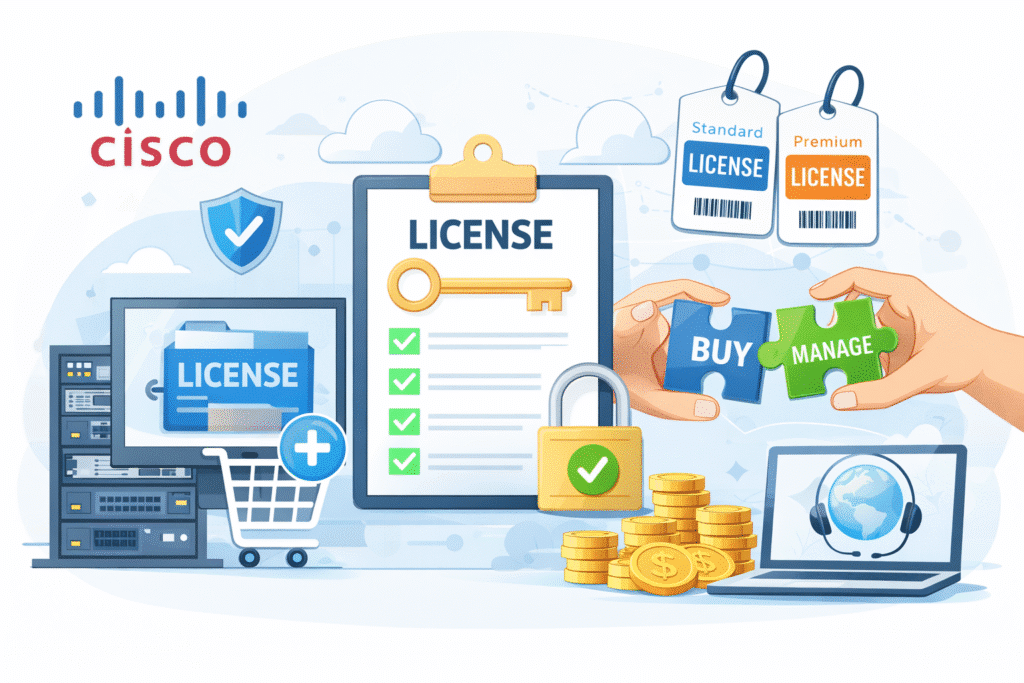
What This Cisco Licensing Guide Helps You Do
Most Cisco licensing questions fall into one of these categories:
- understanding the difference between perpetual and subscription licensing
- figuring out whether a subscription is mandatory on a new quote
- choosing the right software tier
- checking what happens when a subscription expires
- separating support coverage from software entitlement
- deciding whether Enterprise Agreement is worth it
- decoding the SKU before placing the order
- planning renewal around hardware lifecycle and budget
That is the real purpose of this guide. Not to bury you in licensing jargon, but to help you identify what kind of Cisco licensing problem you actually have and where to go next.
How Cisco Licensing Works at a High Level
At a high level, Cisco licensing is easier to manage when you stop thinking of it as one big topic and start thinking of it as four smaller ones: what you own, what you subscribe to, how you manage entitlement, and what happens later.
Perpetual Licenses vs Subscription Licenses
One of the biggest sources of confusion in Cisco projects is the difference between perpetual licensing and subscription licensing.
A perpetual license is usually tied to the hardware or to a long-term software entitlement that stays with the product. A subscription license is tied to a term, such as three, five, or seven years, and is often linked to management, analytics, automation, or software lifecycle functions.
This distinction matters because many Cisco products now combine both models. A buyer may own the hardware and a perpetual software layer, while also being required to purchase a subscription layer at day one.
Hardware Entitlement vs Software Entitlement
Another common mistake is treating hardware entitlement and software entitlement as the same thing.
They are not.
A hardware entitlement question usually sounds like this: “What exactly is this switch model?” or “Does this SKU include PoE and 10G uplinks?”
A software entitlement question sounds different: “Is this Essentials or Advantage?” or “What happens if the DNA term expires?”
Good licensing decisions come from reviewing both layers together, not separately.
Smart Licensing and Why Smart Accounts Matter
Cisco Smart Licensing and Smart Accounts are now part of the normal buying and management process for many Cisco products.
In practical terms, Smart Accounts matter because they affect:
- how software entitlements are registered
- how subscriptions are managed
- how renewals are tracked
- how visibility and compliance are handled across an organization
A Smart Account issue can create real friction even when the hardware quote itself looks fine. That is why licensing is no longer just a “software topic.” It is part of procurement, operations, and lifecycle planning.
Why Cisco Licensing Questions Usually Happen at Four Stages
Most Cisco licensing problems appear in one of four stages:
- Before purchase
The team is reviewing a quote, choosing tiers, or trying to understand whether DNA or another subscription is mandatory. - During deployment
The hardware has arrived, but the team is now dealing with entitlement, Smart Account structure, activation logic, or management platform dependency. - At renewal or expiration
The subscription term is ending, and the business needs to decide whether to renew, replace, or keep running without renewal. - During support and operations
The team is trying to understand how software entitlement, warranty, Smart Net, support status, or renewal risk affects day-to-day operations.
The rest of this guide follows those stages.
Stage 1: Before You Buy Cisco Hardware
This is where the most expensive licensing mistakes usually begin.
A quote can look correct at first glance, but the problems often hide in the details: mandatory subscriptions, the wrong software tier, the wrong suffix, or assumptions about performance that licensing does not actually change.
Is a Cisco DNA Subscription Mandatory at Day 0?
For many Catalyst switching purchases, this is one of the first questions buyers ask.
If you are dealing with a new Catalyst quote and want to understand whether Cisco DNA subscription is mandatory at purchase, read this first:
Is Cisco DNA Subscription Mandatory?
That article explains where subscription logic becomes part of the buying requirement and why some buyers are surprised by it during quote review.
How to Decode a Cisco SKU Before You Approve the Quote
A Cisco SKU can tell you far more than many buyers realize.
It can reveal:
- the product family
- the port count
- whether the switch is data-only or PoE
- the uplink type
- whether the suffix is
-Eor-A
If you want to understand how to read Cisco switch model numbers and avoid ordering the wrong hardware or software tier, start here:
Cisco Switch Naming Convention: How to Read Model Numbers and -E vs -A
Does Licensing Change Cisco Switch Performance?
This is another question that comes up constantly, especially when a buyer is comparing license tiers and assumes the higher tier might also mean better hardware performance.
It usually does not work that way.
If you want the practical answer to that myth before signing off on a quote, read:
Does Cisco Switch Performance Depend on Licensing?
Stage 2: Choosing the Right Cisco Software Tier
Once the hardware is identified, the next real decision is often the software tier.
This is where many buyers lose time. They compare labels, compare price, and compare checklists, but they still do not know what the right tier is for the actual project.
Cisco DNA Essentials vs Advantage: Which Tier Fits Your Project?
This is one of the most commercially important licensing decisions in campus switching.
The real question is not “Which tier has more features?”
The better question is “Which tier fits this project without creating unnecessary cost or future regret?”
If that is the question you are solving, read:
Cisco DNA Essentials vs Advantage: How to Choose the Right License Tier
That page focuses on project fit, ordering logic, and longer-term lifecycle thinking, not just feature comparison.
How DNA Subscription Relates to the Underlying Network Stack
Many buyers compare the wrong layers.
They think they are comparing two software choices, when in reality they are looking at:
- the underlying Network stack
- the subscription tier on top of it
- the term length
- the management and renewal implications later
This is where quote-stage confusion becomes expensive. If your team is unclear about what is perpetual and what is subscription-based, it becomes much harder to make a clean buying decision.
How to Avoid Outdated Tier Assumptions
Licensing pages age quickly, especially when a vendor changes packaging, naming, or product-line structure.
That is why you should be careful with older comparison content, especially if it uses outdated tier language as if it still reflects every current purchase path.
The safe rule is simple: use current project scope and current ordering logic, not old assumptions, to decide the right tier.
Stage 3: What Happens After the Initial Term
This is where licensing stops being a purchase question and becomes a lifecycle question.
Many teams handle this stage reactively. The subscription nears expiration, someone asks whether the switch will stop working, and then the business tries to make a rushed renewal decision.
That is not the best way to manage it.
What Happens When Cisco DNA Expires?
This is one of the highest-value licensing questions in the whole Cisco campus stack.
The short answer is usually that the switch keeps basic connectivity, but the subscription layer changes what the team can do around management, automation, analytics, and lifecycle support.
If you want the deeper explanation, especially for Catalyst 9200 and 9300 environments, read:
What Happens When Cisco DNA License Expires?
That page focuses on what still works, what stops, what changes for Catalyst Center-driven workflows, and when renewal is worth it.
Should You Renew, Replace, or Keep Running Without Renewal?
This is not a one-size-fits-all decision.
Some organizations renew because they rely on subscription-based operations and centralized workflows. Others choose not to renew because they only use the switch for stable Layer 2 and Layer 3 connectivity and have no real dependency on higher subscription value.
The right answer depends on:
- what the network is actually using
- whether the hardware is near refresh
- whether centralized management matters
- whether the organization wants to preserve the current operating model
How to Align Subscription Terms with Hardware Lifecycle
One of the best ways to reduce licensing waste is to stop treating subscription term decisions as isolated finance events.
A three-year term, five-year term, or renewal decision should be aligned with:
- the expected life of the hardware
- the budget cycle
- the refresh roadmap
- the support model
- the role of the device in the network
When subscription and hardware lifecycle are misaligned, cost and complexity both go up.
Stage 4: Support, Warranty, and Post-Sales Risk
A lot of Cisco licensing confusion is actually support confusion.
A buyer may think the issue is “licensing,” when the real issue is support coverage, entitlement, or the difference between warranty and Smart Net.
Cisco Warranty vs Cisco Smart Net
These are not the same thing, and treating them as interchangeable is one of the most common buying mistakes.
If you want the real difference between hardware warranty and Cisco Smart Net support, including how that affects buying and post-sales risk, read:
Cisco Warranty vs Smart Net Service
Why Support Planning Should Start Before the Purchase
Support decisions are easier when they happen before the hardware is in production.
That includes questions like:
- Who will handle RMA if there is a problem?
- Does the buyer care more about local flexibility later?
- Is support part of the current quote, or a later decision?
- Is the hardware being bought through a path that makes future support easy or complicated?
Too many buyers wait until there is a problem, and by then the options may be narrower than expected.
How Serial Status and Coverage Status Affect Buyer Risk
In real Cisco buying decisions, the hardware model is not the only thing that matters. Support status and entitlement status matter too.
That is why buyers who only compare price and model number often miss the more important question: what happens after delivery if support, renewal, or RMA becomes necessary?
Stage 5: Contract-Level Licensing Decisions
Not every licensing question should be solved one product at a time.
In larger environments, licensing becomes a broader contract strategy question.
When Cisco Enterprise Agreement Makes Sense
Cisco Enterprise Agreement can make sense for organizations that want portfolio-level simplicity, broader entitlement structure, and more predictable program-level management.
But it is not automatically the right answer for every buyer.
If you want a practical breakdown of when EA is worth considering and when it is not, read:
Cisco Enterprise Agreement Guide
When Product-by-Product Licensing Is the Better Choice
For many organizations, especially those with more focused product needs or less portfolio complexity, product-by-product licensing remains the cleaner choice.
This is often true when:
- the environment is smaller
- the product scope is narrow
- the business wants tighter budget control
- the organization does not need enterprise-wide bundling
The right contract model depends on scale, product mix, and management style.
Stage 6: Product-Specific Cisco Licensing Guides
One reason Cisco licensing feels complicated is that the rules are not identical across product lines.
That is why this cluster includes product-specific guides as well.
Campus Switching Licensing
If your main licensing questions are about Catalyst switches, start with these:
- Is Cisco DNA Subscription Mandatory?
- Cisco DNA Essentials vs Advantage
- What Happens When Cisco DNA License Expires?
- Does Licensing Affect Cisco Switch Performance?
- Cisco Switch Naming Convention
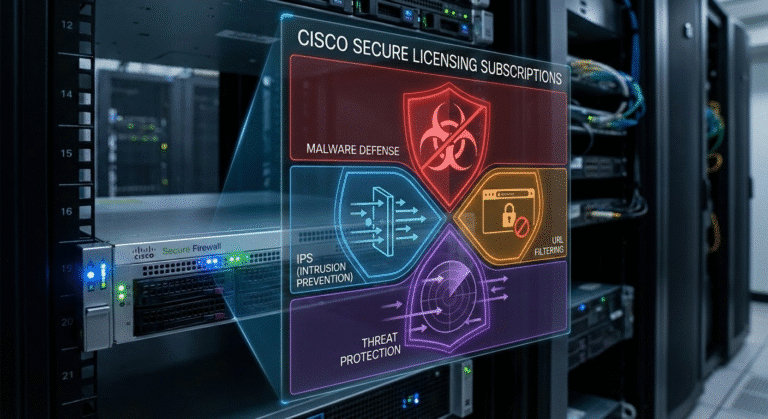
Cisco Firepower Licensing
Security licensing brings its own set of questions around software bundles, subscriptions, and security service scope.
If that is your current topic, read:
Cisco Meraki Licensing
Meraki licensing belongs in this cluster too, but it follows a different model from classic Catalyst and Cisco enterprise software.
That page has not been published yet, but it should sit naturally beside the other product-specific licensing guides once it is ready.
Cisco Licensing Quick Navigation Table
| If your question is… | Read this first | Why |
|---|---|---|
| Do I have to buy DNA with a new switch? | Cisco DNA Subscription Mandatory | Clarifies purchase-stage subscription rules |
What does -E or -A mean on a Cisco switch? | Cisco Switch Naming Convention | Decodes the SKU and software tier suffix |
| Does licensing make the switch faster? | Cisco Switch Performance Licensing | Separates hardware performance from license tier |
| What happens when DNA expires? | Cisco DNA Subscription Expired | Explains what still works and what changes |
| Do I need Smart Net or just warranty? | Cisco Warranty vs Smart Net Service | Separates support from software entitlement |
| Is EA worth it for my company? | Cisco Enterprise Agreement Guide | Helps evaluate contract-level strategy |
| How does Firepower licensing work? | Cisco Firepower License Guide | Covers security licensing separately |
| How does Meraki licensing work? | Meraki licensing guide (coming soon) | Future cluster page for cloud-managed licensing |
The Most Common Cisco Licensing Mistakes
The easiest way to improve licensing decisions is to stop repeating the same avoidable mistakes.
Assuming a Higher Tier Makes the Hardware Faster
This is one of the most common misconceptions in switch buying. A higher license tier usually changes software entitlement and feature scope, not raw forwarding performance.
Assuming DNA Is Always Optional at Day 0
Many buyers still do not realize that some Cisco switching purchases include subscription logic as part of the initial order path.
Treating Warranty and Smart Net as the Same Thing
These are different questions. Warranty is not the same as a support contract, and support is not the same as software subscription.
Reading the Hardware SKU but Ignoring the Final Suffix
A switch quote can look correct until you notice the final -E or -A is not what the project actually needs.
Thinking “The Switch Still Works” Means Expiration Has No Real Impact
This is one of the most common mistakes after subscription expiration. The switch may stay online, but the management experience, automation value, and software lifecycle path can still change in meaningful ways.
Letting Outdated Tier Language Influence Current Buying Decisions
Old licensing content can remain visible for years. Buyers should be careful not to let outdated structures or old packaging assumptions shape current procurement.
FAQ
What is Cisco licensing?
Cisco licensing is the framework Cisco uses to define software entitlement, subscription rights, feature tiers, and management of those entitlements across products and accounts.
What is the difference between Cisco perpetual and subscription licensing?
Perpetual licensing usually stays tied to the hardware or long-term software layer, while subscription licensing is tied to a term and often affects management, analytics, automation, or ongoing software lifecycle rights.
What is a Smart Account in Cisco licensing?
A Smart Account is the management structure used to hold, organize, and manage many Cisco software entitlements and subscriptions.
Is Cisco DNA mandatory on new switches?
In many new Catalyst switch buying scenarios, subscription logic is part of the initial purchase path. The exact answer depends on product family and current ordering structure.
What happens when a Cisco subscription expires?
It depends on the product, but in many campus switching cases the switch keeps basic connectivity while subscription-linked capabilities, management experience, and software lifecycle options change.
Is Cisco Smart Net the same as a Cisco software subscription?
No. Smart Net is a support topic. Cisco software subscription is a software entitlement and term topic. They often appear in the same buying conversation, but they are not the same thing.
When should a company consider Cisco Enterprise Agreement?
EA makes more sense when the environment is broad enough that portfolio-level simplicity, bundling, and program-level management are worth more than product-by-product flexibility.
How to Use This Guide Based on Your Situation
If You Are a Buyer Reviewing a Quote
Start with:
- DNA mandatory
- switch naming convention
- switch performance licensing
Those three pages will usually solve the most common purchase-stage confusion.
If You Are an IT Manager Planning Renewal
Start with:
- DNA subscription expired
- Enterprise Agreement guide
- support vs Smart Net page
That combination gives you the best first view of renewal, lifecycle, and risk.
If You Are a Network Team Managing Catalyst Switches
Start with:
- DNA Essentials vs Advantage
- DNA subscription expired
- switch naming convention
That gives you the operational and lifecycle view, not just the buying view.
If You Are Evaluating Support Risk After Purchase
Start with:
- Cisco warranty vs Smart Net service
- DNA subscription expired
- Enterprise Agreement guide if contract structure is part of the bigger discussion
Final Takeaway
Cisco licensing becomes much easier when you stop trying to learn everything at once.
Most licensing decisions happen in one of four stages:
- before purchase
- during deployment
- at renewal or expiration
- during support and operations
Once you know which stage you are in, the next step usually becomes much clearer.
The goal of this guide is not to turn every buyer into a licensing specialist. The goal is to help you make better Cisco purchasing, renewal, and support decisions with less confusion and fewer expensive mistakes.
Layer23-Switch is a global Cisco supplier helping B2B buyers and project teams review Cisco licensing, software tiers, subscription terms, support options, renewal timing, and quote accuracy before purchase.