Do Cisco Licenses Affect Switch Performance? What Changes and What Does Not
Cisco licenses do not normally make a switch faster. They do not increase raw forwarding rate, switching capacity, PoE budget, uplink speed, or stacking bandwidth. Those limits are defined by the hardware platform itself. What licenses change is the software feature set, automation scope, analytics, and the operational model around the switch.
If you want the broader picture behind Cisco subscriptions, Smart Accounts, software tiers, and renewal planning, start with our Cisco Licensing Ultimate Guide.
This distinction matters because buyers often ask the wrong question. They compare Network Essentials and Network Advantage, or Cisco DNA Essentials and Advantage, and assume the higher tier might also deliver higher performance. In practice, that is usually not how Cisco switching works. The hardware decides the speed. The license decides what the switch can do around that hardware.
That means the real buying question is not, “Will this license make my switch faster?” The real question is, “Am I buying the right hardware for performance, and the right software level for features and operations?”
Short Answer: Does a Cisco License Make a Switch Faster?
No. In normal Cisco Catalyst switching scenarios, a license does not increase the switch’s raw hardware performance.
If you want more throughput, more uplink speed, a larger PoE budget, or higher stacking bandwidth, you usually need a different hardware model, not a different license tier.
What a higher license tier can change is everything around the hardware:
- which software features are available
- how much automation the project can use
- what visibility and analytics the team gets
- how the switch fits into a broader management workflow
So the simplest answer is this:
Licenses change capability, not horsepower.
What Hardware Performance Is Fixed No Matter Which License You Buy
This is the most important boundary to understand before you compare licenses.
Forwarding Rate and Switching Capacity
Forwarding rate and switching capacity are hardware platform specifications. They are tied to the switch architecture, switching ASIC, and overall hardware design.
That means if two switches are the same hardware platform, changing the software tier does not turn one into a faster forwarding device. If your project requires more throughput, the correct answer is usually to move up to a different hardware family or a different model within the family.
For buyers, this is one of the easiest ways to avoid a costly mistake: do not expect a license upgrade to solve a hardware sizing problem.
PoE Power Budget
PoE budget is also a hardware and power-supply question, not a license question.
If the deployment requires more power for phones, access points, cameras, or high-power edge devices, the decision should focus on:
- the switch model
- the PSU configuration
- the actual power budget
- the endpoint demand
A software tier does not increase the physical PoE budget of the box.
Uplink Speed and Port Density
Uplink speed and access port count are defined by the model itself.
If a switch SKU includes 1G uplinks, 10G uplinks, or 25G uplinks, that is part of the hardware platform and product design. The same goes for whether the switch has 24 or 48 access ports, and whether those ports are data-only or PoE-capable.
This is why model selection always comes before license selection. Buyers sometimes spend too much time debating software tier and not enough time checking whether the uplinks or port profile are even right for the project.
Stacking Bandwidth
Stacking bandwidth is another hardware-defined capability.
If the project depends on stack performance, resiliency, or growth, the answer is in the switch platform and stack design, not in the software license level.
A license tier may influence what software features are available across the stack, but it does not rewrite the physical stacking bandwidth built into the hardware family.
Why This Matters in Real Purchases
This matters because quote-stage confusion often starts when a buyer compares software names before validating hardware fit.
A switch can have the “better” license and still be the wrong switch if:
- the uplinks are too slow
- the PoE budget is too small
- the stack design is undersized
- the platform does not match the traffic role
That is why hardware fit should always come first.
What a Cisco License Actually Changes
If licenses do not change raw performance, what are you paying for?
The answer is software capability and operational value.
Software Feature Access
A license tier can determine what software capabilities are available on top of the hardware platform. This is the main reason different license tiers exist in the first place.
That means the license matters, but for a different reason than many buyers assume. It matters because it changes what the switch is allowed to do, not how fast the silicon forwards packets.
Automation and Controller-Driven Workflows
In many enterprise switching environments, software licensing is tightly connected to centralized operations, automation, and controller-driven workflows.
For example, a team may choose a higher software tier not because the hardware needs more speed, but because the network design depends on broader automation, assurance, policy-driven control, or future expansion into those areas.
Analytics, Visibility, and Operations
A higher software tier can also change what the team gets in terms of visibility, analytics, and day-to-day operational tooling.
This can be very valuable, but it should not be confused with “performance.” Better visibility is not the same thing as higher forwarding capacity. Better assurance is not the same thing as more bandwidth.
Software Lifecycle and Update Path
Licensing can also shape the software lifecycle path.
That includes things like:
- how the environment is managed over time
- what subscription-linked capabilities remain active
- what the team depends on for future operations
- how renewal and expiration decisions affect the environment later
So yes, the license matters. It just matters in a different way than most buyers expect.
Network Essentials vs Network Advantage: Does the Higher Tier Improve Performance?
This is one of the most common buying misconceptions in Cisco switching.
The short answer is no. A switch with Network Advantage does not normally become a faster switch than the same hardware with Network Essentials.
What Stays the Same Between -E and -A Variants
When the hardware platform is the same, the following hardware characteristics generally stay the same:
- forwarding rate
- switching capacity
- PoE capability tied to the model
- uplink type
- physical stack capability
That means a -A suffix does not magically turn the switch into a higher-throughput version of the same box.
What Actually Changes with the Higher Tier
What changes is the software tier.
That may be very important for the project. It may affect routing depth, software feature availability, automation readiness, or broader operational value. But it is still a software decision, not a raw hardware speed upgrade.
Why Buyers Sometimes Overpay for Advantage
Some buyers order Advantage by default because it feels safer, more complete, or more “enterprise.”
Sometimes that is correct. But sometimes it is just a more expensive answer to the wrong question.
If the real project need is more bandwidth, more PoE power, or faster uplinks, the right move is usually not to upgrade the license. The right move is to choose the correct hardware model first.
When Advantage Still Makes Sense
Advantage can still be the right choice even when there is no performance gain.
It makes sense when the project genuinely needs the higher software tier for:
- feature depth
- operations
- design flexibility
- lifecycle planning
- architecture roadmap
That is the key distinction. Buy the higher tier because the design needs it, not because you think it changes hardware speed.
Does Cisco DNA Affect Switch Performance?
Cisco DNA is another area where buyers often expect more performance and get confused when the real value is somewhere else.
Why DNA Is Not a Hardware Speed Upgrade
Cisco DNA does not normally turn a Catalyst switch into a faster packet-forwarding device. It is not a hardware acceleration package.
If your concern is raw switching throughput, uplink capacity, stack bandwidth, or PoE power, DNA is not the answer.
What DNA Adds Instead
What DNA adds is usually found in the software and operational layer:
- management workflows
- automation scope
- analytics and assurance
- policy-driven capabilities
- broader lifecycle value
That can be very important in a real enterprise project. But again, it is not the same thing as making the switch itself run faster.
Why Teams Still Buy DNA Anyway
This is where buyers need to think clearly.
Teams still buy DNA because they are not only buying port speed. They are often buying:
- a management model
- a rollout model
- a visibility model
- a software lifecycle model
That is why DNA can be worth paying for even though throughput does not change.
If you are evaluating whether DNA is mandatory at purchase, read Is Cisco DNA Subscription Mandatory?.
If you are choosing between tiers, see Cisco DNA Essentials vs Advantage.
If you are planning around expiration, see What Happens When Cisco DNA License Expires?.
Can a License Affect the Control Plane or Day-to-Day Operations?
This is where the answer gets more nuanced.
Data Plane vs Control Plane
Most buyers ask about “performance” and really mean data-plane performance: throughput, packet forwarding, switching capacity.
That is the right place to start, because that is also where the answer is most straightforward: licenses do not normally change it.
But day-to-day operational experience can still change because software features may affect:
- how the switch is managed
- how much visibility the team gets
- how workflows are organized
- how much the team depends on centralized tooling
Can Advanced Features Add Operational Load?
In practical terms, advanced software capabilities can change the operational profile of the environment, even if they do not change the raw data-plane speed of the hardware.
That does not mean the license is “slowing down the switch.” It means software choices can shape complexity, observability, and management behavior.
This is an important distinction because it helps buyers avoid two bad assumptions:
- “Higher license means more speed”
- “License has no real effect at all”
Both are wrong in different ways.
Performance vs Operational Overhead
The better way to think about it is this:
- hardware performance is primarily a hardware question
- operational overhead and capability are often software questions
That framing is much more useful in real network planning than simply repeating “licenses do not affect performance.”
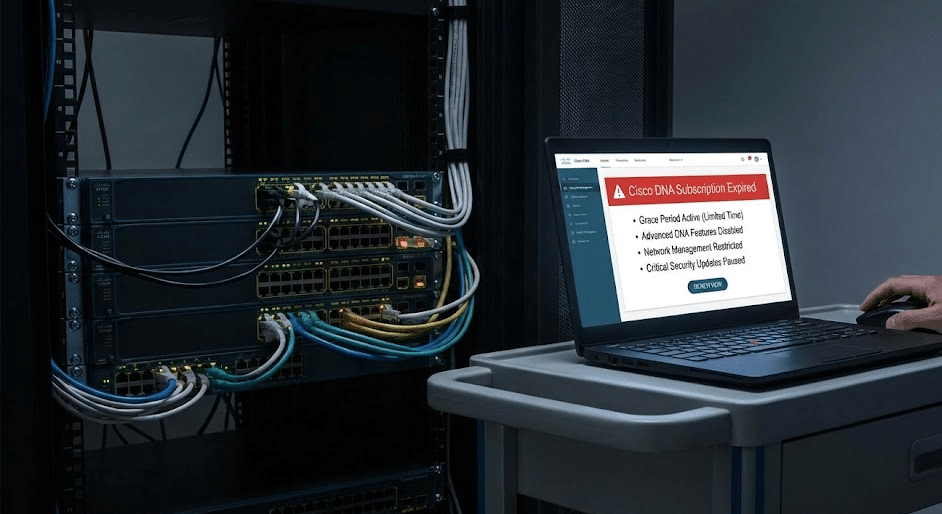
What Happens When the License Expires? Does Performance Change Then?
This question overlaps with renewal and lifecycle planning, and it matters because buyers often assume expiration must reduce performance.
Why the Switch Usually Keeps Forwarding Traffic
In many Catalyst environments, the switch continues basic operation after license expiration. That is why so many teams say, “The switch still works.”
And in a narrow sense, that is true.
What Changes After Expiration
What usually changes is not raw throughput. What changes is the subscription-linked layer:
- management experience
- advanced features
- automation workflows
- analytics value
- software lifecycle path
So the switch may not slow down, but the environment can still lose important capability.
Why This Matters
This is one of the most common mistakes in license planning. Teams focus on whether traffic still passes and ignore whether the operating model still works the way they expect.
That is why expiration is not just a “does the switch still work” question. It is also an operations and lifecycle question.
Procurement Reality: If Licensing Does Not Change Speed, What Are You Actually Paying For?
This is the most important commercial question in the whole topic.
If the license does not increase throughput, why spend more?
When the Lower Tier Is Usually Enough
The lower tier is often enough when:
- the project only needs the hardware performance and a lighter software scope
- the environment is simpler
- the team does not need the broader feature set
- the business is cost-sensitive and clear on actual requirements
When the Higher Tier Is Worth It Anyway
The higher tier is worth it when:
- the project needs the software capabilities
- the operations team will actually use the added value
- the architecture roadmap depends on those features
- the business wants to avoid future design limits
Questions Buyers Should Ask Before Approving the Quote
Before signing off on a quote, ask:
- Do we need more hardware performance or just more software features?
- Is the hardware model already correct for throughput, PoE, uplinks, and stack needs?
- Are we paying for a higher software tier because the project needs it, or because the name sounds safer?
- Are we solving a hardware problem with a software purchase?
Those questions save money far more often than buyers expect.
The Most Common Mistakes People Make About Cisco Licensing and Performance
Assuming a Higher License Tier Means Higher Throughput
It usually does not.
Confusing Software Capability with Hardware Performance
This is the root mistake behind many bad purchasing decisions.
Choosing the License Tier Before Choosing the Right Hardware Platform
This is backward. Hardware sizing comes first.
Ignoring PoE, Stacking, and Uplink Limits While Focusing on License Names
A switch can have the “right” license and still be the wrong switch.
Thinking License Expiration Automatically Slows the Switch Down
Expiration may change operations and features, but it does not normally reduce the box’s raw forwarding capacity.
FAQ
Does Cisco licensing affect switch performance?
Not normally in the sense buyers usually mean. It does not usually increase raw forwarding rate, switching capacity, PoE budget, or uplink speed.
Does Network Advantage make a switch faster than Network Essentials?
No, not on the same hardware platform. It changes software tier, not hardware speed.
Does Cisco DNA increase throughput or switching capacity?
No. Cisco DNA adds software and operational value, not raw hardware performance.
Can a Cisco license affect PoE budget or stacking bandwidth?
Those are normally hardware-defined limits, not software-tier limits.a
Does a switch slow down when the license expires?
Usually not in terms of raw forwarding. What changes is the subscription-linked feature and operational layer.
What should I check first: hardware model or license tier?
Start with the hardware model. Make sure the box fits the performance requirements first, then choose the software level that fits the project.
Final Recommendation
If your concern is raw throughput, switching capacity, PoE budget, uplink speed, or stacking bandwidth, start with the hardware model.
If your concern is software features, automation, analytics, visibility, or lifecycle planning, then review the license tier.
Do not buy a higher license because you assume it will make the switch faster. Buy the right hardware first, then buy the right software level for the project around it.
That is the simplest way to avoid one of the most common Cisco switch buying mistakes.

Layer23-Switch is a global Cisco supplier helping B2B buyers compare Cisco hardware models, software tiers, and licensing decisions before placing the wrong order.