Cisco Unsupported Transceiver Error: Causes, Fixes, and Compatibility
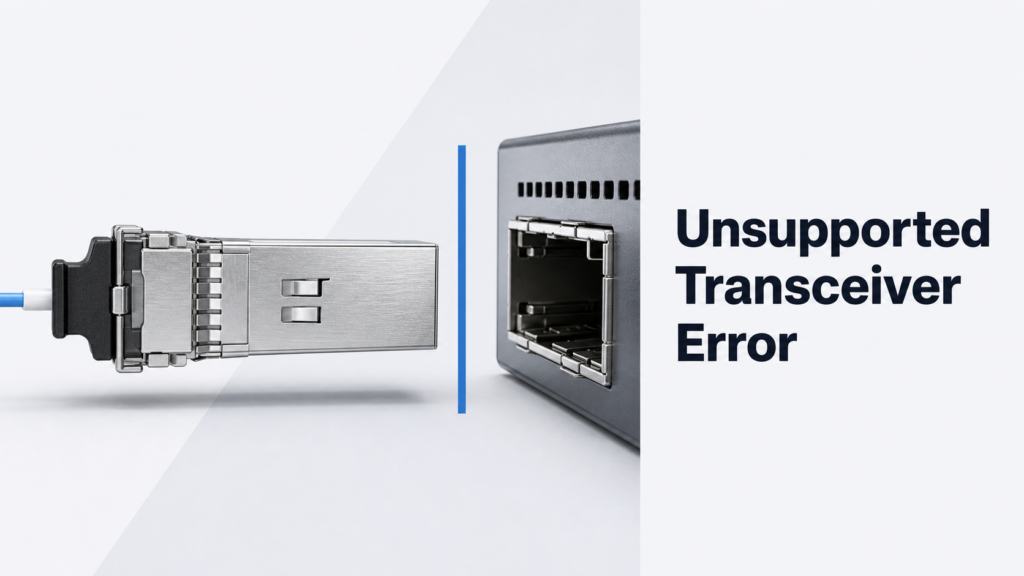
A Cisco unsupported transceiver error means the switch has read the identity programmed into an SFP module and refused to bring it into service, usually putting the port into an err-disabled state. On a Catalyst switch the two log lines look like this, verbatim from Cisco’s troubleshooting documentation:
%PLATFORM_PM-6-MODULE_ERRDISABLE: The inserted SFP module with interface name GiX/Y/Z is not supported
%PM-4-ERR_DISABLE: gbic-invalid error detected on GiX/Y/Z, putting GiX/Y/Z in err-disable state
The usual trigger is a third-party module, but not always: Cisco has published bug IDs where a genuine GLC-SX-MMD lands in the same state.
What Does a Cisco Unsupported Transceiver Error Mean?
The error is an identity check, not a physics check. Every SFP carries an EEPROM that identifies its vendor and part number; when the module is inserted, the switch reads that identity and compares it against what the platform recognizes as supported. A module that fails the check is rejected before the link is ever attempted.
A rejected module is often electrically fine, and an accepted module can still fail to bring a link up. The two cases have different fixes, so start the diagnosis from the symptom.
Common PLATFORM_PM, PHY-4, and SFP_NOT_SUPPORTED Messages
On the Catalyst 3850, Cisco documents the pair exactly as logged: a %PLATFORM_PM-6-MODULE_ERRDISABLE notice naming the interface, followed by %PM-4-ERR_DISABLE marking the gbic-invalid cause and err-disabling the port. Exact facility names vary by platform and software release; other Catalyst and IOS XE platforms log unsupported-transceiver variants under facilities such as PHY and SFP. The constant worth searching your logs for is the cause name gbic-invalid, which is also the keyword the recovery commands use.
Diagnose a Cisco Unsupported Transceiver Error by Symptom
Three different situations get reported as “unsupported transceiver,” and each has a different fix. Identify yours before touching the configuration:
| Symptom | What the switch is telling you | Where the fix lives |
|---|---|---|
| Module rejected, port err-disabled | Identity check failed (gbic-invalid) | Compatibility check, then the platform commands |
| Module not detected at all | The switch cannot read the module | Physical seating, or a dead/misprogrammed module |
| Module detected, link stays down | Identity accepted; the link layer is failing | Speed, fiber, wavelength, or remote-end mismatch |
Triage summary based on the failure modes in Cisco’s Catalyst 3850 unsupported-transceiver TechNote and standard interface troubleshooting.
The SFP Is Rejected or Err-Disabled
This is the true unsupported-transceiver case: the log shows the gbic-invalid pair, and show interfaces status lists the port as err-disabled. The switch read the module and refused it. From here, verify what was actually read, check it against the compatibility matrix, and then decide between a supported replacement and the override commands.
The SFP Is Not Detected
If show interface transceiver returns nothing for the port and show inventory does not list the module, the switch never read an identity at all. Reseat the module firmly, try a known-good port, and try a known-good module in the same port. A module that no switch can read is dead or blank; a port that reads no module is a hardware case.
The SFP Is Detected but the Link Stays Down
If the module shows up cleanly in show interface transceiver with no error logged, the support check already passed. The problem is at the link layer: a speed or mode mismatch, a fiber or wavelength mismatch, or a fault at the remote end. The override command fixes none of these.
Verify the Installed SFP Against Cisco Compatibility
Before changing any configuration, establish three facts: the platform and software release, what the switch actually read from the module, and whether Cisco lists that module for this platform.
- Identify the platform and software release with
show versionfor the model and release, andshow inventoryfor the module and network-module PIDs. Compatibility is decided per platform and per release, so both matter. - Read the module’s programmed identity:
show interface transceiver detail
show idprom interface GigabitEthernet1/1/1
The output shows the vendor name and part number the switch sees, which on a mislabeled or recoded module is not always what the sticker says.
- Check the module against Cisco’s Optics-to-Device Compatibility Matrix at tmgmatrix.cisco.com, filtered to your exact device PID. The matrix lists each optic’s minimum software release; a listed module still fails on a release older than its floor. Cisco’s own 3850 TechNote makes this the first step before any command or hardware conclusion.
Cisco Unsupported Transceiver Commands by Platform
Cisco documents the override in writing for exactly one platform, and its effect is narrow: it tells the switch to skip the identity check. It does not change what the module can do, and it does not restore TAC coverage that the support policy excludes.
Catalyst 3850 Command Sequence
For the Catalyst 3850, Cisco’s TechNote (document 200296, recertified March 2026) gives the sequence explicitly:
3850(config)# no errdisable detect cause gbic-invalid
3850(config)# service unsupported-transceiver
Then perform the physical reset the same document prescribes: shutdown / no shutdown on the port, remove the SFP, and reinsert it. The first command stops gbic-invalid from err-disabling the port; the second tells the platform to tolerate transceivers it does not recognize. If the module still misbehaves afterward, the TechNote points at known software defects, Cisco bug IDs CSCut94443 (a genuine GLC-SX-MMD not recognized after insertion) and CSCuj31712 (certain vendor SFPs forcing err-disable), and recommends moving to the current recommended software release.
Catalyst 9200 and 9300 Command Considerations
On the Catalyst 9200 and 9300, the same command is widely reported to be accepted but hidden: it does not appear in CLI help or tab-completion, and Cisco’s published guidance for the sequence covers only the Catalyst 3850. Treat it as undocumented behavior; no Cisco document defines what it does on these platforms from release to release. Type the command in full if you use it, verify the result on the port, and do not design a production link around it. The documented path on these platforms is the compatibility matrix and a listed optic.
Why Catalyst Commands Should Not Be Copied to Nexus
NX-OS is a different operating system, and Cisco publishes no equivalent unsupported-transceiver procedure for Nexus platforms. Community lab reports describe hidden-command behavior on some Nexus models (including cases where a change only took effect after a full switch reload), but none of that is documented or consistent across releases. On Nexus, the working procedure is the one Cisco supports everywhere: check the exact device PID in the optics matrix and install a listed module.
Why service unsupported-transceiver May Not Fix the Link
The override only skips the support check. The port speed, the optics, the fiber plant, and the far end all still have to be right, and the most common follow-up problem is a port that stops erroring but never comes up.
Port Speed and Mode Mismatches
A dual-rate or slow optic in a port configured for the wrong speed stays down regardless of the check. Set the port speed to match the module explicitly; on several Cisco platforms auto-negotiation is not supported at 10G, so both ends need the speed pinned. Sweep duplex settings and any media-type command left over from a previous module at the same time.
Fiber, Wavelength, and Remote-End Mismatches
An accepted module over the wrong plant is still a dead link: an SR (multimode) optic on single-mode fiber, an LR optic expected to light 40 km, a BiDi pair where the -D and -U modules do not face each other, or simply a dirty connector. Check the remote end as well. The link needs matching optics, matching fiber, and a healthy port on both sides, and only one of those six things is on the switch you are logged into.
Software and Hardware Compatibility Issues
Every optic in Cisco’s matrix carries a minimum software release, and a module newer than your release fails regardless of vendor. The reverse happens too: the two 3850 bug IDs are cases where fully supported modules err-disabled on affected releases until the software was upgraded. When an accepted module behaves erratically (detected on one insertion, missing on the next), check the release against the matrix floor and the platform’s open caveats before condemning the hardware.
Recover a gbic-invalid Err-Disabled Port
Fix the cause first, then clear the state. An err-disabled port re-enabled with the original fault still present goes straight back down.
- Capture the evidence before clearing anything:
show interfaces status err-disabled
show logging | include gbic|SFP|TRANSCEIVER
show interface transceiver detail
- Fix the underlying cause: install a supported module, apply the override commands where you have decided to use them, or correct the seating.
- Clear the err-disable state with a port flap, per the 3850 TechNote:
shutdown, thenno shutdown, then remove and reinsert the SFP. No reload is required. - Optionally enable auto-recovery so a future event does not strand the port until someone logs in:
errdisable recovery cause gbic-invalid, verified withshow errdisable recovery. Auto-recovery re-enables the port on a timer. It does not fix the cause, and an unresolved fault produces a port that flaps in and out of err-disable.
Check the interface name against the log line before entering shutdown.
Cisco Support for Third-Party SFP Modules
Cisco’s position is written down, and it has two halves. The Non-Entitlement Policy (version 2.0) states that when a reported fault can be traced to the use of third-party components, Cisco may, at its discretion, withhold support under warranty or a support program, and reserves the right to charge for services when the root cause turns out to be a third-party product. The same clause states the other half: if Cisco concludes the fault is not attributable to the third-party component, support for the affected product continues.
Operational Compatibility vs Official Support
The override buys operational compatibility only. A third-party optic that links up and passes traffic still sits outside the compatibility matrix, and any fault traced to it sits outside Cisco’s support obligation. That trade can be acceptable in a lab or on a non-critical link. On a production port with a support contract, replacement is usually the cheaper decision.
Evidence to Collect Before Contacting Cisco TAC
If a port with a third-party module has a problem you need TAC for, reproduce it with a Cisco-listed module first. Collect show tech-support, the show interface transceiver detail output for both modules, and the log excerpts. A case that demonstrates the fault with a listed optic in the port keeps the conversation on the actual problem.
When to Replace the SFP Instead of Forcing It
The override has a narrow best-fit: lab gear, temporary links, and equipment already outside support. Replace the module instead when the port carries production traffic, when the device has an active support contract you may need, when the link still fails after the override, or when you cannot confirm what the module actually is.
Replace, Recode, or Continue Troubleshooting
- Replace with a Cisco-listed module when uptime and supportability matter; the cost difference rarely survives one outage postmortem.
- Recoding (third-party vendors reprogramming a module’s EEPROM to present a Cisco identity) makes the check pass, but the module remains a third-party component under the support policy, with its provenance now harder to see. Know exactly what is in the port either way.
- Continue troubleshooting when the module is already listed for the platform: at that point the problem is seating, software release, or a known defect.
Compatibility Checklist Before Ordering
- Exact device PID confirmed in the optics matrix; family-level results miss model differences
- Optic PID listed for that device, with its minimum software release at or below your running release
- Speed, reach, fiber type, and connector matched to the plant and to the remote end
- Module sourced from an authorized channel, so the check and the support policy both stay clean
Layer23-Switch stocks brand-new original Cisco optics with a 3-year warranty and RMA support, from the GLC-TE and SFP-10G-SR-S to the full Cisco optical module range.
Frequently Asked Questions
Can a Genuine Cisco SFP Show as Unsupported?
It can. Cisco’s own 3850 TechNote cites bug CSCut94443, where a GLC-SX-MMD straight from Cisco is not recognized after insertion; an optic newer than the running software release also fails the check until the software is upgraded. Reseat the module, verify it in the matrix, and check your release against the optic’s minimum before assuming a counterfeit.
Why Does the Command Not Appear in CLI Help?
service unsupported-transceiver is a hidden command: the parser accepts it, but it is not published in CLI help or tab-completion, and Cisco documents it only in specific TechNotes. Type it in full. The absence from help marks the command as outside the supported configuration surface.
Can gbic-invalid Be Cleared Without Reloading?
No reload is needed on Catalyst platforms. The documented recovery is a port flap (shutdown, then no shutdown) plus reseating the module, and errdisable recovery cause gbic-invalid adds timed auto-recovery for future events.
Does the Command Persist in the Running Config After Reload?
It is a global configuration command, so it follows the normal rule: it survives a reload only if you save it to the startup configuration. If the override seems to have worn off after maintenance, check whether the config was ever written.
Do Cisco-Branded Optics from Unauthorized Sellers Trigger This Error?
A genuine module passes the check regardless of seller, because the switch reads the EEPROM, not the invoice. The seller risk is different: a counterfeit sold as genuine may or may not pass, and under Cisco’s Non-Entitlement Policy any product determined to be non-genuine has its warranty and service support voided outright. Buying through an authorized or certified channel keeps both the port and the support entitlement clean.
Layer23-Switch is a Cisco certified partner. If an unsupported-transceiver error has turned into a replacement decision, request a quote with your switch model and port plan; we can confirm the exact listed optic, its minimum software release, and current stock before you order.