Link Aggregation: Static vs Dynamic, LACP, and MLAG Configuration
In modern enterprise networks, link aggregation has become one of the most effective ways to increase bandwidth, improve redundancy, and enhance overall network performance.
By combining multiple physical links into one logical connection, link aggregation ensures that traffic continues to flow even when individual links fail.
This article provides a comprehensive explanation of link aggregation — covering LACP, static vs dynamic link aggregation, and MLAG (Link Aggregation Plus) — along with real configuration examples from Cisco and Huawei switches.
What Is Link Aggregation?
Link Aggregation is a technology defined in IEEE 802.3ad (now IEEE 802.1AX) that allows multiple Ethernet interfaces to operate as a single logical link.
It enhances bandwidth, provides fault tolerance, and allows load balancing between connected devices.
Key benefits of link aggregation:
- Higher bandwidth: Combine multiple physical interfaces into one logical connection (e.g., 4×1G links = 4Gbps total throughput).
- Redundancy: If one link fails, traffic is automatically switched to the remaining links.
- Load balancing: Distribute traffic evenly across aggregated ports to prevent congestion.
- Simplified management: Treated as a single interface in network configuration and monitoring.
How Link Aggregation Works
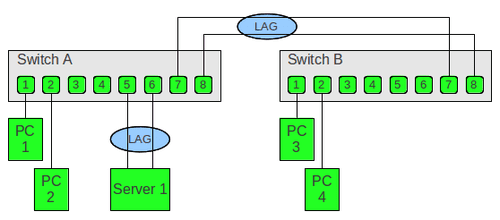
When devices such as switches or routers support LACP (Link Aggregation Control Protocol), they can automatically negotiate which physical interfaces participate in an aggregation group.
The process typically involves:
- Multiple physical Ethernet ports are bundled into a logical interface (called Port-Channel on Cisco or Eth-Trunk on Huawei).
- LACP Data Units (LACPDU) are exchanged between devices to verify compatibility and link status.
- Traffic is distributed according to algorithms such as source/destination MAC or IP address.
- If one link fails, the remaining links handle the traffic seamlessly.
Static vs Dynamic Link Aggregation
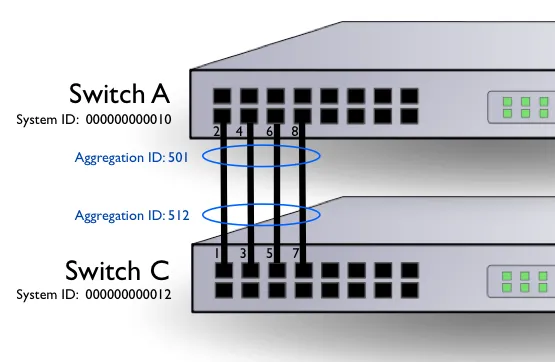
Link aggregation operates in two main modes — Static Link Aggregation and Dynamic Link Aggregation (LACP).
Although both serve the same purpose, they differ in terms of configuration method, fault recovery, and flexibility.
Static Link Aggregation
Static link aggregation is manually configured and does not rely on any negotiation protocol.
Each side of the connection must be manually configured to include the same physical ports.
Advantages:
- Simple configuration, ideal for small and stable networks.
- No control traffic overhead (no LACPDU).
- Works even if the peer device doesn’t support LACP.
Disadvantages:
- No automatic link detection or recovery.
- Any mismatch in configuration can cause a link failure.
- Difficult to scale or modify dynamically.
Use case example:
Small office or LAN environments where topology changes are rare.
? Read more: Dynamic vs Static Link Aggregation – Key Differences and Use Cases
What is LACP ?
Dynamic link aggregation uses the Link Aggregation Control Protocol (LACP) to automatically negotiate and manage link membership.
It is more flexible, adaptive, and resilient compared to static aggregation.
Advantages:
- Automatically detects and activates links.
- Simplifies fault recovery and topology changes.
- Reduces configuration errors.
Disadvantages:
- Slightly more complex configuration.
- LACP negotiation adds minimal control traffic overhead.
Best suited for:
Large enterprise networks, data centers, or multi-switch environments requiring redundancy and flexibility.
What is MLAG?
MLAG (Multi-Chassis Link Aggregation), also known as Link Aggregation Plus, is an advanced version of link aggregation that allows aggregation across two physical switches instead of one.
This eliminates the single point of failure present in traditional LAG setups.
Key Characteristics
- Cross-switch redundancy: Two switches act as one logical system to connected devices.
- Active-active forwarding: Both devices forward traffic simultaneously, maximizing efficiency.
- STP-free topology: No blocked links, better utilization of available bandwidth.
Advantages of MLAG:
- Enhanced redundancy and fault tolerance.
- Simplified high-availability design for critical networks.
- Seamless link recovery and faster convergence compared to traditional STP-based topologies.
? Explore more: MLAG High Availability – Link Aggregation Plus Explained
Link Aggregation Configuration Examples
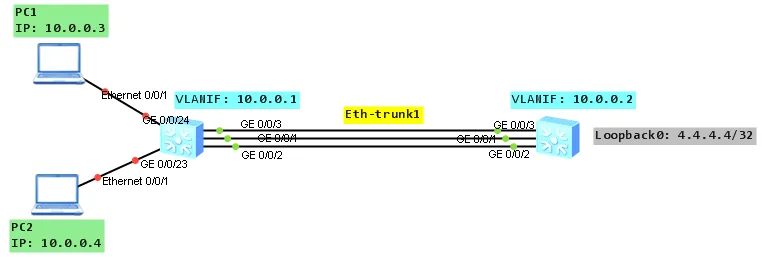
Below are sample configurations for both Cisco and Huawei devices that implement LACP-based link aggregation.
Cisco Switch Configuration (EtherChannel / LACP)
Switch# configure terminal
Switch(config)# interface range gigabitEthernet0/1 - 2
Switch(config-if-range)# channel-group 1 mode active
Switch(config-if-range)# exit
Switch(config)# interface port-channel 1
Switch(config-if)# switchport trunk encapsulation dot1q
Switch(config-if)# switchport mode trunk
Switch(config)# end
Switch# show etherchannel summary
Explanation:
channel-group 1 mode activeenables LACP dynamic mode.- Both interfaces Gi0/1 and Gi0/2 are grouped into Port-Channel 1.
- The link now provides combined throughput and redundancy.
Huawei Switch Configuration (Eth-Trunk / LACP)
<HUAWEI> system-view
[HUAWEI] interface eth-trunk 1
[HUAWEI-Eth-Trunk1] mode lacp-static
[HUAWEI-Eth-Trunk1] trunkport gigabitethernet 0/0/1 to 0/0/3
[HUAWEI-Eth-Trunk1] quit
[HUAWEI] display eth-trunk 1
Load Balancing Algorithms in Link Aggregation
Traffic distribution within a link aggregation group is determined by hash algorithms, which decide which link each packet uses.
Common load-balancing methods include:
- Source MAC / Destination MAC
- Source IP / Destination IP
- Source and Destination TCP/UDP Ports
Selecting the right algorithm ensures even traffic distribution and minimizes bottlenecks.
Cisco and Huawei devices allow flexible hash-based load balancing depending on traffic patterns.
Link Aggregation Best Practices
To ensure optimal network stability and performance when deploying link aggregation:
- Maintain consistency — All ports must have the same speed, duplex, and VLAN settings.
- Use LACP Active/Passive modes properly — Avoid mismatched configurations.
- Monitor regularly — Check interface status and link utilization.
- Avoid mixing vendors unless necessary — Always test interoperability.
- Combine MLAG for maximum uptime — When designing mission-critical networks.
Use Cases in Enterprise Networks
- Data Centers: High-bandwidth inter-switch links and server uplinks.
- Campus Networks: Aggregated uplinks between access and core layers.
- Industrial Networks: Redundancy in automation and control systems.
- SMBs: Cost-effective performance improvement without upgrading switches.
Conclusion
Link Aggregation is essential for creating resilient, high-performance networks.
While static aggregation is sufficient for small-scale networks, LACP-based dynamic aggregation offers greater flexibility and fault tolerance.
For maximum reliability, MLAG (Link Aggregation Plus) delivers switch-level redundancy and active-active forwarding — a must-have for modern data centers and large enterprise infrastructures.
By understanding and properly deploying link aggregation, network administrators can ensure smooth, stable, and high-capacity data transmission across their entire infrastructure.