Cisco Switch PoE Not Working: A Step-by-Step Troubleshooting Guide
If your Cisco switch PoE is not working, the most common causes are an exhausted PoE power budget, a disabled inline power configuration, physical cable faults, incompatible powered devices (PD), or a crashed PoE controller. To isolate the problem fast, log into the Catalyst switch and run
show power inlineandshow interface statusto determine if the issue is a simple configuration error, a depleted power supply, or a hardware fault.
What “Cisco Switch PoE Not Working” Actually Means
Before you start typing commands, you must define the scope of the failure. Power over Ethernet (PoE) issues on Cisco Catalyst switches generally manifest in one of three ways:
- No PoE on only one port: The rest of the switch provides power normally. This usually points to a physical cable issue, a dead Powered Device (PD), or a port that has been administratively shut down or placed in an err-disabled state.
- No PoE on a group of ports: A consecutive block of ports (e.g., ports 1 through 12) fails to provide power. This often indicates a hardware failure in a specific PoE microcontroller inside the switch chassis.
- No PoE on all ports: The switch passes data but provides absolutely no power. This typically points to a total PoE budget exhaustion, a failed PoE section within the power supply unit (PSU), or an IOS software crash requiring a cold reload.

First Checks Before You Touch the CLI
Field engineers know that physical layer isolation saves hours of unnecessary software troubleshooting. Perform these checks first:
- Verify the powered device works elsewhere: Plug the IP phone, access point, or camera into a known-good PoE port. If it powers up, the device itself is fine.
- Test the cable path: Bypass long cable runs and patch panels. Use a short, known-good patch cable to connect the PD directly to the switch port.
- Check the hardware LED status: On Cisco Catalyst switches like the 9300 series, the PoE LED indicates the status of the port. If it is off, power is not being provided; if it is flashing amber, there is a PoE fault.
- Check whether the data link works without PoE: Plug a non-PoE device (like a laptop) into the suspect port. If the data link fails to establish, the port hardware itself may be damaged, meaning the issue is not exclusively related to PoE.
Core CLI Commands to Diagnose Cisco PoE Failures
When physical checks are inconclusive, these are the essential commands to diagnose Catalyst PoE failures:
show power inline– Displays the overall PoE status, including the allocated, used, and remaining power budget for the entire switch.show power inline detail– Provides granular information on PD detection, device IEEE classification, and specific power assignments for a single interface.show interface status– Reveals if the port is in anerr-disabled,down, oradmin downstate.show logging– Essential for identifying PoE controller errors, power supply alarms, or hardware-related syslog messages (likeImaxfaults).show environment all– Checks the health and status of the switch’s power supplies and internal thermal sensors.
| Symptom | Likely Cause | First Command |
|---|---|---|
| One port no power | config / cable / PD | show power inline |
| All ports no power | PSU / controller / budget | show environment all |
| Data works, no power | PoE controller / policy | show power inline detail |
Troubleshooting PoE Not Working on One Port
If only a single port is failing to deliver power, follow these specific steps:
- Check for “power inline never”: A previous engineer may have manually disabled PoE on that specific interface. Use
show run interface [type/number]to verify. To re-enable it, applypower inline autoin interface configuration mode. - Check admin / err-disable state: If a port triggers a security violation (like port-security) or detects a short circuit on the copper wire, Cisco IOS will place it in an err-disabled state, cutting off both data and power.
- Check cable quality and run length: Standard PoE degrades over long distances or poor-quality copper. Ensure the total run length is well under 100 meters and the cable meets Cat5e/Cat6 standards.
Troubleshooting PoE Not Working on All or Multiple Ports
When large sections of the switch or the entire chassis lose power, the problem is systemic.
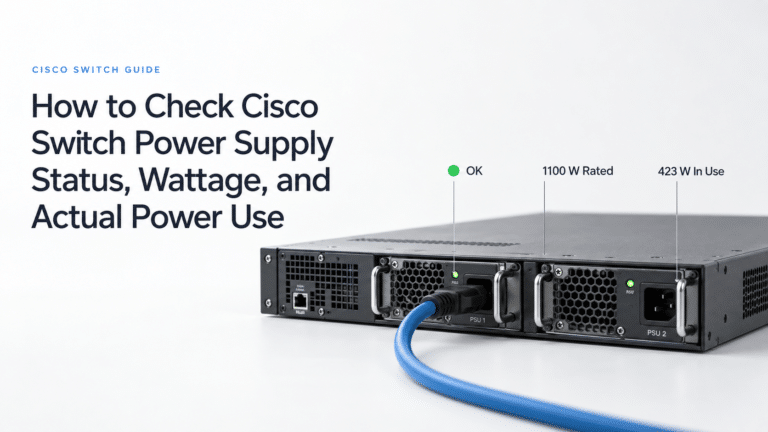
- Check the total PoE budget: A switch’s PoE capacity depends entirely on its installed power supply. For example, a switch might have a 715W or 1100W power supply. If you plug in too many high-draw access points or PTZ cameras, the switch will exhaust its available budget and deny power to any newly connected devices.
- Inspect power supply PoE status: A power supply can fail partially. It may provide enough wattage to run the switch’s mainboard (passing data) but fail to provide the 54V required for the PoE circuit.
- Identify consecutive failed ports: If exactly 8 or 12 ports in a row are dead, a specific internal PoE microcontroller has likely failed and the switch may require an RMA.
Identify consecutive failed ports: If exactly 8 or 12 ports in a row are dead, a specific internal PoE microcontroller has likely failed and the switch may require an RMA. If the hardware has reached the end of its lifecycle, you can explore our complete inventory of reliable, high-capacity Cisco networking equipment to find a suitable replacement with a larger PoE budget.
Why Non-Cisco Powered Devices Fail on Cisco Switches
Connecting third-party IP cameras, IoT sensors, or non-Cisco phones to Catalyst switches can sometimes cause unexpected PoE failures.
- CDP vs. LLDP Negotiation: Cisco devices heavily rely on Cisco Discovery Protocol (CDP) to negotiate exact power requirements. Non-Cisco devices rely on Link Layer Discovery Protocol (LLDP). If
lldp runis disabled globally or on the port, the switch and the device may fail to negotiate higher power levels (like PoE+ 30W), causing the device to constantly boot loop. - Inrush current: Some third-party devices draw a massive spike of power the millisecond they are connected. If this spike exceeds the port’s safety threshold, the Cisco switch will instantly cut power to protect itself (registering an
Imaxerror in the logs).
Software Bugs, Uptime, and Hidden PoE Failure Patterns
Sometimes, the configuration is perfect, the cables are new, and the hardware is fine, but PoE still drops.
- Long uptime and old code trains: Memory leaks or stalled processes in older Cisco IOS-XE versions can cause the internal PoE controller to stop responding.
- Why cold reboots restore PoE: If a software bug has locked the PoE controller, a simple
reloadcommand via SSH might not fix it. A cold power cycle (physically unplugging the power cables, waiting 30 seconds, and plugging them back in) forces the hardware PoE controllers to completely re-initialize.
PoE Not Working After a Reboot or IOS Upgrade
If PoE was working perfectly before an IOS-XE upgrade or a scheduled maintenance reload, investigate these areas:
- Configuration persistence: Ensure no configurations were lost during the reload.
- Microcode updates: Sometimes, an IOS-XE upgrade also pushes a microcode firmware update to the internal PoE controllers. If this process is interrupted, PoE functionality can fail. Check the logs for failed firmware updates.
- Known software issues: Check the Cisco Release Notes for your specific IOS-XE version, searching for known bugs related to “inline power” or “PoE controller.”
Decision Tree: Isolate the Root Cause Fast
Use this mental flowchart to isolate the issue in minutes:
- Is it one port or many ports?
- One port: Focus on the PD, the patch cable, and the specific interface configuration (
power inline auto). - Many/All ports: Focus on the
show power inlinebudget and theshow environment allpower supply status.
- One port: Focus on the PD, the patch cable, and the specific interface configuration (
- Does data work but power fails, or do both fail?
- Data works, no power: PoE controller issue, exhausted budget, or
power inline neverconfigured. - No data, no power: Port is physically damaged, administratively shut down, or err-disabled.
- Data works, no power: PoE controller issue, exhausted budget, or
- Is the PoE budget available or exhausted?
- If available: Check PD compatibility and ensure LLDP is enabled.
- If exhausted: Upgrade the power supply or remove non-critical PoE devices.
CLI Runbook: Commands in Exact Order
Copy and paste this runbook for your next troubleshooting session. Execute these commands in this exact sequence:
show interface status(Check if the port is connected, admin down, or err-disabled)show power inline(Check total switch budget and overall port power states)show power inline detail [interface](Look for exact IEEE class detection and applied faults)show logging | include inline(Filter syslogs specifically for PoE hardware errors)show environment all(Verify the power supply has not suffered a partial failure)show run interface [interface](Ensurepower inline neveris not configured)
Common Mistakes That Cause Cisco PoE to Fail
Avoid these frequent engineering pitfalls:
- Assuming the PoE budget is fine: Just because a switch has 48 ports doesn’t mean it has the power supply wattage to drive 48 high-draw UPOE+ (90W) devices simultaneously.
- Ignoring cable length: Ethernet data can travel 100 meters, but high-wattage PoE degrades over distance, especially on older, thin Cat5 cables.
- Treating every failure as a hardware issue: Always check logs and LLDP negotiation before assuming a switch port is physically dead.
People Also Ask (FAQ)
Why is my Cisco switch PoE not working?
The most common reasons are exhausted power supply budgets, disabled inline power configurations, faulty Ethernet cables, incompatible devices, or ports placed in an err-disabled state due to a short circuit.
How do I check PoE status on a Cisco switch?
Log into the switch via SSH or console and run the command show power inline. This will display the power budget of the entire switch and the individual power allocation status of every port.
Why does PoE work on some ports but not others?
This usually occurs when the switch has reached its maximum PoE power budget. Once the budget is exhausted, any newly connected devices will be denied power, even though devices on other ports continue to work normally.
Can a Cisco PoE port pass data but still fail to provide power?
Yes. If the PoE budget is exhausted, or if the internal PoE controller fails while the main switching ASIC remains healthy, a port can successfully pass standard network data without providing inline power.
Conclusion
Troubleshooting Cisco switch PoE issues does not have to be a blind guessing game. By diagnosing the scope of the symptom first (single port vs. switch-wide), using CLI commands in a structured order, and understanding the difference between budget limits, physical cabling, and hardware faults, you can resolve outages quickly.