How to Fix CVE-2026-20127 Error: Cisco SD-WAN vManage Authentication Bypass Zero-Day?
Emergency Alert: The global enterprise networking community is currently facing a critical security crisis. A maximum severity zero-day vulnerability, officially tracked as CVE-2026-20127 (CVSS Score: 10.0), has been discovered affecting the Cisco SD-WAN infrastructure. Because this vulnerability allows remote, unauthenticated attackers to completely compromise the system with zero user interaction, the Cybersecurity and Infrastructure Security Agency (CISA) has issued an emergency directive (ED 25-03) mandating immediate remediation.
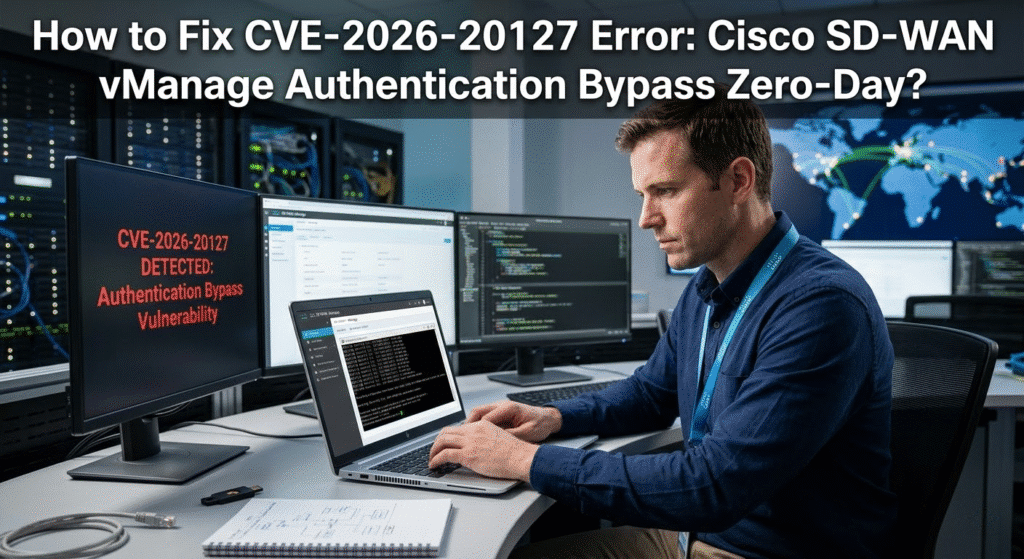
If you are an IT administrator or network architect, understanding this Cisco SD-WAN vulnerability and knowing exactly how to fix the CVE-2026-20127 error is crucial to preventing catastrophic network breaches.
1. Phenomenon & Logs: Is Your Cisco SD-WAN Controller Hacked?
Before taking systems offline, administrators must determine if their infrastructure has already been compromised. The most insidious aspect of the CVE-2026-20127 exploit is its stealth. However, if your Cisco SD-WAN controller hacked not working issues are surfacing, you should immediately inspect your vManage audit logs for the following Indicators of Compromise (IoCs):
- Anomalous Firmware Downgrade/Upgrade Cycles: Look for unexplained software downgrades initiated by unknown users, immediately followed by rapid upgrades back to the current version.
- Unauthorized High-Privilege Authentication Attempts: Check for access logs showing successful logins from unrecognized internal IP addresses bypassing standard RBAC (Role-Based Access Control) policies.
- Concurrent Exploitations: Monitor for signs of related vulnerabilities (such as CVE-2026-20122 and CVE-2026-20126) which are often chained together by attackers to force arbitrary file overwrites and trigger memory allocation errors.
2. Affected Systems & Devices
To prevent misdiagnosis, it is vital to know exactly which components of the Cisco Catalyst SD-WAN architecture are in the crosshairs. This zero-day does not affect edge routers directly; instead, it targets the central nervous system of your network.
The vulnerability specifically impacts:
- Cisco Catalyst SD-WAN Manager (vManage): The centralized management plane.
- Cisco Catalyst SD-WAN Controller (vSmart): The centralized control plane.
Note: Various recent firmware releases are vulnerable. Always consult the official Cisco Security Advisory for the daily-updated list of affected build numbers.
3. Root Cause Analysis: The Anatomy of the Attack
Why is this Catalyst SD-WAN Controller zero-day so devastating? The root cause lies in a fundamental flaw within the initial cryptographic handshake sequence of the peering authentication mechanism.
Due to insufficient input validation and a lack of strict state-machine enforcement, an attacker can completely bypass the vManage authentication bypass protections. Threat intelligence indicates that an advanced persistent threat (APT) group known as UAT-8616 has weaponized this flaw using a sophisticated “Software Version Downgrade” attack chain:
- Initial Access: The attacker bypasses authentication to gain non-root access to the controller.
- Forced Downgrade: They force the system to roll back to an older, obsolete firmware version that contains known historical vulnerabilities.
- Privilege Escalation: Once running the older software, the attacker exploits a legacy flaw (CVE-2022-20775) to achieve absolute root access to the underlying operating system.
- Covering Tracks: Finally, they upgrade the firmware back to the latest version to wipe standard IoCs, leaving backdoor access intact.
4. Emergency Protocol: How to Fix CVE-2026-20127 Error
When dealing with a CVSS 10.0 vulnerability, hesitation leads to compromise. Network administrators must strictly follow these remediation steps.
Critical Warning: There is absolutely NO WORKAROUND. Do not rely on Access Control Lists (ACLs) or temporary configuration tweaks. Cisco has explicitly stated that no mitigation exists other than applying the patched software.
The Solution: Emergency Firmware Upgrade The only effective way to neutralize this threat is to execute an emergency firmware upgrade Cisco SD-WAN.
- Isolate your vManage and vSmart controllers from public internet exposure immediately.
- Download the latest patched firmware releases directly from the official Cisco Software Central portal.
- Schedule an emergency maintenance window and apply the patch following Cisco’s validated upgrade matrix.
- If you suspect an active compromise based on the log analysis mentioned above, you must rebuild the controllers from a known-good, offline backup rather than simply upgrading a compromised OS.
5. Conclusion & Next Steps
The discovery of CVE-2026-20127 highlights a critical blind spot in enterprise network security: the vulnerability of the management plane itself. Because attackers actively wipe their tracks by upgrading the firmware post-compromise, simply checking your current firmware version is not enough to guarantee safety. Conduct a deep forensic audit of your network environment and implement strict compliance checks immediately.
Frequently Asked Questions (FAQs)
Q1: How to stop UAT-8616 root access Cisco SD-WAN systems?
A: To stop UAT-8616 from gaining root access, you must disrupt their attack chain. Since they rely on CVE-2026-20127 for initial entry, you must perform an emergency firmware upgrade immediately. If you cannot patch immediately, you must restrict all network access to the vManage and vSmart administrative interfaces strictly to out-of-band management jump hosts.
Q2: Is there any configuration workaround for the vManage authentication bypass?
A: No. Cisco has officially confirmed that there are no temporary configuration workarounds or mitigation strategies available for this specific vulnerability. Patching the firmware is the only viable solution.
Q3: Why is my Cisco SD-WAN controller showing unauthorized downgrade logs?
A: Unauthorized downgrade logs are a primary Indicator of Compromise (IoC) for this zero-day. It highly suggests that an attacker has successfully bypassed your authentication and is attempting to roll your firmware back to a vulnerable state to execute a local privilege escalation attack.
Q4: Does CVE-2026-20127 affect Cisco Catalyst Edge Routers (cEdge)?
A: No, this specific CVE strictly targets the centralized control and management planes (vSmart controllers and vManage platforms). However, if your central controllers are compromised, attackers can seamlessly push malicious routing policies or configurations down to your cEdge devices.