Selecting Cisco Switches for AI Workloads: Fabric Design, Lossless Ethernet, and Upgrade Strategy
Selecting Cisco switches for AI workloads requires separating front-end and back-end fabrics. For training, deploy Cisco Nexus 9000 switches to build non-blocking, lossless RoCEv2 compute networks. For inference, prioritize deterministic low-latency delivery. Avoid traditional campus switches, as AI requires deep buffers and dynamic congestion controls to prevent packet loss.
Executive Summary:
Modern AI infrastructure breaks the assumptions behind traditional enterprise and even standard cloud data center switching. Training fabrics need non-blocking east-west performance and lossless behavior under synchronized bursts. Inference fabrics prioritize deterministic low latency and stable token delivery. The best Cisco switch strategy starts by separating fabric roles, then aligning Nexus platforms, congestion controls, optics, and operations to the workload rather than simply buying “the fastest switch available.”
Why AI Workloads Change Cisco Switch Selection
Traditional enterprise data centers were built around north-south traffic: users accessing applications, web services, and virtualized compute. AI workloads invert that model. Distributed training generates synchronized east-west traffic across large GPU clusters, while modern inference adds strict latency and jitter sensitivity. That means switch selection must account for flow behavior, congestion response, and fabric design discipline in a way that ordinary data center refresh projects often do not.
The practical mistake many teams make is assuming AI networking is just a larger version of existing leaf-spine design. It is not. AI fabrics fail even when aggregate bandwidth looks sufficient on paper because elephant flows, burst synchronization, and low-entropy traffic patterns create congestion behaviors that standard designs do not handle well. That is why Cisco Nexus platforms, not campus-oriented switching platforms, become the default serious option for AI back-end fabrics.
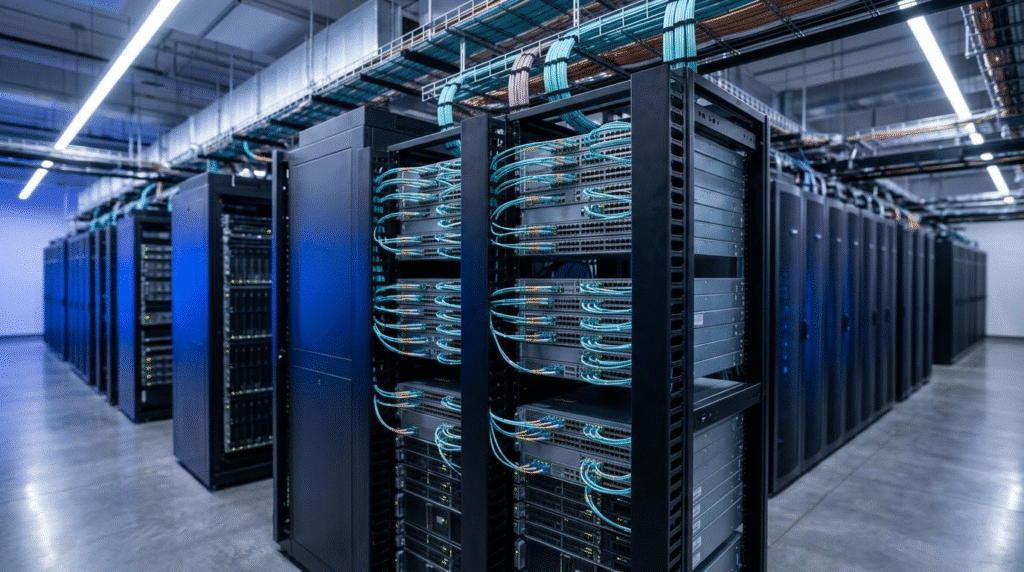
Training vs. Inference: Start With the Workload
Training fabrics are built for synchronized burst traffic
Large-model training is the harshest possible test for a switch fabric. During distributed training operations such as All-Reduce, GPUs exchange gradients and parameters at the same time, producing synchronized elephant flows at line rate. In that environment, a single lossy or congested hop slows the entire cluster and leaves extremely expensive GPU resources idle while retransmissions and recovery kick in. The switch decision is therefore about preserving cluster efficiency, not just delivering raw link speed.
For training, the network must be non-blocking, deeply buffered, and tuned for zero-packet-loss transport. Switches selected for this role need high radix, predictable latency, and congestion mechanisms that respond before a queue overflows. In practice, this pushes the design toward Cisco Nexus 9000 back-end fabrics built around 400G and increasingly 800G interfaces.
Inference fabrics are built for latency stability
Inference is different. It is often more pipeline-oriented, and the user-facing metric is not only throughput but time to first token and stability during decode. A fabric for inference still benefits from high bandwidth, but the primary design objective becomes deterministic latency with minimal jitter and tail-latency spikes. Teams that treat inference as “small training” often over-design some layers and under-design others.
What this means for Cisco switch selection
If you are building mainly for training, prioritize non-blocking back-end fabrics, deep shared buffers, and 400G/800G Nexus density. If you are building for inference, prioritize low latency, consistent congestion handling, and front-end/back-end coordination. If you are building for both, design the fabric in tiers rather than trying to force one undifferentiated network to do everything equally well.
Deconstructing the AI Data Center: Front-End, Back-End, Storage, and OOB
A strong AI network is not one fabric. It is a system of fabrics with different jobs, different traffic profiles, and different failure modes. This is where many otherwise capable network teams go wrong. They focus their entire budget and engineering attention on the GPU back-end, then discover the real bottleneck lives in storage ingestion, checkpointing, or user-facing front-end paths.
The back-end fabric
The back-end fabric is the compute network. It exists for GPU-to-GPU communication and is dominated by RoCEv2 traffic. Oversubscription is unacceptable here. The design target is non-blocking connectivity with 1:1 bandwidth ratios and predictable congestion handling. Cisco’s AI-focused back-end guidance centers on Nexus 9000 platforms delivering dense 400G and 800G connectivity for leaf and spine roles.
The front-end fabric
The front-end fabric connects the AI environment to the broader enterprise stack: APIs, orchestration, user requests, model serving, and upstream applications. This fabric must still be fast, but its job is broader and more heterogeneous than the compute network. It is where many enterprises discover that “the back-end is fine” but overall AI service quality still suffers.
The storage fabric
The storage fabric is critical because AI clusters are only productive when they are continuously fed. Data ingestion and checkpointing can create severe incast and burst conditions. If the storage side is weak, GPUs wait for data instead of computing. In practice, many organizations need to treat front-end and storage design as first-class selection criteria rather than secondary details.
The out-of-band management network
The OOB layer isolates telemetry, BMC access, and recovery functions from the high-speed data planes. It is not glamorous, but it is essential. During congestion or incident response, the management tier is what keeps the environment observable and recoverable.
Fabric Role Matrix
| Fabric Tier | Main Traffic Type | Primary Goal | Best-Fit Cisco Direction | Key Requirement |
| Back-end compute | GPU-to-GPU RoCEv2 | Maximum throughput, zero packet loss | Nexus 9000 high-radix 400G/800G | Non-blocking, lossless, deep buffers |
| Front-end | User/API/application traffic | Service access and orchestration | Nexus front-end fabric role | Stable latency and flexible L3 integration |
| Storage | Ingestion and checkpointing | Keep GPUs fed, absorb incast | Nexus converged front-end/storage role | Strong queueing and congestion visibility |
| OOB management | BMC, telemetry, admin traffic | Control and recovery | Dedicated management network | Isolation and operational resilience |
Why Lossless Ethernet Matters: RoCEv2, ECN, PFC, and PFC Watchdog
RoCEv2 is central to modern AI back-end networking because it enables GPU memory-to-memory communication over Ethernet. The problem is that RoCEv2 runs over UDP. UDP does not give the fabric the safety net of classic TCP congestion behavior. If the network drops packets during a synchronized training burst, the resulting timeout and retransmission behavior is extremely costly at cluster scale. In AI, packet loss is not just “a network issue.” It is a GPU utilization problem and a business efficiency problem.
ECN: proactive congestion control
ECN is the proactive layer. Instead of waiting for a queue to overflow, the switch marks packets when congestion starts to build. The receiving NIC can then generate congestion feedback so the sender slows down before the network enters packet-drop territory. For AI workloads, this matters because proactive throttling is far less damaging than letting synchronized flows slam into full buffers.
PFC: reactive no-drop behavior
PFC is the reactive emergency mechanism. When a no-drop queue reaches the critical threshold, the switch sends pause frames upstream to stop transmission on that priority. This prevents immediate packet loss, but it must be used carefully. PFC can protect a fabric during extreme bursts, but it is not a magic feature you turn on casually. It requires disciplined queue design and careful operational monitoring.
PFC Watchdog: protecting the cluster from deadlock
One of the most valuable details in AI networking is the role of the PFC Watchdog. If pause behavior becomes pathological, the fabric can deadlock. Nexus platforms address this with watchdog logic that detects stalled queues, clears the condition, and prevents a local failure from freezing larger portions of the cluster.
Lossless Ethernet Decision Table
| Mechanism | Purpose | Trigger | Action | Why it matters for AI |
| ECN with WRED | Proactive congestion signaling | Queue depth crosses threshold | Marks packets to slow sources | Reduces burst damage before loss occurs |
| PFC | Reactive no-drop control | Queue reaches critical xOFF threshold | Sends pause upstream | Prevents overflow during extreme bursts |
| PFC Watchdog | Deadlock protection | Queue remains stalled too long | Clears stuck condition | Prevents pause storms from freezing the fabric |
Hardware Selection: Why Cisco Nexus 9000 Dominates AI Fabrics
For serious AI back-end fabrics, the answer is not “Catalyst or Nexus.” It is definitively Nexus. AI back-end networking is the uncompromising domain of the Nexus 9000 series.
400G remains the current workhorse
For many deployable AI fabrics today, 400G is still the practical workhorse. It provides the density, optics ecosystem, and maturity needed for back-end compute fabrics at meaningful scale. In Cisco AI guidance, dense 400G Nexus systems serve as the standard leaf and spine building blocks for current-generation clusters.
800G changes cluster economics
800G is not just about “more speed.” It changes radix, breakout strategy, spine count, and optical economics. A higher-radix 800G switch can reduce the number of layers and simplify the cabling matrix in very large clusters. That makes 800G a strategic choice when you expect rapid scale growth rather than a vanity specification.
Why buffers and silicon matter
AI fabrics expose the difference between commodity switching assumptions and AI-optimized design. Cisco’s recent AI networking direction emphasizes Silicon One and shared-buffer behavior precisely because synchronized GPU bursts punish shallow or inflexible designs. Buyers should evaluate switch silicon and buffering as first-order criteria, not buried product-sheet details.
AI Switch Selection Table
| Design Priority | Better Cisco Direction | Why |
| Training back-end fabric | High-radix Nexus 9000 at 400G/800G | Non-blocking scale, deep buffers, RoCEv2 readiness |
| Inference fabric | Low-latency Nexus design with clear front/back separation | Better control of jitter and user-facing latency |
| Front-end / Storage convergence | Nexus platforms with strong L3 flexibility and telemetry | Better operational visibility across mixed traffic |
| OOB and auxiliary control | Separate management-tier design | Preserves control during data-plane stress |
Why Standard ECMP Fails in AI Networks
Standard Equal-Cost Multi-Pathing (ECMP) can fail badly in AI environments because elephant flows often lack entropy. Traditional 5-tuple hashing assumes a traffic mix with enough variation to distribute load. AI training traffic does not cooperate. Large synchronized flows can hash onto the same paths, creating hot links while adjacent paths remain underused—a phenomenon known as hash polarization.
This is why “we have enough total bandwidth” is often a false comfort. The problem is whether the fabric can distribute large flows intelligently and avoid localized collapse. AI network architects need dynamic load balancing logic and congestion-aware traffic handling rather than relying on old data center intuition.
Power, Cooling, and Optics: The Physical Layer Will Decide Whether the Design Survives
AI networking is not only a topology problem; it is a power, cooling, and optics discipline problem. Rack densities can exceed the assumptions of older enterprise data centers, and high-capacity Nexus switching adds its own thermal footprint. In the most demanding environments, switch selection increasingly intersects with liquid-cooling strategy and rack-level thermal planning.
At 400G and 800G, the optical layer becomes far less forgiving. PAM4 links are sensitive to contamination, connector issues, and general physical sloppiness. Forward Error Correction (FEC) can recover some errors, but it is not a substitute for high-quality optics, clean fiber handling, and disciplined physical validation. Poor optics quality is a direct source of packet loss, retransmissions, and hidden fabric instability.
Use Validated Designs, AI PODs, and Nexus Dashboard to Reduce Risk
Enterprises do not want to build AI fabrics by improvisation; they want known-good architectures. Cisco Validated Designs (CVDs) and AI PODs provide proven deployment models that reduce the chance of multi-million-dollar mistakes by turning AI infrastructure into repeatable building blocks.
Furthermore, tools like Cisco Nexus Dashboard and NDFC matter because lossless Ethernet policies, queue settings, and congestion controls are not things teams want to manage inconsistently by hand across a growing fabric. Pre-validated design reduces risk, and centralized fabric control reduces human error.
The Most Common Mistakes in AI Switch Selection
Mistake 1: Believing bandwidth alone solves the problem
Teams often assume that if they buy enough 400G or 800G ports, the design will work. The reality is that elephant flows, congestion behavior, and path imbalance can still break the fabric.
Mistake 2: Overbuilding the back-end and underbuilding the front-end
A beautiful GPU fabric cannot save an environment where storage ingestion, checkpointing, or API ingress is the real bottleneck. AI success depends on the whole multi-fabric system.
Mistake 3: Ignoring buffer architecture
Buying on port speed while ignoring burst absorption is one of the fastest ways to build an unstable AI back-end. AI clusters severely punish shallow-buffer assumptions.
Mistake 4: Treating AI as one workload
Training and inference are not the same. Designing them the same way creates poor cost efficiency and avoidable operational pain.
Final Verdict: The Enterprise Selection Framework
If you are building for large-scale training, prioritize Cisco Nexus 9000 back-end fabrics with non-blocking 400G or 800G designs, deep shared buffers, and disciplined RoCEv2 congestion control. If you are building for inference, optimize for deterministic latency and stable front-end/back-end coordination rather than copying a training fabric blindly.
If you are integrating AI into an existing enterprise data center, do not reuse legacy data center assumptions without validating congestion behavior, storage flows, and operational tooling. The simplest rule is this: choose Cisco AI switches by workload type first, fabric tier second, lossless behavior third, and operational model fourth.
(To continue your data center selection research, read our broader Cisco Catalyst vs Nexus Selection Guide to evaluate where traditional enterprise switching ends and AI data center design begins).
Frequently Asked Questions
What Cisco switches are used for AI workloads?
For serious AI back-end fabrics, Cisco Nexus 9000 platforms are the primary fit because they support high-radix 400G/800G designs, lossless Ethernet controls, and the operational tooling AI fabrics require.
Why are AI back-end networks different from front-end networks?
The back-end network exists strictly for GPU-to-GPU communication and must be non-blocking and lossless. The front-end network handles application access, orchestration, and user traffic, so its design priorities are broader and less uniform.
Do AI fabrics require lossless Ethernet?
For RoCEv2-based GPU fabrics, yes. AI training in particular is highly sensitive to packet loss, so congestion must be managed proactively with mechanisms such as ECN, PFC, and PFC Watchdog.
Is 400G enough for AI, or should I design for 800G?
400G is still the current workhorse for many production AI fabrics. 800G becomes strategically important when radix, breakout efficiency, and cluster scale justify fewer stages and simpler cabling economics.
Can traditional enterprise switches support AI back-end traffic?
Traditional enterprise switching logic is the wrong choice for AI back-end fabrics. AI compute networks require Nexus-class behavior around buffering, congestion handling, and lossless transport rather than campus-oriented feature priorities.
What is the biggest AI networking mistake buyers make?
The most common mistake is buying for bandwidth alone. In practice, congestion behavior, front-end/storage under-design, and poor physical-layer execution often break AI fabrics long before raw switch capacity is exhausted.