Cisco 3650 EoL Migration: Catalyst 9300L Hardware Mapping & Performance Guide
The direct replacement for the End-of-Life Cisco Catalyst 3650 is the Catalyst 9300L. Both switches feature fixed uplink architectures, making the 9300L a cost-effective 1:1 hardware swap. However, a successful migration requires validating your new switching capacity, purchasing new StackWise-320 cables, and transitioning to mandatory Cisco DNA software subscriptions.
Executive Summary
The Cisco Catalyst 3650 series has officially reached End of Life (EoL), forcing enterprise IT teams to execute hardware refreshes to maintain network security. The primary decision factor for architects is choosing a successor that preserves the fixed-uplink design without overspending on modularity. The Catalyst 9300L perfectly fills this role. It delivers a massive performance jump—moving 24-port closets from 92 Gbps to 208 Gbps of switching capacity—while upgrading the backplane stacking to 320 Gbps. This guide provides exact 1:1 hardware SKU mapping, exposes critical physical stacking incompatibilities, and outlines the financial shift from perpetual to subscription licensing.
1. Problem Context: The Catalyst 3650 End-of-Life
For years, the Catalyst 3650 was the standard access-layer switch for enterprise wiring closets that didn’t require the modularity of the 3850. Now that the 3650 is EoL, running it exposes the campus network to unpatched software vulnerabilities and compliance violations.
Before allocating budget for a building-wide refresh, verify your exact lifecycle dates and overall campus strategy in our overarching Cisco Switch EoL Migration: Choosing the Right Upgrade Path. Once your overarching strategy is confirmed, you must navigate the hardware transition carefully to avoid treating a 3650 refresh as a simple “port-count matching” exercise. A 24-port switch replacing a 24-port switch is exactly how access-layer upgrade mistakes happen if you ignore performance and power metrics.
2. Catalyst 3650 vs 9300L Performance Comparison
For fixed access-switch replacement projects, buyers often loosely call this “backplane bandwidth,” but engineers measure it strictly as Switching Capacity and Forwarding Rate.
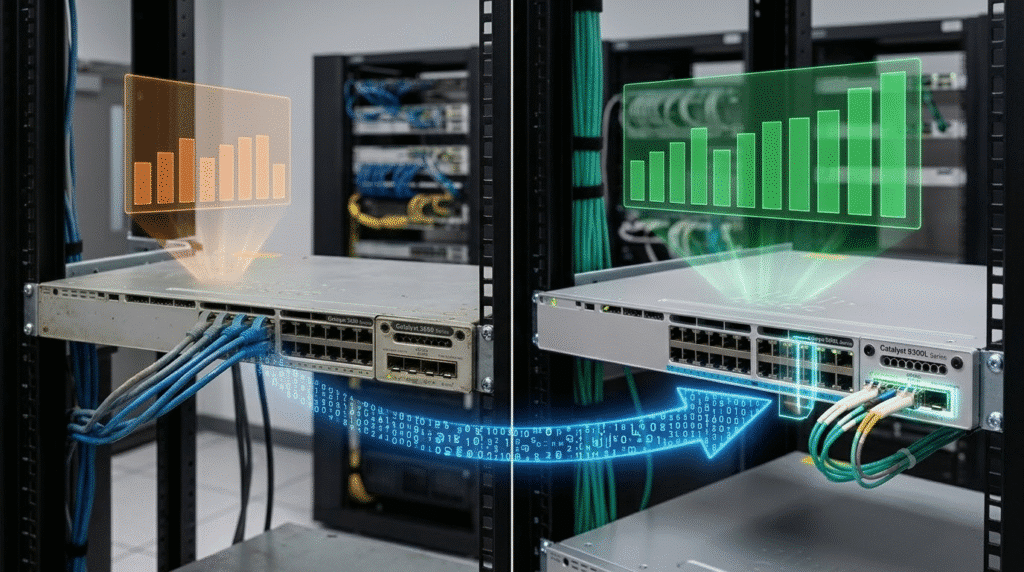
A 9300L refresh is not just about support renewal; it is a massive access-layer performance upgrade. Look at the hard numbers below to understand how the UADP 2.0 ASIC inside the 9300L gives your closet more room for voice, video, AP density, and east-west traffic:
| Model Architecture | Switching Capacity | Forwarding Rate | Stacking Bandwidth |
| Catalyst 3650 (24-port non-mGig) | 92 Gbps | 41.66 Mpps | 160 Gbps (StackWise-160) |
| Catalyst 9300L (24-port 4G / 4X) | 208 Gbps | 154.76 Mpps | 320 Gbps (StackWise-320) |
| Catalyst 3650 (48-port non-mGig) | 176 Gbps | 77.37 Mpps | 160 Gbps (StackWise-160) |
| Catalyst 9300L (48-port 4G / 4X) | 256 Gbps | 190.47 Mpps | 320 Gbps (StackWise-320) |
3. Catalyst 3650 to 9300L Hardware Mapping Table
Do not use old 3650 Bill of Materials (BOM) data to request vendor quotes. The right model must be chosen based on downlink density, uplink speed (1G vs 10G), and PoE demand.
Use the following mapping logic to find your exact Catalyst 9300L equivalent:
| Legacy Catalyst 3650 (EoL) | Modern Catalyst 9300L Replacement | Why This is the Common Fit |
| WS-C3650-24TS-S / E | C9300L-24T-4G-E/-A | Closest fixed-uplink data-only replacement (4x 1G uplinks). |
| WS-C3650-48TS-S / E | C9300L-48T-4G-E/-A | Best fit for dense wired access where 1G uplinks remain acceptable. |
| WS-C3650-24PS-S / E | C9300L-24P-4G-E/-A | Common replacement for VoIP phones and APs (4x 1G uplinks). |
| WS-C3650-48PS-S / E | C9300L-48P-4G-E/-A | Typical replacement for larger PoE+ wiring closets. |
| WS-C3650-24TD-S / E | C9300L-24T-4X-E/-A | Better fit when the old closet already depended on 10G uplinks. |
| WS-C3650-48PD-S / E | C9300L-48P-4X-E/-A | Standard migration path when 10G uplinks matter more than simple 1G reuse. |
(Note: If your legacy 3650 was a high-power model like the 48FQM, you must strictly calculate your new PoE endpoint power draw. You may need the C9300L-48PF-4X or a multigigabit C9300L-48UXG-4X to support modern Wi-Fi 6E/7 access points).
4. Deployment Scenarios: The Stacking Hardware Trap
The most severe deployment trap involves the physical stacking architecture. Network engineers cannot perform a phased, mixed-stack migration.
- Physical Incompatibility: The biggest mistake in a 3650 replacement project is assuming “fixed uplink” means “same physical stacking architecture.” It does not. The 3650 utilized StackWise-160. The new Catalyst 9300L utilizes StackWise-320. The physical shapes of the rear stacking ports are completely different. Your legacy 3650 stacking cables will not plug into a 9300L.
- New Cables Required: You must explicitly order new StackWise-320 cables (e.g.,
STACK3-320-50CM=) and stacking kits for every new switch. - Rip-and-Replace Cutover: Because the ASICs and cables differ, you cannot mix a 3650 and a 9300L in the same stack. The migration requires a hard cutover: power down the 3650 stack, remove it from the rack, and boot the 9300L units as a brand-new, independent stack.
5. Decision Framework: Shifting to DNA Subscriptions
Procurement teams must adjust their TCO (Total Cost of Ownership) calculations. The 3650 belonged to the era of perpetual licensing (LAN Base, IP Base, IP Services). You bought the hardware, and the software worked forever.
A switch refresh budget that only includes metal, optics, and power supplies is incomplete. The Catalyst 9300L requires a mandatory Cisco Catalyst or Cisco DNA software subscription. To purchase the switch, you must attach a 3, 5, or 7-year term license (Essentials or Advantage) at configuration time. If you ignore this OpEx software shift, your project budget will face immediate financial blockers.
6. Frequently Asked Questions (FAQ)
Is the Cisco Catalyst 3650 officially End of Life?
Yes. The Cisco Catalyst 3650 series has passed its End of Sale date, and Cisco has published the final End of Vulnerability/Security Support milestones. It must be replaced to maintain compliance.
What is the exact replacement for the WS-C3650-48PS-L?
In standard access-layer closets, the direct 1:1 hardware replacement is the Cisco Catalyst C9300L-48P-4G, which provides 48 ports of PoE+ and 4x 1G fixed SFP uplinks. If 10G is needed, the C9300L-48P-4X is the correct choice.
Can I mix Catalyst 3650 and Catalyst 9300L in the same stack?
Absolutely not. They use different ASICs and completely different physical stacking cables (StackWise-160 vs StackWise-320). Mixing them is physically and logically impossible.
Can I reuse my 3650 SFP transceivers in the new 9300L?
Yes. In the vast majority of enterprise deployments, standard 1G (GLC-SX-MMD) and 10G (SFP-10G-SR) optical transceivers pulled from a 3650 will work perfectly in the 9300L fixed uplink ports. However, always validate your optics against the exact 9300L model (4G vs 4X) you select.
Does the 9300L have better switching performance than the 3650?
Yes. A 24-port 9300L delivers 208 Gbps of switching capacity compared to just 92 Gbps on a legacy 3650. The forwarding rate also jumps from 41.66 Mpps to 154.76 Mpps, significantly reducing network bottlenecks.
Conclusion
Migrating from the Catalyst 3650 to the 9300L is the most logical and cost-effective strategy for enterprise access layers. By acknowledging the fixed-uplink architecture, purchasing the correct StackWise-320 cables, and budgeting for DNA Smart Licensing, network engineers can execute a flawless cutover with massively improved forwarding performance.