Cisco DAC vs AOC Cable: Differences, Distance, Power and Data Center Use Cases
Direct Answer
Direct Attach Copper (DAC) cables utilize twinaxial copper for short, cost-effective intra-rack connections (up to 7 meters), offering near-zero power consumption and ultra-low latency. Conversely, Active Optical Cables (AOC) use multimode fiber with integrated transceivers for inter-rack links (up to 100 meters), providing total EMI immunity and superior high-density airflow.
Executive Summary
Choosing the correct physical interconnect layer—specifically DAC versus AOC—impacts initial capital expenditures, long-term operational costs, thermal management dynamics, and strict latency budgets. In most enterprise deployments, DAC cables are generally mandated for short server-to-Top-of-Rack (ToR) switch connections. Meanwhile, AOCs are required for longer inter-rack connections and spine-leaf fabric uplinks. For Cisco environments, such as Nexus 9000 data center fabrics, architects must deploy a hybrid cabling strategy to balance performance and cost.
DAC vs AOC Cable: What’s the Difference?
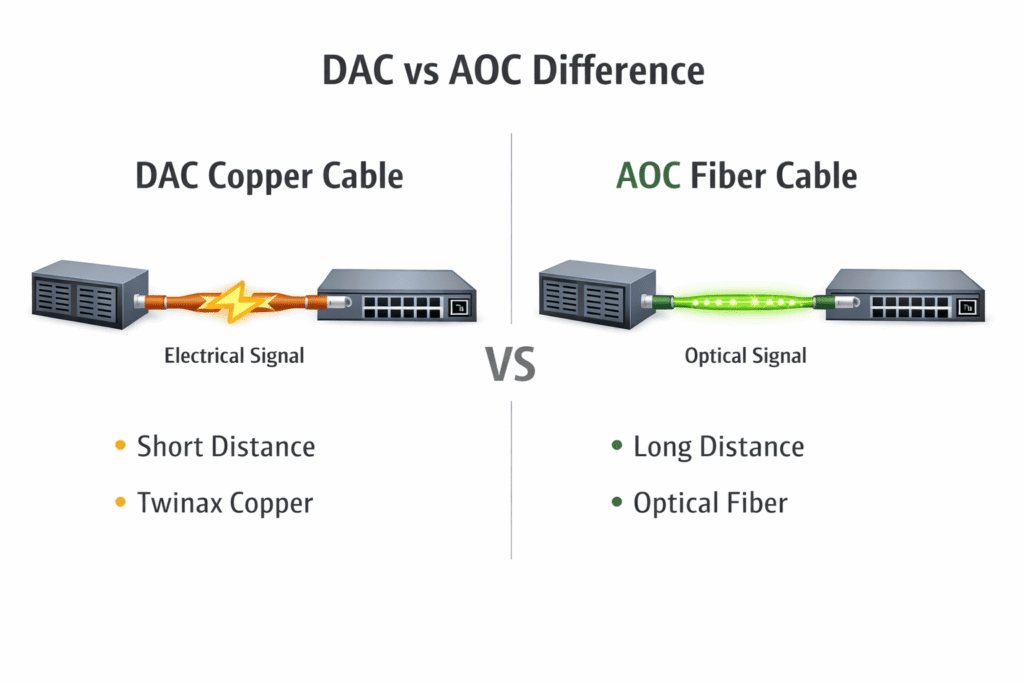
The primary difference lies in the transmission medium and the presence of electro-optical conversion components. DAC cables rely on twinaxial copper to transmit electrical signals, whereas AOC cables use multimode fiber (such as OM3 or OM4) and incorporate active components to translate electrical data into light.
Key Differences
| Feature | DAC (Direct Attach Copper) | AOC (Active Optical Cable) |
| Transmission medium | Twinax Copper | Multimode Fiber |
| Typical distance | 1–7 m | 10–100 m |
| Latency | Ultra-low (≤0.1 μs) | Slightly higher (0.2–0.5 μs) |
| Power consumption | Very low (<0.15W) | Higher (1–2W) |
| Cost | 30% to 70% lower upfront | Higher initial CapEx |
What Is a DAC Cable in Networking?
A DAC cable (Direct Attach Copper) is a fixed-length twinaxial copper assembly with integrated connectors designed for high-speed data center interconnections.
Passive vs Active DAC
| Type | Distance | Power |
| Passive DAC | up to 7 m | near zero (<0.15W) |
| Active DAC | up to 15 m | low |
Active DACs utilize internal circuitry to boost electrical signals, allowing them to push distance limits slightly further than their passive counterparts, though they are largely being replaced by AECs in modern 400G deployments.
What Is an AOC Cable?
An AOC cable (Active Optical Cable) is a fixed-length fiber optic assembly that combines multimode fiber with built-in transceiver modules to convert electrical data into optical signals.
Typical AOC Performance
| Metric | Value |
| Distance | up to 100 m |
| Power consumption | 1–2 W per end |
| Latency | 0.2–0.5 μs (due to E-O/O-E conversion) |
DAC vs AOC Comparison: Distance, Latency, Power and Cost
Distance Limit Constraints
The physical limits of copper signal degradation dictate DAC reach. Distance decreases rapidly as bandwidth increases.
- DAC: 5–7 meters at 25G, dropping to 3 meters at 100G.
- AOC: Up to 100 meters at 10G, 40G, and 100G speeds, making it ideal for End-of-Row (EoR) deployments.
Latency Budgets
DAC cables have lower latency because they avoid the processing time required for electrical-to-optical (E-O) and optical-to-electrical (O-E) conversions, making them the strict standard for High-Frequency Trading (HFT) environments.
Power Consumption
AOCs require significantly more wattage to power their integrated optical laser components. While 1–2 watts per cable seems negligible, multiplying this by 5,000 cables in a hyperscale facility drastically shifts the facility’s Power Usage Effectiveness (PUE).
Cisco DAC vs AOC: Deployment in Nexus Data Center Fabrics

A robust enterprise cabling matrix must be tailored specifically to the hardware ecosystem. Here are two real-world deployment scenarios using Cisco architectures:
Scenario 1: Cisco HyperFlex / HCI (Intra-Rack)
In a Hyperconverged Infrastructure (HCI) cluster using Cisco UCS C-Series servers connecting to a pair of Cisco Nexus 93180YC-EX Top-of-Rack (ToR) switches, storage I/O latency is the most critical metric.
- Cabling Choice: DAC.
- Justification: The servers are located within 1 to 3 meters of the ToR switches. 25G DAC cables provide the required zero-packet-loss, sub-microsecond latency necessary for VMware vSAN or HyperFlex storage synchronization.
Scenario 2: Cisco ACI Spine-Leaf Fabric (Inter-Rack)
When connecting Cisco Nexus 9300 series Leaf switches to Nexus 9500 series modular Spine switches, the physical distance traverses multiple rows of server cabinets.
- Cabling Choice: AOC.
- Justification: The 100G or 400G uplinks must span 15 to 45 meters. Copper DAC cannot carry 100G signals beyond 5 meters. AOC provides the necessary bandwidth, reach, and flexibility to route through dense overhead cable trays.
Common Cisco DAC and AOC SKUs (Reference Guide)
To ensure compatibility with Cisco’s Digital Optical Monitoring (DOM) telemetry, network engineers frequently specify the following exact Cisco part numbers on their Bills of Materials (BoM):
Cisco DAC SKUs (Twinax Copper):
- SFP-H10GB-CU3M: 10GBASE-CU SFP+ Cable, 3 Meters, Passive
- SFP-H25G-CU2M: 25GBASE-CU SFP28 Cable, 2 Meters, Passive
- QSFP-100G-CU3M: 100GBASE-CR4 QSFP28 Cable, 3 Meters, Passive
Cisco AOC SKUs (Active Optics):
- QSFP-H40G-AOC15M: 40GBASE-AOC QSFP Cable, 15 Meters
- QSFP-100G-AOC10M: 100GBASE-AOC QSFP28 Cable, 10 Meters
- QDD-400G-AOC15M: 400GBASE-AOC QSFP-DD Cable, 15 Meters
DAC vs AOC Airflow Impact in High-Density Server Racks
In large data centers, airflow efficiency drastically affects Operational Expenditure (OPEX) costs.
Copper DAC cables are thicker (using 30AWG or 26AWG copper), highly rigid, and possess severe bend radius limitations. When bundled in groups of 48 behind a switch, they readily block hot aisle exhaust flow from server fans, forcing CRAC units to operate at higher RPMs.

AOC cables are significantly thinner (typically featuring a 3mm jacket) and highly flexible. They provide superior cable management, ensuring better rack cooling and efficient thermal dissipation for high-density AI clusters.
Enterprise Decision Matrix: Which Cable Should You Use?
Use the following strict decision table to map your physical deployment scenario to the correct interconnect technology.
| Deployment Scenario | Distance | Key Requirement | Recommended Cable | Example Cisco SKU |
| Server to ToR Switch | 1–3 m | Lowest cost, lowest latency | Passive DAC | SFP-H25G-CU2M |
| Storage Area Network (HCI) | 3–5 m | Microsecond latency, zero loss | Passive DAC | QSFP-100G-CU3M |
| Leaf to Spine Uplinks | 15–50 m | High bandwidth, long reach | AOC | QSFP-100G-AOC15M |
| High-Density GPU Clusters | 10–30 m | Cable flexibility, unhindered airflow | AOC | QDD-400G-AOC15M |
| Industrial / High EMI Sites | 5–20 m | Complete EMI immunity | AOC | QSFP-H40G-AOC10M |
| 400G Medium Reach | 5–15 m | Bridging copper limits without full optics | AEC (Active Electrical) | QDD-400G-AEC7M |
People Also Ask(FAQ)
What is the difference between DAC and AOC cables?
DAC cables utilize twinax copper and transmit electrical signals, whereas AOC cables use multimode fiber and integrated electro-optical conversion chips to translate electrical data into light.
Are AOC cables better than DAC?
AOC is superior for extending distance, maximizing airflow, and ensuring total EMI immunity, but it is inferior to DAC regarding upfront cost, power consumption, and latency.
How far can DAC cables reach?
Passive DAC cables generally max out at 5 to 7 meters at lower speeds, while high-speed 100G DACs are strictly limited to 3 to 5 meters before signal degradation occurs.
Can third-party DAC cables work with Cisco switches?
Yes, but they require proper transceiver EEPROM coding to ensure compatibility, avoid “unsupported transceiver” error states, and maintain visibility within Cisco’s switch telemetry.
Why do AOC cables consume more power?
AOC cables draw between 1W and 2W per end because they require continuous electrical power to drive their integrated optical laser transceivers, whereas passive DACs draw less than 0.15W.
About Layer23-Switch
If you are planning to deploy high-speed network interconnects in enterprise or data center environments, selecting the correct cabling solution is critical for performance, cost efficiency, and long-term scalability.
At Layer23‑Switch, we specialize in providing genuine Cisco networking hardware, including switches, optics, and high-speed DAC and AOC cables used in modern data center fabrics.
Our engineering team helps enterprises and system integrators select the right connectivity solutions for deployments such as:
- Cisco Nexus data center fabrics
- high-density server racks
- spine-leaf architectures
- high-performance computing clusters