Common Risks in Cisco EOL Upgrade Projects
This topic is part of our
Cisco EOL & Network Upgrade Planning Guide,
which explains how to manage Cisco lifecycle changes and execute network upgrades with controlled risk and predictable outcomes.
Cisco EOL-driven upgrade projects rarely fail because of hardware quality.
They fail because risks are underestimated, ignored, or discovered too late.
This article highlights the most common risks in Cisco EOL upgrade projects, based on real-world deployment experience, and explains how to identify them early—before they turn into costly issues.
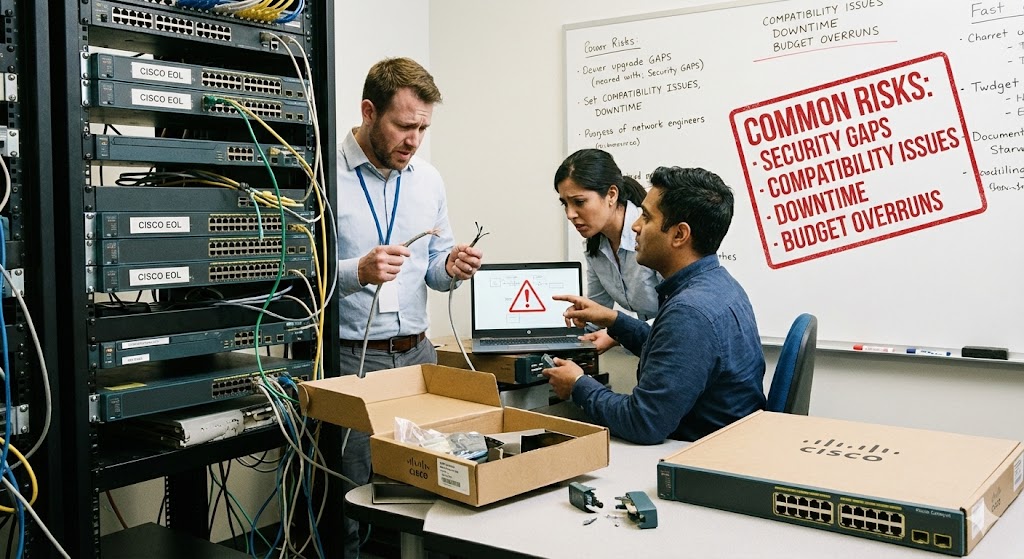
Risk 1: Treating EOL as a Purely Technical Issue
One of the most frequent mistakes is assuming EOL upgrades are only a technical refresh.
In reality, EOL impacts:
- Operations and maintenance
- Budget cycles
- Procurement timelines
- Business continuity
When EOL planning is handled only by engineering teams without broader coordination, projects often face delays or misalignment with business priorities.
Risk 2: Incomplete or Inaccurate Lifecycle Information
Many projects begin with assumed EOL timelines rather than verified data.
This leads to:
- Incorrect urgency assessments
- Missed support deadlines
- Unexpected gaps in coverage
Before committing to any upgrade plan, lifecycle milestones must be confirmed for every affected model.
You can verify official EOL and EOSL timelines using our
Cisco EOL & EOSL Lookup Tool
Accurate lifecycle data is the foundation of all EOL-related decisions.
Risk 3: Underestimating the Impact of Downtime
EOL upgrades are often scheduled based on hardware availability, not operational reality.
Common issues include:
- Insufficient maintenance windows
- Poor coordination with application owners
- Underestimating rollback complexity
Even well-planned upgrades can cause disruption if operational impact is not fully assessed.
Risk 4: Hidden Dependencies and Compatibility Issues
Cisco EOL replacements frequently uncover hidden dependencies.
Examples include:
- Legacy optics incompatible with new platforms
- Power or cooling limitations in existing racks
- Feature mismatches between old and new software versions
Ignoring these dependencies can delay deployments and increase unplanned costs.
Risk 5: Overlapping EOL Events Across Multiple Devices
In many environments, EOL does not affect a single device in isolation.
Multiple devices reaching EOL at similar times can:
- Overwhelm budgets
- Strain operational resources
- Force rushed decision-making
Without prioritization and phasing, organizations risk turning manageable upgrades into large, high-risk projects.
Risk 6: Over-Specifying Replacement Hardware
In an effort to “future-proof,” some projects overcompensate by selecting overly complex or expensive replacement models.
This often results in:
- Underutilized features
- Increased licensing and support costs
- Higher operational complexity
Effective EOL upgrades balance future readiness with realistic operational needs.
Risk 7: Delayed Procurement and Lead Time Constraints
Even the best technical plan can fail due to procurement delays.
Long lead times, backorders, or regional availability issues can:
- Push projects past support deadlines
- Force temporary extension of EOL equipment
- Increase reliance on emergency sourcing
Procurement planning must be integrated early into the EOL upgrade process.
Risk 8: Lack of a Clear Exit Strategy for Extended Equipment
When organizations choose to temporarily extend EOL equipment usage, the extension often lacks a defined endpoint.
Without a clear exit strategy:
- Temporary solutions become permanent
- Risk accumulates silently
- Future upgrades become more difficult
Extensions should always be time-bound and actively monitored.
How These Risks Fit Into EOL Upgrade Planning
Most EOL project risks are not technical surprises—they are planning gaps.
A structured EOL approach helps:
- Identify risks early
- Prioritize actions logically
- Coordinate technical, financial, and operational stakeholders
For a complete lifecycle framework, refer back to the main guide: Cisco EOL & Network Upgrade Planning Guide
Final Thoughts
Cisco EOL upgrade projects succeed when risks are acknowledged—not avoided.
The most resilient organizations:
- Treat EOL as a strategic planning exercise
- Validate lifecycle data before acting
- Align upgrades with business and operational realities
Risk-aware planning transforms EOL from a disruption into a controlled transition.
Need Help Managing Cisco EOL Upgrade Risks?
If you need assistance with:
- EOL risk assessment
- Upgrade sequencing
- Dependency validation
- Cisco lifecycle and replacement planning
Our team provides practical guidance for enterprise network environments.