Cisco EOL & Network Upgrade Planning Guide
Cisco End of Life (EOL) announcements are a normal part of enterprise network lifecycles. However, many organizations struggle not because equipment reaches EOL—but because they lack a clear, structured plan for what to do next.
This guide explains how to approach Cisco EOL from a planning perspective, helping enterprises move from lifecycle awareness to controlled, risk-managed network upgrades.
Rather than focusing on individual models or announcements, this page provides a decision framework that connects EOL status, upgrade timing, replacement strategy, and project risk.
What Cisco EOL Really Means for Enterprise Networks
Cisco EOL does not mean equipment suddenly stops working.
Instead, it signals a gradual reduction in:
- Hardware availability
- Software updates and security patches
- Vendor support options
The real challenge is not technical failure, but increasing operational and security risk over time.
Organizations that treat EOL as a planning milestone—rather than an emergency—are better positioned to control cost, timing, and impact.
Why EOL Planning Matters More Than Individual Announcements
Single EOL announcements are rarely the real problem.
The risk emerges when:
- Multiple devices approach EOL at different times
- Upgrades are handled reactively
- Budget and procurement are disconnected from lifecycle timelines
A structured EOL planning approach allows teams to:
- Prioritize upgrades logically
- Avoid rushed purchasing decisions
- Reduce downtime and project risk
This guide outlines a step-by-step planning path to manage Cisco EOL effectively.
Step 1: Can Cisco EOL Equipment Still Be Used?
The first question most teams ask is simple: can Cisco EOL equipment still be used safely?
In many cases, EOL devices continue operating reliably—especially in low-risk or redundant roles. However, continued use always involves trade-offs related to support, security, and recovery time.
Understanding when EOL equipment can be extended—and when it should not—is the foundation of all upgrade planning.
Step 2: How to Plan a Network Upgrade After Cisco EOL
Once EOL status is confirmed, the next challenge is planning—not purchasing.
Effective upgrade planning focuses on:
- Impact assessment
- Prioritization by network role
- Phased versus full upgrades
- Alignment with architecture and operations
Well-planned upgrades reduce disruption and prevent unnecessary replacements. To execute this effectively, you need a solid framework for how to plan a network upgrade after Cisco EOL.
Step 3: How to Choose Replacement Models After Cisco EOL
Replacing EOL equipment is not about finding a newer version of the same device.
Successful replacements consider:
- Future performance and capacity requirements
- Architectural compatibility
- Lifecycle longevity
- Licensing and operational complexity
This step helps ensure upgrades solve long-term constraints, not just short-term lifecycle issues.
Step 4: Common Risks in Cisco EOL Upgrade Projects
Even well-intentioned EOL upgrades can fail if risks are overlooked.
Common issues include:
- Incomplete lifecycle data
- Hidden dependencies
- Downtime underestimation
- Procurement delays
- Over- or under-specifying replacements
To ensure a smooth transition and avoid unexpected downtime, it is crucial to understand and mitigate these common risks in Cisco EOL upgrade projects before they affect timelines or operations.
Understanding EOL and EOSL Milestones
Cisco lifecycle planning involves several key milestones, including:
- End of Sale (EoS)
- End of Software Maintenance
- End of Vulnerability/Security Support
- End of Life / End of Support (EOSL)
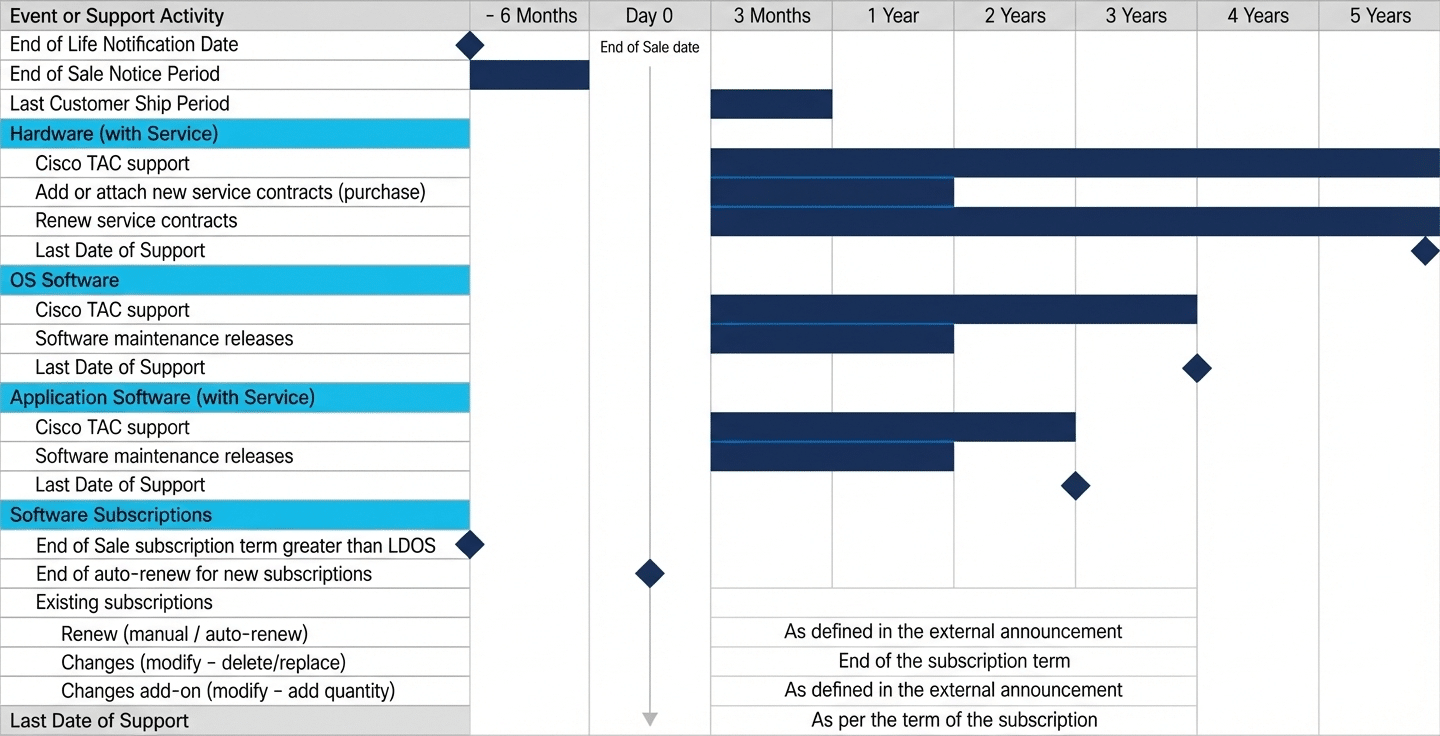
Each milestone affects operational risk differently.
Before making any upgrade or replacement decision, it is essential to confirm official lifecycle dates for each deployed model. You can instantly verify these critical dates using our free Cisco EOL & EOSL Lookup Tool to ensure your upgrade planning is based on facts, not assumptions.
How This Guide Fits Into a Broader Network Strategy
Cisco EOL planning should not exist in isolation.
It connects directly to:
- Network architecture decisions
- Budget forecasting
- Procurement strategy
- Long-term operational stability
A structured EOL approach transforms lifecycle changes into predictable, manageable transitions rather than disruptive events.
Final Thoughts
Cisco EOL is not a problem to be solved—it is a condition to be managed.
Organizations that succeed with EOL planning:
- Accept lifecycle change as inevitable
- Replace urgency with structure
- Align technical, financial, and operational priorities
This guide provides a clear path to approach Cisco EOL upgrades with confidence, control, and long-term clarity.
Need Help With Cisco EOL Planning?
If you need assistance with:
- EOL assessment and prioritization
- Upgrade planning and sequencing
- Replacement strategy and risk evaluation
- Cisco lifecycle and network upgrade projects
Our team provides practical guidance tailored to enterprise network environments.