Cisco Nexus 9300 100G vs 400G vs 800G: Which Fabric Speed Fits?
On the Cisco Nexus 9300, 100G, 400G, and 800G are three current platform generations, and the right one is decided by your server NIC speeds and oversubscription target, not by the biggest number on the faceplate. A 100G fabric still fits most enterprise virtualization and storage estates. A 400G fabric is the sensible default for a new spine in 2026. 800G platforms earn their cost when AI pods, 200G/400G server NICs, or very high spine density define the design.
| Your situation | Fabric speed to plan | Current Nexus 9300 platforms |
|---|---|---|
| Enterprise virtualization, ERP, storage front-end, steady east-west | 100G | 9336C-FX2, 9364C-GX, 9364C-H1 |
| New general-purpose spine, cloud-native east-west growth, GPU inference pools | 400G | 9332D-GX2B, 9364D-GX2A, 9332D-H2R |
| AI training pods, 200G/400G server NICs, very high-density spine, scale-across sites | 800G | N9364E-SG2, N9364E-SG2X, N9364E-SP2R |
The decision has a 2026 wrinkle at each end. At the 100G end, the popular Nexus 9364C is already past end-of-sale, so some “current” advice is a generation stale. At the 800G end, Cisco’s newest collateral renames the family: the ordering description for the N9364E-SG2 reads “Cisco N9300 64p 800G switch.” This guide walks the decision in order: what each tier is, the bandwidth math, the scenario boundaries, mixed-speed designs, running costs, and the licensing and lifecycle checks that belong on the order.
What 100G, 400G, and 800G Mean on the Nexus 9300 Today
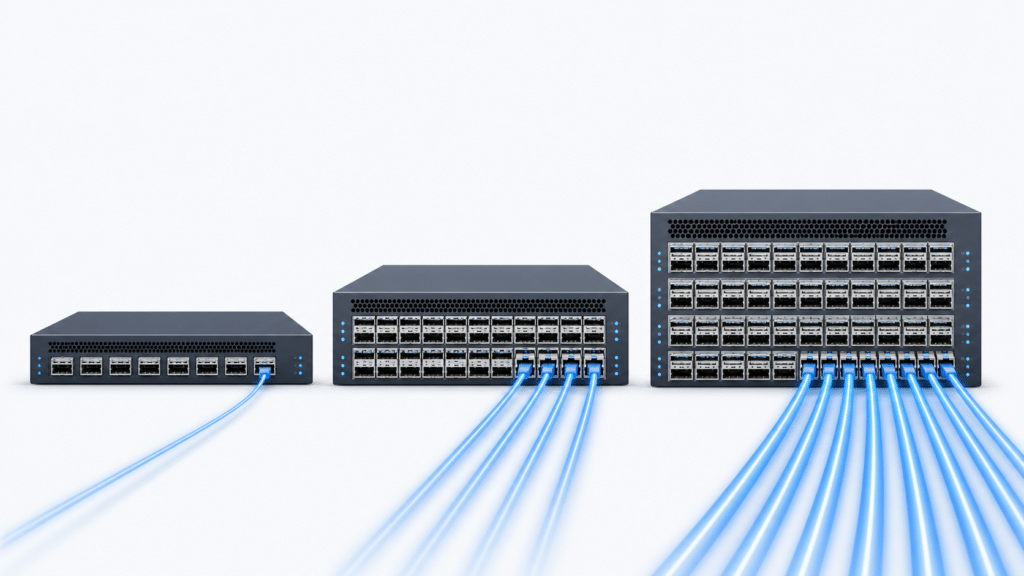
Each speed tier corresponds to a distinct set of fixed platforms, and they differ in more than port speed. The 100G and 400G models run Cisco Cloud Scale ASICs; the 800G models move to Cisco Silicon One and split into shared-buffer and deep-buffer branches.
| Tier | Platform | Ports and size | Silicon and buffer | Role in short |
|---|---|---|---|---|
| 100G | N9K-C9336C-FX2 | 36 x 40/100G QSFP28, 1RU | Cloud Scale, shared buffer | Compact 100G leaf or spine with breakout on every port |
| 100G | N9K-C9364C-GX | 64 x 40/100G QSFP28, 2RU | Cloud Scale, shared buffer | Dense 100G aggregation; official successor to the end-of-sale 9364C |
| 100G | N9K-C9364C-H1 | 64 x 40/100G QSFP28, 2RU | Cloud Scale | Newer 100G branch; higher forwarding scale and different MACsec coverage, so compare per PID |
| 400G | N9K-C9332D-GX2B | 32 x 400G QSFP-DD + 2 x 1/10G SFP+, 1RU | Cloud Scale, shared buffer | Mainstream fixed 400G leaf or spine |
| 400G | N9K-C9364D-GX2A | 64 x 400G QSFP-DD, 2RU | Cloud Scale, shared buffer | Dense fixed 400G spine |
| 400G | N9K-C9332D-H2R | 32 x 400G QSFP-DD, 1RU | Deep buffer: 80MB on-die + 8GB HBM | Burst-heavy, storage, and DCI designs |
| 800G | N9364E-SG2 (-Q/-O) | 64 x 800G QSFP-DD or OSFP, 2RU | Silicon One, 256MB shared | High-density 800G fabric; 51.2 Tbps |
| 800G | N9364E-SG2X (-Q/-O) | 64 x 800G QSFP-DD or OSFP, 2RU | Silicon One | Current high-density 800G branch with lower-speed and breakout support |
| 800G | N9364E-SP2R (-Q/-O) | 64 x 800G QSFP-DD or OSFP, 3RU | Silicon One P200, 144MB on-die + 16GB HBM | Deep-buffer 800G spine and scale-across designs |
One naming note before you search further: recent Cisco material increasingly writes “N9300” where older documents said “Nexus 9300,” and the 800G platforms carry ordering PIDs without the N9K- prefix, while current 100G and 400G models such as the N9K-C9364C-H1 keep it. Both styles describe the same fixed-switch family, so match on the exact PID when you compare data sheets or quotes.
This article settles the speed question. Choosing the exact model within a tier, and weighing 9300 alternatives such as the Nexus 9232E, the modular 9800, or the NVIDIA-silicon 9100, is the job of our Nexus 9000 series selection guide.
The Bandwidth Math That Picks Your Tier
Fabric speed is an arithmetic decision before it is a product decision. Four numbers settle most designs:
- Access bandwidth per leaf. Add up the NIC speeds you will actually connect.
- Oversubscription target. General enterprise fabrics commonly accept 3:1 or 2:1 at the leaf. Lossless RoCE and AI traffic push designs toward 1:1.
- Uplink bandwidth required. Access bandwidth divided by the oversubscription ratio.
- Uplink ports needed at each tier. This is where a tier quietly runs out.
Work the numbers on an ordinary enterprise leaf: 48 servers at 25G is 1,200G of access bandwidth. At 3:1, the leaf needs 400G of uplink capacity, which is four 100G uplinks or a single 400G port. At 2:1 it needs 600G: six 100G uplinks, or two 400G ports with room to spare. A 100G fabric handles this leaf comfortably, which is exactly why 100G remains the right answer for so many enterprise estates.
Now a small GPU pod on the same math. Suppose four training nodes each expose eight 100G NICs, a common RoCE layout, for 3.2 Tbps of access. On a 36-port 100G switch, the node links consume 32 ports and leave four uplinks: 400G of capacity against 3.2T of access, an 8:1 ratio that a lossless RoCE design cannot accept. The same pod on a 32-port 400G platform uses eight ports for node links (nodes at 2 x 400G) and eight for uplinks, and reaches 1:1 with half the switch still free.
The pattern generalizes: when your oversubscription target approaches 1:1 and your access ports run at 100G or faster, uplink math consumes a 100G platform almost immediately. When access is 25G server connectivity at 2:1 or 3:1, the 100G tier keeps working. Run this calculation before comparing any data sheets; it eliminates at least one tier every time.
When 100G Still Fits, When 400G Is the Default, and What Forces 800G
| Workload profile | Plan this tier | The trigger that moves you up |
|---|---|---|
| Virtualization, ERP, databases, storage front-end | 100G | Sustained leaf-uplink congestion, or a server refresh that lands 100G NICs |
| Backup, replication, storage back-end | 100G or 400G | Deep-buffer or DCI requirements point to the 9332D-H2R |
| Cloud-native platforms with heavy east-west | 400G | Growth alone; this is the default new-spine tier |
| GPU inference pools | 400G | Per-node NIC bandwidth rising past 2 x 100G |
| AI training pods | 400G or 800G | 1:1 lossless targets with 200G/400G NICs |
| Very high-density spine, inter-site scale-across | 800G | Port count per RU and long-haul burst absorption; SP2R territory |
100G still fits more designs than the upgrade-cycle marketing admits. The workloads that pushed hyperscalers past 100G are not the workloads in a typical enterprise data center. If servers connect at 10G and 25G and the fabric meets its oversubscription target with uplinks left over, moving the fabric tier buys bandwidth nothing will use.
400G is the default for a new spine in 2026 because it collapses uplink counts, its optics ecosystem has matured, and every port can break out to 4 x 100G when the leaf below it has not caught up. Per Cisco’s Nexus 9300-GX2 series data sheet, breakout works across all ports on the GX2 platforms, and a 9332D-GX2B can present up to 128 logical 10/25/50/100G ports. A 400G spine over 100G leaves is a normal, supported end state, and for many networks it will stay that way for years.
800G is a triggered decision. The honest triggers are specific: training pods whose nodes present 200G or 400G NICs at 1:1, spine layers where 64 x 800G in 2RU replaces multiple 400G chassis, and scale-across designs between sites where the N9364E-SP2R’s 16GB HBM buffer absorbs long-distance bursts. Cisco’s own N9364E-SG2 data sheet frames the platform for AI/ML fabrics and next-generation spine designs; that is the market it serves. Multi-thousand-GPU training fabrics bring their own engineering discipline (topology, congestion control, NIC validation) that runs beyond a speed-tier decision, and vendors publish dedicated reference architectures for them.
The reverse recommendation matters as much. Buying 800G “for headroom” without a NIC roadmap that reaches 200G/400G parks capital in the most expensive optics tier on the market. A 400G fabric with breakout covers every intermediate step and keeps the upgrade path open.
Mixed-Speed Fabrics and the Migration Path
Almost nobody replaces a fabric in one step, and the Nexus 9300 tiers are designed to interoperate:
- 100G leaves under a 400G spine is the standard migration state. Spine ports break out 4 x 100G to existing leaves; new leaves attach at native 400G.
- An 800G spine can face both older tiers. The N9364E-SG2 data sheet lists 2 x 400G and 8 x 100G breakout per port, so one 800G port can serve two 400G leaves or eight 100G links during transition.
- Migrate the spine first. A faster spine immediately relieves uplink pressure on every leaf and lets you refresh leaves rack by rack as server NICs change.
Three physical-layer boundaries decide whether the plan survives contact with the loading dock:
- Form factors do not mix. 100G platforms use QSFP28; 400G platforms use QSFP-DD; 800G platforms come in QSFP-DD or OSFP variants, and the -Q and -O models take different optics. QSFP28 optics do insert into QSFP-DD ports, which is what makes gradual leaf migration practical, but OSFP and QSFP-DD are mechanically incompatible with each other.
- Breakout must be verified per port and per PID, in the platform’s current optics matrix, along with the minimum NX-OS release for each transceiver. Assume nothing from the faceplate.
- FEC settings must match on both ends of every breakout link, or the link will flap in ways that look like bad optics.
Budget the cable plant with the switches: moving tiers usually means new transceivers, new DAC/AOC assemblies, and often MPO trunk changes. On multi-rack projects those line items rival the switch spend.
What Each Tier Really Costs to Run
Three cost layers separate the tiers in practice:
Optics dominate. Per-port transceiver cost rises steeply with each tier, and the 800G optics ecosystem is the youngest and priciest. A speed decision is really a fleet-of-optics decision; multiply your port count by the optic price at each tier before comparing switch prices.
Power and cooling scale with the ASIC generation. Cisco’s data sheet puts the N9364E-SG2 at 995W typical draw, with a 3kW power supply and correspondingly serious airflow. The deep-buffer SP2R is a 3RU platform with a heavier profile still. Check the typical and maximum draw for your exact PID against rack power budgets; a tier jump can force a PDU conversation you did not plan.
The secondary market rewards the 100G tier. As large operators migrated their fabrics upward, current 100G platforms such as the 9336C-FX2 became widely available through the secondary market at a fraction of new-generation cost, while remaining fully supported NX-OS citizens. For an enterprise whose bandwidth math lands at 100G, that combination of mature platform and depressed pricing is the strongest value position in the lineup. Request a quote for current availability on specific PIDs.
Licensing, Software, and Lifecycle Checks Before the BOM
Licensing. Nexus 9300 platforms use Cisco Data Center Networking (DCN) subscription licenses in Essentials, Advantage, and Premier tiers, and the license class varies by platform: the N9364E-SG2 data sheet specifies XF3-class DCN subscriptions for that switch. Confirm the class and tier for your exact PID in Cisco’s current NX-OS licensing guide before quoting. Per the same data sheet, Nexus Dashboard is included with tiered licenses, while specific services such as Fabric Controller and Insights map to specific tiers.
Software model. The speed tiers do not change the operating-model decision: NX-OS, ACI, Hyperfabric, or SONiC support is model-specific, and the choice belongs before the BOM. Our Nexus 9000 selection guide covers the operating-model boundaries per family; verify the minimum NX-OS release for every optic and breakout mode you plan to use.
Lifecycle. The tiers are at different points in their life:
| Platform | Lifecycle status | What it means for a 2026 order |
|---|---|---|
| Nexus 9364C | End-of-sale January 30, 2024; support ends January 31, 2029, per Cisco’s August 2023 notice | Do not build new on it; Cisco names the 9364C-GX as the migration option |
| 9336C-FX2 | No end-of-sale announcement as of July 2026 | Orderable and refresh-safe at the 100G tier |
| 400G GX2 family | Current | Mainstream tier; standard lifecycle risk |
| 800G SG2/SG2X/SP2R | Current, newest generation | Longest runway; earliest-adopter optics economics |
The pre-order checklist, in the order mistakes actually happen:
- Bandwidth math per leaf and spine, with the oversubscription target written down.
- Breakout modes verified per port in the optics matrix.
- Optics, DACs, and MPO trunks priced into the BOM at the chosen tier.
- QSFP-DD versus OSFP settled for any 800G platform.
- DCN license class and tier confirmed for each exact PID.
- Lifecycle status checked for every PID on the quote.
Two platforms at the same speed can still differ in buffer, encryption, and scale, so compare exact models once the tier is settled, or send us the design for a BOM review against current stock.
FAQ
Can 100G, 400G, and 800G coexist in one Nexus 9300 fabric?
Yes. Mixed-speed operation through native ports and breakout is a supported, normal design; the constraints are per-port breakout support, matching FEC, and minimum NX-OS per optic, all verified in the platform’s optics matrix.
Should an 800G order use OSFP or QSFP-DD?
Match the installed optics ecosystem you plan to standardize on; the -O and -Q variants are functionally parallel but take mechanically incompatible optics, so the decision is really about your transceiver supply chain and any existing QSFP-DD estate.
Is “N9300” the same thing as “Nexus 9300”?
Yes. Newer Cisco collateral shortens the family name to N9300 and drops the N9K- prefix on new PIDs; older documents use the long forms. Match on the exact PID when comparing documents.
Do AI clusters require InfiniBand instead of an Ethernet fabric?
No. Lossless Ethernet with RoCE, PFC, and ECN is a mainstream AI fabric choice, and the current Nexus 9300 platforms are built for it; very large training clusters simply demand careful congestion design on either technology.