Cisco MDS 9148T vs 9148V: Choosing Between 32G and 64G Fibre Channel
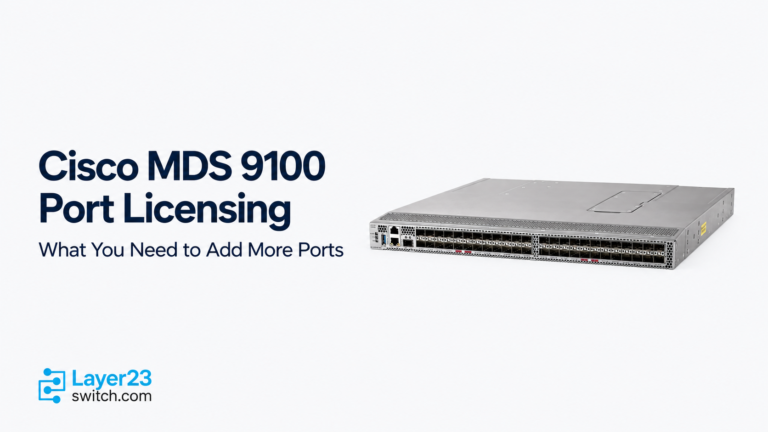
The Cisco MDS 9148T and MDS 9148V are both 48-port, 1RU fixed Fibre Channel switches in the MDS 9100 Series, and they share far more than they differ: same port count, same 24-port base with 8-port activation licenses, same nonblocking line rate, same choice of port-side exhaust or intake airflow. The decisive difference is the speed generation. Every 9148T port tops out at 32G; every 9148V port reaches 64G on a newer ASIC with deeper buffer credits. Choose the 9148T when your HBAs, arrays, and ISLs run at 32G or below and price per port drives the decision. Choose the 9148V when you are building for all-flash arrays, NVMe/FC visibility, 64G ISLs, or a fabric that has to absorb two or three future server refreshes.
Key Differences Between the 9148T and 9148V
The rows below are the ones that change a buying decision. Everything else in the two datasheets is effectively identical: VSAN, IVR, NPV, smart zoning, dual hot-swappable PSUs and fans, and the same 99.999% availability design.
| Specification | MDS 9148T | MDS 9148V | Why it matters |
|---|---|---|---|
| Port speeds (autosensing) | 4/8/16/32G | 8/16/32/64G | The 9148V doubles the ceiling but drops the 4G floor |
| Aggregate bandwidth | 1.5 Tbps | 3 Tbps | Headroom for ISL and host consolidation |
| ASIC and analytics scope | 32G ASIC; SAN Analytics inspects SCSI headers | 64G ASIC; SAN Analytics inspects SCSI and NVMe headers | Only the 9148V gives flow-level visibility into NVMe traffic |
| Buffer credits | 8,300 per 16-port group, 500 per port default | 24,000 per 24-port group, 1,000 per port default | Long-distance and credit-hungry ISLs favor the 9148V |
| Port groups and port-channel | 3 groups of 16 ports, up to 16 links per channel | 2 groups of 24 ports, up to 24 links per channel | Wider port-channels and different HA striping on the 9148V |
| Congestion handling | Slow-drain detection and isolation | Adds Dynamic Ingress Rate Limiting (DIRL) | The 9148V rate-limits a misbehaving device automatically |
| Typical power, 48 ports populated | 297W | 286W | The 64G platform runs slightly leaner |
| Feature licensing | Perpetual per-switch licenses | Premier or Advantage subscription, 1 to 7 years | CapEx versus recurring OpEx |
| Minimum MDS NX-OS | 8.3(1) | 9.3(1), and 9.4(1) for SAN Analytics | Sets the software floor for the whole fabric |
For a full side-by-side of every published field, including the rows left out here, run both PIDs through our Cisco switch comparison tool
That last row deserves attention before you order either switch. If you run a single NX-OS release across a mixed fabric, adding a 9148V raises your minimum to 9.3(1), and turning on SAN Analytics raises it again to 9.4(1). Older MDS platforms in the same fabric may not have a supported path to those releases, which turns a switch purchase into a fabric-wide software project. Check the release notes for your target NX-OS train against every platform you operate, not just the new one.
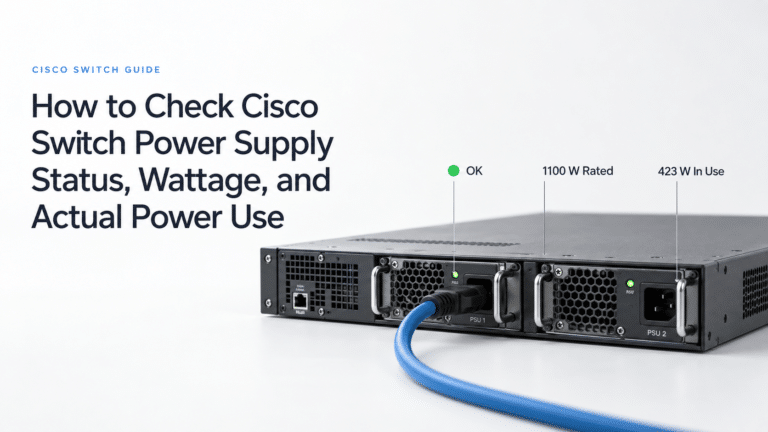
Worth noting on power: the 64G switch is the more efficient of the two at every load point Cisco publishes, from idle (174W against 217W) to fully populated. Moving up a generation costs you nothing in rack power or cooling.
Do You Need 64G, or Is 32G Enough?
Start from the speed your end devices actually negotiate, not the speed printed on the switch. A 16G or 32G HBA connected to a 64G F-port still logs in at 16G or 32G. If your servers and arrays are current-generation 32G equipment, a 9148V delivers no additional throughput on day one. What it delivers is the ability to go faster later without replacing the switch.
That framing resolves most cases. A fabric of matched 32G endpoints with no near-term refresh plan is a 9148T fabric. A fabric where new arrays or hosts are arriving with 64G front-end ports, or where you want NVMe/FC flow analytics, is a 9148V fabric.
The 4G and 8G Legacy Device Boundary
The 9148V’s port speeds start at 8G. Its optics lineup starts at 16G, since Cisco lists only 16G, 32G, and 64G transceivers for it. The 9148T autosenses down to 4G and its ordering table includes 8G shortwave and longwave SFPs.
If you still attach 4G devices, older tape libraries being the usual case, the 9148T is the only one of the two that will link them. If you have 8G devices with existing 8G optics, those optics do not carry over to a 9148V; the devices themselves can still negotiate 8G, but only through 16G-or-faster transceivers on the switch side. Inventory your slowest attached devices before you assume the 64G platform is a drop-in.
ISL Consolidation Math: Where 64G Buys Back Ports
Doubling link speed matters most where links aggregate. Take an edge switch carrying 24 hosts that each log in at 32G, with a 3:1 oversubscription budget toward the core. That requires roughly 256G of trunk bandwidth: eight 32G ISLs on a 9148T, or four 64G ISLs on a 9148V.
Those four saved ports are saved twice, once on the edge switch and once on the director, and they come out of the ports you would otherwise sell to servers and storage. On a 48-port switch, an eight-port trunk consumes one sixth of the chassis before a single host is connected. The same arithmetic applies to array front-end connections: a 64G array port replaces two 32G ports at equal bandwidth.
The 9148V’s larger buffer-credit pool reinforces the same use case. With up to 24,000 credits per 24-port group and 16,000 available to a single port, it sustains long-distance ISLs that would starve a 9148T port limited to 8,270.
| Your situation | Better fit |
|---|---|
| Expanding an existing 32G fabric with matched optics and platforms | MDS 9148T |
| New build for all-flash arrays or NVMe/FC workloads | MDS 9148V |
| Refreshing a 16G fabric with a multi-year horizon | MDS 9148V |
| Fabric must keep 4G or 8G legacy devices attached | MDS 9148T |
| Long-distance or credit-constrained ISLs | MDS 9148V |
| Tight budget, 32G endpoints, no 64G roadmap | MDS 9148T |
If 48 ports is the wrong size, the same generation split repeats across the MDS 9100 Series lineup: the 9132T and 9396T on the 32G side, the 9124V on the 64G side.
Optics, Licensing, and Port Activation
The two switches are ordered differently enough that a like-for-like price comparison is easy to get wrong. Three mechanics drive the real cost.
Port activation works the same way on both. Each ships with 24 ports active and grows in 8-port increments to 32, 40, or 48 ports through an activation license (M9148T-PL8 for the 9148T, M9148V-PL8 for the 9148V). If you know you need more than 32 ports, compare a 48-port bundle against a base unit plus licenses before ordering; the bundle is frequently cheaper and always simpler to deploy.
Decoding the PETK9 and PEVK9 Bundles
Bundled part numbers on the 9148V encode which optics are in the box, and this is where orders go wrong.
| Bundle suffix | Optics included | Resulting link speed |
|---|---|---|
| PETK9 / PITK9 | 32G shortwave | 32G until transceivers are replaced |
| PEVK9 / PIVK9 | 64G shortwave | 64G with 64G endpoints |
A DS-C9148V-24PETK9 is a 64G switch that arrives with 32G optics. That combination is the sensible choice when you are replacing older equipment and the attached devices will not exceed 32G for years. It does mean every populated port stays capped at 32G until you buy 64G transceivers. If your reason for choosing the 9148V is 64G today, order a PEVK9 bundle such as the DS-C9148V-48PEVK9 instead.
On the 9148T, the T in PETK9 and PITK9 carries the same meaning: 32G optics, matching the switch’s own ceiling. The letters E and I appear in both families and denote airflow, port-side exhaust or port-side intake.
Existing Cisco 16G and 32G SFPs carry forward into a 9148V, which protects prior optics spend. A working 64G link needs DS-SFP-FC64G optics at both ends plus a 64G HBA or array port.
Perpetual Licenses vs Subscription
The 9148T uses the traditional model: perpetual per-switch feature licenses such as the MDS 9000 Enterprise Package, bought once. The 9148V uses Cisco MDS Smart Licensing Using Policy with two subscription tiers, Premier and Advantage, in 1-, 3-, 5-, or 7-year terms. Advantage covers Enterprise and NDFC features; SAN Analytics is included only in Premier.
Two consequences for procurement. First, a multi-year comparison has to put subscription cost alongside hardware cost, or the 9148V looks cheaper than it is over a seven-year life. Second, 9148V subscriptions are not tied to a serial number and live in your Smart Account, so licenses can be reallocated across switches of the same model when one is repurposed or replaced.
Ordering Checklist
Before the purchase order goes out, confirm each of these:
- Slowest attached device. Anything that negotiates at 4G rules out the 9148V.
- Port count at 24, 32, 40, or 48. Price the bundle against base plus activation licenses; the DS-C9148T-48PETK9 and its intake twin cover the 48-port 32G case in one line item.
- Optics suffix. PETK9 and PITK9 ship 32G optics, PEVK9 and PIVK9 ship 64G. Match the bundle to your HBA and array plan.
- Airflow letter. E is port-side exhaust, I is port-side intake, on both switches. Fans and PSUs are directional and cannot be changed in software; the wrong letter means replacing the unit.
- NX-OS floor across the fabric. 8.3(1) for the 9148T, 9.3(1) for the 9148V, 9.4(1) if you want SAN Analytics on the 9148V.
- Licensing model in the TCO. Perpetual on the 9148T, subscription term on the 9148V.
Both platforms are stocked at Layer23 in new factory-sealed condition, with per-variant pricing and datasheet downloads on each product page. The DS-C9148T-24PETK9 is the common 32G starting point. For a project-quantity quote, or a second opinion on a BOM that spans switches, optics, and licenses, send us your port map and we will price both paths.