New vs Refurbished Cisco Equipment: Cost, Reliability, and Enterprise Buying Guide
Refurbished Cisco equipment refers to previously used Cisco hardware that has been rigorously tested, repaired, and certified for resale. Compared with new Cisco devices, refurbished models typically cost 40–80% less, but differences in SmartNet eligibility, warranty coverage, lifecycle status, and cloud-based licensing make careful evaluation absolutely essential for enterprise networks.
Executive Summary
For many organizations navigating tight IT budgets, purchasing brand-new Cisco equipment is not always necessary or financially prudent. Refurbished Cisco hardware can deliver identical network performance, throughput, and reliability at a significantly lower price point, drastically reducing initial Capital Expenditures (CapEx).
However, enterprise IT teams and procurement managers must carefully evaluate several critical operational factors before issuing a purchase order. The modern secondary hardware market is fraught with hidden complexities. Buyers must navigate strict Cisco SmartNet support eligibility rules, complex software licensing restrictions tied to cloud portals, the hardware lifecycle (EOL / EOS), and the severe cybersecurity risks of counterfeit hardware infiltrating the supply chain.
This guide explains the fundamental differences between new vs refurbished Cisco equipment, compares true street costs and reliability metrics, and provides a practical, architectural framework for enterprise procurement decisions.
What Is Refurbished Cisco Equipment?
To make an informed purchasing decision, network architects must first understand that the secondary IT hardware market is not a single, uniform entity. There are strict classifications regarding the quality and origin of non-new hardware.
Difference Between Used vs Refurbished Cisco Hardware
The terms “used” and “refurbished” are frequently, and incorrectly, used interchangeably. Used Cisco hardware is typically sold “as-is” by unauthorized liquidators or on auction sites like eBay. It is pulled directly from a decommissioned rack, retaining its original dust, degraded cooling fans, and potentially the leftover configurations of the previous owner. It carries immense operational risk.
Refurbished Cisco hardware, however, undergoes a professional restoration process. It is acquired by specialized vendors, physically and internally cleaned, subjected to intense diagnostic traffic testing, reset to factory defaults, and repackaged for enterprise deployment. Refurbished equipment is designed to operate as reliably as a new unit out of the box.
Cisco Refresh vs Third-Party Refurbished
There are two primary avenues for acquiring refurbished gear:
- Cisco Refresh (-RF): This is Cisco’s official, manufacturer-certified remanufacturing program. Hardware bearing an “-RF” suffix on its part number has been returned to Cisco, rebuilt using proprietary factory diagnostics, and upgraded with the latest firmware. It carries the exact same software licensing rights and original manufacturer warranty as brand-new equipment.
- Third-Party Refurbished (Grey Market): This equipment is restored and sold by independent brokers. While it offers the steepest financial discounts, it breaks the official Cisco chain of custody. It is sold without OEM warranties and often lacks the legal software entitlements required to operate modern features.
How Cisco Hardware Is Refurbished
A reputable third-party refurbishment facility follows a strict, multi-step restoration process before any hardware is certified for resale:
- Asset Recovery: Procuring equipment from bankrupt enterprises, cloud providers, or scheduled corporate upgrades.
- Data Sanitization: Executing cryptographic wipes of the NVRAM and flash storage to permanently destroy the previous owner’s proprietary configurations and routing tables.
- Diagnostic Burn-In Testing: Running the switch or router at 100% CPU and port utilization for 24 to 48 hours to expose any failing ASICs or memory modules.
- Component Replacement: Swapping out degraded internal power supplies, blown capacitors, and failing modular fan trays.
- Firmware Restoration: Flashing the device with a clean, stable version of Cisco IOS or IOS-XE software.
New vs Refurbished Cisco Equipment: Key Differences
When evaluating the total cost of ownership, buyers must look beyond the initial purchase price. The following matrix highlights the operational differences between the two procurement paths.
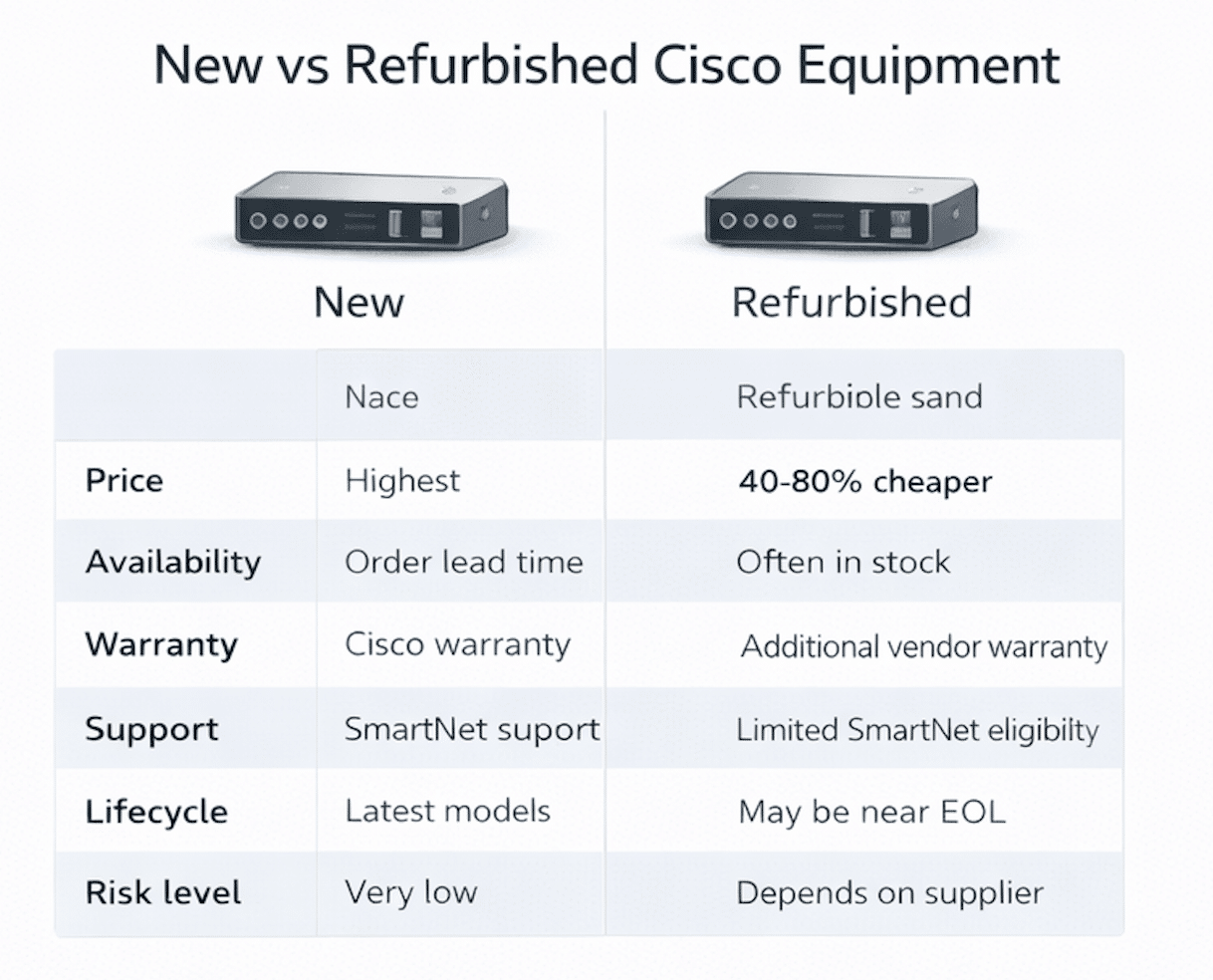
| Factor | New Cisco Equipment | Refurbished Cisco Equipment (Third-Party) |
| Price | Highest (Negotiated EA Discounts) | 40–80% cheaper than New Street Price |
| Availability | Often requires OEM manufacturing lead time | Usually in stock for next-day shipping |
| Warranty Coverage | Cisco Standard Limited Lifetime Warranty | Broker/Vendor specific warranty |
| SmartNet Eligibility | Fully supported and easily attachable | Limited / Subject to strict reinstatement penalties |
| Lifecycle Status | Latest generation models | May be approaching End of Life (EOL) |
| Risk Level | Very low (Secure supply chain) | Depends entirely on supplier reputation |
Cost Comparison: How Much Cheaper Is Refurbished Cisco?
The primary catalyst for exploring the secondary market is CapEx reduction. However, comparing the refurbished price to the manufacturer’s suggested retail price (MSRP) is misleading. Enterprises rarely pay MSRP; they pay a discounted “street price.”
Real Market Pricing Example
Even when calculating aggressive 45% to 55% enterprise discounts on new hardware, the grey market provides monumental savings. When you compare Cisco Catalyst switches, the true financial delta becomes clear.
| Device Model | New Street Price (Est. with Discount) | Refurbished Grey Market Price |
| Catalyst 9300 (48-Port PoE) | $4,500 | $1,500 |
| Catalyst 9200 (48-Port PoE) | $2,800 | $900 |
| ISR 4331 Router | $7,00 | $300 |
Note: Pricing is illustrative and fluctuates based on global supply chain availability.
Why Refurbished Cisco Hardware Is Cheaper
The massive price depreciation of enterprise IT hardware is driven by three primary factors:
- Enterprise Upgrade Cycles: Fortune 500 companies and government agencies refresh their entire networks every 3 to 5 years, flooding the secondary market with perfectly functional, mid-lifecycle hardware.
- Decommissioned Data Centers: Corporate mergers and the rapid migration to cloud services (AWS, Azure) result in the mass liquidation of physical on-premise infrastructure.
- Secondary Hardware Markets: Independent brokers operate with minimal overhead compared to Cisco, allowing them to sell acquired hardware at aggressive, volume-based margins.
Reliability: Is Refurbished Cisco Equipment Safe?
When IT directors ask, “Is refurbished Cisco safe?” they are generally inquiring about hardware failure rates. Will a used switch crash and bring down a critical corporate subnet? Statistically, refurbished enterprise-grade solid-state electronics are exceptionally robust.
Hardware Reliability and the “Bathtub Curve”
The failure rate of networking hardware follows a well-documented engineering principle known as the “Bathtub Curve.”
- Infant Mortality: Brand-new hardware experiences its highest failure rate during the first 30 to 90 days of operation due to microscopic manufacturing defects, poor solder joints, or faulty components that escaped factory Quality Assurance (QA).
- Useful Life: Once a device survives the infant mortality phase, its failure rate drops to near zero, remaining flat and stable for a decade or more.
- Wear-Out Phase: Failures only spike again at the extreme end of the hardware’s physical lifespan as capacitors dry out.
Because refurbished equipment has already been actively running in a climate-controlled data center for years, it has successfully bypassed the infant mortality phase. Mathematically, a properly tested refurbished switch is just as reliable as a brand-new unit pulled from a sealed box.
Enterprise Refurbishment Testing Standards
Reliability is directly tied to the vendor’s testing protocols. Elite secondary market vendors do not simply power on a switch to see if the lights blink. They utilize automated testing scripts that push line-rate traffic across every individual ASIC and physical port to ensure zero packet loss under heavy load.
When Refurbished Cisco Hardware Is Reliable
Refurbished hardware is remarkably reliable and perfectly suited for the following deployment scenarios:
- Access layer switches: Providing PoE to standard office VoIP phones and workstations.
- Lab environments: Allowing engineers to test complex BGP or OSPF routing configurations without risking production hardware.
- Branch networks: Cost-effectively connecting small, remote retail locations.
SmartNet Support: The Most Critical Enterprise Consideration
While the hardware may be reliable, the true value of enterprise networking lies in the support infrastructure. Understanding how a refurbished Cisco warranty interacts with official Cisco Technical Assistance Center (TAC) support is where many procurement strategies fail.
Can Refurbished Cisco Equipment Get SmartNet?
Yes, but the process is fraught with financial penalties. Cisco tightly regulates its support ecosystem to protect its primary sales channels. If you purchase grey market equipment, the original OEM warranty is immediately voided. You cannot simply log onto a portal and attach a SmartNet Total Care (SNTC) contract to a switch bought on eBay.
Cisco TAC Support Limitations
When attempting to place third-party refurbished hardware under official support, buyers trigger the Cisco Network Equipment Entitlement (NEE) Policy. Because the hardware has suffered a lapse in coverage (or changed ownership unauthorized by Cisco), Cisco will demand:
- A physical hardware inspection to ensure the device is not counterfeit.
- The retroactive purchase of valid software licenses.
- Heavy Reinstatement Penalties (backdating the contract to the date the original coverage lapsed).
By the time an enterprise pays the reinstatement penalties and inspection fees, the “cheap” refurbished switch often costs more than purchasing a brand-new unit.
Third-Party Maintenance vs Cisco SmartNet
To bypass Cisco’s punitive fees, many enterprises utilize Third-Party Maintenance (TPM) providers for their refurbished fleets.
| Support Type | Cisco SmartNet (SNTC) | Third-Party Maintenance (TPM) |
| TAC Access | Yes (Direct access to Cisco Engineers) | No |
| Firmware Updates | Yes (Critical zero-day security patches) | Limited (Only publicly available OS updates) |
| Hardware Replacement | Yes (4-Hour or Next Business Day) | Yes (Vendor dependent SLAs, often NBD) |
| Cost | Premium pricing | Highly discounted |
Cisco Licensing Issues With Refurbished Hardware
This is the largest blind spot in the secondary market today. The transition from legacy licensing to modern cloud-based subscriptions has fundamentally altered hardware ownership.
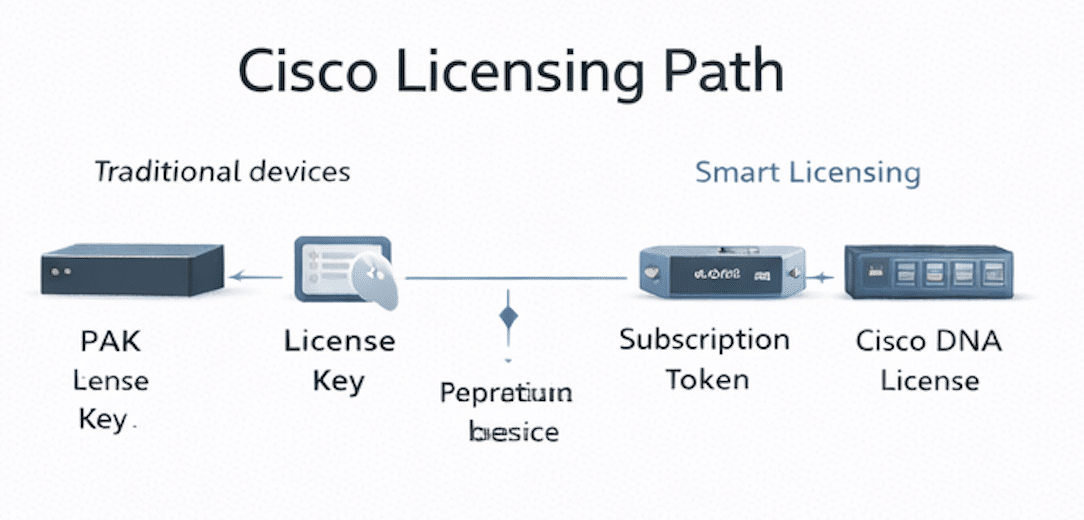
Right-to-Use vs Smart Licensing
Older generation switches (like the Catalyst 2960-X or 3750-X) utilized Right-to-Use (RTU) licensing. The software feature set was permanently burned into the physical hardware. When you bought a used switch, you automatically acquired its software capabilities.
Modern Cisco hardware architecture utilizes Smart Licensing Using Policy (SLP). Software entitlements are completely decoupled from the physical metal and are registered to a cloud-hosted Cisco Smart Software Manager (CSSM) account owned by the original purchasing corporation.
DNA Subscriptions and Catalyst 9000
If a broker sells you a refurbished Catalyst 9300 switch, they are only selling you a metal box. The DNA Essentials or DNA Advantage subscription required to utilize the switch’s routing features remains the property of the original owner. Cisco End User License Agreements (EULA) explicitly forbid transferring these licenses on the secondary market.
Why Licensing Can Break the Refurbished Value Model
If you deploy a grey-market Catalyst 9000 series switch, you must legally purchase brand-new DNA subscription licenses from Cisco to operate it. Because Cisco does not discount standalone software licenses for grey-market hardware, this requirement frequently destroys the financial value of buying refurbished. IT architects must deeply understand Cisco licensing mechanics before issuing a PO for any post-2018 hardware.
Security Risks: Counterfeit Cisco Hardware
Procuring hardware outside the authorized Cisco supply chain exposes the enterprise to severe, hardware-level cybersecurity threats.
How Counterfeit Cisco Devices Enter the Market
The threat of counterfeit hardware is not theoretical. In a landmark cybersecurity report, researchers at F-Secure discovered counterfeit Cisco Catalyst 2960-X switches operating within active enterprise networks. These counterfeits were visually perfect—featuring cloned holographic stickers and replicated PCB boards.
Crucially, the counterfeiters engineered a custom component that successfully bypassed Cisco’s Secure Boot authentication process. This allowed the counterfeit switches to run modified firmware, providing malicious threat actors with a permanent, undetectable physical backdoor into the enterprise data plane.
How to Verify Cisco Hardware Authenticity
To protect the network from supply chain attacks, administrators must execute strict zero-trust hardware validation on all secondary market devices:
- Cisco Serial Number Checker: Always verify Cisco serial numbers against official databases to identify cloned, blacklisted, or stolen hardware.
- SmartNet Coverage Lookup: Check if the serial number is already registered to another corporate entity’s CSSM portal.
- Trusted Suppliers: Only purchase from elite secondary market vendors that provide transparent chain-of-custody documentation and utilize advanced counterfeit detection imaging.
Lifecycle Considerations: EOL and EOSL
Refurbished hardware is heavily tied to the manufacturer’s lifecycle announcements. Buying outdated hardware can create severe compliance and security liabilities.
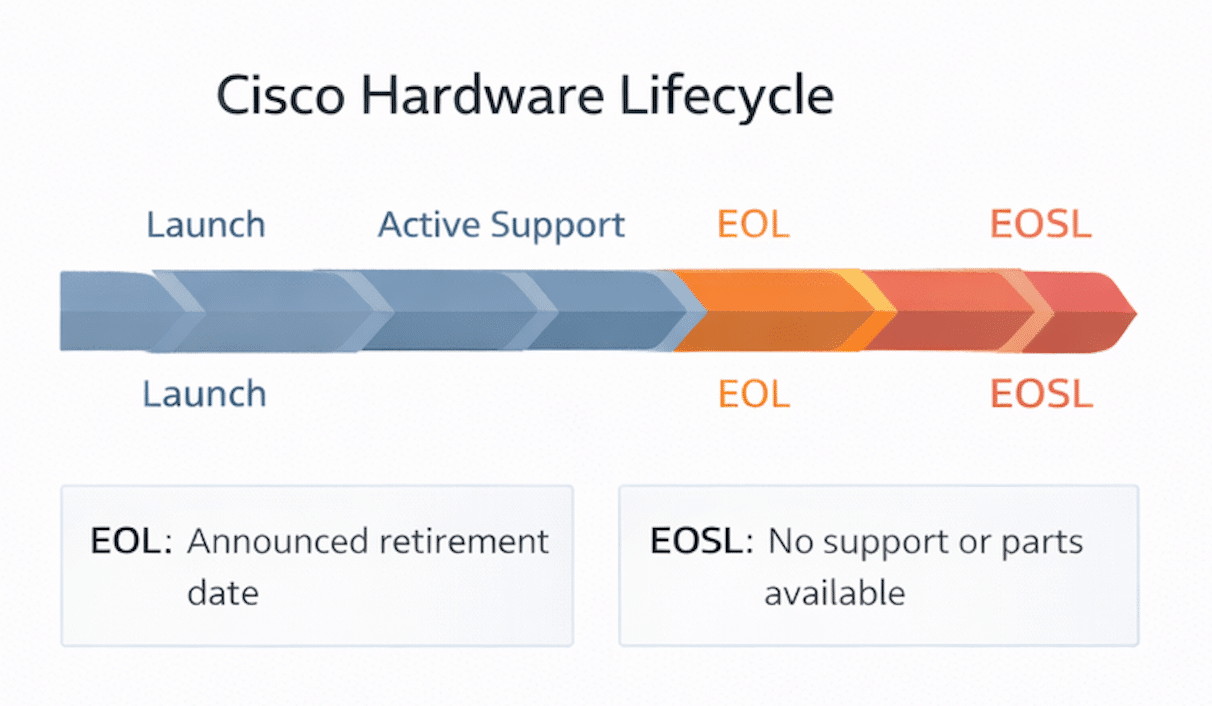
Cisco Product Lifecycle Explained
Every Cisco product goes through a strict lifecycle:
- End of Sale (EOS): The date the product can no longer be purchased new from Cisco.
- End of Software Maintenance (EoSW): Cisco stops releasing new features or bug fixes.
- End of Vulnerability/Security Support (EoVSS): Cisco stops issuing security patches for zero-day exploits.
- End of Support Life (EOSL): The hardware is entirely obsolete; Cisco TAC will no longer accept support tickets.
Risks of Buying Near-EOL Equipment
Purchasing refurbished hardware that has passed its EoVSS date is a critical security risk. If a new vulnerability is discovered in the IOS firmware, Cisco will not patch it, leaving your network permanently exposed to hackers.
How to Check Cisco EOL Status
Before integrating refurbished gear into your architecture, IT teams must proactively check Cisco device lifecycle status to ensure the hardware will receive security updates for the intended duration of its deployment.
Enterprise Deployment Strategy
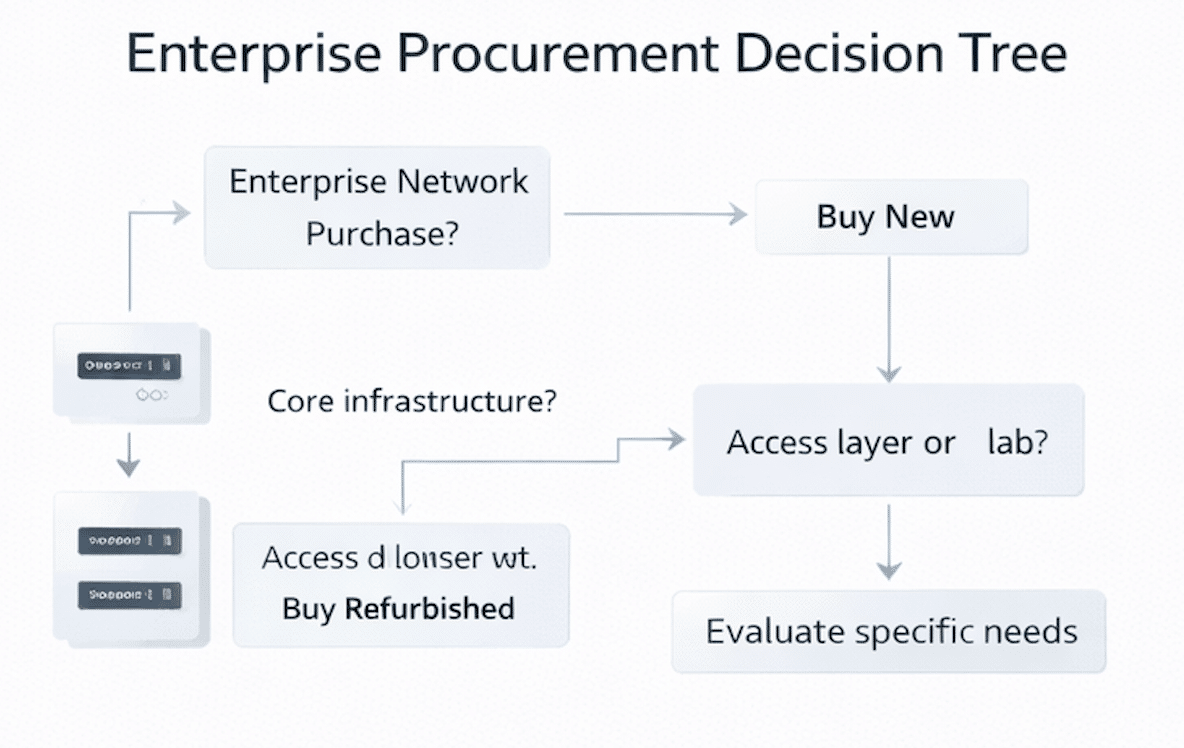
Enterprise networking is not a binary choice between “all new” or “all refurbished.” The most financially efficient organizations utilize a hybrid procurement strategy based on architectural risk.
Where Refurbished Cisco Equipment Works Best
- Access layer switches: Ideal for wiring closets providing basic connectivity to standard office endpoints.
- Spare hardware (“ShelfNet”): Keeping cheap, refurbished identical models on a shelf allows local IT staff to swap a dead switch in 15 minutes, entirely bypassing the 4-hour SmartNet delivery SLA.
- Test environments: Perfect for staging networks, QA labs, and engineer training racks.
Where New Cisco Hardware Is Recommended
- Core switches: The backbone of the data center (e.g., Nexus 9000, Catalyst 9600) where a failure halts the entire enterprise.
- Security appliances: Firewalls (Firepower/ASA) require constant, immediate access to zero-day threat intelligence and firmware patches from Cisco TAC.
- High-availability environments: Mission-critical hospital networks or financial trading floors where unhindered TAC support is non-negotiable.
Enterprise Procurement Decision Matrix
To simplify the sourcing strategy, utilize this decision matrix to align the deployment scenario with the optimal procurement path.
| Scenario / Network Layer | Recommended Option | Justification |
| Core network infrastructure | New | Absolute uptime required; unhindered TAC access is mandatory. |
| Access layer switches | Refurbished | Localized risk; massive CapEx savings across hundreds of edge ports. |
| Lab environments | Refurbished | No production traffic impact; OEM warranties are unnecessary. |
| Security appliances | New | Requires constant threat signature updates and firmware patching. |
| Cold spare hardware | Refurbished | Provides immediate physical redundancy faster than an SLA replacement. |
Frequently Asked Questions
Is refurbished Cisco equipment reliable?
Yes. High-quality refurbished Cisco equipment has already survived the “infant mortality” phase of electronics manufacturing. When procured from a reputable vendor that performs strict diagnostic burn-in testing, it is mathematically as reliable as brand-new hardware.
How much cheaper is refurbished Cisco hardware?
Refurbished Cisco hardware is typically 40% to 80% cheaper than the discounted “street price” of new hardware. Older generation equipment (like the Catalyst 3850) offers the deepest discounts, while current generation hardware (like the Catalyst 9300) commands a higher premium on the secondary market.
Can refurbished Cisco devices get SmartNet?
Yes, but it is rarely cost-effective for grey-market hardware. Cisco’s Network Equipment Entitlement (NEE) policy requires physical hardware inspections, the retroactive purchase of software licenses, and heavy reinstatement penalties to attach SmartNet to devices bought outside the authorized supply chain.
What is Cisco Refresh?
Cisco Refresh (notated by an “-RF” part number suffix) is Cisco’s official remanufacturing program. Unlike third-party grey market gear, Cisco Refresh equipment is restored at the factory, carries identical software licensing rights, and includes the exact same original manufacturer warranty and SmartNet eligibility as brand-new equipment.
Is buying used Cisco equipment safe?
Buying “used” equipment from unauthorized auction sites carries immense security risks, including the threat of sophisticated counterfeit hardware that can bypass Secure Boot. However, buying “refurbished” equipment from elite, vetted secondary market vendors who perform cryptographic data wiping and serial number verification is safe and standard practice for enterprise networks.
Layer23-Switch is an enterprise IT hardware supplier focused on Cisco networking equipment and practical infrastructure solutions. Through our resource center, we share straightforward guides, compatibility insights, and buying references to help IT teams, resellers, and business buyers make more confident network decisions.