Cisco Firepower 1000 vs 2100 vs 3100: Which Series Should You Choose?
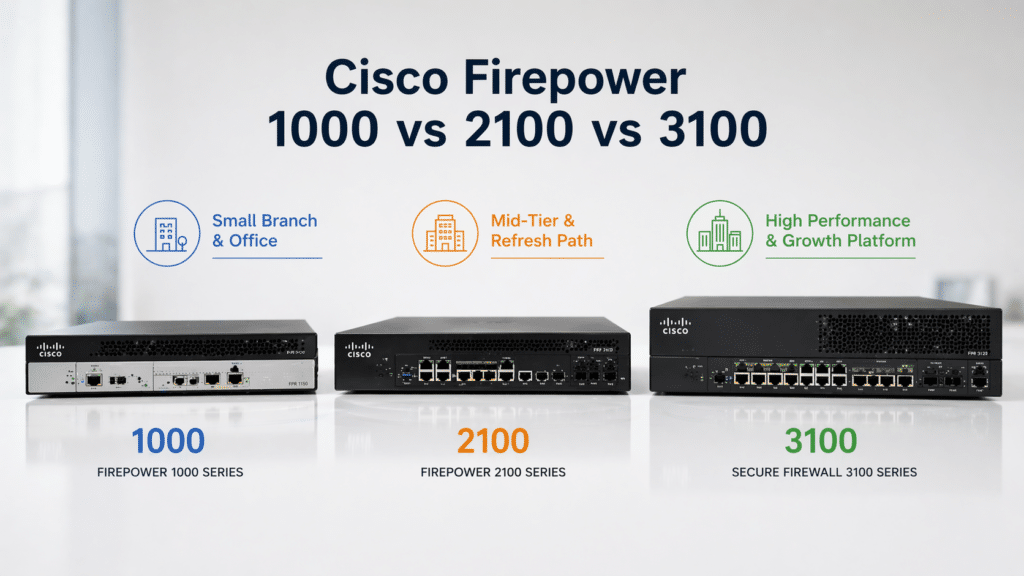
Small branch: start with Firepower 1000.
Installed-base refresh: Firepower 2100 may still belong in the shortlist.
Growth-focused branch or regional edge: move to Secure Firewall 3100.
That is the fastest accurate answer for most buyers. Cisco positions Firepower 1000 for small offices and remote branches, while Secure Firewall 3100 is positioned higher for hybrid work, internet edge, private cloud, and larger-scale growth. Firepower 2100 is still relevant in real-world estates, but Cisco has already put the family into end-of-sale status, with end of support set for May 31, 2030, and Cisco’s 7.6 release path no longer includes 2110, 2120, 2130, or 2140.
So this is not just a throughput comparison. The real question is whether your project is a small branch problem, a legacy refresh problem, or a growth-platform problem. That is also why this page works best inside a broader Cisco firewall comparison content cluster instead of as a generic spec roundup.
Quick answer: which Cisco Firepower series fits your deployment?
Choose Firepower 1000 when the site is clearly branch-sized, budget-aware, and unlikely to outgrow a lighter platform quickly. Cisco’s official material places the 1000 family in small office, remote branch, and branch-office use cases, and Cisco’s current product page continues to position the 1150 as a branch-office productivity firewall.
Consider Firepower 2100 mainly when the project starts from an existing 2100 or older Firepower path, an established procurement standard, or a mid-tier refresh requirement where continuity matters more than moving to Cisco’s newer platform tier. Cisco’s lifecycle page lists the family as end of sale, and Cisco’s release notes say 2110, 2120, 2130, and 2140 cannot run Version 7.6 or later.
Move to Secure Firewall 3100 when the site is larger, more strategic, or more likely to grow in VPN demand, inspection load, segmentation, or lifecycle complexity. Cisco positions 3100 for hybrid work, stronger VPN performance, internet edge, and private cloud, and Cisco documents multi-instance and clustering on the 3100 path.
To compare exact appliances within these series, use our Cisco firewall comparison tool to review security throughput, VPN performance, interfaces and connection capacity.
Cisco Firepower 1000 vs 2100 vs 3100 at a glance
| Series | Best fit | Typical role | Why buyers choose it | When it becomes the wrong choice |
|---|---|---|---|---|
| Cisco Firepower 1000 | Small branch, small office, lighter edge | Entry branch firewall path | Lower footprint, branch-friendly sizing, practical starting point | When the site needs much more lifecycle headroom or becomes a heavier regional edge |
| Cisco Firepower 2100 | Installed-base refresh, legacy-standard mid-tier edge | Transition / refresh path | Familiarity, continuity, existing standards | When you want a clearly newer long-term platform path |
| Cisco Secure Firewall 3100 | Larger branch, regional edge, growth-focused enterprise edge | Higher-tier modern growth platform | More performance, stronger VPN scale, multi-instance and clustering options | When the site is genuinely small and likely to stay that way |
The key point is that these three series do not play the same role in a 2026 shortlist. Firepower 1000 is still a real branch answer, 2100 is increasingly a lifecycle-context answer, and 3100 is the platform you shortlist when the site is likely to grow or carry more strategic load over time. Cisco’s product and support pages make that hierarchy much easier to justify than many older comparison pages do.
Main models covered in this comparison
This guide focuses on the main models that most buyers actually shortlist rather than every possible SKU variation.
| Series | Main models in this guide | Best fit |
|---|---|---|
| Firepower 1000 | FPR1010, FPR1120, FPR1150 | Very small to standard branch, lighter edge |
| Firepower 2100 | FPR2110, FPR2120, FPR2130 | Mid-tier refresh, established edge, legacy-standard paths |
| Firepower 3100 | FPR3105, FPR3110, FPR3120 | Growth-focused branch, regional edge, stronger long-term headroom |
Cisco’s 1000 data sheet lists 1010, 1120, 1140, and 1150 as the family appliances. Cisco’s 2100 data sheet lists 2110, 2120, 2130, and 2140. Cisco’s 3100 hardware overview lists 3105, 3110, 3120, 3130, and 3140 in the lineup. Focusing on the nine models above keeps the article practical without turning it into a spreadsheet.
What each series is actually best for
Firepower 1000: small branch and lighter edge
Cisco’s 1000 family is the most straightforward fit when the deployment is clearly branch-sized. The official data sheet says it addresses small offices and remote branches, and Cisco’s SMB material describes it as designed for smaller offices and branch offices. Cisco’s current product page keeps the 1150 explicitly in that branch-oriented role.
That makes Firepower 1000 the right series when the site has predictable traffic, ordinary branch inspection requirements, and no strong sign that it will soon become a more demanding regional or multi-role edge location.
Firepower 2100: mid-tier path with stronger legacy relevance
Firepower 2100 still matters, but not in the same way it once did. Cisco still maintains support and lifecycle material for the family, and many environments still run it. But Cisco now lists the family as end of sale, and its newer software path is narrowing further because Version 7.6 and later do not support 2110, 2120, 2130, or 2140.
That changes how 2100 should be evaluated. In a modern buying guide, 2100 is best understood as a refresh-era shortlist rather than a default new-project recommendation. It makes sense when the installed base already points there, when procurement policy still aligns to that family, or when continuity matters more than moving to a clearly newer platform tier.
Secure Firewall 3100: the stronger modern growth platform
Cisco’s current 3100 story is much more future-facing. The data sheet calls it a family of threat-focused security appliances built for multiple firewall use cases. The product page emphasizes hybrid work, faster VPN performance, and stronger return on investment. Cisco’s technical docs also document multi-instance mode and clustering, which places 3100 in a different scale class than a straightforward branch appliance.
So in practical terms, 3100 is the platform you shortlist when you want more than “enough for today.” It is the stronger answer for larger branches, regional edge roles, heavier remote-access use cases, and deployments where the business would rather buy more platform runway now than reopen the decision too early.
When Firepower 1000 is the right choice
Firepower 1000 is the right answer when the project is genuinely branch-first and likely to stay that way.
Very small branch and low-demand edge
If the site is a very small office, a small remote site, or a lighter internet edge with limited complexity, FPR1010 is the most natural starting point. Cisco lists the 1010 as the smallest appliance in the family, and the family itself is aimed at small offices and remote branches.
Standard branch that still needs to stay cost-aware
If the site is a more typical branch and you need a sturdier starting point than the very bottom of the family, FPR1120 is usually the more realistic entry model. Cisco’s current product page places the 1120 at 2.3 Gbps NGFW throughput and keeps it in the same branch-oriented family.
Branch projects that need more room without leaving the family
When the site is still branch-led but you want more headroom before stepping out of the 1000 family, FPR1150 is the stronger upper end of this path. Cisco markets the 1150 as improving productivity for branch offices and lists 4.9 Gbps NGFW throughput on the current product page.
The important point is not just the number. It is that 1150 is often where buyers should stop and ask whether they are still solving a branch problem or whether they are starting to solve a growth-platform problem.
When Firepower 2100 still makes sense
This is the section many competing articles get wrong. Firepower 2100 still belongs in some shortlists, but its role has changed.
Installed-base refresh projects
If the project starts from existing 2100 appliances or adjacent older Cisco firewall standards, the 2100 family can still make sense as part of a refresh discussion. In that context, FPR2110, FPR2120, and FPR2130 are not being evaluated as brand-new strategic bets; they are being evaluated as continuity options.
Existing mid-tier firewall standards
Some organizations are not choosing from a blank page. They already have processes, support structures, spares strategy, or operational familiarity aligned to 2100. In those environments, 2100 can still appear in a shortlist for rational reasons even if it is no longer Cisco’s active forward-selling family. Cisco’s lifecycle pages show support runway through 2030.
Projects that sit between branch-class entry and a modern growth platform
This is the hardest judgment call. If the project is too large for a comfortable 1000-series answer but still being assessed through a legacy-standard lens, 2100 may still show up. But this is exactly where many net-new buyers should ask a harder question: am I choosing 2100 because it is truly the best fit, or because it is the most familiar middle step?
When you should move straight to Secure Firewall 3100
This is where many modern projects should land sooner than they expect.
Larger branch and regional edge deployments
If the site is already a large branch, a regional office, or an edge location carrying more business-critical traffic, FPR3105 and FPR3110 are often more realistic starting points than forcing the project into an older or lighter family. Cisco’s 3100 family overview and installation docs position 3105, 3110, and 3120 inside a platform built for higher-end roles.
Growth-focused environments
If the site is likely to add more remote users, more encrypted traffic, more segmentation, or more security services over time, 3100 is often the safer long-term choice. Cisco’s hybrid-work and VPN positioning reinforces that 3100 is meant to support more demanding edge evolution, not just higher throughput.
Projects where platform headroom matters more than lowest entry cost
A cheaper firewall is not always the cheaper decision. If the business is likely to push the site into a heavier role within the lifecycle of the deployment, buying the lowest acceptable platform class can create a second selection project sooner than expected. This is exactly where 3100 earns its place.
When the site is still called a branch, but no longer behaves like one
This is one of the most useful real-world tests. If a site is called a branch internally but behaves more like a regional edge node, a user aggregation point, or a remote-access concentration site, it should not be selected like a small branch firewall. In that case, FPR3110 or FPR3120 usually makes more sense than stretching a lower platform tier.
Which model range makes the most sense?
Most buyers do not start with a model. They start with a deployment shape. The model shortlist only makes sense after the series choice is already clear.
| If your project looks like this | Most likely starting point |
|---|---|
| Very small branch or light edge | FPR1010 or FPR1120 |
| Standard branch with more room to grow | FPR1150 |
| Mid-tier refresh or existing 2100 path | FPR2110 / FPR2120 / FPR2130 |
| Growth-focused branch or regional edge | FPR3105 / FPR3110 |
| Stronger long-term capacity planning | FPR3120 |
This is the most practical model view for real buying. It avoids two common mistakes: choosing purely by performance tables, and forcing every project through the same platform ladder.
The real buying question: small branch, legacy refresh, or growth platform?
If the project is a small branch question, Firepower 1000 is usually the best place to start. Cisco’s own branch positioning for the family is too clear to ignore.
If the project is a legacy refresh question, Firepower 2100 may still belong in the shortlist, especially where the installed base or procurement standards still point there. But it should be treated as a lifecycle-context choice, not automatically as the best modern platform path. Cisco’s lifecycle and software-support pages make that distinction unavoidable now.
If the project is a growth platform question, Secure Firewall 3100 is usually the stronger answer. This is also where management model matters more. If you expect centralized operations, broader policy control, and multi-device administration, pair this shortlist logic with our Cisco FDM vs FMC guide instead of treating hardware choice and management choice as separate afterthoughts.
Our recommendation
Choose Firepower 1000 if the site is clearly small branch or lighter edge and the project needs a right-sized physical firewall rather than a larger growth platform.
Consider Firepower 2100 if the project starts from an existing 2100 or related legacy path and continuity still matters. But be realistic about its lifecycle position and software runway before treating it as the default answer.
Move to Secure Firewall 3100 if the environment is larger, more strategic, more growth-sensitive, or more likely to move beyond normal branch scope over the firewall lifecycle.
Do not compare these three series only by raw performance numbers. Compare them by site role, growth risk, operational model, and platform lifecycle. If your project also needs a software-path decision, review Cisco ASA vs FTD Differences. If it is refresh-driven, continue with ASA to FTD Migration Guide.
FAQ
What is the difference between Firepower 1000, 2100, and 3100?
Firepower 1000 is the branch-oriented entry family. Firepower 2100 is now best treated as a legacy-refresh or continuity path. Secure Firewall 3100 is the stronger modern platform for larger branch, regional edge, and enterprise growth.
Is Firepower 2100 still worth buying?
Sometimes, yes. It can still make sense in refresh and continuity-driven environments. But it is no longer the same kind of net-new recommendation it once was because Cisco lists it as end of sale and excludes 2110/2120/2130/2140 from Version 7.6 and later.
Should I choose Firepower 2100 or move directly to 3100?
If the project is mainly a legacy refresh, 2100 can still belong in the shortlist. If it is a net-new growth deployment, 3100 is usually the stronger long-term choice because it sits on Cisco’s newer higher-tier platform path.
Is Secure Firewall 3100 too much for a branch office?
For a normal small branch, often yes. For a larger branch, regional office, or growth-heavy site, often no. The better question is whether the site still behaves like a small branch.
Which Firepower model is best for a growing branch?
In many cases, start at FPR1150 if the site is still solidly in the branch class, but move quickly to FPR3105 or FPR3110 if the site needs stronger long-term headroom or regional-edge capability.
What is the best starting model in each series?
A practical starting set is FPR1010 or FPR1120 for very small branch, FPR2110 for legacy-path refresh evaluation, and FPR3105 or FPR3110 for growth-focused branch and regional-edge planning. Cisco’s family pages and hardware docs support those roles inside each lineup.