Cisco vs Aruba Switches: Enterprise Campus Comparison, Licensing, and Buyer Guide
When comparing Cisco vs Aruba switches for enterprise networks, Cisco Catalyst leads in massive scalability, deep proprietary feature sets like SD-Access, and legacy infrastructure integration. HPE Aruba CX excels in operational simplicity, cloud-native management via Aruba Central, and vendor-agnostic security. Choosing between them depends entirely on your engineering expertise, cloud readiness, and software licensing budget.
For enterprise network architects and IT decision-makers, evaluating Cisco versus HPE Aruba Networking is no longer a simple hardware bake-off based on port density or switching capacity. Both vendors produce exceptional, non-blocking silicon capable of driving modern campus networks. The core differences lie in their architectural ecosystems and business models. Cisco relies on ecosystem depth, driving end-to-end policy integration that rewards larger enterprises willing to standardize strictly on Cisco architecture. Aruba, conversely, champions operational simplicity and lower friction, offering a highly programmable, cloud-native approach that integrates seamlessly into multi-vendor environments.
This guide strips away the marketing jargon to provide a decisive, analyst-level comparison of architecture, management platforms, licensing models, and Total Cost of Ownership (TCO) to help you make the right procurement decision.
Cisco vs Aruba Switches: Key Differences at a Glance
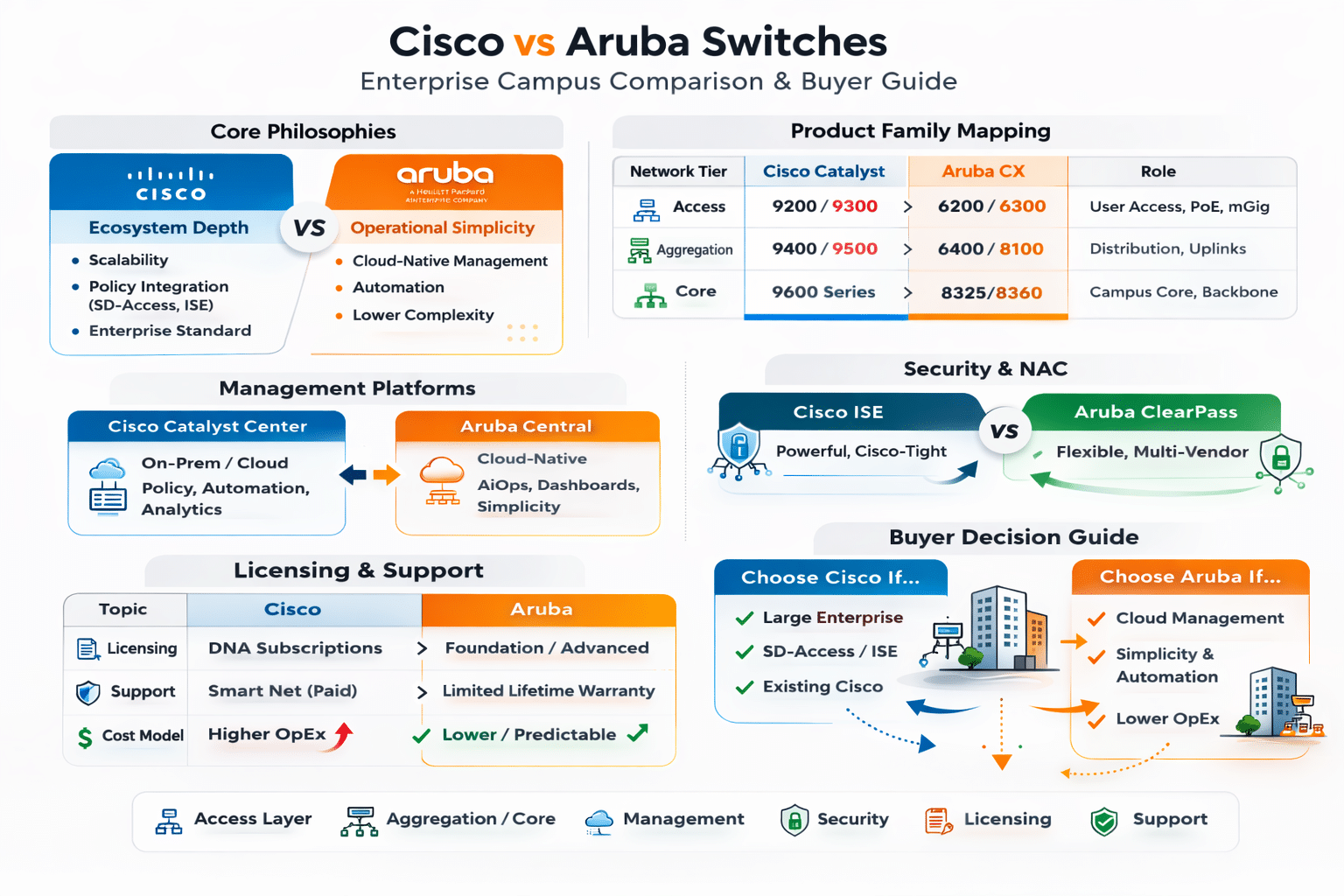
At the highest architectural level, Cisco and Aruba operate on fundamentally different design philosophies. Cisco builds highly integrated, top-down fabrics where the network, identity engine, and management appliance are deeply intertwined. Aruba focuses on edge-to-cloud agility, utilizing a microservices-based operating system designed to simplify Day 2 operations and reduce administrative overhead.
High-Level Differences Comparison
| Feature | Cisco Catalyst Enterprise Campus | HPE Aruba CX Enterprise Campus |
| Operating System | Cisco IOS XE (Monolithic with modular processes) | Aruba AOS-CX (Database-driven, microservices-based) |
| Management Platform | Cisco Catalyst Center (Historically on-prem heavy, transitioning to cloud) | Aruba Central (Cloud-native SaaS, AIOps driven) |
| NAC Platform | Cisco ISE (Extremely powerful, highly Cisco-optimized) | Aruba ClearPass (Industry-leading multi-vendor compatibility) |
| Licensing Model | Mandatory DNA Subscriptions (Essentials / Advantage) | Aruba Foundation / Advanced (More flexible term models) |
| Default Support | Standard 90-day software; heavily reliant on paid Smart Net | Limited Lifetime Warranty (LLW) highly advantageous at the edge |
Cisco Catalyst vs Aruba CX: Product Family Mapping
To accurately design a campus refresh, buyers must map the hardware tiers. Both vendors have consolidated their legacy product lines into unified families: Cisco’s Catalyst 9000 series and Aruba’s CX series.
While Cisco IOS XE is a mature, feature-rich evolution of classic IOS, Aruba AOS-CX was built from the ground up as a modern, database-driven operating system. Every state change in an Aruba CX switch is recorded in an in-memory database, making it incredibly responsive to Python scripts, REST APIs, and automated telemetry.

Enterprise Switch Family Mapping Table
| Network Tier | Cisco Catalyst Family | HPE Aruba CX Family | Typical Campus Role |
| Edge / Access | Catalyst 9200 Series | Aruba CX 6200 Series | Basic branch access, standard PoE+ VoIP/data deployments |
| Advanced Access | Catalyst 9300 Series | Aruba CX 6300 Series | High-density mGig, 90W PoE++, physical stacking, edge routing |
| Distribution / Aggregation | Catalyst 9500 (Fixed) / 9400 (Modular) | Aruba CX 8100 / 6400 (Modular) | Fiber aggregation, routing boundary, L2/L3 policy enforcement |
| Campus Core | Catalyst 9600 Series | Aruba CX 8325 / 8360 / 6400 | High-availability backbone, massive 40G/100G routing capacity |
(Note: Deep model-by-model evaluations, such as Catalyst 9300 vs CX 6300, require specific port-level and ASIC analysis, but the architectural intent of these families perfectly mirrors one another).
Cisco vs Aruba for Campus Access Layer Deployments
At the campus access layer, hardware capabilities between the two vendors are largely at parity. Both the Catalyst 9000 and Aruba CX 6000 series offer robust support for multi-gigabit (mGig) Ethernet and IEEE 802.3bt PoE++ (up to 90W per port) to power Wi-Fi 6E/7 access points and smart building IoT devices.
The differentiation lies in operational simplicity and stacking architecture. Cisco relies on its proven StackWise technology, utilizing dedicated backplane cables to fuse up to eight Catalyst switches into a single logical entity with a massive backplane capacity. Aruba CX utilizes Virtual Switching Framework (VSF) via standard front-panel uplink ports (10G/25G/50G). While VSF does not require proprietary stacking cables—lowering procurement complexity—Cisco’s hardware-level StackWise often provides slightly faster stateful failover times in mission-critical edge environments.
Cisco vs Aruba for Distribution and Campus Core Networks
When moving up to the distribution and campus core, resiliency, scale, and routing protocols become the primary decision factors. Both vendors offer a mix of fixed-configuration 1RU/2RU switches and massive modular chassis (Catalyst 9400/9600 vs Aruba CX 6400).
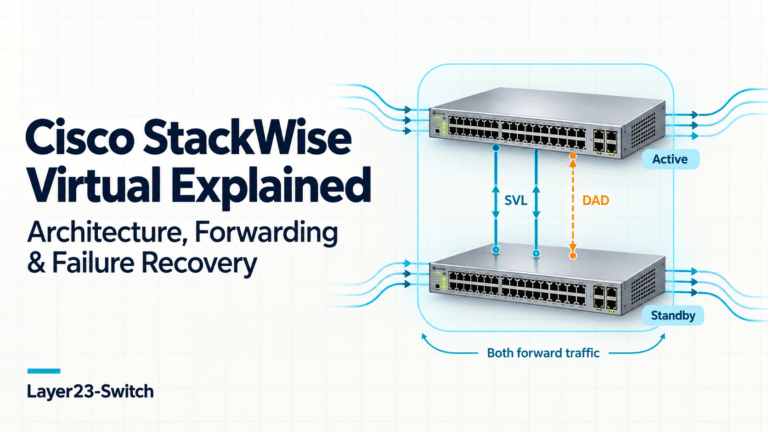
- Cisco High Availability: Cisco dominates traditional enterprise cores using StackWise Virtual (SVL) on fixed switches or Quad-Supervisor redundancy in their modular chassis. Cisco’s ASICs (UADP and Silicon One) are legendary for their deep buffers and hardware-level traffic shaping.
- Aruba High Availability: Aruba CX utilizes Virtual Switching Extension (VSX) in the core. Unlike traditional stacking where the control plane is shared (creating a single point of software failure during upgrades), VSX keeps the control planes separate while synchronizing the data planes. This allows for true zero-downtime firmware upgrades (ISSU) in the core, a feature that network architects heavily favor for reducing weekend maintenance windows.
Cisco SD-Access vs Aruba Dynamic Segmentation
Enterprise campus fabric design is where the architectural philosophies diverge most aggressively.
Cisco SD-Access (Software-Defined Access) relies on a complex fabric of LISP (Locator/ID Separation Protocol) for the control plane, VXLAN for the data plane, and Cisco TrustSec (SGTs) for policy. It requires Cisco Catalyst Center (DNA Center) and Cisco ISE to function. When fully deployed, it is an incredibly powerful, micro-segmented fortress. However, it requires a massive engineering lift, strict adherence to Cisco-only hardware, and significant professional services to design and maintain.
Aruba Dynamic Segmentation takes a simpler, controller-driven approach. It utilizes User-Based Tunneling (UBT) to dynamically tunnel edge switch traffic directly to an Aruba gateway/controller or enforce policies locally via CX switches. ClearPass handles the identity profiling. This approach achieves excellent micro-segmentation and role-based access control (RBAC) without requiring the business to re-architect its entire IP routing topology or deploy complex LISP/VXLAN fabrics across the campus.
Cisco Catalyst Center vs Aruba Central: Management Platform Comparison
The shift from CLI management to centralized UI/API orchestration is a major driver of campus upgrades.
| Management Feature | Cisco Catalyst Center (DNA Center) | HPE Aruba Central |
| Deployment Model | Historically On-Premises appliance; transitioning to virtual/cloud | Native Cloud SaaS (On-prem options available but cloud is primary) |
| Operational Model | Highly structured, strictly templated, fabric-focused | Agile, highly intuitive, excellent for multi-site deployments |
| Visibility & AIOps | Deep packet-level telemetry; excellent for Cisco-only environments | Industry-leading AIOps; extremely fast time-to-resolution for issues |
| Learning Curve | Steep; requires dedicated training and workflow adaptation | Shallow; highly intuitive interface preferred by leaner IT teams |
Aruba Central frequently wins head-to-head evaluations based on usability. Its AIOps engine is widely considered more intuitive for Day 2 troubleshooting. Cisco Catalyst Center is a heavier, more rigid platform, but it offers unparalleled depth for telemetry and compliance if an organization has the engineering talent to harness it.
Cisco ISE vs Aruba ClearPass: Policy, Identity, and Access Control
Network Access Control (NAC) is frequently the deciding factor in a switch procurement battle.
Cisco ISE (Identity Services Engine) is the undisputed heavyweight of the NAC industry. It is deeply integrated into the Cisco ecosystem and is a mandatory component for SD-Access. However, ISE is notoriously complex to design, deploy, and troubleshoot. It operates best in a homogenized Cisco environment.
Aruba ClearPass is widely regarded as the “Swiss Army Knife” of NAC. It is highly respected by network architects for its vendor-agnostic compatibility. You can seamlessly authenticate Cisco switches, Aruba APs, and Palo Alto firewalls using the same ClearPass cluster. For enterprises with mixed-vendor environments or those migrating away from legacy hardware, ClearPass offers significantly smoother onboarding and policy depth without the operational friction of ISE.
Cisco DNA Licensing vs Aruba Foundation and Advanced Licensing
Software licensing has become the most contentious topic in enterprise networking procurement.
| Licensing Metric | Cisco Catalyst (DNA Licensing) | Aruba CX (Central Licensing) |
| Licensing Approach | DNA Essentials or DNA Advantage | Foundation or Advanced |
| Subscription Dependency | Mandatory subscription required at purchase (3, 5, or 7 years) | Subscription required for Aruba Central management features |
| Perpetual Baseline | Network Essentials/Advantage remains if DNA expires | Switch hardware features remain active indefinitely |
| Cost Predictability | High initial Opex; rigid renewal enforcement | More flexible; less punitive if cloud management is dropped |
Cisco’s mandatory DNA licensing has faced buyer resistance. Even if an enterprise does not intend to use Catalyst Center, they must purchase a DNA subscription to acquire the hardware. While the base switching features (Network Advantage) continue to function after the DNA license expires, the mandatory initial Opex increases the Total Cost of Ownership (TCO).
Aruba offers a cleaner model. While Aruba Central requires subscriptions (Foundation/Advanced), the core AOS-CX software is fully featured out of the box. Buyers generally find Aruba’s software pricing to be more transparent and less punitive during renewal cycles.
Cisco Smart Net vs Aruba Limited Lifetime Warranty
Do not overlook hardware warranties when calculating TCO for a 5-to-7-year campus deployment.
Aruba provides a Limited Lifetime Warranty (LLW) on its campus access switches. This includes Next Business Day (NBD) hardware replacement and access to major AOS-CX software updates for the life of the product without requiring an ongoing support contract. For a campus with hundreds of edge switches, omitting paid support at the edge saves millions in Opex.
Cisco provides only a limited 90-day software warranty. To receive firmware updates, TAC support, and NBD hardware replacement, enterprises must purchase Cisco Smart Net Total Care. While Smart Net is arguably the best technical support organization in the world—and absolutely necessary for core switches requiring 4-hour replacement SLAs—applying Smart Net to every access switch in a campus drastically inflates the lifetime cost of the network.
Migration Risks and TCO: Switching from Cisco to Aruba
For organizations running legacy Cisco Catalyst (e.g., 2960-X, 3850), migrating to Aruba CX is an attractive financial proposition, but it carries human and operational risks.
- CLI and Operations: Moving from Cisco IOS to Aruba AOS-CX requires retraining. While AOS-CX has a CLI that is somewhat familiar, the underlying architecture, spanning tree defaults, and configuration contexts are different.
- Talent and Certification: The enterprise talent pool is saturated with CCNA/CCNP certified engineers. Finding engineers with Aruba (ACMP/ACSP) certifications is harder. Switching vendors means investing in retraining your current staff.
- Mixed-Environment Friction: Migrating a campus takes time. Running Cisco Core switches with Aruba Access switches means your network automation tools must support multi-vendor APIs, and your operational team must troubleshoot two different operating systems simultaneously until the migration is complete.
When calculating TCO, you must factor in the cost of operational retraining and potential migration downtime, not just the hardware discount applied to the Aruba Bill of Materials.
Which Is Better for Your Business: Cisco or Aruba?
There is no universal winner; the right choice depends on your organization’s IT maturity, budget, and operational philosophy.
Choose Cisco Catalyst if:
- You operate a massive, highly complex enterprise that requires the absolute highest scale of routing and fabric integration (SD-Access).
- You already have a deep investment in Cisco ISE, Cisco DNA Center, and CCIE-level engineering talent.
- You require strict, top-down standardization and prefer a single-vendor throat to choke for support (Cisco TAC).
Choose HPE Aruba CX if:
- You want to reduce operational friction and prefer an intuitive, cloud-native management experience via Aruba Central.
- You operate a multi-vendor environment and need a flexible, highly compatible NAC solution like ClearPass.
- You are highly sensitive to mandatory recurring licensing costs and want to leverage Limited Lifetime Warranties to reduce edge TCO.
Cisco vs Aruba Switches FAQs
Is Aruba better than Cisco switches?
Neither is universally “better.” Aruba is often considered better for operational simplicity, cloud management, and licensing costs. Cisco is considered better for massive enterprise scalability, complex routing protocols, and organizations requiring a highly integrated, single-vendor security fabric.
What is the Aruba equivalent of Cisco Catalyst?
The HPE Aruba CX family is the direct equivalent to the Cisco Catalyst 9000 family. Specifically, the Aruba CX 6200/6300 series competes with the Catalyst 9200/9300 at the access layer, while the Aruba CX 6400 and 8000 series compete with the Catalyst 9400/9500/9600 in the core.
Is Cisco more expensive than Aruba?
Generally, yes. While initial hardware discounts can be highly competitive between both vendors, Cisco’s Total Cost of Ownership (TCO) is usually higher due to mandatory DNA subscription licensing and the ongoing requirement for Smart Net support contracts for firmware and hardware replacement.
Can Aruba switches replace Cisco in enterprise networks?
Yes. Aruba CX switches utilize industry-standard routing and switching protocols (OSPF, BGP, 802.1Q, LACP) and can seamlessly replace or interoperate with legacy Cisco Catalyst switches in any standard enterprise campus or data center environment.
Is Aruba AOS-CX similar to Cisco IOS?
While both use a Command Line Interface (CLI), they are architecturally different. Cisco IOS XE is a mature, monolithic OS with modular processes. Aruba AOS-CX is a modern, database-driven, microservices-based operating system designed specifically for high-speed API programmability and automated telemetry.