Cisco Catalyst IE9300 Rugged Series Guide: Models, PoE, Licensing & SFP
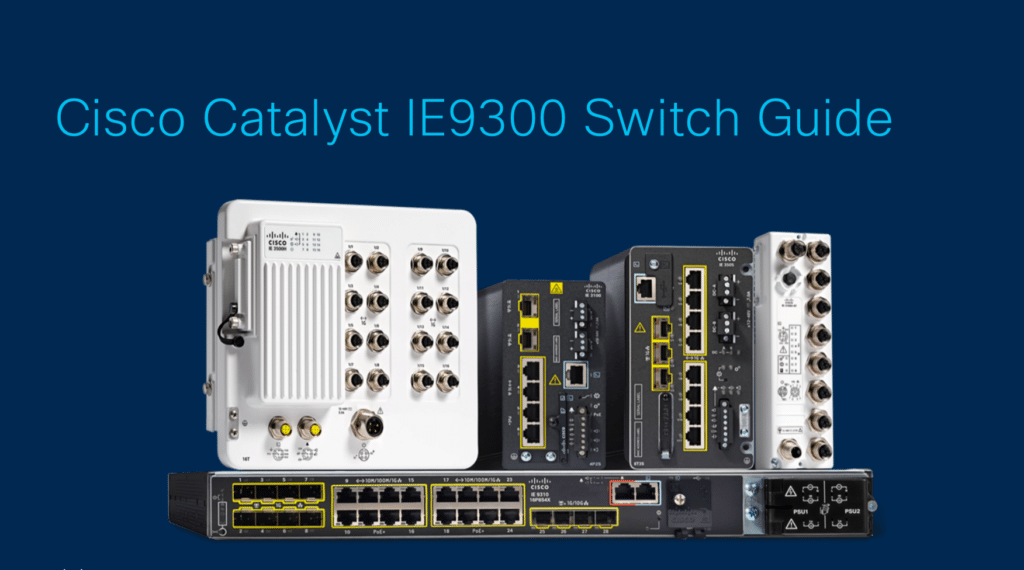
The Cisco Catalyst IE9300 Rugged Series is a family of eight hardened, stackable rackmount switches that bring Cisco IOS XE and enterprise-grade switching into substations, utility yards, roadside cabinets, and other harsh operational-technology (OT) environments. It occupies a specific niche: a 1RU industrial switch with the port density, 10-gigabit uplinks, and stacking of a data-center access switch, packaged for −40°C to +75°C fanless operation and certified to substation standards such as IEC 61850-3 and IEEE 1613.
Choosing the right IE9300 is not a matter of price alone. Three platform-level decisions — port media and PoE capacity, uplink speed, and redundancy-protocol support — narrow the field, and each is constrained to specific SKUs. This guide compares all eight models, explains the PoE budget mathematics that govern power-supply selection, decodes Network Essentials versus Network Advantage licensing by network role, and details SFP optics compatibility including the temperature-derating and timing caveats that affect a real bill of materials. The data reflects Cisco’s published IE9300 specifications; engineering context is drawn from the relevant IEC and IEEE standards. Confirm the exact configuration against the current Cisco data sheet before ordering.
What Is the Cisco Catalyst IE9300 Rugged Series?
The Cisco Catalyst IE9300 is Cisco’s hardened, high-performance rackmount industrial Ethernet switch line, positioned above the compact DIN-rail IE3000-series and as the modern successor to the rackmount IE5000 and IE4010. Where the Cisco IE3300, IE3400, and IE3500 rugged families target machine-level and in-cabinet deployments on a DIN rail, the IE9300 is built for the aggregation and distribution layer of an industrial network — the point where dozens of field connections converge and uplink into the core.
Three design choices define the platform. First, it runs the same Cisco IOS XE as Cisco’s enterprise Catalyst switches, which unifies the operating model, security architecture (Secure Boot, image signing, the Trust Anchor module), and automation tooling (NETCONF, RESTCONF, YANG, IOx application hosting) across IT and OT. Second, it is environmentally hardened and conduction-cooled, with no fans or moving parts, so it tolerates the temperature extremes, vibration, and contamination of substations and trackside enclosures. Third, it is stackable on the IE-9320 variants, allowing several switches to operate and be managed as a single logical unit — a capability rare in ruggedized switching and valuable where rack space and management overhead are both constrained.
The series is aimed squarely at electric utilities, transportation and intelligent transportation systems (ITS), oil and gas, and large manufacturing aggregation. Its certification profile — IEC 61850-3 and IEEE 1613 for electric power substations, plus Class I Division 2 / ATEX / IECEx ratings for hazardous locations — is what separates it from a standard enterprise access switch and what makes model selection a compliance decision as much as a technical one.
Cisco IE9300 Models Compared: All 8 SKUs, Ports, and Specs
The IE9300 range divides into three functional groups: SFP-based aggregation switches, copper PoE access switches, and a multigigabit high-power-PoE switch. All eight share a 28-port, 1RU rugged chassis with dual field-replaceable power supplies, conduction cooling, four alarm inputs and one output, and IEEE 1588v2 PTP on every port. They diverge on downlink media, PoE capability, uplink speed, and — critically — which support PRP/HSR redundancy and stacking. The matrix below maps each model to those variables.
Cisco IE9300 Series Specs at a Glance
| Model | Downlink ports | PoE budget | Uplinks | PRP/HSR | Stackable | Base power draw |
|---|---|---|---|---|---|---|
| IE-9310-26S2C | 22× 100/1000M SFP + 2× GE combo | None | 4× 1G SFP (1000M only) | No | No | 61 W |
| IE-9320-26S2C | 22× 100/1000M SFP + 2× GE combo | None | 4× 1G SFP (100/1000M) | Yes | Yes | 64 W |
| IE-9320-22S2C4X | 22× 100/1000M SFP + 2× GE combo | None | 4× 1/10G SFP | Yes | Yes | 73 W |
| IE-9320-24T4X | 24× 10/100/1000M RJ45 (no PoE) | None | 4× 1/10G SFP | No | Yes | 35 W |
| IE-9320-24P4S | 24× 10/100/1000M RJ45 PoE/PoE+ | Up to 385 W | 4× 1G SFP (1000M only) | No | Yes | 37 W |
| IE-9320-24P4X | 24× 10/100/1000M RJ45 PoE/PoE+ | Up to 720 W | 4× 1/10G SFP | No | Yes | 39 W |
| IE-9320-16P8U4X | 16× 1G PoE/PoE+ + 8× mGig 90W 4PPoE | Up to 720 W | 4× 1/10G SFP | No | Yes | 45 W |
| IE-9310-16P8S4X (new) | 16× 10/100/1000M RJ45 PoE+ + 8× 100/1000M SFP | Up to 480 W | 4× 1/10G SFP | Yes | No | 105 W |
Two patterns in this table drive most selection decisions. The SFP-rich models (26S2C, 22S2C4X) are aggregation switches that terminate fiber from field devices and other switches; the copper models (24T4X, 24P4S, 24P4X, 16P8U4X) are access switches that connect powered endpoints over twisted pair. The “X” suffix denotes 10-gigabit uplink capability — only the 22S2C4X, 24T4X, 24P4X, 16P8U4X, and 16P8S4X carry 1/10G uplinks, while the 26S2C variants are limited to 1-gigabit uplinks.
Detailed Port Configuration by Model
The full port breakdown clarifies the downlink media mix and confirms which models reach 10G aggregation. Note that conformal coating — a protective board coating for high-humidity and corrosive atmospheres — is factory-applied on the IE-9320-22S2C4X only.
| Model | Total | 100/1000M SFP | SFP + RJ45 combo | 10/100/1000M RJ45 | mGig 2.5G RJ45 | SFP uplinks | Conformal coating |
|---|---|---|---|---|---|---|---|
| IE-9310-26S2C-E/A | 28 | 22 | 2 | — | — | 4 (1000M only) | No |
| IE-9320-26S2C-E/A | 28 | 22 | 2 | — | — | 4 (100/1000M) | No |
| IE-9320-22S2C4X-E/A | 28 | 22 | 2 | — | — | 4 (1/10G) | Yes |
| IE-9320-24P4S-E/A | 28 | — | — | 24 (PoE+) | — | 4 (1000M only) | No |
| IE-9320-24T4X-E/A | 28 | — | — | 24 | — | 4 (1/10G) | No |
| IE-9320-24P4X-E/A | 28 | — | — | 24 (PoE+) | — | 4 (1/10G) | No |
| IE-9320-16P8U4X-E/A | 28 | — | — | 16 (PoE+) | 8 (4PPoE) | 4 (1/10G) | No |
| IE-9310-16P8S4X-E/A | 28 | 8 | — | 16 (PoE+) | — | 4 (1/10G) | No |
IE-9310 vs IE-9320: Stackable vs Non-Stackable
The numeric model identifier encodes the most consequential architectural difference in the series: the IE-9310 is non-stackable and the IE-9320 is stackable. Both share the same chassis, environmental rating, IOS XE software, and license tiers, but stacking changes how the switches are deployed and operated.
Stacking binds multiple IE-9320 units into a single logical switch with one control plane, one configuration file, and one management IP address. For an aggregation layer that grows over time, this is an operational advantage: capacity is added by joining a unit to the stack rather than provisioning a separate device, spanning-tree topologies are simplified because the stack presents as one bridge, and link aggregation can span physical members for resilience. MRP-over-stacking — ring redundancy that survives the loss of a stack member — is available on the IE-9320 stackable variants only.
The two IE-9310 models run as standalone switches. The IE-9310-16P8S4X is the appropriate choice when a site needs PoE, fiber, and 10G uplinks but does not require stacking — a single-switch substation bay, for instance — while the IE-9310-26S2C serves the same role for all-fiber aggregation. Where future expansion or single-pane management is expected, the IE-9320 variants are the stronger long-term selection.
What the IE9300 -E and -A License Suffix Means
The product-ID suffix designates the embedded software license tier: -E denotes Network Essentials and -A denotes Network Advantage. An IE-9320-24P4X-E ships with Network Essentials; the -A variant of the same hardware ships with Network Advantage. The hardware is identical between the two; only the licensed feature set differs. Network Essentials is the default tier and, importantly, does not require a Cisco Smart Account, which simplifies first-time procurement. The licensing section below details the feature boundary between the two tiers and maps each to a network role.
PoE, PoE+, and 4PPoE Power Budgets on the Cisco IE9300
Power over Ethernet on the IE9300 is governed by two independent variables — the model’s PoE controller and the installed power supplies — so the deliverable PoE budget is a configured value rather than a fixed specification. Four of the eight models source PoE: the IE-9320-24P4S, IE-9320-24P4X, IE-9320-16P8U4X, and IE-9310-16P8S4X. The SFP aggregation models (26S2C, 22S2C4X) and the data-only IE-9320-24T4X provide no inline power.
Which IE9300 Models Support PoE, PoE+, and 90W 4PPoE
The IE9300 PoE models span two power classes. PoE+ (IEEE 802.3at) delivers up to 30 W per port, sufficient for most IP cameras, wireless access points, IP phones, and sensors. The IE-9320-16P8U4X adds a higher tier: 90 W four-pair PoE (Cisco’s 4PPoE, aligned with IEEE 802.3bt Type 4) on its eight multigigabit 100/1000/2500M ports, which powers pan-tilt-zoom-heater camera assemblies, Wi-Fi 6E/7 access points, and PoE-powered edge compute that exceed the 30 W envelope.
| Model | PoE class | Max PoE budget | Powered ports |
|---|---|---|---|
| IE-9320-24P4S | PoE / PoE+ (≤30 W/port) | Up to 385 W | 24× copper, 1G uplinks |
| IE-9320-24P4X | PoE / PoE+ (≤30 W/port) | Up to 720 W | 24× copper, 10G uplinks |
| IE-9320-16P8U4X | PoE+ plus 90 W 4PPoE | Up to 720 W | 16× copper PoE+ and 8× mGig 90 W |
| IE-9310-16P8S4X | PoE+ (≤30 W/port) | Up to 480 W | 16× copper plus 8× SFP |
The choice between the 24P4S and 24P4X is not only PoE capacity but uplink speed: both are 24-port PoE+ access switches, but the 24P4S tops out at 385 W with 1-gigabit uplinks, while the 24P4X reaches 720 W with 10-gigabit uplinks for higher aggregate camera or AP loads behind a faster backhaul.
Cisco IE9300 Power Supply Options (PWR-RGD Models)
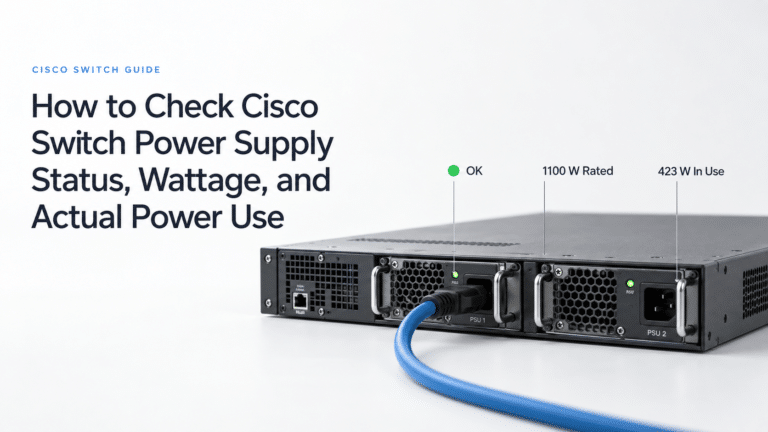
The IE9300 uses Hazloc-rated, field-replaceable modular power supplies, and reuses the same PWR-RGD family as the earlier IE4010 and IE5000 — relevant to migrating sites that already stock these units as spares. Two supplies install per chassis, configured for redundancy (N+1) or load sharing depending on the PoE budget required. The line spans low-voltage DC for substation and telecom −48 V plants through universal AC/high-voltage DC.
| Power supply | Wattage | Rated input range | Input voltage range |
|---|---|---|---|
| PWR-RGD-LOW-DC-H | 150 W | DC 24–60 V / 10 A | DC 18–75 V |
| PWR-RGD-AC-DC-H | 150 W | AC 100–240 V 2 A 50–60 Hz, or DC 100–250 V 2.0 A | AC 85–264 V / DC 88–300 V |
| PWR-RGD-AC-DC-250 | 250 W | AC 100–240 V 3.3 A 50–60 Hz, or DC 100–250 V 3.3 A | AC 85–264 V / DC 88–300 V |
| PWR-RGD-AC-DC-400 | 400 W | AC 100–240 V 3.3 A 50–60 Hz, or DC 100–250 V 3.3 A | AC 85–264 V / DC 88–300 V |
IE9300 PoE Power Budget per Power Supply
The deliverable PoE budget is a function of supply wattage and quantity. A single supply powers the switch and a portion of the PoE load; a second supply, in load-sharing mode, raises the budget toward the model maximum. The table below is the central input to a PoE bill of materials — a 24P4X reaches its full 720 W only with two 400 W supplies, not one.
| Model | 150 W | 150 W (dual) | 250 W | 250 W + 150 W | 250 W (dual) | 400 W* | 400 W (dual) |
|---|---|---|---|---|---|---|---|
| IE-9320-24P4S | 70 W | 190 W | 170 W | 280 W | 370 W | 320 W | 385 W |
| IE-9320-24P4X | 70 W | 190 W | 170 W | 280 W | 370 W | 320 W | 720 W |
| IE-9320-16P8U4X | 70 W | 190 W | 170 W | 280 W | 370 W | 320 W | 720 W |
| IE-9310-16P8S4X | 50 W | 170 W | 150 W | 260 W | 350 W | 300 W | 480 W |
*A 400 W supply cannot be combined with a 150 W or 250 W supply in a load-sharing configuration.
Sizing PoE and Redundant Power Supplies in the BOM
Power-supply selection follows from two requirements: the aggregate PoE load of the endpoints and the level of power redundancy the deployment demands. A worked example clarifies the constraint. Twenty PoE+ cameras at 25 W each present a 500 W load; on a 24P4X, that load is reachable only with two 400 W supplies (720 W budget), since a single 400 W supply caps the budget at 320 W and dual 250 W supplies provide 370 W. If the same deployment also requires N+1 power redundancy at full load, both supplies must be 400 W — the platform does not permit a 400 W unit to load-share with a lower-rated supply.
Input voltage is the second sizing decision. Substation and telecom DC plants in the 18–75 V range take the PWR-RGD-LOW-DC-H; sites with utility AC or high-voltage DC use the universal PWR-RGD-AC-DC supplies. Where availability targets justify it, stock spare rugged power supplies as field-replaceable units, since a supply fault on a single-PSU switch is otherwise an outage.
Redundancy and Substation Hardening: PRP, HSR, and IEC 61850-3
For utility and critical-infrastructure networks, redundancy protocol support and environmental certification are gating requirements, and both are constrained to specific IE9300 models. This is where model selection becomes a compliance decision.
Parallel Redundancy Protocol (PRP) and High-availability Seamless Redundancy (HSR), defined in IEC 62439-3, provide bumpless, zero-recovery-time redundancy that standard spanning-tree or even Resilient Ethernet Protocol (REP) cannot match. PRP sends duplicate frames simultaneously across two independent LANs; the receiving node accepts the first copy and discards the second, so a failure on either path causes no frame loss and no convergence delay. HSR applies the same duplicate-and-discard principle within a single ring. Substation process-bus and protection networks built to IEC 61850 typically mandate PRP or HSR because a protection relay cannot tolerate the tens of milliseconds a spanning-tree reconvergence would cost.
On the IE9300, PRP, HSR, and PTP-over-PRP are supported on the IE-9320-22S2C4X, IE-9320-26S2C, and IE-9310-16P8S4X only. No other model in the series supports these protocols, so a substation design that requires PRP or HSR is restricted to those three SKUs from the outset — a constraint that should be confirmed before any other specification work begins.
Environmental hardening is the second pillar. All IE9300 models are certified to IEC 61850-3 and IEEE 1613:2009 (class 2), the standards governing communications equipment installed in electric power substations, covering electromagnetic immunity, surge, and temperature behavior in the presence of high-voltage switching transients. Conduction cooling without fans removes the most common mechanical failure point and supports operation in sealed enclosures. The IE-9320-22S2C4X extends this further with conformal coating for corrosive and high-humidity atmospheres and GPS/IRIG-B timing input for substations that distribute time from a station clock.
Precise time synchronization underpins both protection and event correlation. Every IE9300 port supports IEEE 1588v2 PTP with the C37.238 Power Profile, the substation timing profile that delivers sub-microsecond accuracy for sampled-value and GOOSE traffic. This timing requirement also shapes optics selection, as the SFP section explains.
IE9300 Licensing: Network Essentials vs Network Advantage
The IE9300 runs Cisco IOS XE under two perpetual license tiers, and the correct tier follows from the switch’s role in the network rather than from a feature checklist. Network Essentials — the default — provides a complete Layer 2 access and aggregation feature set with limited-scale Layer 3; Network Advantage adds dynamic routing, network virtualization, and stronger segmentation and encryption for switches acting as routed distribution or security boundaries.
What Cisco Network Essentials Includes by Default
Network Essentials is sufficient for the majority of industrial access and aggregation roles. It includes the full Layer 2 switching set (802.1Q, RSTP/MSTP, PVRST+, EtherChannel, VTP, QinQ and Selective QinQ, 802.1Q tunneling, storm control), multicast snooping (IGMP v1/v2/v3, MLD), and the complete QoS toolkit (MQC, class-based shaping and marking, egress policing, Low Latency Queuing). It also provides limited-scale Layer 3 — static routing, OSPF, OSPFv3 to 1,000 routes, RIP, and policy-based routing — which covers stub and small routed segments without an Advantage license.
For OT specifically, Essentials includes the industrial protocol suite: GOOSE messaging, SCADA protocol classification, PTP Default and Power Profiles (2011 and 2017), NTP-to-PTP, BFD, and IOx application hosting. Its redundancy set covers REP and REP Fast, MRP and MRP-over-stacking, and PRP, HSR, and PTP-over-PRP on the three SKUs that support them. Security and management are equally complete at this tier: 802.1x, Dynamic ARP Inspection, IP Source Guard, DHCP snooping, RADIUS, TACACS+, MACsec-128, plus WebUI, SNMP, NETCONF/RESTCONF/YANG, Plug and Play, and Embedded Event Manager.
PRP, HSR, and PTP-over-PRP are supported on the IE-9310-16P8S4X, IE-9320-26S2C, and IE-9320-22S2C4X only; MRP-over-stacking is supported on IE-9320 stackable variants only. These constraints apply within both license tiers.
Features That Require Network Advantage
Network Advantage is warranted when a switch performs dynamic Layer 3 routing, network segmentation, or 256-bit encryption. It adds, on top of the entire Essentials set:
- Dynamic Layer 3 routing: BGP, EIGRP, IS-IS, MBGP, HSRP, and NSF — required where the IE9300 is a routed distribution node participating in a dynamic routing domain rather than a stub.
- Network virtualization: VRF-Lite, for maintaining isolated routing tables across tenants, zones, or safety domains on shared hardware.
- Advanced security: Cisco TrustSec (SGACL and SGACL logging), EAP-TLS, IEEE 802.1AE MACsec-256, and L3NAT — relevant to utility cybersecurity programs and segmentation mandates.
- Advanced IP multicast: AutoRP, MSDP, PIMv2, and IPv6 multicast with VRF-Lite.
| Capability | Network Essentials | Network Advantage |
|---|---|---|
| Layer 2 switching, QoS, EtherChannel | Yes | Yes |
| Limited-scale L3 (static, OSPF, RIP, PBR) | Yes | Yes |
| Industrial (GOOSE, SCADA, PTP, REP, PRP/HSR¹) | Yes | Yes |
| Dynamic L3 (BGP, EIGRP, IS-IS, HSRP, MBGP) | No | Yes |
| VRF-Lite | No | Yes |
| TrustSec / MACsec | MACsec-128 | MACsec-256 + TrustSec |
| Advanced IP multicast (PIMv2, MSDP, AutoRP) | No | Yes |
¹ PRP/HSR limited to the IE-9320-22S2C4X, IE-9320-26S2C, and IE-9310-16P8S4X.
The practical rule: an IE9300 acting as a Layer 2 access or aggregation switch, or running a small OSPF stub, is correctly licensed with Network Essentials. One acting as a routed distribution switch in a BGP or EIGRP domain, enforcing TrustSec segmentation, or requiring MACsec-256, needs Network Advantage.
Cisco Catalyst Center DNA Licenses for the IE9300
Cisco Catalyst Center (DNA) licensing is a separate, optional layer that governs centralized fleet management and SD-Access, not the on-box switching features above. It is not mandatory, and it does not include Network-tier capabilities. Two tiers exist, and DNA Advantage can be paired only with Network Advantage.
| Catalyst Center feature | DNA Essentials | DNA Advantage |
|---|---|---|
| Discovery, topology, inventory, image management | Yes | Yes |
| Overall Health Dashboard (visibility) | Yes | Yes |
| Day-zero bring-up automation (Plug and Play) | Yes | Yes |
| SD-Access Extended Node | Yes | Yes |
| Industrial support (MRP monitoring, REP config/topology, PRP topology) | Yes | Yes |
| LAN Automation | No | Yes |
| SD-Access Policy Extended Node | No | Yes |
| SD-Access Fabric Edge Node | No | Yes |
| Device 360 / Client 360 / Network Health Insights | No | Yes |
| Patch / SMU lifecycle management | No | Yes |
| Application Visibility and Control (NBAR2) | No | Yes |
Smart Account Requirements and License SKUs
Network Essentials is perpetual and does not require a Smart Account; Smart Account entitlement applies to Catalyst Center (DNA) licensing and the Network Advantage workflow. The standalone Network Advantage license is ordered as IE9300-NW-A= (perpetual), and Catalyst Center licenses are term-based:
| License SKU | Description |
|---|---|
| IE9300-DNA-E | Cisco DNA Essentials for IE9300 |
| IE9300-DNA-E-3Y / -5Y / -7Y | DNA Essentials, 3 / 5 / 7-year term |
| IE9300-DNA-A | Cisco DNA Advantage for IE9300 |
| IE9300-DNA-A-3Y / -5Y / -7Y | DNA Advantage, 3 / 5 / 7-year term |
| IE9300-NW-A= | Network Advantage license, perpetual |
A Layer 2 substation or access switch is typically deployed on Network Essentials with no Smart Account and no Catalyst Center license. Network Advantage is added for routed and segmented designs; Catalyst Center DNA is added only when the fleet is managed centrally through Catalyst Center or integrated into an SD-Access fabric.
SFP and Optics Compatibility for the Cisco IE9300
The IE9300 accepts a broad range of Cisco 100M, 1G, and 10G SFP and SFP+ optics, but two engineering rules govern optic selection for a rugged deployment: match the optic temperature rating to the operating environment, and keep precision-timing paths on fiber rather than copper. Cisco updates the supported-optics list over time, so validate the current data sheet for any optic not listed here.
Supported 1G and 100M SFP Modules for the IE9300
Industrial-temperature (IND) optics are the correct default for a switch rated to −40°C to +75°C. The following 100M and 1G modules carry the industrial temperature rating; the BiDi (BX) single-fiber options are particularly relevant in substations and along rail corridors where fiber pairs are scarce and a single strand must carry bidirectional traffic.
| Part number | Specification | Type | Max distance | Cable | Temp |
|---|---|---|---|---|---|
| GLC-FE-100FX-RGD | 100BASE-FX | FE | 2 km | MMF | IND |
| GLC-FE-100LX-RGD | 100BASE-LX10 | FE | 10 km | SMF | IND |
| GLC-SX-MM-RGD | 1000BASE-SX | GE | 550 m | MMF | IND |
| GLC-LX-SM-RGD | 1000BASE-LX/LH | GE | 550 m / 10 km | MMF/SMF | IND |
| GLC-ZX-SM-RGD | 1000BASE-ZX | GE | 70 km | SMF | IND |
| GLC-BX40-U-I / -D-I | 1000BASE-BX40 | GE | 40 km | SMF (single) | IND |
| GLC-BX80-U-I / -D-I | 1000BASE-BX80 | GE | 80 km | SMF (single) | IND |
| GLC-T-RGD | 1000BASE-T | GE | 100 m | Copper | IND² |
Commercial- and extended-temperature 1G modules — GLC-SX-MMD, GLC-LH-SMD, GLC-EX-SMD, GLC-ZX-SMD (EXT), and GLC-BX-U/D, GLC-ZX-SM (COM) — are also supported, subject to the derating rule below.
Supported 10G SFP+ Modules for the IE9300
The 10G uplink (“X”) models accept SFP+ optics and direct-attach twinax. Industrial-rated 10G optics preserve the full temperature envelope; the BiDi 10G options again address single-fiber plant.
| Part number | Specification | Type | Max distance | Cable | Temp |
|---|---|---|---|---|---|
| SFP-10G-SR-X | 10GBASE-SR | 10G | 400 m | MMF | EXT |
| SFP-10G-LR-X | 10GBASE-LR | 10G | 10 km | SMF | EXT |
| SFP-10G-BXD-I / BXU-I | 10GBASE-BX | 10G | 10 km | SMF (single) | IND |
| SFP-10G-BX40D-I / BX40U-I | 10GBASE-BX | 10G | 40 km | SMF (single) | IND |
| SFP-10G-ER-I | 10GBASE-ER | 10G | 40 km | SMF | IND |
| SFP-10G-ZR-I | 10GBASE-ZR | 10G | 80 km | SMF | IND |
| ONS-SI+-10G-SR / LR / ER / ZR | 10GBASE-SR/LR/ER/ZR | 10G | 400 m–80 km | MMF/SMF | IND |
| SFP-10G-T-X | 10GBASE-T | 10G | 30 m | Copper | EXT² |
| SFP-H10GB-CU1M/3M/5M | Twinax (passive DAC) | 10G | 1 / 3 / 5 m | Twinax | COM |
| SFP-H10GB-ACU7M/10M | Twinax (active DAC) | 10G | 7 / 10 m | Twinax | COM |
Source compatible Cisco SFP and optics modules to the temperature rating and reach the deployment requires, rather than to the lowest unit price.
Industrial vs Commercial-Temperature Optics and Derating
The chassis temperature rating and the optic temperature rating must be considered together. The IE9300 is rated to −40°C to +75°C in a blower-equipped cabinet, but that envelope assumes industrial-temperature optics in the cages. Populating the switch with commercial- (COM) or extended- (EXT) temperature optics narrows the usable operating range, because the optic, not the switch, becomes the limiting component — a material risk in an unconditioned substation, a desert roadside cabinet, or an Arctic enclosure. For any port exposed to the full environmental range, specify the industrial (RGD or -I suffix) optics in the tables above; reserve commercial-temperature optics for climate-controlled control rooms.
Why GLC-T Copper Optics Degrade PTP Timing
Copper SFP modules degrade PTP timing accuracy and should be avoided on timing-critical ports. The 1000BASE-T modules (GLC-T, GLC-TE, GLC-T-RGD) and the 10GBASE-T module (SFP-10G-T-X) introduce variable PHY latency: the copper transceiver’s internal processing adds a delay that is neither fixed nor symmetric, which undermines the sub-microsecond path-delay measurement that IEEE 1588v2 depends on. On a switch selected specifically for substation timing under the C37.238 Power Profile, that variability translates directly into timing error on protection and sampled-value traffic. The engineering practice is to keep all PTP-bearing paths on fiber optics and confine copper SFPs to ports where precise time synchronization is not a requirement.
Which Cisco IE9300 Switch Should You Buy?
Model selection resolves to three variables — PoE requirement, uplink speed, and redundancy-protocol support — applied to the deployment role. The shortlists below map the most common industrial use cases to the appropriate SKU.
Best IE9300 for Substation Automation (PRP/HSR, IEC 61850-3)
Substation automation requiring PRP or HSR is restricted to the IE-9320-22S2C4X, IE-9320-26S2C, and IE-9310-16P8S4X. The IE-9320-22S2C4X is the most fully substation-optimized: it combines PRP/HSR, conformal coating, GPS/IRIG-B timing input, 10G uplinks, and stacking in one SFP-based aggregation switch. The IE-9320-26S2C is the equivalent where 1-gigabit uplinks suffice and conformal coating is not required, and the IE-9310-16P8S4X suits a bay that needs PoE plus fiber as a standalone, non-stacked switch.
Best IE9300 for PoE Access and IP Cameras
PoE access deployments are served by the IE-9320-24P4X for high-density PoE+ with 10G backhaul and the IE-9320-16P8U4X where 90 W 4PPoE is required. The IE-9320-24P4X provides 24 PoE+ ports at a full 720 W budget (dual 400 W supplies) with 10-gigabit uplinks for aggregating heavy camera or access-point loads. The IE-9320-16P8U4X is the choice for 90 W endpoints — heated PTZ cameras, Wi-Fi 6E/7 access points, or PoE edge compute — on its multigigabit ports. For lighter PoE loads behind 1-gigabit uplinks, the IE-9320-24P4S at 385 W is the more economical option.
Best IE9300 for 10G Aggregation and Stacking
Fiber aggregation with 10G uplinks and stacking points to the IE-9320-22S2C4X for SFP-dense designs and the IE-9320-24T4X for copper aggregation. The IE-9320-24T4X is a data-only, low-draw (35 W) stackable switch with 24 copper gigabit ports and four 10G uplinks, suited to aggregating non-powered devices. The 22S2C4X is the fiber-rich counterpart. Because both stack, the aggregation layer can be managed as a single logical switch and expanded in place — an option the non-stacking IE-9310 models do not provide.
Cisco IE9300 System Hardware and Operating Environment
The eight models share a common rugged platform: a 1RU chassis with 4 GB or 8 GB of DRAM (the IE-9310-16P8S4X ships with 8 GB), 8 GB of onboard flash, SD-flash and USB 2.0 storage, and dual Hazloc field-replaceable power supplies. Cooling is by conduction, with no fans or moving parts — the design choice most responsible for the platform’s reliability in sealed enclosures, since it removes the fan as a wear-out and contamination-ingress point.
| Attribute | Specification |
|---|---|
| DRAM | 4 GB / 8 GB (IE-9310-16P8S4X ships with 8 GB) |
| Flash | 8 GB onboard |
| Rack mounting | 19″, ETSI, 23″ |
| Cooling | Conduction, no fans or moving parts |
| Operating temperature | −40°C to +75°C (blower cabinet); −40°C to +70°C (vented); −40°C to +60°C (sealed) |
| Power supplies | Two Hazloc modular FRU (Hi AC/DC and Low DC options) |
| Substation compliance | IEC 61850-3, IEEE 1613:2009 (class 2) |
| Industrial EMC | EN 61000-6-2 / -6-4 industrial, EN 61326, ODVA EtherNet/IP, IP30 |
| Hazardous locations | UL 121201 / CSA 213 (Class I, Div 2); IEC/EN 60079-0,-7 ATEX/IECEx (Class I, Zone 2) |
| Shock / vibration / corrosion | IEC 60068-2-6/-27/-31/-32/-64; salt fog 2-52; flowing mixed gas 2-60 |
Base power consumption, before PoE load, ranges from 35 W to 105 W depending on model. The figure scales with port count, media type, and the larger memory and PoE controllers of the access models.
| Model | Base power consumption |
|---|---|
| IE-9320-24T4X | 35 W |
| IE-9320-24P4S | 37 W |
| IE-9320-24P4X | 39 W |
| IE-9320-16P8U4X | 45 W |
| IE-9310-26S2C | 61 W |
| IE-9320-26S2C | 64 W |
| IE-9320-22S2C4X | 73 W |
| IE-9310-16P8S4X | 105 W |
Migrating to the IE9300 from the Cisco IE5000 and IE4010
The IE9300 is the natural upgrade path for sites running the rackmount Cisco IE5000 or IE4010, and Cisco designed the transition to reuse existing power infrastructure: the IE9300 accepts the same PWR-RGD power supplies as those platforms, so spares and DC-plant wiring carry forward. The functional gains are the move to Cisco IOS XE (and its unified security and automation model), 10-gigabit uplinks on the “X” models, stacking on the IE-9320 variants, and current-generation timing and redundancy support.
Two planning items warrant attention in a migration. First, redundancy-protocol parity: if the existing design relies on PRP or HSR, the replacement must be one of the three IE9300 SKUs that support it. Second, optics carry-over: existing industrial-temperature SFPs may be reusable, but confirm each part against the IE9300 supported-optics list rather than assuming compatibility. Before scheduling a refresh, verify the end-of-life and end-of-support milestones for the installed IE5000 or IE4010 models on Cisco’s published notices, as those dates drive the migration timeline.
Cisco IE9300 Procurement Checklist
Confirm the following before placing an IE9300 order:
- Model and port architecture — does the SKU’s media mix (SFP aggregation, copper PoE, or multigigabit) and uplink speed (1G vs 10G) match the design role?
- Redundancy protocol — if PRP or HSR is required, the model must be the IE-9320-22S2C4X, IE-9320-26S2C, or IE-9310-16P8S4X. No other IE9300 qualifies.
- Stacking — required for single-logical-switch management or MRP-over-stacking? The model must be an IE-9320; the IE-9310 does not stack.
- PoE budget and redundancy — size the supplies to the aggregate PoE load plus any N+1 requirement. A full 720 W needs dual 400 W supplies, and a 400 W supply cannot load-share with a 150 W or 250 W unit.
- Power input — match the PWR-RGD supply to the plant: low-voltage DC (18–75 V) or universal AC/high-voltage DC.
- License tier — Network Essentials (default, no Smart Account) for Layer 2 and limited-L3 roles; Network Advantage for dynamic routing, VRF-Lite, TrustSec, or MACsec-256. Add Catalyst Center DNA only for centrally managed or SD-Access fleets.
- Optics — specify industrial-temperature (IND/RGD) SFPs to hold the full −40°C to +75°C range, and keep PTP-critical paths on fiber, not copper SFPs.
- Environment — conformal coating and GPS/IRIG-B timing input are available only on the IE-9320-22S2C4X.
Frequently Asked Questions About the Cisco IE9300
What is the difference between the Cisco IE-9310 and IE-9320?
The IE-9310 is non-stackable and the IE-9320 is stackable. Both are rugged 28-port IE9300 switches sharing the same chassis, environmental rating, and license tiers; the IE-9320 adds stacking, allowing multiple switches to operate as one logical unit and to run MRP-over-stacking ring redundancy.
Which Cisco IE9300 models support PoE and 90 W 4PPoE?
Four models supply PoE: the IE-9320-24P4S (up to 385 W), IE-9320-24P4X (up to 720 W), IE-9320-16P8U4X (up to 720 W), and IE-9310-16P8S4X (up to 480 W). Only the IE-9320-16P8U4X provides 90 W four-pair PoE, on its eight multigigabit ports.
How much PoE power does the Cisco IE9300 provide?
The budget depends on the installed power supplies. A 24P4X or 16P8U4X reaches up to 720 W with dual 400 W supplies, while a single 400 W supply caps the budget at 320 W. The 24P4S provides up to 385 W and the 16P8S4X up to 480 W.
What is the difference between IE9300 Network Essentials and Network Advantage?
Network Essentials, the default tier, covers Layer 2 switching, full QoS, industrial protocols, and limited-scale Layer 3 (OSPF, RIP, static, PBR). Network Advantage adds dynamic routing (BGP, EIGRP, IS-IS, HSRP), VRF-Lite, TrustSec, and MACsec-256. Both are perpetual licenses.
Does the Cisco IE9300 require a Smart Account?
Network Essentials does not require a Smart Account. Smart Account entitlement applies to Catalyst Center (DNA) licensing and the Network Advantage workflow. The standalone Network Advantage license is ordered as IE9300-NW-A= (perpetual).
Which IE9300 switches support PRP and HSR?
PRP and HSR are supported on the IE-9320-22S2C4X, IE-9320-26S2C, and IE-9310-16P8S4X only. No other IE9300 model supports them, so a design requiring IEC 62439-3 parallel or ring redundancy must specify one of these three SKUs.
What SFP modules are compatible with the Cisco IE9300?
The IE9300 supports Cisco 100M, 1G, and 10G SFP and SFP+ optics, including industrial-temperature modules such as GLC-SX-MM-RGD, GLC-LX-SM-RGD, and SFP-10G-BXD-I. Use industrial-rated optics to preserve the full temperature range, and avoid copper SFPs (GLC-T, SFP-10G-T-X) on PTP-critical ports.
Is the Cisco IE9300 stackable?
The six IE-9320 models are stackable; the two IE-9310 models are not. Stacking presents multiple IE-9320 switches as a single managed unit and is a prerequisite for MRP-over-stacking redundancy.
Where to Buy the Cisco IE9300
Layer23-Switch supplies the full Cisco Catalyst IE9300 Rugged Series with stock, lead-time, and configuration support for industrial and substation networks. For model selection, PoE and power-supply sizing, license-tier guidance, and SFP compatibility, request a quote on the Cisco Catalyst IE9300 pricing and stock page, or compare the broader Cisco industrial Ethernet switches range, including the DIN-rail IE3300, IE3400, and IE3500 families. Validate exact specifications, supported optics, and lifecycle status against the Cisco Catalyst IE9300 Rugged Series data sheet before ordering.
References
- Cisco Catalyst IE9300 Rugged Series data sheet — model specifications, port configurations, power-supply and PoE budgets, software licensing, and supported optics (Cisco.com).
- IEC 62439-3 — Parallel Redundancy Protocol (PRP) and High-availability Seamless Redundancy (HSR).
- IEC 61850-3 and IEEE 1613:2009 — environmental and communications requirements for equipment in electric power substations.
- IEEE 1588v2 Precision Time Protocol and IEEE C37.238 Power Profile for substation time synchronization.
- IEEE 802.3at (PoE+) and IEEE 802.3bt (Type 4 / 90 W four-pair PoE).