Cisco Wireless License Explained: AP Licensing, DNA Subscription, and Smart Licensing Guide
Direct Answer Cisco wireless licensing is based on a subscription model tied directly to the number of access points deployed in a network. Each access point requires a Cisco DNA license that enables automation, analytics, and centralized management. These licenses are globally managed through Cisco Smart Licensing and are consumed dynamically by Catalyst wireless controllers as devices join the network.
Navigating Cisco’s software subscriptions can be complex. Before diving into wireless-specific rules, we highly recommend reading our comprehensive Cisco Licensing Ultimate Guide for a complete overview of how Smart Accounts, EA agreements, and enterprise routing/switching licenses function.

What Is a Cisco Wireless License?
The modern Cisco enterprise wireless ecosystem has transitioned away from legacy, hardware-locked Product Activation Keys (PAKs). Today, a Cisco wireless license is a software entitlement that grants network administrators the legal right to operate Cisco access points (APs) and utilize advanced cloud-managed telemetry, security, and automation features.
How Cisco Wireless Licensing Works
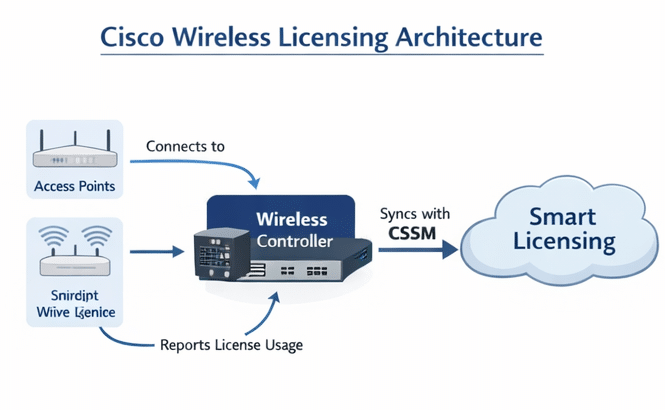
The architecture of Cisco wireless licensing operates through a strict hierarchical flow:
- Access Point: The physical hardware broadcasts the wireless signal.
- Wireless Controller (WLC): The localized appliance (or virtual machine) that aggregates and manages the access points.
- Cisco Smart Licensing: The software framework running on the controller that tracks license usage.
- Cisco Smart Software Manager (CSSM): The centralized, cloud-hosted portal where enterprise IT teams manage their global license pools and subscriptions.
Why Cisco Uses Subscription Licensing
The shift to the Cisco DNA subscription and the broader Cisco licensing model aligns with modern cloud-software practices. Instead of forcing customers to buy static features that become obsolete, subscription licensing allows Cisco to continuously deliver new artificial intelligence (AI) features, security patches, and cloud integrations over the life of the hardware.
Do Cisco Access Points Require a License?
One of the most common questions from network engineers migrating from older platforms is: Do Cisco access points require a license? The definitive answer is yes. You cannot legally or functionally operate a modern Cisco enterprise wireless network without fulfilling the strict Cisco AP license requirement.
One Cisco DNA License per Access Point
Cisco enforces a strict 1:1 licensing ratio. For every single physical access point you wish to manage and broadcast SSIDs from, you must have one active Cisco DNA license in your Smart Account.
Example: Wireless License Calculation
Calculating your licensing requirements is highly straightforward, but it is a critical step in network procurement.
Scenario: An enterprise is deploying a new office network utilizing a centralized Catalyst 9800 wireless controller and a fleet of 35 Catalyst 9100 series access points.
Required Licenses:
- 35 × Physical Access Points
- 35 × Cisco DNA Advantage (or Essentials) Licenses
- Result: The wireless controller will attempt to pull exactly 35 DNA licenses from the CSSM pool.
How Cisco Wireless Controller Licensing Works
Understanding the Cisco wireless controller license model is vital, as the controller itself handles the logic of license enforcement, not the individual access points.

Does a Catalyst 9800 Controller Require a License?
A frequent point of confusion is whether the Cisco Catalyst 9800 series requires its own standalone license just to boot up and route traffic. No, the Catalyst 9800 controller does not require a dedicated device license. Instead, the Catalyst 9800 acts as a proxy. The licensing cost is entirely absorbed by the access point subscriptions.
How Controllers Consume Access Point Licenses
The Cisco WLC license model operates dynamically:
- An access point physically boots up and joins the wireless controller.
- The controller registers the AP and immediately checks the enterprise’s connected Smart Account (CSSM).
- A single Cisco DNA license is dynamically consumed (checked out) from the available pool.
- If the AP is disconnected or removed from the network, that license is released back into the pool for another AP to use.
What Is Cisco DNA Wireless License?
The Cisco DNA wireless license is the core subscription overlay that unlocks the true power of modern Cisco hardware. While the base network license handles local routing, the DNA tier provides enterprise-grade management.
Cisco DNA Wireless Features
A DNA subscription transforms a basic wireless network into an intelligent IT fabric. Key features include:
- Network Automation: Zero-touch provisioning and Plug and Play (PnP) deployment.
- AI Analytics: Machine learning-driven insights to proactively identify Wi-Fi interference and client connectivity issues.
- Cisco Catalyst Center: (Formerly Cisco DNA Center) The centralized dashboard for monitoring global network health.
- SD-Access: Software-Defined Access for advanced micro-segmentation and zero-trust security policies.
Cisco DNA Essentials vs Advantage
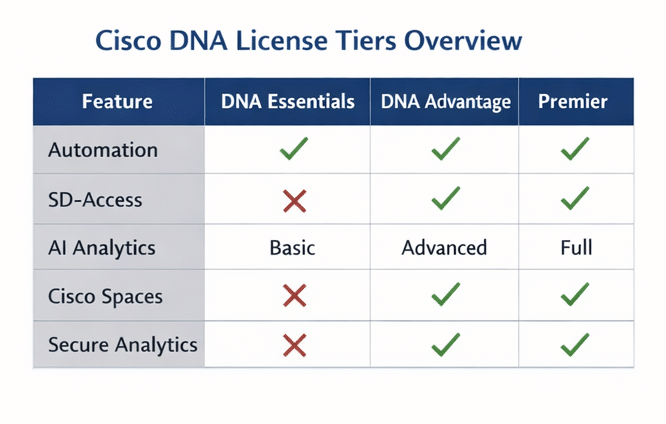
Cisco divides its wireless subscriptions into two primary tiers. DNA Essentials covers basic telemetry, standard automation, and basic mapping. DNA Advantage unlocks the full suite of AI analytics, SD-Access, and advanced location-based services via Cisco Spaces.
For a deep dive into feature differences and choosing the right tier, read our complete guide on Cisco DNA Essentials vs Advantage.
Cisco Smart Licensing Explained
The days of manually typing 20-character license keys into a command-line interface are over. The Cisco Smart Licensing explained model simplifies compliance through a centralized, cloud-based framework.
Cisco Smart Software Manager (CSSM)
The Cisco CSSM is the cloud portal where your organization’s entire inventory of licenses is stored. It acts as a global bank account for your IT assets, allowing administrators to seamlessly move licenses between different controllers, sites, or branch offices without contacting Cisco support.
Smart Licensing Using Policy (SLUP)
Modern IOS-XE devices utilize Smart Licensing Using Policy (SLUP). Instead of requiring a constant, real-time connection to the internet to verify licenses, SLUP relies on periodic Resource Utilization Measurement (RUM) reports. The controller periodically syncs with the CSSM, preventing network outages if your internet connection temporarily drops.
Offline Cisco Licensing for Secure Networks
For highly secure, air-gapped environments (such as military bases or financial institutions) that cannot connect to the cloud, Cisco provides offline licensing methods:
- Specific License Reservation (SLR) / Permanent License Reservation (PLR): Allows administrators to permanently lock a set of licenses to a specific controller offline.
- Smart License Utility (SLU): A local Windows-based server installed on-premises that mimics the CSSM, handling RUM reports locally without reaching the internet.
What Happens If a Cisco DNA License Expires?
Navigating a Cisco DNA license expired scenario requires understanding exactly what generation of hardware your enterprise is running, as Cisco has drastically altered its enforcement policies.
License Expiration Behavior for Wi-Fi 6 Access Points
For legacy Wi-Fi 6 hardware (e.g., Catalyst 9120), if your DNA subscription expires, the network will not crash. The access points will continue to broadcast SSIDs, authenticate users, and route traffic utilizing the perpetual base “Network” license. However, you will immediately lose access to Cisco Catalyst Center, AI analytics, and software upgrades.
New Enforcement Model for Wi-Fi 7 Access Points
With the introduction of Wi-Fi 7 hardware (e.g., CW9176) and the new Cisco Networking Subscription, Cisco has implemented a strict enforcement model. If a Wi-Fi 7 Cisco license expires and passes the standard grace period, the hardware suffers deliberate radio degradation. The access point will actively disable its high-speed 5 GHz and 6 GHz radios, forcing all client traffic onto the slow, congested 2.4 GHz spectrum until the license is renewed.
Migrating from AireOS Licensing to Catalyst 9800
For enterprises upgrading from legacy WLCs (like the 5520 or 2504), moving from traditional AireOS licensing to the Catalyst 9800 smart license model requires specific conversion steps.
Device-Led Conversion (DLC)
Cisco provides a Device-Led Conversion (DLC) process that allows organizations to legally convert their legacy Right-to-Use (RTU) perpetual AP licenses into modern Smart Entitlements within the CSSM. This ensures that previous hardware investments are recognized in the new cloud portal.
Cisco License Portability
One of the massive advantages of Smart Licensing is portability. If you decommission an old access point, its DNA license is instantly freed up in the CSSM pool and can be immediately applied to a newly purchased access point, protecting your software investment during hardware refresh cycles.
Cisco Wireless License Planning Best Practices
To ensure a smooth deployment and avoid compliance warnings, enterprise IT teams should adopt strict Cisco wireless license planning strategies:

- AP License Planning: Always co-term your DNA subscriptions. Buying licenses that expire on the same date drastically reduces administrative overhead and renewal complexity.
- High Availability (HA) Clusters: If you deploy two Catalyst 9800 controllers in an SSO (Stateful Switchover) HA pair, both controllers must be registered to the exact same Virtual Account in the CSSM to share the AP license pool properly.
- Audit Your CSSM: Schedule quarterly audits of your Cisco Smart Software Manager to ensure you do not have “Out of Compliance” warnings, which can halt future hardware deployments.
Cisco Wireless License FAQ
Do Cisco access points require licenses?
Yes. Every modern Cisco enterprise access point requires a valid, active license to join a wireless controller and function on the network.
Is Cisco DNA license mandatory?
Yes. When purchasing a new Catalyst access point, Cisco strictly mandates the attachment of a 3-, 5-, or 7-year DNA subscription license (Essentials or Advantage) at the point of sale.
How many Cisco wireless licenses do I need?
Cisco utilizes a strict 1:1 ratio. You need exactly one Cisco DNA license for every physical access point deployed in your environment.
Does a Catalyst 9800 controller require a license?
No. The Catalyst 9800 wireless controller does not require a standalone device license to operate. It acts as a management proxy, dynamically consuming licenses from the CSSM based solely on the number of access points connected to it.
What happens when a Cisco DNA subscription expires?
For Wi-Fi 6 (Catalyst 9100) APs, local traffic routing continues, but cloud analytics and automation features are disabled. For modern Wi-Fi 7 (CW917x) APs utilizing the Cisco Networking Subscription, the 5 GHz and 6 GHz radios are actively disabled, restricting all traffic to the 2.4 GHz band until the license is renewed.