How to Enable PoE on Cisco Switch: CLI Commands and Checks
On most Cisco Catalyst PoE switches, PoE is already enabled by default on PoE-capable ports. To explicitly enable or re-enable PoE on a port, enter interface configuration mode, apply power inline auto, make sure the interface is not shut down, and verify the result with show power inline.
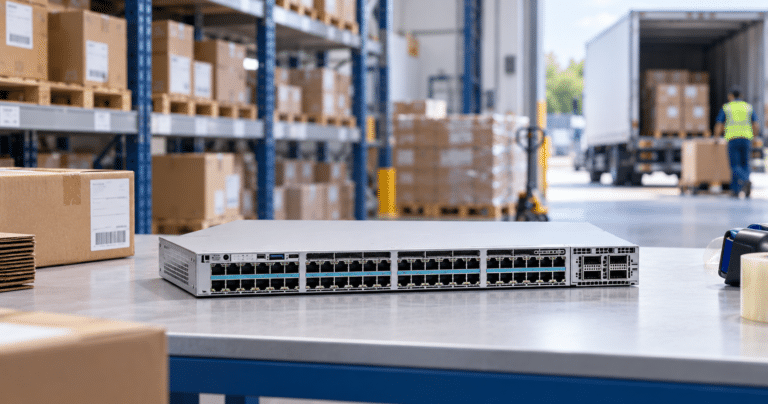
The CLI change should be treated as a verification workflow, not a one-line fix. A port can be configured for PoE and still fail to power an access point, phone, camera, badge reader, or sensor if the switch model is data-only, the port is not PoE-capable, the power budget is exhausted, the power supply is undersized, the cable is faulty, or the powered device requires a higher PoE class than the switch can deliver.
For procurement and operations teams, the sequence should be disciplined: confirm the switch and port can provide PoE, enable the correct inline-power mode, verify the port output, then check budget and endpoint requirements before treating the issue as solved.

Cisco PoE Enable Command: Quick Answer
Use power inline auto on a PoE-capable Cisco switch port to allow the switch to detect a powered device and provide power when budget is available.
Switch> enable
Switch# configure terminal
Switch(config)# interface GigabitEthernet1/0/10
Switch(config-if)# power inline auto
Switch(config-if)# no shutdown
Switch(config-if)# end
Switch# show power inline GigabitEthernet1/0/10
Switch# copy running-config startup-config
power inline auto controls inline-power behavior. no shutdown controls the Ethernet interface administrative state. A port normally needs both the correct PoE mode and an active interface state before the connected device can come online.
If the power inline command is missing, do not assume a software problem first. Check the exact switch SKU, interface type, and platform command reference. Data-only models and non-PoE ports cannot provide power through a configuration command.
Before You Enable PoE on a Cisco Switch Port
Before changing a production port, confirm the physical and power conditions. PoE configuration changes can briefly remove power from the endpoint, which can reboot an access point, desk phone, camera, door controller, or building system.
| Check | Why it matters |
|---|---|
| Switch model supports PoE | Data-only SKUs cannot power connected devices |
| Port supports PoE | Some switch families have mixed port types or uplink-only interfaces |
| Interface is not shut down | A disabled interface will not operate normally |
| PoE mode is not disabled | power inline never prevents powered-device detection |
| Power budget is available | The switch can deny power when the budget is exhausted |
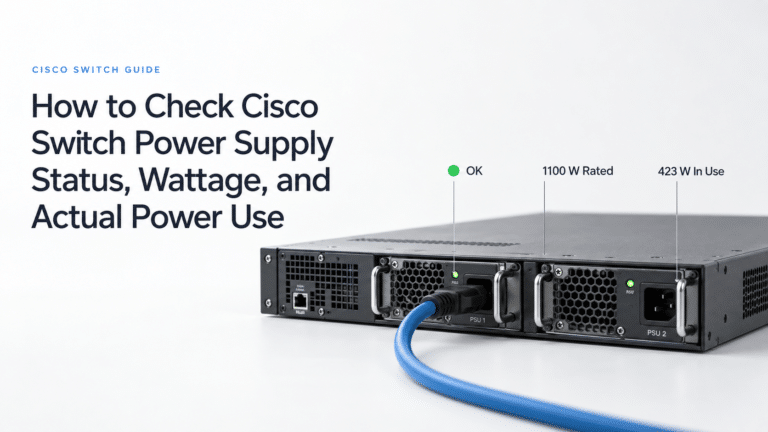
| Power supply is sized correctly | A PoE switch may need a larger PSU or redundant power plan |
| Endpoint power class is known | PoE, PoE+, UPOE, UPOE+, and 802.3bt devices have different needs |
| Cable is known good | Bad pairs can prevent detection or stable power delivery |
| Change window is approved | APs, phones, cameras, and access-control devices can reboot |
If the project is still in hardware planning, build the hardware shortlist before treating the issue as a configuration task. Review Cisco PoE switches, 24-port PoE switches, and 48-port PoE switches when the requirement is already defined by port count and endpoint power.
Is PoE Enabled by Default on Cisco Switches?
On many Cisco Catalyst PoE platforms, the default inline-power mode on PoE-capable access ports is automatic detection. That means a new or defaulted PoE port can usually detect a standard powered device and supply power without adding power inline auto.
In production networks, engineers usually need power inline auto when a port was previously changed to power inline never, when a template disabled PoE on unused ports, when a replacement switch inherited a restrictive configuration, or when the team wants the running configuration to show the intended PoE behavior clearly.
Do not treat the default as universal across every Cisco switch family and software release. Catalyst IOS XE switches, Catalyst 1200/1300 switches, industrial switches, small business switches, and older Catalyst platforms can expose different PoE command sets. Confirm the exact platform and software release before applying a template across many ports.
How to Enable PoE on One Cisco Switch Port
Use this sequence when one access port needs to power a device such as an IP phone, wireless access point, IP camera, access-control panel, or room endpoint.
Switch> enable
Switch# configure terminal
Switch(config)# interface GigabitEthernet1/0/10
Switch(config-if)# power inline auto
Switch(config-if)# no shutdown
Switch(config-if)# end
Switch# show power inline GigabitEthernet1/0/10
If the output shows the port in auto mode but the device is not powered, check the operational state rather than repeating the command. Admin auto means the port is configured to provide power automatically; it does not prove that power is currently being delivered.
Save the configuration only after confirming the endpoint behaves as expected:
Switch# copy running-config startup-config
For access-layer refreshes where many PoE endpoints are expected, the hardware family matters as much as the CLI. Cisco Catalyst 9200 switches are common for standard access closets, while Cisco Catalyst 9300 switches are usually reviewed when the closet needs stronger PoE, UPOE, mGig, stacking, or uplink headroom.
How to Enable PoE on Multiple Cisco Switch Ports
Use interface range when several known PoE-capable access ports need the same inline-power mode. Confirm budget first; enabling many ports at once can cause a group of endpoints to start drawing power at the same time.
Switch# configure terminal
Switch(config)# interface range GigabitEthernet1/0/10-20
Switch(config-if-range)# power inline auto
Switch(config-if-range)# no shutdown
Switch(config-if-range)# end
Switch# show power inline
Switch# copy running-config startup-config
Do not apply a broad range to uplinks, trunk ports, data-only ports, or ports connected to non-PoE equipment without checking the interface list. A verified access-port range is safer than a blanket command across the whole switch.
For dense access closets, the port count decision often becomes a purchasing decision. Use 24-port PoE switches for smaller closets and staged deployments, and 48-port PoE switches when endpoint density, rack efficiency, and standardized access builds are more important.
How to Enable PoE on Cisco Catalyst 9200 and 9300 Switches
On Cisco Catalyst 9200 and Catalyst 9300 PoE-capable access ports, the normal enablement command is still power inline auto. The important check is not whether the switch belongs to the 9200 or 9300 family; it is whether the exact SKU and port can supply the required power class.
Switch# configure terminal
Switch(config)# interface GigabitEthernet1/0/1
Switch(config-if)# power inline auto
Switch(config-if)# no shutdown
Switch(config-if)# end
Switch# show power inline GigabitEthernet1/0/1
Switch# copy running-config startup-config
For a known group of PoE access ports, use an interface range only after checking endpoint load and available switch power.
Switch# configure terminal
Switch(config)# interface range GigabitEthernet1/0/1-48
Switch(config-if-range)# power inline auto
Switch(config-if-range)# no shutdown
Switch(config-if-range)# end
Switch# show power inline
Do not use the series name alone as the compatibility check. Catalyst 9200, 9200L, 9300, 9300L, 9300X, and related access models include different port, PoE, power supply, uplink, and stacking options. A data-only model will not provide PoE through configuration, and a PoE model can still deny power if the budget is already consumed.
| Deployment need | Practical direction |
|---|---|
| Standard access closet with phones, cameras, and ordinary APs | Check Catalyst 9200 switches and confirm the selected model is a PoE-capable SKU |
| Higher AP power, mGig endpoints, UPOE, or larger access stacks | Check Catalyst 9300 switches and validate PoE class, PSU, and stack power design |
| Mixed 9200 and 9300 estate | Keep the CLI template separate from the BOM check; the command may be similar, but available power and port capability are model-specific |
| Bulk port enablement | Verify show power inline before and after the change so denied ports are caught before users report offline devices |
For procurement, the safe question is not “Can a Cisco 9200 or 9300 enable PoE?” but “Does this exact switch, power supply, and port plan support the endpoint load?” That distinction prevents a correct command from being applied to the wrong hardware.
Cisco PoE Commands: auto vs static vs never
On many Cisco Catalyst IOS XE switches, the main PoE interface commands are auto, static, and never. The exact syntax and supported options vary by platform, so the table below should be used as an operating reference, not as a substitute for the command reference of the switch in front of you.
| Command | What it does | When to use |
|---|---|---|
power inline auto | Detects a powered device and supplies power if budget is available | Normal AP, phone, camera, badge reader, sensor, and endpoint ports |
power inline auto max <mW> | Uses automatic detection but caps the maximum allocation | Preventing one endpoint from consuming more than its planned budget |
power inline static max <mW> | Reserves power for the port on supported Catalyst platforms | High-priority endpoints where allocation should be predictable |
power inline never | Disables powered-device detection and power output | Data-only ports, non-PoE equipment, or ports where power must be blocked |
no power inline or default command | Returns the port toward platform default behavior where supported | Cleaning up a custom PoE configuration |
Use static carefully. Reserving power for ports that do not need it can reduce the available budget for other endpoints. In a large access closet, unnecessary reservations can create apparent PoE shortages even when only a portion of devices are drawing power.
Catalyst 1200 and Catalyst 1300 switches use their own command reference. Common PoE controls include power inline auto, power inline never, limits, priority, and threshold options. Verify the platform command set before applying an IOS XE Catalyst template to a switch family with different CLI behavior.
How to Check If PoE Is Enabled on a Cisco Switch Port
Use show power inline as the primary verification command. The goal is to confirm both the administrative mode and the operating state.
| Command | What to check |
|---|---|
show power inline | Overall inline-power state, power used, power remaining, and port status |
show power inline <interface> | Per-port admin state, operating state, class, and allocation |
show interface status | Link state, VLAN, duplex, speed, and whether the port is connected |
show running-config interface <interface> | Whether the interface has power inline never, static, max, or other custom settings |
| `show logging | include ILPOWER` |
show environment power | Power supply status on supported chassis and fixed switches |
A healthy port usually shows an automatic or enabled administrative mode and an operating state that indicates power is being delivered to a detected powered device. If the admin state is enabled but the operating state is off, the switch is configured to provide power but is not currently powering a valid endpoint.
What Successful PoE Output Should Show
Exact output differs by switch family, but the useful fields are consistent enough for operations teams: interface, admin mode, operational state, device or class, power allocated, and maximum power.
Switch# show power inline GigabitEthernet1/0/10

Interface              Admin  Oper       Power   Device              Class
Gi1/0/10               auto   on         15.4    Ieee PD             3
In this simplified example, Admin auto means the port is configured for automatic PoE detection. Oper on means the switch is actually supplying power. Ieee PD means a standards-based powered device was detected. The class and wattage help confirm whether the endpoint is being powered at the expected level.
If the output shows auto and off, check the endpoint, cable, device class, and available switch budget. If the output shows never, PoE is disabled on the port. If the output does not show PoE fields at all, the port or platform may not support inline power.
Why PoE Still Does Not Work After power inline auto
When power inline auto does not bring the endpoint online, the fault is often outside the command itself. Start with the physical and budget checks before changing advanced policy.
| Symptom | Likely cause | First check |
|---|---|---|
power inline command is unavailable | Non-PoE model, non-PoE port, or different platform CLI | Exact SKU and interface capability |
Admin auto but Oper off | No powered device detected, bad cable, endpoint not requesting power | Swap cable and test a known-good PoE device |
| Power denied | PoE budget exhausted or reserved elsewhere | show power inline |
| Device boots then resets | Startup draw, insufficient allocation, cable loss, or power policing | Logs and per-port power output |
| Works on one port but not another | Port configuration, hardware fault, or disabled PoE mode | Compare running config and move the device |
| AP reports low power | Endpoint needs PoE+, UPOE, UPOE+, or 802.3bt | Endpoint datasheet and switch power class |
If the issue persists after the basic checks, use the dedicated Cisco switch PoE not working guide for deeper troubleshooting. Keep the current article focused on enabling, verifying, and identifying the first likely cause.
Cisco Catalyst and Catalyst 1200/1300 PoE Command Differences
Cisco switch families do not all expose PoE controls in exactly the same way. A Catalyst IOS XE access switch and a Catalyst 1200/1300 switch may both support PoE, but the surrounding command options, limits, priority behavior, and verification output can differ.
For Catalyst IOS XE access switches, power inline auto is the normal enablement direction for a PoE-capable port. power inline never disables power delivery. Some Catalyst platforms also support static allocation and maximum power settings.
For Catalyst 1200/1300 switches, the command reference includes controls such as automatic mode, never mode, power limits, port priority, and usage thresholds. That makes the platform useful in smaller deployments, but it also means engineers should not blindly reuse Catalyst 9300 templates without checking syntax.
If the deployment includes a mix of access switch families, document the platform and software release in the change plan. A clean template for Cisco Catalyst 9300 switches may not be the correct template for a small branch access switch or an industrial PoE switch.
PoE Budget Checks Before Enabling a Port Range
PoE is a shared power budget, not just a port feature. A switch can have 48 PoE-capable ports and still lack enough available wattage for 48 high-power devices at the same time.
Before enabling a range, estimate the connected load:
| Endpoint type | Planning note |
|---|---|
| IP phone | Usually low to moderate draw, but depends on model, expansion module, and passthrough needs |
| Wireless access point | Can require PoE+, UPOE, UPOE+, or 802.3bt depending on radio and feature set |
| Fixed camera | Often moderate, but heaters, IR, or outdoor housings can raise demand |
| PTZ camera | Can require more power, especially with motors, heaters, or IR |
| Door controller or badge reader | Often lower draw, but uptime impact can be high |
| Video endpoint or room device | Can require higher power and should be checked against the endpoint datasheet |
Leave reserve capacity for startup draw, endpoint replacement, firmware changes, and future AP or camera upgrades. For detailed planning, use the Cisco PoE budget planning guide. If the requirement includes higher-power endpoints, compare Cisco UPOE switch options and confirm whether standard PoE+ hardware is enough.
When This Is a Hardware or Procurement Issue
Some PoE problems cannot be fixed in configuration. If the port does not support PoE, if the switch is a data-only SKU, or if the power supply cannot support the required endpoint load, the correct fix is hardware validation.
| Requirement | Commercial direction |
|---|---|
| Standard access ports with moderate PoE | Review Catalyst 9200 switches and exact PoE SKU options |
| Higher PoE headroom, UPOE, mGig, or larger access stacks | Review Catalyst 9300 switches |
| High-density modular PoE access | Review Catalyst 9400 switches and line-card power design |
| 24-port PoE closet | Review 24-port PoE switch options |
| 48-port PoE closet | Review 48-port PoE switch options |
| General Cisco switching refresh | Start from the Cisco switches catalog |
Layer23-Switch can help validate whether the BOM should use PoE, PoE+, UPOE, or UPOE+ hardware, and whether the switch, power supply, optics, stacking accessories, warranty, stock, and lead time match the deployment plan. This is especially useful when replacing a data-only switch with a PoE model or when an AP refresh increases power demand beyond the original access closet design.
Cisco PoE Enablement Checklist for Change Windows
Use this checklist before enabling or changing PoE on production switch ports.
- Confirm the switch model and port support PoE.
- Confirm the powered device wattage and PoE class.
- Confirm the available PoE budget.
- Confirm the power supply and redundancy plan.
- Confirm the interface is not shut down.
- Check the current PoE mode.
- Apply
power inline autoor the required platform-specific mode. - Verify with
show power inline. - Check logs for inline-power denial or policing messages.
- Confirm the endpoint boots and negotiates the expected power.
- Save the configuration after validation.
For a new closet or refresh project, do the same check before the quote is approved. A switch that is correct by port count can still fail the deployment if it lacks the required PoE class, power budget, PSU option, or uplink design.
FAQ
How do I enable PoE on a Cisco switch?
On a PoE-capable Cisco switch port, enter interface configuration mode and use power inline auto, then verify with show power inline. Also confirm the interface is not shut down and that the switch has enough available PoE budget.
How do I enable PoE on Cisco Catalyst 9200 or 9300 switches?
On a PoE-capable Catalyst 9200 or 9300 access port, use power inline auto, keep the interface active with no shutdown, and verify with show power inline <interface>. Confirm the exact SKU, port type, power supply, and available PoE budget before enabling a large range.
Is PoE enabled by default on Cisco switches?
On many Cisco Catalyst PoE switches, PoE-capable ports default to automatic powered-device detection. Still check the running configuration because a port may have been changed to power inline never, given a maximum limit, or placed under a template that disables PoE.
What command checks PoE status on a Cisco switch?
Use show power inline for overall PoE status and show power inline <interface> for a specific port. Also check show running-config interface <interface> and platform logs when the endpoint does not power up.
What does power inline auto do?
power inline auto allows the switch port to detect a powered device and supply power if the device is valid and the switch has available power budget. It is the normal PoE mode for most access endpoints.
What is the difference between power inline auto and power inline static?
power inline auto supplies power after a powered device is detected. power inline static reserves power for the port on supported Catalyst platforms, which can be useful for priority endpoints but can also reduce available budget for other ports.
How do I disable PoE on a Cisco switch port?
Use power inline never under the interface on platforms that support the command. This disables powered-device detection and prevents the switch from supplying PoE on that port.
Why does show power inline show off?
If the administrative mode is enabled but the operational state is off, the switch is not currently powering a detected device. Common causes include no powered device, bad cable, incompatible endpoint, disabled interface, insufficient power budget, or a non-PoE port.
Why is the power inline command missing?
The command may be missing because the switch model is data-only, the selected interface does not support PoE, or the platform uses a different command set. Confirm the exact SKU, interface type, and software release.
Does no shutdown enable PoE?
No. no shutdown enables the Ethernet interface administratively. PoE behavior is controlled by inline-power commands such as power inline auto, platform defaults, and the switch power budget.
Can I enable PoE on all Cisco switch ports at once?
You can use interface range to apply power inline auto to multiple PoE-capable ports, but confirm the port list and power budget first. Bulk changes can reboot connected APs, phones, cameras, and access-control devices.