Mbps vs MB/s (and MB vs Mbps): What’s the Difference?
Mbps means megabits per second — a speed. MB/s means megabytes per second — also a speed, but 8 times larger. MB (megabyte) is a file size, not a speed. Because one byte is 8 bits, you divide a connection speed in Mbps by 8 to get the real transfer speed in MB/s. So a 100 Mbps connection downloads at about 12.5 MB/s.
Quick Answer: Mbps vs MB/s vs MB
| Term | What it measures | Note |
|---|---|---|
| Mbps | Speed — megabits per second | Lowercase b = bit; used on internet plans |
| MB/s | Speed — megabytes per second | Capital B = byte; 8× larger than Mbps |
| MB | File size — megabytes | A size, not a speed |
The single rule that ties them together: 1 byte = 8 bits, so MB/s = Mbps ÷ 8.
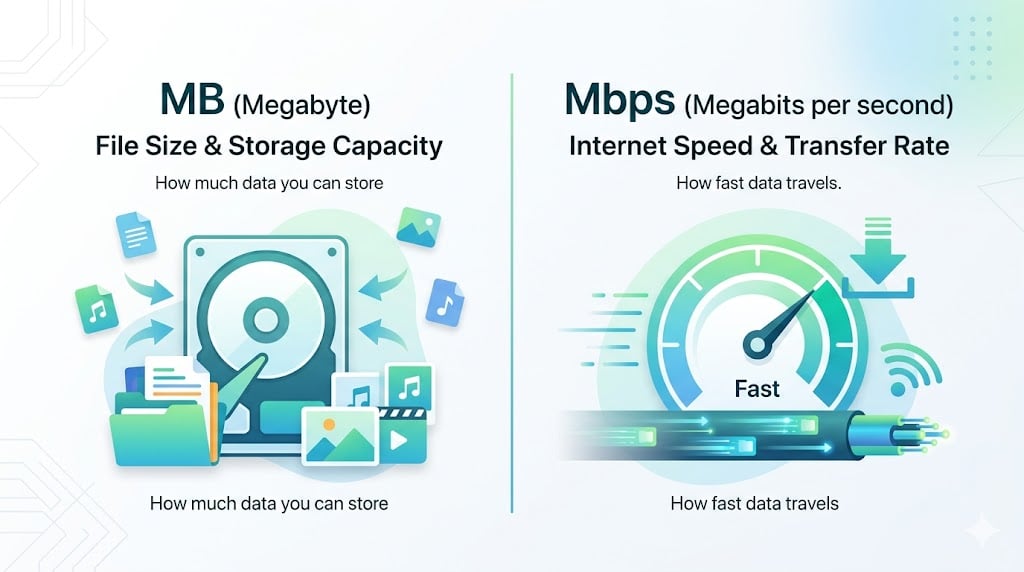
Mbps vs MB/s: What’s the Difference?
Both are speeds, but MB/s is 8 times larger than Mbps. Internet providers advertise speed in megabits per second (Mbps), while download managers, browsers, and operating systems usually show transfer speed in megabytes per second (MB/s).
- MB/s = Mbps ÷ 8
- Mbps = MB/s × 8
- 1 MB/s = 8 Mbps
So a 100 Mbps plan transfers files at about 12.5 MB/s, and a 1 Gbps plan transfers at about 125 MB/s. The number does not change because the connection got slower — it changes because bits and bytes are different units that differ by a factor of 8.
Mbps to MB/s Formula (÷ 8)
To convert any connection speed to real download speed:
MB/s = Mbps ÷ 8
Examples: 50 Mbps ÷ 8 = 6.25 MB/s; 300 Mbps ÷ 8 = 37.5 MB/s; 500 Mbps ÷ 8 = 62.5 MB/s. To go the other way, multiply MB/s by 8.
MB vs Mbps: File Size vs Internet Speed
MB measures file size; Mbps measures speed — they are not directly comparable. A 700 MB file is an amount of data. A 100 Mbps connection is a rate at which data moves. Asking “is MB bigger than Mbps?” is like asking whether a gallon is bigger than a mile per hour.
The capital letter is the key:
- Capital B (MB, MB/s) = byte
- Lowercase b (Mbps, Mb) = bit
- 1 byte = 8 bits
Once you see the capital B as “bytes” and lowercase b as “bits,” the 8× relationship — and most of the confusion — disappears.
Mbps to MB/s Converter
Enter a speed to see Mbps, MB/s, and Gbps at once, then estimate how long a file takes to download.
Common Internet Speeds: Mbps and MB/s Side by Side
| Connection speed (Mbps) | Real transfer speed (MB/s) |
|---|---|
| 25 Mbps | 3.125 MB/s |
| 50 Mbps | 6.25 MB/s |
| 100 Mbps | 12.5 MB/s |
| 300 Mbps | 37.5 MB/s |
| 500 Mbps | 62.5 MB/s |
| 1,000 Mbps (1 Gbps) | 125 MB/s |
Every value in the right column is the left column divided by 8. These are theoretical maximums; real transfers run a little slower because of protocol overhead.
Why Does 100 Mbps Download at Only 12.5 MB/s?
Nothing is broken — this is the bits-versus-bytes conversion in action. A 100 Mbps connection moves 100 megabits per second. A file’s size is measured in megabytes, and one byte is 8 bits, so:
100 megabits ÷ 8 = 12.5 megabytes, i.e. 12.5 MB/s.
In the real world you will usually see slightly less than 12.5 MB/s. Protocol overhead (TCP/IP headers, encryption, retransmissions), Wi-Fi conditions, and the server’s own limits typically shave 10–20% off the theoretical figure. So a 100 Mbps line that downloads at 10–11 MB/s is performing normally.
What Do MB, MB/s, and Mbps Mean?
- MB (megabyte): a unit of file size — about one million bytes. Used for photos, PDFs, and firmware images.
- MB/s (megabytes per second): a transfer speed — how many megabytes move each second. This is the number download tools display.
- Mbps (megabits per second): a link speed — how many megabits the connection carries each second. This is the number on internet plans and switch port ratings.
MB is a quantity; MB/s and Mbps are rates. MB/s and Mbps measure the same thing (speed) in different units that differ by 8.
Real-World Examples: Downloads, Streaming, and Backups
- Downloading a 3 GB installer on a 500 Mbps line: 500 Mbps = 62.5 MB/s, so 3,000 MB ÷ 62.5 ≈ 48 seconds in theory, closer to a minute after overhead.
- Streaming 4K video: a 4K stream needs roughly 25 Mbps (about 3.1 MB/s); HD needs about 5 Mbps. These are sustained rates, not file sizes.
- Backing up 100 GB over a 1 Gbps link: 1 Gbps = 125 MB/s, so 100,000 MB ÷ 125 ≈ 800 seconds (about 13 minutes) at full rate — useful when planning maintenance windows. Reaching those rates also depends on the right optics and transceivers end to end.
Common Mistakes With MB, MB/s, and Mbps
- Thinking MB and Mbps are the same. One is a file size, the other is a speed.
- Expecting 100 Mbps to mean 100 MB/s. It is 12.5 MB/s — divide by 8.
- Ignoring the ÷8 conversion. Bits and bytes differ by a factor of 8, always.
- Confusing MB with MB/s. MB is a size; MB/s is a rate over time.
- Reading the capital B wrong. Capital B is bytes (MB, MB/s); lowercase b is bits (Mbps).
Storage Sizes vs Network Speed (How These Units Fit Together)
Two families of units are in play, and they are easy to keep straight once separated:
- File size and storage capacity use bytes: KB, MB, GB, TB. For the full size order and conversions, see our KB vs MB vs GB vs TB guide.
- Network speed uses bits per second: Mbps and Gbps. For how link speeds compare and what a plan or port really delivers, see Mbps vs Gbps.
This page sits between the two: it converts a bit-based speed (Mbps) into a byte-based transfer rate (MB/s).
FAQ
What is the difference between Mbps and MB/s?
Both are speeds, but MB/s is 8 times larger. Mbps is megabits per second; MB/s is megabytes per second; one byte is 8 bits, so MB/s = Mbps ÷ 8.
Is MB/s the same as Mbps?
No. They measure the same thing — speed — but in different units. 1 MB/s equals 8 Mbps.
How many Mbps is 1 MB/s?
1 MB/s equals 8 Mbps, because one byte is 8 bits.
How do I convert Mbps to MB/s?
Divide the Mbps figure by 8. For example, 200 Mbps ÷ 8 = 25 MB/s.
Is MB the same as Mbps?
No. MB (megabyte) is a file size; Mbps (megabit per second) is a speed. They are not directly comparable.
What does the capital B in MB mean?
The capital B stands for byte. A lowercase b, as in Mbps, stands for bit. One byte is 8 bits.
Why is my download speed lower than my internet plan?
Plans are advertised in Mbps (bits), while downloads display in MB/s (bytes), which is 8 times smaller. Protocol overhead and Wi-Fi conditions reduce it a further 10–20%.
Is 100 Mbps the same as 100 MB/s?
No. 100 Mbps is about 12.5 MB/s — eight times smaller.
How many MB/s is 1 Gbps?
1 Gbps equals 1,000 Mbps, or about 125 MB/s. See our Mbps vs Gbps guide for more on gigabit speeds.
References
- IEC 80000-13:2008, Quantities and units — Part 13: Information science and technology (defines the bit and the byte).
- IEEE 802.3 Ethernet standards — network data rates are expressed in decimal bits per second (e.g., 1 Gbps = 1,000 Mbps).