C9300L-48PF-4X-E vs C9300L-48P-4X-E: 890W vs 505W PoE Compared (2026)
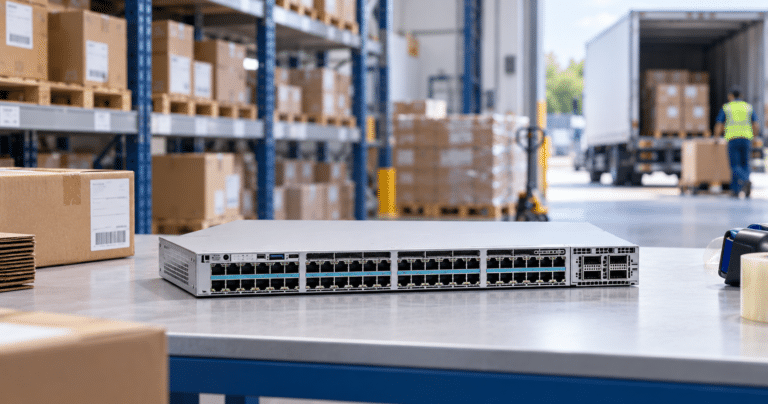
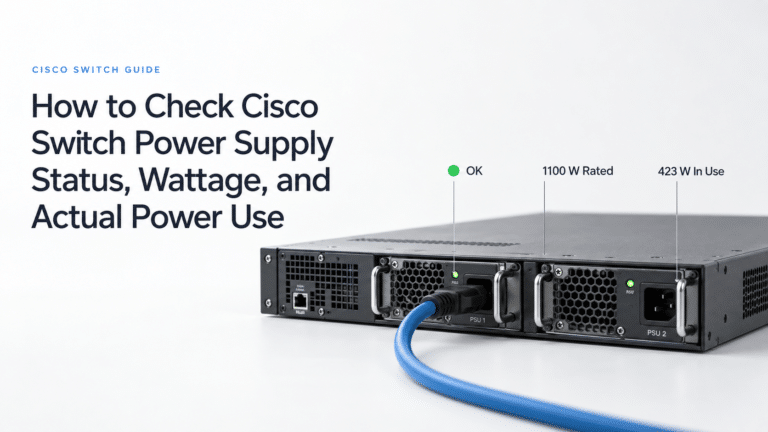
C9300L-48PF-4X-E and C9300L-48P-4X-E are both Cisco Catalyst 9300L 48-port 1G PoE+ access switches with four fixed 10G/1G SFP+ uplinks, StackWise-320 stacking, UADP 2.0 ASIC, and Network Essentials licensing. They share the same hardware platform, performance specs, and software image. The only meaningful difference is the bundled (default) power supply and the resulting default PoE budget: C9300L-48P-4X-E ships with one PWR-C1-715WAC-P (505W PoE budget), and C9300L-48PF-4X-E ships with one PWR-C1-1100WAC-P (890W PoE budget).
When C9300L-48PF-4X-E is unavailable, has a long lead time, or is more expensive, C9300L-48P-4X-E plus a secondary PWR-C1-1100WAC-P PSU can deliver 1220W of available PoE — exceeding the PF’s 890W default — making it a practical equivalent-capacity alternative. However, the base SKU does not change, so tenders, approved BOMs, and end-user specifications must confirm acceptance of substitution before ordering.
For current pricing and availability, see the C9300L-48P-4X-E product page or the C9300L-48PF-4X-E product page.

C9300L-48PF-4X-E vs C9300L-48P-4X-E: Full Side-by-Side Comparison
The two switches are mechanically and functionally identical on every spec except the bundled power supply. The table below is built directly from the Cisco Catalyst 9300 Series Data Sheet (updated October 9, 2025).
|
Specification |
C9300L-48P-4X-E |
C9300L-48PF-4X-E |
|---|---|---|
|
Product family |
Cisco Catalyst 9300L (fixed uplink) |
Cisco Catalyst 9300L (fixed uplink) |
|
Access ports |
48 × 10/100/1000BASE-T PoE+ (IEEE 802.3at, 30W/port) |
48 × 10/100/1000BASE-T PoE+ (IEEE 802.3at, 30W/port) |
|
Uplinks |
4 × 10G/1G SFP+ (fixed) |
4 × 10G/1G SFP+ (fixed) |
|
License (suffix E) |
Network Essentials |
Network Essentials |
|
ASIC / CPU |
UADP 2.0 / x86, 8 GB RAM, 16 GB flash |
UADP 2.0 / x86, 8 GB RAM, 16 GB flash |
|
Switching capacity (standalone) |
176 Gbps |
176 Gbps |
|
Forwarding rate (standalone) |
130.95 Mpps |
130.95 Mpps |
|
Stacking |
StackWise-320 (up to 8 members, kit ordered separately) |
StackWise-320 (up to 8 members, kit ordered separately) |
|
StackPower |
Not supported (C9300L limitation) |
Not supported (C9300L limitation) |
|
Stack bandwidth |
320 Gbps |
320 Gbps |
|
Stack throughput (8-member) |
496 Gbps switching / 369.05 Mpps forwarding |
496 Gbps switching / 369.05 Mpps forwarding |
|
MAC address table |
32,000 |
32,000 |
|
IPv4 routes (ARP + learned) |
32,000 (24,000 direct + 8,000 indirect) |
32,000 (24,000 direct + 8,000 indirect) |
|
VLAN IDs |
4,094 |
4,094 |
|
Jumbo frames |
9,198 bytes |
9,198 bytes |
|
Packet buffer |
16 MB |
16 MB |
|
FNF entries |
64,000 flows |
64,000 flows |
|
Default (primary) PSU |
1 × PWR-C1-715WAC-P |
1 × PWR-C1-1100WAC-P |
|
Default PoE+ budget |
505W |
890W |
|
Max PoE with one 1100W secondary |
1220W |
1440W (port-rated cap) |
|
Hardware PoE cap (48 × 30W) |
1440W |
1440W |
|
Perpetual PoE / Fast PoE |
Supported (IOS XE) |
Supported (IOS XE) |
|
MACsec encryption |
AES-256 line-rate (IEEE 802.1AE) |
AES-256 line-rate (IEEE 802.1AE) |
|
Encrypted Traffic Analytics (ETA) |
Supported |
Supported |
|
Fans |
3 × field-replaceable, N+1 redundancy (FAN-T2=) |
3 × field-replaceable, N+1 redundancy (FAN-T2=) |
|
PSU bays |
2 (1+1 redundancy supported) |
2 (1+1 redundancy supported) |
|
Minimum IOS XE |
16.11.1b or later |
16.11.1b or later |
|
Mandatory subscription |
Cisco DNA / Catalyst term license (3/5/7 yr) |
Cisco DNA / Catalyst term license (3/5/7 yr) |
|
Best-fit deployment |
Standard PoE access, IP phones, light AP density |
Wi-Fi 6 APs, mixed PoE+ load, surveillance |
Bottom line: every line in this table is identical except default PSU, default PoE budget, and maximum PoE achievable with a single primary PSU. The two SKUs are not “different switches”; they are the same hardware with different power supplies pre-installed at the factory.
Default PSU and PoE Budget — Why It Matters
The “48 PoE+ ports” specification is a marketing summary. In a real deployment, only the total PoE budget determines how many endpoints the switch can safely power. The IEEE 802.3at PoE+ standard reserves up to 30W per port, so 48 ports running at the full PoE+ limit would consume 1440W — far beyond the default budget of either switch.
| Model | Bundled PSU | Default PoE Budget | Approx. Avg Watts/Port (48 ports) |
|---|---|---|---|
| C9300L-48P-4X-E | PWR-C1-715WAC-P | 505W | ~10.5W per port |
| C9300L-48PF-4X-E | PWR-C1-1100WAC-P | 890W | ~18.5W per port |
The “PF” suffix in Cisco’s fixed-uplink naming convention indicates “Full PoE,” signaling that the switch is pre-configured to provide more usable PoE per port out of the box. Below ~10W per port average, the standard “P” model is fine; above that, the PF SKU (or an upgraded P configuration) is the safer choice.
Can C9300L-48P-4X-E Replace C9300L-48PF-4X-E?
Yes — from a PoE capacity perspective. C9300L-48P-4X-E can be configured with a secondary PWR-C1-1100WAC-P to deliver 1220W of available PoE, which exceeds the PF default of 890W. Combined with a primary 1100W upgrade, it can reach the hardware port-rated ceiling of 1440W.
No — from a procurement perspective. C9300L-48P-4X-E with an upgraded PSU is still C9300L-48P-4X-E on the shipping invoice, the warranty record, the Cisco Smart License entitlement, and any tender BOM line item. It is an equivalent-capacity configuration, not the PF SKU.
This distinction matters when buyers must satisfy:
- government and public-sector tenders
- OEM-approved BOMs and reference designs
- consultant-locked architecture documents
- insurance, audit, or compliance specifications
- end-of-life replacement of an existing PF unit
If a tender explicitly names C9300L-48PF-4X-E as a mandatory line item and does not permit equivalent configurations, do not substitute the P model — even if the resulting PoE budget would be higher. When the underlying requirement is “≥ 890W of available PoE on a 48-port 9300L PoE+ access switch with 4× 10G SFP+ uplinks,” then C9300L-48P-4X-E + secondary 1100W PSU is a legitimate alternative — subject to written buyer approval.
PSU Configurations and Available PoE — Cisco Official Numbers
The table below is taken directly from Table 4 of the Cisco Catalyst 9300 Series Data Sheet, which lists the validated PoE power available for every PSU combination. Use this as your authoritative reference — not vendor product pages, which sometimes show inconsistent or simplified numbers.
| Configuration | Primary PSU | Secondary PSU | Available PoE | Procurement Notes |
|---|---|---|---|---|
| C9300L-48P-4X-E (default) | PWR-C1-715WAC-P | — | 505W | Light PoE only; ~10W/port average |
| C9300L-48P-4X-E + 350W | PWR-C1-715WAC-P | PWR-C1-350WAC-P | 855W | Modest gain; below PF default |
| C9300L-48P-4X-E + 715W | PWR-C1-715WAC-P | PWR-C1-715WAC-P | 855W | Same total as 350W secondary; insufficient as PF substitute |
| C9300L-48P-4X-E + 1100W | PWR-C1-715WAC-P | PWR-C1-1100WAC-P | 1220W | Exceeds PF default; recommended PF substitute |
| C9300L-48P-4X-E + dual 1100W* | PWR-C1-1100WAC-P (upgrade) | PWR-C1-1100WAC-P | 1440W (port-rated cap) | Maximum possible PoE on this hardware |
| C9300L-48PF-4X-E (default) | PWR-C1-1100WAC-P | — | 890W | Native PF configuration |
| C9300L-48PF-4X-E + 350W | PWR-C1-1100WAC-P | PWR-C1-350WAC-P | 1240W | Cheapest upgrade path; +350W PoE |
| C9300L-48PF-4X-E + 715W | PWR-C1-1100WAC-P | PWR-C1-715WAC-P | 1440W (port-rated cap) | Reaches port-rated PoE ceiling |
| C9300L-48PF-4X-E + 1100W | PWR-C1-1100WAC-P | PWR-C1-1100WAC-P | 1440W (port-rated cap) | Full PoE + best 1+1 redundancy |
*Upgrading the default 715W to a 1100W on the P SKU requires ordering PWR-C1-1100WAC-P separately and physically swapping the primary PSU. The 715W unit can be redeployed as spare stock.
Key insight that most competitor pages miss: the 1440W figure in Cisco’s data sheet is annotated “Limited by port number and port rating (48 PoE+ × 30W = 1440W).” This means once total available wattage reaches 1440W, adding a larger secondary PSU produces no further PoE benefit on this hardware — only redundancy improvements.
PoE Load Planning — Real-World Calculation Method
Rather than rely on rule-of-thumb estimates, calculate worst-case continuous PoE draw for the actual endpoint mix. Apply a 15–20% headroom factor for surge, cable loss, and future growth.
Formula:
Required PoE budget = Σ (per-endpoint max watts × quantity) × 1.20
The table below uses official Cisco maximum-power-draw figures from the Cisco AP Power Requirements Reference (Document ID 215467, updated Aug 29, 2025).
| Endpoint type | Max PoE draw | Class / Standard |
|---|---|---|
| Cisco IP Phone 7800/8800 (audio only) | 3–7W | Class 2 (PoE) |
| Cisco IP Phone 8865 (video) | ~13W | Class 4 (PoE+) |
| Cisco Catalyst 9115 AP (Wi-Fi 6) | 21.4W | PoE+ full functionality |
| Cisco Catalyst 9117 AP (Wi-Fi 6) | 28.9W | PoE+ (USB reduced) |
| Cisco Catalyst 9120 AP (Wi-Fi 6) | 25.5W | PoE+ full functionality |
| Cisco Catalyst 9130 AP (Wi-Fi 6) | 30.5W | UPOE recommended; PoE+ limits USB only |
| Cisco Catalyst 9136 AP (Wi-Fi 6E) | 47.3W | Requires UPOE+ (90W) |
| Cisco Catalyst 9166 AP (Wi-Fi 6E) | 30.5W | UPOE recommended |
| Cisco Catalyst 9172/9176/9178 AP (Wi-Fi 7) | 32–47W | Requires UPOE+ for full features |
| Fixed indoor IP camera | 5–10W | Class 2/3 (PoE) |
| PTZ outdoor camera w/ heater | 25–30W | Class 4 (PoE+) |
| Door access controller | 5–10W | Class 2/3 (PoE) |
| Digital signage display | 15–25W | Class 4 (PoE+) |
Worked example A — IP telephony deployment:
48 × Cisco IP Phone 8841 (~6W avg) = 288W × 1.20 = 346W required → C9300L-48P-4X-E default (505W) is sufficient.
Worked example B — Wi-Fi 6 dense AP deployment:
32 × Catalyst 9120 AP (25.5W max) + 16 unused PoE ports = 816W × 1.20 = 979W required → C9300L-48P-4X-E default (505W) fails; C9300L-48PF-4X-E default (890W) marginal; PF + 350W secondary (1240W) or P + 1100W secondary (1220W) recommended.
Worked example C — Mixed surveillance/access:
24 cameras (12W avg) + 12 access controllers (8W) + 8 fixed IP phones (6W) = 384W + 96W + 48W = 528W × 1.20 = 634W required → C9300L-48P-4X-E default fails by ~130W; C9300L-48PF-4X-E default (890W) handles comfortably.
Worked example D — Wi-Fi 7 AP deployment:
24 × Catalyst 9176 AP (39W max) = 936W × 1.20 = 1123W required AT PoE+ levels. Critically, 9176 requires UPOE+ (90W per port) for full features — PoE+ mode forces the AP into reduced functionality. Do not specify a 9300L PoE+ switch for Wi-Fi 7 or Catalyst 9136 deployments; use C9300-48H (UPOE+, 822W default PoE) or higher.
When to Choose C9300L-48PF-4X-E
- The tender, BOM, or design document explicitly requires the PF SKU.
- The customer wants ≥ 890W of usable PoE on day one without additional PSU purchases.
- Wi-Fi 6 AP density is medium-to-high (≥ 24 APs per switch at ~25W each).
- Mixed PoE loads (phones + APs + cameras) exceed 700W total worst case.
- The procurement team wants a single-line-item order without PSU add-ons.
- Stock and pricing for the PF SKU are acceptable in the deployment region.
When to Choose C9300L-48P-4X-E
- The deployment is dominated by low-power endpoints (IP phones, simple cameras).
- Total worst-case PoE load (with 20% headroom) is under 500W.
- PF SKU is out of stock, on long lead time, or significantly more expensive.
- The buyer is prepared to add a secondary PWR-C1-1100WAC-P later as deployment scales.
- Tender language allows “C9300L-48P-4X-E or equivalent” configurations.
- Future-proofing matters: starting with P + adding a 1100W later costs roughly the same as PF, with more PoE headroom upon expansion.
Note: For full 48-port PoE+ saturation with redundancy, the P + dual-1100W configuration provides the maximum practical PoE ceiling (1440W; full redundancy in 1+1 shared mode).
Power Redundancy Modes — Shared vs Redundant
Both switches support dual PSUs in two modes (configured via IOS XE):
- Shared mode (default): Both PSU outputs sum into the available power budget. If one fails, the remaining PSU continues to power whatever its capacity allows; lower-priority PoE ports may shed.
- Redundant mode: The system reserves capacity equal to the larger PSU. Available PoE drops, but a single PSU failure causes zero PoE interruption.
For mission-critical access closets (hospitals, manufacturing, financial trading floors), specify dual 1100W PSUs and configure redundant mode. For standard office deployments, shared mode maximizes usable PoE.
Important: Catalyst 9300L (fixed uplink) models do not support Cisco StackPower — power cannot be shared across stack members the way it can on modular C9300/C9300X SKUs. Each 9300L unit must satisfy its own PoE budget independently.
Stacking Compatibility
C9300L-48P-4X-E and C9300L-48PF-4X-E can stack together at StackWise-320 (320 Gbps) provided they share the same license level (in this case, Network Essentials / E suffix). Stack rules per the Cisco data sheet:
- Up to 8 members in a single C9300L stack.
- C9300L SKUs can mix-stack with C9300LM SKUs at the same license level.
- C9300L SKUs cannot stack with modular-uplink C9300 / C9300X SKUs, Catalyst 3850, or 3650.
- Stack adapters and cable are not included by default. Order C9300L-STACK-KIT (or C9300L-STACK-KIT2 if mixing with C9300LM).
Regional and Voltage Considerations
- Japan (100V deployments): Per Cisco’s Catalyst 9300L hardware installation guide, PWR-C1-1100WAC-P will not operate on 100V; it requires 115V–240V AC, 50/60 Hz. For Japan, deploy on 200V+ outlets with a 250VAC power cord. If only 100V is available, the C9300L-48P-4X-E with its default 715W PSU is the only compliant choice.
- Power cords: Must be ordered by region (CAB-AC-C15-US, CAB-AC-C15-EU, CAB-AC-C15-UK, CAB-AC-C15-JPN, CAB-AC-C15-CHN, etc.). The default switch order includes one regional power cord matched to the ship-to country.
- Platinum efficiency: Both PWR-C1-715WAC-P and PWR-C1-1100WAC-P are 80 PLUS Platinum-rated (>90% efficiency at full load), reducing operating cost over the switch lifetime.
Complete BOM Checklist Before Ordering
| BOM Item | Why It Matters | Often Missed? |
|---|---|---|
| Base switch SKU (P vs PF) | Determines default PSU and PoE budget | No |
| Secondary PSU | Required for PoE expansion or 1+1 redundancy | Yes |
| Primary PSU upgrade (for P → 1100W) | Only needed if upgrading from default 715W | Yes |
| StackWise-320 kit (C9300L-STACK-KIT) | Switch ships without stack adapters; must order separately | Yes — frequent omission |
| StackWise cable (STACK-T3-50CM / 1M / 3M) | Included with stack kit at 50cm by default; 1m or 3m must be ordered separately | Yes |
| SFP+ modules (SFP-10G-SR / LR / SR-S etc.) | Uplinks are unpopulated; transceivers ordered separately | Yes |
| Power cord (regional) | Must match destination country; default includes one matching ship-to | Sometimes |
| Cisco DNA / Catalyst term license | Mandatory at time of purchase (3/5/7 yr term) | Yes — frequent omission |
| SmartNet / Solution Support | Required for TAC access; usually 1 or 3 yr | Sometimes |
| Console cable | Switch includes USB Type-B port; cable not included | Yes |
| Rack mount kit | Standard 19″ rails included; review for non-standard cabinets | No |
The two most frequent BOM errors on first-time 9300L orders are (1) forgetting the stack kit — the switch literally cannot stack without it — and (2) forgetting to attach a Cisco DNA or Catalyst software subscription, which Cisco requires at time of purchase. Both issues cause order rejection or delay.
Common Buying Mistakes
- Comparing only “48 PoE+ ports” and ignoring the actual PoE budget delta (505W vs 890W).
- Assuming all 48 ports can simultaneously deliver 30W PoE+ — they cannot, without dual high-capacity PSUs.
- Believing two 715W PSUs (855W combined PoE) fully replace the PF default (890W). They fall short by 35W.
- Treating P + 1100W secondary as the “same” SKU as PF for tender purposes — it is not.
- Specifying 9300L PoE+ for Wi-Fi 7 or Catalyst 9136 (Wi-Fi 6E) APs that require UPOE+ — these need C9300-48H hardware.
- Forgetting the StackWise-320 kit — the switch has stack slots but no stack adapters installed by default.
- Quoting C9300L-48PF-4X-E in Japan on 100V circuits — the 1100W PSU will not power on below 115V.
- Mixing 9300L stack members with C9300 modular-uplink units — Cisco does not support this combination.
- Skipping the mandatory Cisco DNA / Catalyst subscription license at order time.
Final Recommendation Matrix
| Buying Scenario | Recommended Choice |
|---|---|
| Tender explicitly requires PF SKU | C9300L-48PF-4X-E (no substitution) |
| Native 890W default PoE without add-ons | C9300L-48PF-4X-E |
| Standard office / IP phone deployment under 500W total | C9300L-48P-4X-E (default) |
| PF unavailable; ≥ 890W usable PoE required; equivalent accepted | C9300L-48P-4X-E + PWR-C1-1100WAC-P secondary |
| Mission-critical PoE with 1+1 redundancy | C9300L-48PF-4X-E + PWR-C1-1100WAC-P secondary (redundant mode) |
| Maximum 1440W PoE with full redundancy | C9300L-48P-4X-E or PF with dual PWR-C1-1100WAC-P |
| Japan 100V deployment | C9300L-48P-4X-E with default 715W (PF only on 200V+ circuits) |
| Wi-Fi 7 or Catalyst 9136 (UPOE+ required) | Neither — specify C9300-48H instead |
The right choice depends on five factors in order of priority: (1) tender / BOM rigidity, (2) worst-case PoE load with headroom, (3) redundancy requirement, (4) regional voltage and stock availability, (5) total project cost including PSUs, stack kit, transceivers, license, and support. Decide in that order and the SKU choice usually becomes obvious.
Layer23-Switch supports global B2B buyers with Cisco product selection, PoE load planning, PSU configuration, stock confirmation, shipping logistics, and pre-sales technical support across the full Catalyst 9300 / 9300L / 9300X portfolio.

FAQ
What is the main difference between C9300L-48PF-4X-E and C9300L-48P-4X-E?
The only meaningful difference is the bundled default power supply and the resulting default PoE budget. C9300L-48P-4X-E ships with PWR-C1-715WAC-P providing 505W PoE budget; C9300L-48PF-4X-E ships with PWR-C1-1100WAC-P providing 890W PoE budget. All other specifications — ports, uplinks, ASIC, license, stacking, switching capacity, MAC scale — are identical.
Can C9300L-48P-4X-E replace C9300L-48PF-4X-E?
From a PoE capacity perspective, yes — C9300L-48P-4X-E configured with a secondary PWR-C1-1100WAC-P provides 1220W of available PoE, exceeding the PF default of 890W. However, the base SKU remains C9300L-48P-4X-E on invoices, warranties, and Cisco Smart Licensing records. For strict tenders or BOMs that name the PF SKU, this substitution requires written buyer approval.
Is two PWR-C1-715WAC-P enough to replace C9300L-48PF-4X-E?
No. C9300L-48P-4X-E with two PWR-C1-715WAC-P supplies provides 855W of PoE per Cisco’s data sheet, which is 35W below the C9300L-48PF-4X-E default of 890W. To match or exceed the PF default, you need at least one PWR-C1-1100WAC-P.
Can C9300L-48P-4X-E deliver full 30W PoE+ on all 48 ports simultaneously?
Not with the default 715W PSU. Full-rate PoE+ across all 48 ports requires 1440W (48 × 30W). This is only achievable with one PWR-C1-1100WAC-P plus a secondary PWR-C1-715WAC-P or larger. Cisco’s data sheet caps the available PoE at 1440W due to the hardware port rating, regardless of further PSU upgrades.
What does ‘4X’ mean in C9300L-48P-4X-E?
4X indicates four fixed 10G/1G SFP+ uplink ports. The 4G variant has four 1G-only SFP uplinks instead. Both C9300L-48P-4X-E and C9300L-48PF-4X-E share the same 4X uplink configuration; the 4G versions (C9300L-48P-4G-E and C9300L-48PF-4G-E) are separate SKUs.
What does the ‘E’ suffix mean in these Cisco SKUs?
The E suffix indicates Network Essentials licensing. The alternative is A (Network Advantage), which adds features like flexible NetFlow, VRF-Lite, advanced routing protocols (BGP, multicast), and SD-Access support. Both SKUs in this comparison use Network Essentials.
Which model should I choose for wireless APs or surveillance cameras?
For light or moderate PoE demand (IP phones, indoor cameras, Catalyst 9115 APs at 21.4W), C9300L-48P-4X-E may be sufficient. For Wi-Fi 6 AP density above ~24 APs at 25W each (e.g., Catalyst 9120 or 9130), PTZ outdoor cameras, or mixed high-power deployments, choose C9300L-48PF-4X-E or C9300L-48P-4X-E with an upgraded 1100W PSU. For Wi-Fi 6E (Catalyst 9136 at 47.3W) or Wi-Fi 7 APs, neither switch is suitable — these require UPOE+ hardware such as C9300-48H.
Does C9300L support StackPower like the modular C9300?
No. Cisco Catalyst 9300L fixed-uplink switches (including C9300L-48P-4X-E and C9300L-48PF-4X-E) do not support StackPower. Each switch must satisfy its own PoE budget independently. Only modular-uplink C9300 and C9300X SKUs support StackPower across the stack.
Is PWR-C1-1100WAC-P compatible with 100V power in Japan?
No. According to Cisco’s Catalyst 9300L hardware documentation, PWR-C1-1100WAC-P will not operate on 100V input. It requires 115V–240V AC, 50/60 Hz. For Japan deployments on 100V circuits, use the default 715W PSU on C9300L-48P-4X-E, or deploy C9300L-48PF-4X-E only on 200V+ outlets with the appropriate 250VAC power cord.
Do I need to order anything extra besides the switch?
Yes. The switch ships with one PSU, three fans, and the regional power cord, but you typically also need: (1) StackWise-320 kit (C9300L-STACK-KIT) if stacking — not included by default; (2) SFP+ transceivers for the uplinks; (3) Cisco DNA or Catalyst term software subscription, which is mandatory; and optionally (4) a secondary PSU, (5) SmartNet support contract, and (6) a longer 1m or 3m StackWise cable if the default 50cm is too short.
Can Layer23-Switch help confirm the right configuration?
Yes. Layer23-Switch helps B2B buyers select between C9300L-48P-4X-E and C9300L-48PF-4X-E based on PoE load calculation, PSU configuration, regional power constraints, stock availability, compatible transceivers, stacking kits, license terms, and shipping logistics for global delivery.
Need to confirm whether C9300L-48P-4X-E can replace C9300L-48PF-4X-E in your project? Send Layer23-Switch your required PoE load (worst-case watts and endpoint mix), preferred PSU configuration, destination country and voltage, redundancy requirement, project deadline, and BOM constraints. Our team will verify stock, compatible PSUs, stack kits, transceivers, license terms, and shipping options before you place the purchase order.