How to Select Cisco Access Switches for Enterprise Networks
Select Cisco access switches by defining the access closet role before comparing model names. For enterprise buyers, the first questions are what the closet connects, what it must power, how traffic leaves the closet, how much growth is expected, and how the switch standard will be maintained across sites. A model that looks attractive in a catalog can still be wrong if the PoE budget, uplink path, license tier, optics, accessories, warranty, or delivery timing does not fit the project BOM.
Access-layer selection should create a quote-ready requirement, not a model-by-model comparison. If the project still needs to decide between access, distribution, and core switching roles, start with the Cisco switch selection guide for enterprise campus networks. Once the access requirement is clear, model comparison and SKU validation should happen in the next layer of the buying process.
How Enterprises Should Select Cisco Access Switches
An enterprise Cisco access switch should be selected by closet role, endpoint mix, PoE load, uplink path, multigig requirement, operating standard, and quote constraints. Model comparison comes after these inputs are documented. The access switch is not only a port count; it is a power, traffic, support, and spare-unit decision at the network edge.
The access layer connects user devices, phones, wireless access points, printers, cameras, room systems, badge readers, and other local endpoints. Because those endpoints differ by floor, building, and business function, access switch selection should begin with the deployment area rather than a preferred model number. A standard office closet, a wireless-heavy floor, a camera zone, and a small branch rarely deserve the same buying logic.

Access Closet Requirements to Define Before Buying
The closet role decides which requirements are worth paying for and which ones only add cost. A low-density office floor may need predictable 1G access and moderate PoE. A wireless-heavy floor may need stronger PoE planning, multigig readiness, and more careful uplink sizing. A camera-heavy or building-services area may care less about user count and more about continuous powered-device load and failure impact.
Procurement teams should not reduce this step to a headcount estimate. Headcount can be useful, but it misses shared devices, wireless access points, room systems, phones, printers, badge readers, and future additions. In many refresh projects, a closet that looked simple on paper becomes difficult because powered endpoints and uplink requirements were not captured early.
| Access closet role | Typical connected devices | Selection priority | Procurement risk |
|---|---|---|---|
| Standard office floor | Users, phones, printers, several APs | Port count, moderate PoE, standard uplinks | Buying too many features for a stable closet |
| Wireless-heavy floor | APs, users, phones, collaboration devices | PoE reserve, multigig readiness, uplink capacity | Underestimating AP power and traffic growth |
| Security or IoT area | Cameras, badge readers, panels, sensors | Continuous PoE load and fault isolation | Counting endpoints but not total powered load |
| Small branch | Users, phones, APs, local devices | Simpler BOM, compact spare strategy, easy replacement | Overbuilding the site with campus-heavy assumptions |
| Multi-site rollout | Repeated office or branch designs | Standard model policy, lead time, spares | Creating too many one-off configurations |
The role does not automatically select a model, but it sets the correct evaluation path. Once the role is clear, the next step is converting it into buying inputs that can pass both engineering review and procurement review.
Cisco Access Switch Buying Inputs for Enterprise Projects
Enterprise buyers need a quote-ready set of inputs, not a loose requirement such as “48-port PoE switch.” That phrase can hide important differences in PoE budget, uplink speed, optics, license tier, stack accessories, power supply configuration, and acceptable substitutes. A clearer input set reduces quote revisions and avoids hardware that matches the port count but fails the deployment.
| Buying input | What to confirm | Why it affects the shortlist |
|---|---|---|
| Active endpoints | Users, phones, APs, cameras, printers, panels, IoT devices | Determines the base port count and endpoint mix |
| Spare capacity | Moves, additions, AP growth, temporary devices | Prevents early saturation after deployment |
| PoE load | Powered device count, expected wattage, reserve margin | Changes PoE model, power supply, and UPS planning |
| Uplink path | Fiber or copper, speed, distance, upstream switch | Determines optics, modules, and bottleneck risk |
| Multigig need | AP generation, user density, cable plant, refresh cycle | Separates ordinary 1G access from higher-speed edge demand |
| Standardization | Common model per floor, building, or region | Simplifies support, spares, firmware planning, and future quotes |
| License tier | Required features, management platform, subscription expectations | Prevents buying hardware that lacks the needed software entitlement |
| Delivery deadline | Stock, lead time, shipping destination, substitute policy | Determines whether the preferred BOM can be delivered on schedule |
These inputs should be collected before the model shortlist is finalized. A late discovery, such as a different uplink distance or a higher AP power requirement, can change the switch, power supply, optic, or delivery plan.
Enterprise Access Switch Selection Matrix by Deployment Scenario
The purpose of an access selection matrix is not to decide every Cisco model in one table. It is to match the buying situation to the right requirement class before the project moves into family or SKU comparison.
| Enterprise environment | Access requirement | Selection priority | Next buying action |
|---|---|---|---|
| Predictable office access | User ports, phones, printers, limited AP growth | Stable port count, moderate PoE, standard uplinks | Build a repeatable access closet standard |
| Wireless-driven floor | More APs, more concurrent clients, higher traffic | PoE reserve, multigig readiness, stronger uplinks | Validate AP power draw and uplink path before quote |
| Camera or facilities access | Cameras, badge readers, room controls, sensors | Continuous PoE load and contained fault impact | Separate endpoint count from PoE load |
| Branch office | Smaller footprint and simpler operation | Compact BOM, known spare model, straightforward support | Avoid campus overbuild unless growth justifies it |
| Large building rollout | Many closets with similar requirements | Standardization, stock planning, accessory consistency | Quote by repeatable BOM block rather than isolated switches |
| Executive or critical area | Low tolerance for disruption | Fault isolation, support plan, spare readiness | Confirm warranty, replacement process, and acceptable substitutes |
For enterprise procurement, the strongest access design is often the one that is easiest to repeat. Standardization can reduce troubleshooting time, simplify spare-unit planning, and make future quotes cleaner. Exceptions still matter, but each exception should be justified by a deployment requirement rather than a small price difference.
Port, PoE, Uplink, and Multigig Checks for Access Switches
Port count is the visible part of access switch selection, but it is not enough for ordering. Count live endpoints by category, then add practical spare capacity for moves, new access points, room upgrades, and unexpected additions. A closet that is full on day one creates operational friction even when the switch is functioning correctly.
If the main decision is whether a site should use 24-port or 48-port switching, use the 24-port vs 48-port switch guide after the endpoint count is known. Access selection should identify the port-count question; the detailed port-count comparison belongs on the dedicated guide.
PoE should be treated as a power budget, not just a port feature. A switch may have enough PoE-capable ports and still be the wrong choice if the total usable power budget does not support the connected APs, phones, cameras, panels, and future powered devices. For detailed power planning, use the Cisco PoE budget planning guide.
Higher-power edge devices also change the buying conversation. If the requirement includes UPOE, higher-power APs, video endpoints, or specialty powered devices, verify the required PoE type, total wattage, power supply, and reserve margin before quoting. For the power-class boundary, see the Cisco PoE and UPOE selection guide.
Uplink planning should follow the traffic profile of the closet. A standard office floor, a wireless-heavy area, and a camera-heavy zone can create very different aggregation patterns. The quote should specify the required uplink speed, fiber distance, optic type, upstream switch, and whether redundant uplinks are part of the design.
Multigig access should be tied to real endpoints and lifecycle plans. It is worth evaluating when wireless access points, cable plant, and user density justify speeds beyond ordinary 1G access. It should not be added only because it sounds more advanced. For a focused explanation, use the Cisco multigigabit switch guide.
When Access Switch Selection Should Move to Platform Comparison
Access selection should stop once the deployment requirements are documented and the remaining question becomes a Cisco Catalyst family or model boundary. At that point, the next decision belongs in the platform-comparison stage, not in access planning.
Move into platform comparison when the shortlist has reached questions such as which Catalyst family fits the campus edge, which platform class fits a high-density access layer, or whether the same project also needs distribution and core switching decisions. Access planning should not carry those model-level decisions directly.
This boundary keeps access selection useful for enterprise decision-makers and procurement teams. Access planning defines the closet requirement. Platform comparison evaluates the Cisco family direction. Product pages and quote review then confirm the exact SKU, license, accessories, and availability.
BOM Checks Before Requesting a Cisco Access Switch Quote
A Cisco access switch quote should include enough context for the supplier to validate the full bill of materials. The base switch model is only one line item. The working BOM may also require the correct license tier, power supply, optics, uplink module, stack cable, rack accessory, console cable, transceiver distance, spare unit, and warranty expectation.
Layer23-Switch can support this stage by checking stock, compatible accessories, quote completeness, global shipping requirements, warranty expectations, and acceptable substitutes. That review is most useful when the project team provides the deployment role and endpoint assumptions, not only a preferred model number.
| BOM item | What to verify before ordering | Why it matters |
|---|---|---|
| Base switch | Exact SKU, port type, license suffix, condition requirement | Prevents near-match substitutions |
| PoE requirement | PoE type, total budget, reserve margin | Avoids underpowered closets |
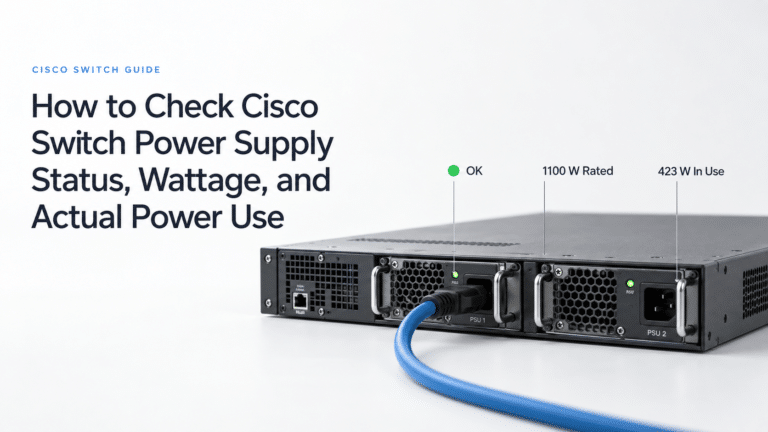
| Power supply | Wattage, redundancy, plug or regional requirement | Prevents power budget and installation delays |
| Uplinks | Speed, fiber distance, optics, upstream compatibility | Avoids transceiver and bottleneck issues |
| License | Required feature tier and subscription expectation | Prevents software entitlement gaps |
| Accessories | Stack kit, rack kit, cables, console access, spare parts | Avoids incomplete shipment |
| Warranty and support | Warranty term, service expectation, replacement process | Reduces project risk after delivery |
| Availability | Stock status, lead time, shipping destination | Determines whether the rollout schedule is realistic |
| Substitutes | Approved alternatives and non-substitution rules | Keeps procurement from accepting the wrong hardware |
Do not approve a substitute only because the port count is similar. A substitute should be checked against PoE, uplinks, license tier, optics, accessories, management requirements, physical installation, and delivery timing.
Common Cisco Access Switch Buying Mistakes
The most common mistake is starting with a model number before defining the closet role. A widely used access switch can be wrong for a specific site if the endpoint mix, power load, uplink path, or rollout schedule does not fit.
Another mistake is treating port count as the full requirement. A 48-port switch with the wrong PoE budget, uplink speed, license tier, or accessory set can create more project delay than a smaller switch quoted correctly.
PoE mistakes often appear late because the project team counts powered devices but does not document total load. Wireless refreshes, camera additions, and meeting room upgrades can change power demand quickly. A quote should include reserve margin rather than only day-one draw.
Uplink and optics are also easy to overlook. The access switch may be correct, but the project can still stall if the fiber distance, transceiver type, upstream port, or redundancy plan is missing from the BOM.
One-off buying decisions create a quieter long-term problem. Saving a small amount on a non-standard switch can increase support complexity, reduce spare efficiency, and make future expansion harder. Large enterprises usually benefit from a controlled access standard with documented exceptions.
Enterprise Access Switch Quote Checklist
Use this checklist before requesting price and lead time for Cisco access switches.
- Site name, building, floor, and access closet role
- Endpoint count by device type
- Required copper and fiber port count
- Spare port target for moves and future additions
- PoE type, powered device count, and total wattage estimate
- Uplink speed, optic distance, and upstream switch requirement
- Multigig requirement and the endpoints that justify it
- License tier and required management or security features
- Power supply, rack, stack, and cable accessories
- Preferred standard model and approved substitute policy
- Warranty expectation and replacement process
- Delivery deadline, shipping destination, and stock requirement
A clear checklist helps engineering and procurement work from the same facts. It also makes supplier review faster because the quote can be checked against the real deployment rather than a vague model request.
FAQ: Cisco Access Switch Selection for Enterprise Networks
What is the first step in selecting a Cisco access switch?
Start by defining the access closet role and endpoint mix. Identify whether the switch will support a standard office floor, wireless-heavy area, security and IoT zone, branch site, or repeated multi-site rollout. The model shortlist should come after the role, endpoint count, PoE load, uplink path, and standardization target are documented.
Should Cisco access switch selection start with port count?
Port count is important, but it should not be the first or only selection factor. A switch can have enough ports and still be wrong because of PoE budget, uplink speed, multigig requirements, license tier, accessories, stock, or support expectations. Treat port count as one buying input inside the full BOM.
What information should be prepared before requesting a Cisco access switch quote?
Prepare the site role, endpoint count, powered-device list, PoE requirement, uplink speed, optic distance, license tier, accessory needs, delivery deadline, and substitute policy. This gives the supplier enough information to validate the configuration rather than quoting only a base switch.
When should access selection move to platform comparison?
Move to platform comparison when the access-layer requirements are already documented and the remaining question is which Cisco Catalyst family or model direction fits the campus. Access selection defines the requirement; platform comparison handles family-level and model-level tradeoffs.
How should procurement handle acceptable substitutions?
Procurement should approve substitutions only after checking the full requirement, not only the port count. A substitute must match the needed PoE capability, uplink path, license tier, optics, accessories, installation constraints, warranty expectations, and delivery schedule.
What makes enterprise access switch buying different from small-office buying?
Enterprise access switch buying usually involves repeatable standards, multi-closet rollout, formal BOM review, warranty expectations, stock planning, and spare-unit strategy. The decision affects operations across floors or sites, so support consistency and configuration accuracy can matter more than a small one-off discount.
Final Buying Takeaway
The right Cisco access switch is selected when the deployment requirements and the procurement constraints agree. Start with the closet role, endpoint inventory, PoE load, uplink path, growth plan, and standardization target. Convert those inputs into a quote-ready BOM, then move to platform comparison only when the family boundary is the remaining decision.
For enterprise buyers, the strongest access switch decision is usually the one that can be justified technically, quoted accurately, delivered on schedule, and supported consistently after installation.