Cisco Catalyst 9800 Wireless Controller Comparison: C9800-L-C-K9 vs C9800-L-F-K9 vs C9800-40-K9 vs C9800-80-K9
When choosing a Cisco Catalyst 9800 wireless LAN controller, the C9800-L-C-K9 and C9800-L-F-K9 fit small to midsize deployments, while the C9800-40-K9 and C9800-80-K9 are designed for larger campus and enterprise WLAN environments. The right model depends on AP scale, client density, uplink design, and high-availability requirements.
Selecting the wrong wireless controller creates expensive problems later: uplink mismatches, insufficient scale, weak HA design, or unnecessary overspending. For enterprise WLAN projects, the real decision is not just how many APs you need today, but how much growth, redundancy, and throughput your architecture must support over the next three to five years. In most deployments, the C9800-L models fit compact or midsize environments, while the C9800-40 and C9800-80 are better suited to larger campus, healthcare, education, and high-density enterprise networks.
Why These Cisco 9800 WLC Models Still Matter
These four models remain highly relevant because they still appear in active enterprise environments, replacement projects, expansion plans, and refurbished-market sourcing. Cisco continues to maintain 9800-series technical documentation, deployment guidance, ISSU guidance, and HA resources, which reflects the platform’s ongoing operational importance in enterprise wireless networks.
This comparison is especially important because the C9800-40-K9 and C9800-80-K9 are now in Cisco’s published end-of-sale and end-of-life cycle, with a last day to order of December 31, 2025, while the notice explicitly states that the C9800-L and C9800-CL are not included. That makes model selection more nuanced: some buyers are evaluating new deployments, while others are planning expansion, HA pairing, or migration around existing 9800 installations.
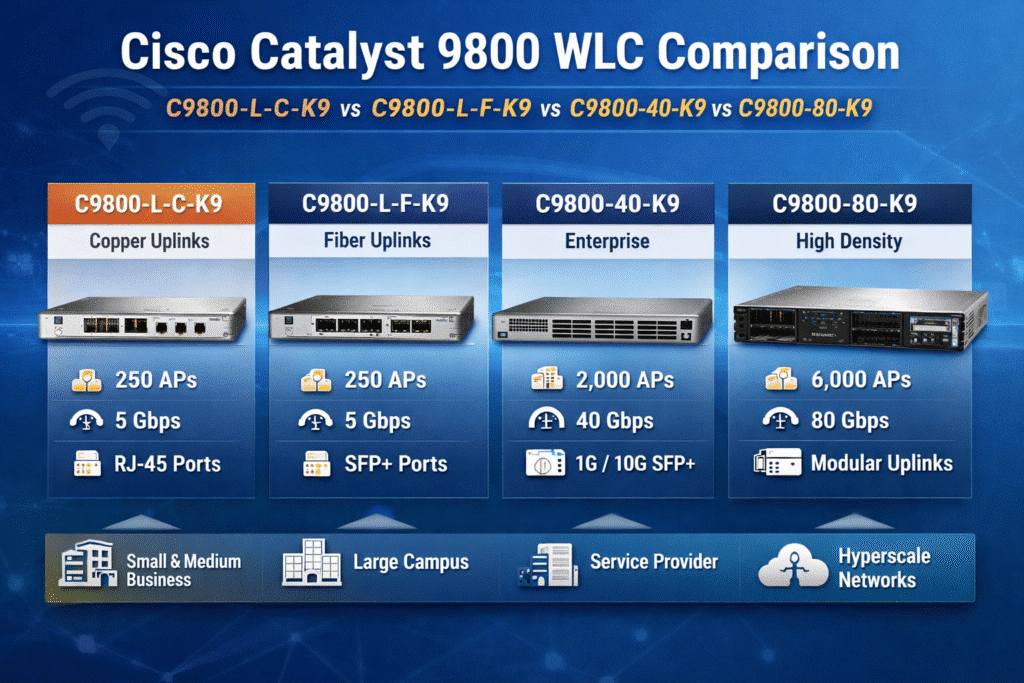
Cisco 9800 WLC Comparison at a Glance
| Model | Best Fit | Max APs | Max Clients | Max Throughput | Uplink Style | HA Suitability | Lifecycle Context |
|---|---|---|---|---|---|---|---|
| C9800-L-C-K9 | Small to midsize deployments | 250 | 5,000 | 5 Gbps | Copper multigig | Good for smaller HA designs | Still relevant for compact enterprise WLAN |
| C9800-L-F-K9 | Small to midsize deployments with fiber handoff | 250 | 5,000 | 5 Gbps | Fiber SFP/SFP+ | Good for smaller HA designs | Still relevant for compact enterprise WLAN |
| C9800-40-K9 | Midsize to large campus | 2,000 | 32,000 | 40 Gbps | Fixed SFP/SFP+ | Strong enterprise HA fit | In Cisco EoS/EoL cycle |
| C9800-80-K9 | Large campus and high-density enterprise | 6,000 | 64,000 | 80 Gbps | Fixed SFP/SFP+ plus modular uplink | Best for large-scale HA and growth headroom | In Cisco EoS/EoL cycle |
Cisco positions the 9800-L for small and midsize enterprises, the 9800-40 for midsize and large enterprise environments, and the 9800-80 for higher-scale deployments with modular uplink flexibility.
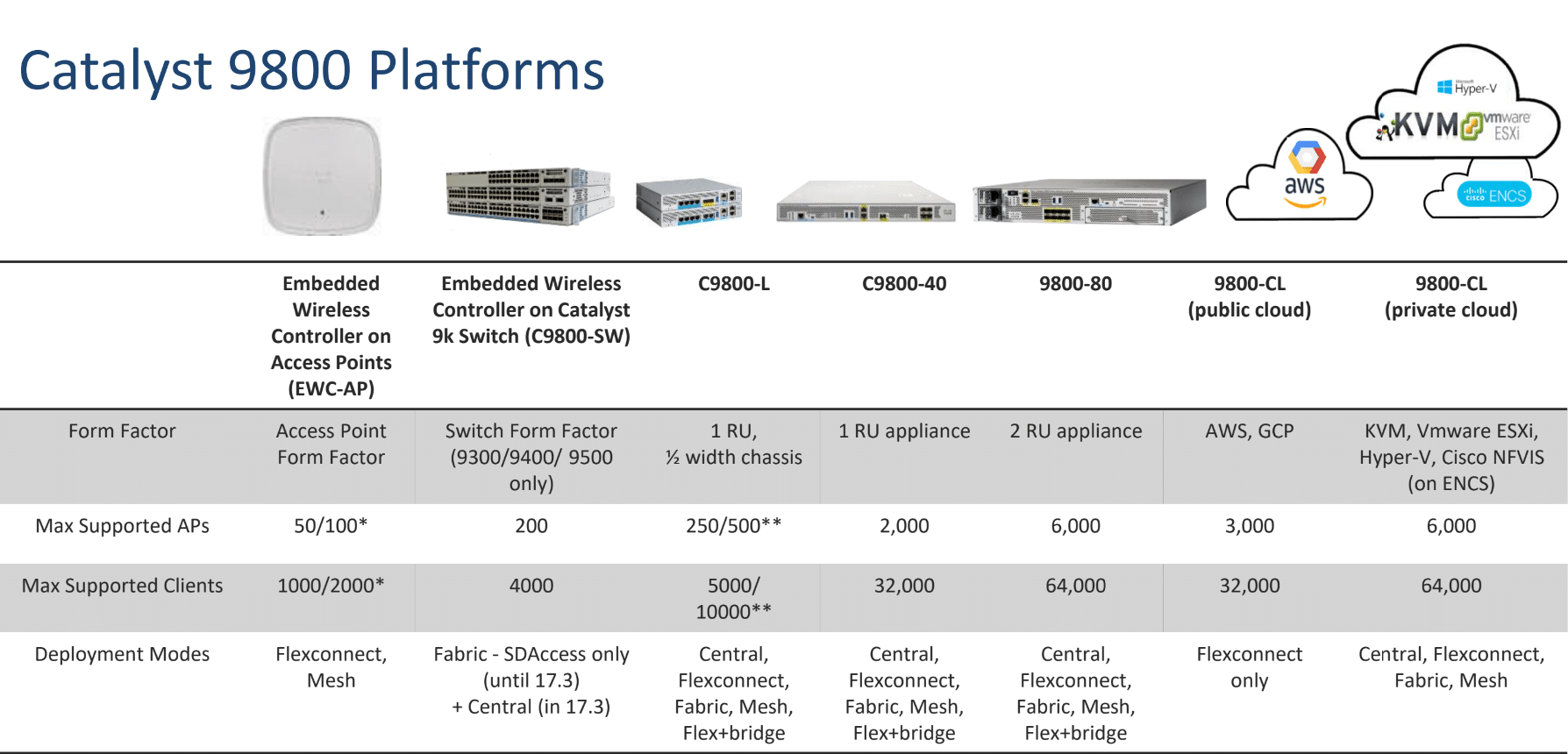
Full Hardware Comparison Matrix
| Specification / Parameter | C9800-L-C-K9 | C9800-L-F-K9 | C9800-40-K9 | C9800-80-K9 |
|---|---|---|---|---|
| Maximum APs | 250 | 250 | 2,000 | 6,000 |
| Maximum Clients | 5,000 | 5,000 | 32,000 | 64,000 |
| Maximum Throughput | 5 Gbps | 5 Gbps | 40 Gbps | 80 Gbps |
| Maximum WLANs | 4,096 | 4,096 | 4,096 | 4,096 |
| Maximum VLANs | 4,096 | 4,096 | 4,096 | 4,096 |
| Primary Data Port Style | Copper multigig RJ-45 | Fiber SFP/SFP+ | 4 x 10G / 1 x 1G SFP+/SFP | Fixed 1/10G ports plus modular uplink |
| Modular Uplink | No | No | No | Yes |
| High Availability (SSO) | Yes | Yes | Yes | Yes |
| Form Factor | 1RU half-width | 1RU half-width | 1RU | 2RU |
| License Model | Smart License enabled | Smart License enabled | Smart License enabled | Smart License enabled |
| Deployment Positioning | Small to midsize enterprise | Small to midsize enterprise | Midsize to large enterprise | Large-scale enterprise / high-density |
| Best Network Role | Compact campus / branch hub | Compact campus / branch hub with fiber handoff | Campus controller | Core enterprise wireless controller |
The sizing gap between the L series and the 40/80 platforms is substantial. The L models are built for compact and midsize WLAN designs, while the 40 and 80 are sized for enterprise-scale access layer growth, larger client populations, and stronger long-term expansion headroom.
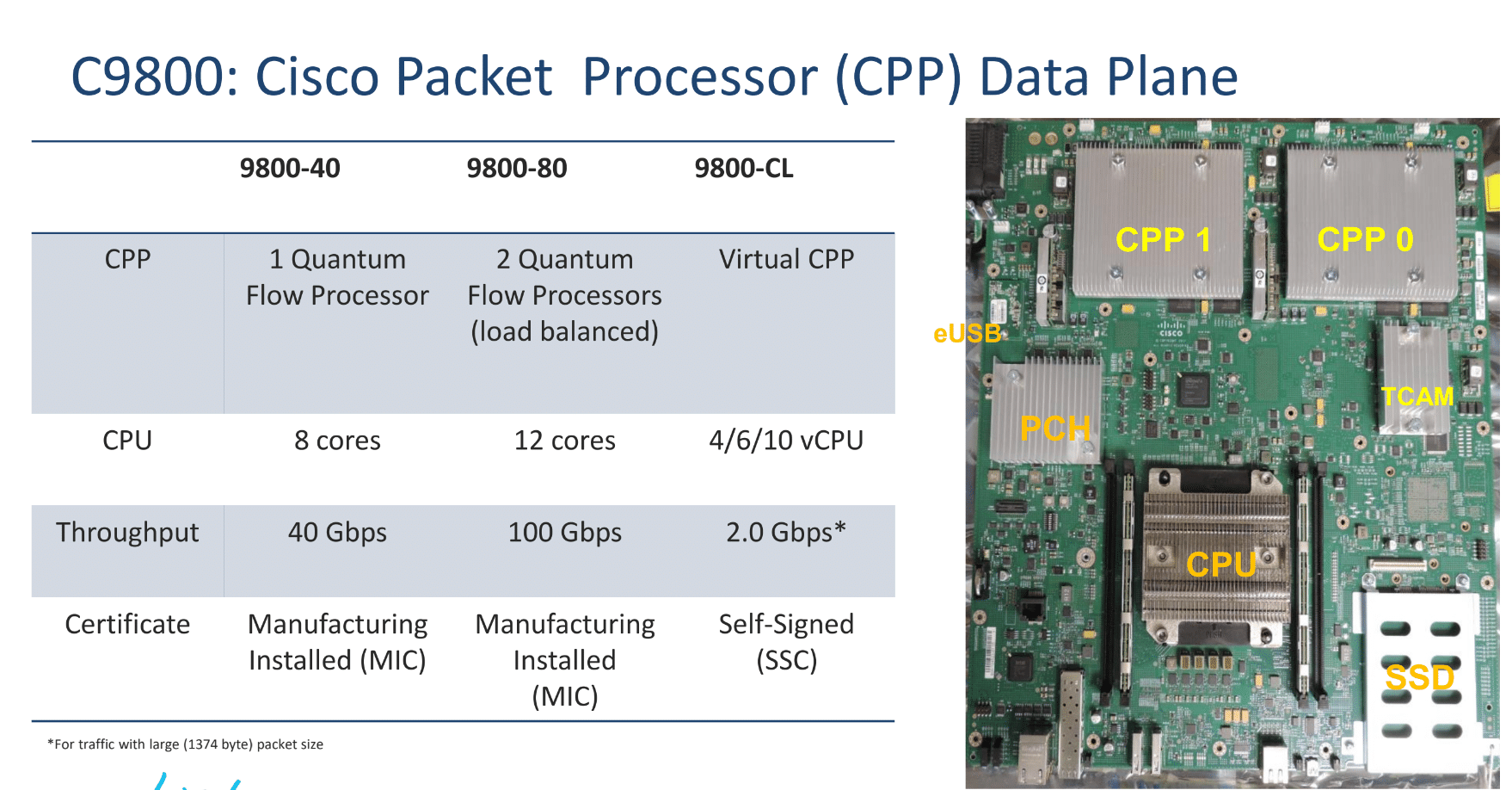
C9800-L-C-K9 vs C9800-L-F-K9
The C9800-L-C-K9 and C9800-L-F-K9 belong to the same controller family and share the same scale profile: up to 250 APs, 5,000 clients, and 5 Gbps of throughput. The main decision point is not controller performance but physical uplink preference and cabling architecture.
What the “C” and “F” actually mean
Cisco’s 9800-L documentation explicitly highlights the choice between copper and fiber uplinks. In practical terms, the C9800-L-C-K9 is the copper-uplink version, while the C9800-L-F-K9 is the fiber-uplink version.
When to choose C9800-L-C-K9
Choose the C9800-L-C-K9 when your controller will connect into a campus access or distribution environment that is already standardized on copper Ethernet handoff. It is usually the simpler fit for branch hubs, compact MDF rooms, and environments where direct multigig copper connectivity is operationally easier than optics management. The 9800-L-C front-panel details include multigig copper interfaces and additional RJ-45 multigig ports, which makes it especially practical for traditional enterprise wiring models.
When to choose C9800-L-F-K9
Choose the C9800-L-F-K9 when your wireless controller is deployed in a cleaner fiber-based aggregation environment, such as a data center rack, core-adjacent cabinet, or fiber-standardized MDF. This model is typically easier to integrate where SFP/SFP+ optics are already standard and where fiber is preferred for distance, interference isolation, or consistency with upstream switching architecture.
Bottom line on LC vs LF
From a capacity standpoint, these two SKUs are the same controller class. This is not a scale decision. It is an uplink-media decision. If your WLAN design fits within 250 APs and 5,000 clients, the correct choice is whichever uplink model aligns with your switching and cabling standard.
C9800-40-K9 vs C9800-80-K9
The comparison between the C9800-40-K9 and C9800-80-K9 is fundamentally different from the L-series comparison. Here, the issue is not copper versus fiber. It is scale, throughput, modularity, and long-term architectural headroom. Cisco rates the C9800-40-K9 for up to 2,000 APs and 32,000 clients at up to 40 Gbps, while the C9800-80-K9 scales to 6,000 APs, 64,000 clients, and up to 80 Gbps.
When C9800-40-K9 is enough
For many large enterprises, the C9800-40-K9 is the most balanced choice. It fits midsize to large campus networks that need enterprise HA, substantial AP growth room, and strong throughput without stepping all the way into flagship-scale hardware. If your organization operates a typical corporate campus, university environment, hospital network, or distributed enterprise that does not require hyperscale controller density, the 40 often lands in the practical sweet spot.
When C9800-80-K9 is justified
The C9800-80-K9 makes sense when your wireless environment is large enough that oversizing is actually risk reduction, not waste. That includes very large campuses, high-density multi-building environments, large public venues, or enterprise designs that want substantial capacity reserve for expansion, failover planning, or traffic bursts. Its modular uplink architecture also creates more flexibility than fixed-only platforms for higher-speed backbone integration. The 9800-80 supports modular uplinks with 10G, 40G, and 100G options in addition to fixed 1/10G data ports.
When C9800-80-K9 is overkill
The 9800-80 is not automatically the better buy. If your wireless environment will remain comfortably below the 9800-40’s scale envelope for years, a 9800-80 can add unnecessary capital cost, rack space, and procurement complexity without solving a real architectural problem. In enterprise WLAN design, buying more controller than the environment can use is not strategic by itself. The stronger strategy is to align controller class with realistic AP growth, HA planning, and uplink architecture.
Cisco 9800 WLC Sizing by Deployment Scenario
Small branch and compact campus
For small branch aggregation, compact campuses, and midsize sites that need enterprise IOS XE wireless features without large-scale controller overhead, the C9800-L-C-K9 or C9800-L-F-K9 is usually the right fit. The decision should be driven by copper versus fiber handoff, not by a belief that one has greater wireless capacity than the other.
Growing midsize campus
If a network has already outgrown compact-controller logic or is likely to cross into higher-density growth, the C9800-40-K9 becomes the safer design choice. This is especially true when the controller must support broader campus mobility domains, heavier client concurrency, and more demanding uptime expectations.
Large campus and multi-building enterprise
For large campuses, healthcare environments, larger universities, and multi-building enterprise WLAN architectures, the C9800-40-K9 is often the baseline serious-enterprise option, while the C9800-80-K9 is the better fit when the design requires significantly more scale, modular uplinks, or deeper expansion reserve.
High-density public venue or very large enterprise
For the largest and densest wireless environments, the C9800-80-K9 is the strongest fit among these four models. Its scale envelope and modular uplink flexibility make it the more natural choice where growth, peak density, and traffic burst absorption matter more than minimizing platform size.
Licensing and High-Availability Design Considerations
Hardware sizing is only part of the decision. Cisco’s licensing FAQ states that it is mandatory to license all access points joined to a Catalyst 9800 WLC in order to remain in license compliance, and APs without a valid license are out of compliance. Cisco also states that if the device is improperly licensed, the network will be out of commercial license compliance and Cisco retains audit rights.
For HA, Cisco 9800 platforms support Stateful Switchover and are positioned for always-on operations. In practice, production enterprise designs should treat a single controller as a risk point and plan around paired deployment where uptime matters. Cisco’s 9800-L documentation explicitly highlights SSO with active-standby and N+1 redundancy, and Cisco’s HA SSO guidance remains actively maintained for the platform family.
A practical buying rule is simple: if the environment is important enough to require predictable wireless continuity, buy the controller as part of an HA design, not as a standalone appliance. That matters more to user experience than chasing raw spec sheet numbers alone.
Are C9800-40-K9 and C9800-80-K9 Still Worth Buying?
Yes, but the answer depends on the project type.
Cisco’s EoL bulletin states that the C9800-40-K9 and C9800-80-K9 reached a published last day to order of December 31, 2025, and that customers with active service contracts continue to receive TAC support according to the published lifecycle milestones. Cisco also notes that refurbished units may continue to be available in limited supply through the Cisco Certified Refurbished Equipment program, and that the C9800-L and C9800-CL are not part of this EoL notice.
That means these platforms can still make sense in several real-world situations:
- expanding an existing 9800-40 or 9800-80 deployment
- maintaining hardware consistency inside an established environment
- sourcing replacement units for continuity or HA symmetry
- supporting transition-phase enterprise projects where architecture is already standardized around these platforms
For brand-new long-horizon deployments, buyers should weigh lifecycle timing carefully. For expansion and installed-base continuity, these models can still be rational choices. The key is to evaluate them as part of a lifecycle decision, not just a raw capacity comparison.
Final Recommendation
Choose C9800-L-C-K9 if
You need a compact enterprise controller for a small or midsize deployment and your upstream switching environment is best matched to copper multigig handoff. It is the right choice when WLAN scale is modest but operational simplicity matters.
Choose C9800-L-F-K9 if
You need the same 9800-L capacity profile but your network architecture is fiber-oriented and optics-based handoff is the cleaner operational fit. It is usually the better SKU when the controller sits closer to a fiber-standardized aggregation or core environment.
Choose C9800-40-K9 if
You are designing for a serious enterprise campus and need a strong balance of scale, throughput, and HA suitability without moving to the largest platform in the family. For many midsize and large campus WLAN designs, this is the most balanced controller among the four.
Choose C9800-80-K9 if
You need large-scale wireless control, modular uplink flexibility, and significant expansion headroom for dense or very large environments. It is the strongest fit when controller scale is part of the architecture, not just part of the bill of materials.
For enterprise teams evaluating controller options for active projects, refresh cycles, or installed-base continuity, you can also review more Cisco wireless infrastructure guidance on Layer23-Switch.
People Also Ask
What is the difference between C9800-L-C-K9 and C9800-L-F-K9?
The main difference is uplink media. The C9800-L-C-K9 is the copper-uplink version, while the C9800-L-F-K9 is the fiber-uplink version. Their core scale profile is otherwise the same.
Is C9800-40-K9 enough for a midsize campus?
Usually yes. The C9800-40-K9 is rated for up to 2,000 APs, 32,000 clients, and 40 Gbps, which is enough for many midsize and large campus deployments.
When should you choose C9800-80-K9 over C9800-40-K9?
Choose the C9800-80-K9 when you need materially more scale, higher client density, or modular uplink flexibility beyond what the 9800-40 is designed to provide.
Do Cisco 9800 controllers require licenses for joined APs?
Yes. All APs joined to a Catalyst 9800 WLC must be licensed to remain in license compliance.
Are C9800-40-K9 and C9800-80-K9 still worth buying after Cisco EoS?
They can still be worth buying for expansion, replacement, or installed-base consistency, but new long-term deployments should consider lifecycle timing carefully because Cisco has already published their end-of-sale and end-of-life notice.