Cisco ISR vs ASR Routers: What is the Difference?
The primary difference between the two platforms lies in their architectural purpose and underlying packet-processing hardware. The Cisco ISR (Integrated Services Router) is an all-in-one appliance designed exclusively for branch office consolidation, utilizing generalized multi-core x86 processors to combine routing, switching, voice gateways, and firewall security into a single cost-effective chassis. Conversely, the Cisco ASR (Aggregation Services Router) is a high-performance networking powerhouse engineered for high-speed edge aggregation, utilizing dedicated hardware ASICs to maintain line-rate multi-gigabit speeds under massive IPsec VPN and BGP routing workloads.
Cisco ISR vs ASR Overview: Branch vs Edge Routing
When architecting a Wide Area Network (WAN) for an enterprise, selecting the correct routing platform dictates the performance, scalability, and operational stability of the entire infrastructure. For over a decade, Cisco’s enterprise routing portfolio has been bifurcated into two distinct hardware families, each engineered to solve completely different topological challenges.
What is a Cisco ISR (Integrated Services Router)?
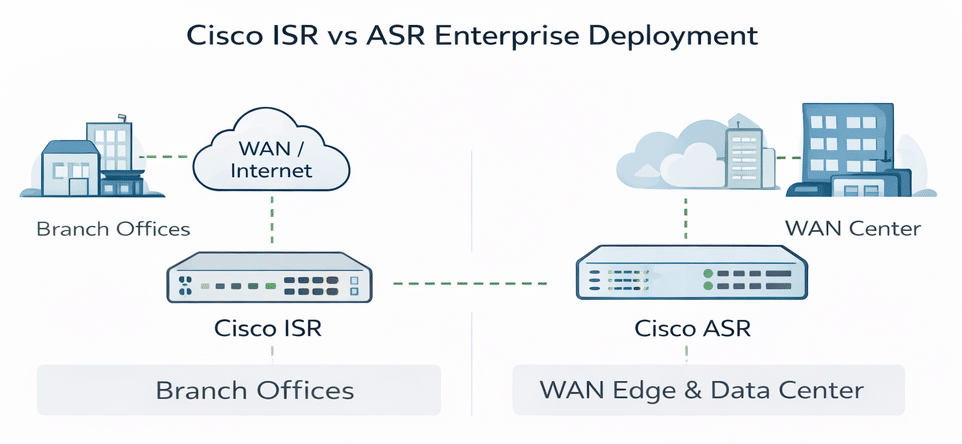
The Cisco ISR is the undisputed industry standard for enterprise branch office deployments. The engineering philosophy behind the ISR is “consolidation.” In a traditional, legacy network, a remote branch office might require a separate physical router for WAN connectivity, a dedicated firewall appliance for perimeter security, and a standalone PBX hardware system for local telephony. The ISR eliminates this hardware sprawl by integrating all of these network services into a single physical footprint. It handles Direct Internet Access (DIA), local DHCP, Zone-Based Firewalls (ZBFW), and unified communications simultaneously, making it the perfect gateway for small to medium-sized retail stores, bank branches, and remote clinics.
What is a Cisco ASR (Aggregation Services Router)?
The Cisco ASR abandons the “all-in-one” branch approach in favor of raw, unadulterated packet-processing power. It is specifically designed for the enterprise network edge, regional data centers, Internet Service Provider (ISP) peering points, and campus distribution cores. Rather than providing local VoIP survivability or basic switching, the ASR focuses on terminating thousands of incoming VPN connections, aggregating massive SD-WAN overlays, and processing full BGP internet routing tables (which currently exceed 900,000 routes). It is built for absolute high availability, offering hardware-level redundancy that the branch-focused ISR simply does not possess.
Cisco ISR vs ASR Comparison Chart
To make immediate architectural and procurement decisions, network engineers must evaluate the strict hardware boundaries separating these two platforms.

| Feature / Metric | Cisco ISR (e.g., 4000 Series) | Cisco ASR (e.g., 1000 Series) |
| Primary Target Environment | Remote Branch Offices, Small-to-Medium Business (SMB) | Data Centers, Headquarters, ISP Edge, WAN Aggregation |
| Processing Architecture | Generalized x86 Multi-Core CPUs (Software Processing) | Cisco QuantumFlow Processor (QFP) & Dedicated ASICs |
| Maximum Throughput | 50 Mbps up to ~2 Gbps (Highly dependent on enabled services) | 2.5 Gbps up to 200 Gbps (Line-rate hardware processing) |
| IPsec VPN Termination | Low to Medium scale (Dozens to hundreds of concurrent tunnels) | Massive scale (Thousands of concurrent IPsec/DMVPN tunnels) |
| Modularity & Expansion | NIMs (Network Interface Modules) and SM-X expansion slots | SIPs (SPA Interface Processors), SPAs, and redundant Route Processors |
| Operating System | Cisco IOS / IOS XE | Cisco IOS XE / IOS XR (on Service Provider models) |
Popular Hardware Models: ISR 4000 vs ASR 1000 Series
While both product lines span multiple generations, the ISR 4000 and ASR 1000 series remain the most heavily deployed routing platforms in the global enterprise footprint. Understanding the specific capabilities of these individual models is critical for capacity planning.
Top Cisco ISR Models (ISR 4221, 4331, and 4451)
The ISR 4000 series utilizes a “pay-as-you-grow” performance license model, meaning the hardware is artificially rate-limited out of the box until a performance license is applied.
- Cisco ISR 4221: A desktop-sized, entry-level router designed for micro-branches and ATM kiosks. It provides a base throughput of 35 Mbps, upgradable to 75 Mbps via software licensing.
- Cisco ISR 4331: The most popular 1-Rack Unit (1RU) enterprise branch router. It delivers a base throughput of 100 Mbps, upgradable to 300 Mbps. It provides a balanced mix of Gigabit Ethernet ports, NIM slots for cellular LTE backup, and an SM-X slot for compute modules.
- Cisco ISR 4451: A massive 2RU branch router designed for very large remote sites. It offers a base throughput of 1 Gbps, scalable to 2 Gbps, making it the most powerful ISR before stepping up to the ASR platform.
Top Cisco ASR Models (ASR 1001-X, 1002-HX, and 1006)
The ASR 1000 series is defined by extreme high availability, redundant power supplies, and massive optical interface density.
- Cisco ASR 1001-X: A 1RU edge router that provides between 2.5 Gbps and 20 Gbps of forwarding throughput. It is the perfect entry-level data center aggregation router for terminating enterprise IPsec tunnels.
- Cisco ASR 1002-HX: A 2RU powerhouse designed for high-end enterprise edge and managed service providers. It delivers up to 100 Gbps of total system bandwidth and includes built-in 10 Gigabit Ethernet (10GbE) SFP+ ports without requiring extra line cards.
- Cisco ASR 1006: A massive 6RU modular chassis designed for carrier-grade environments. It supports completely redundant Route Processors (RPs) and Embedded Services Processors (ESPs), ensuring that if the primary routing engine crashes, the standby engine takes over instantaneously without dropping active network sessions.
ISR vs ASR Performance: Hardware ASICs vs Software Processing
The most critical distinction between an ISR and an ASR is invisible from the outside of the chassis. It comes down to how the internal silicon processes data packets. This distinction addresses the most common complaint among network engineers: real-world throughput degradation.
ISR Architecture: The Software “Performance Tax”
Cisco ISRs utilize standard, generalized x86 multi-core Intel processors. In this software-based architecture, every single network function must compete for the exact same CPU cycles. While the ISR 4000 series improved upon older generations by separating the control plane (routing updates) from the data plane (packet forwarding), the heavy lifting is still fundamentally performed by a general-purpose CPU.
This creates a severe “performance tax.” When an engineer purchases an ISR 4331, the datasheet advertises 300 Mbps of throughput. However, if that engineer enables an advanced Zone-Based Firewall (ZBFW), configures complex Quality of Service (QoS) queuing for voice traffic, and routes all branch data through an AES-256 encrypted IPsec tunnel, the generalized CPU becomes rapidly saturated. Under these heavy, real-world service loads, the actual throughput of the ISR will collapse significantly below the advertised 300 Mbps limit.
ASR Architecture: QuantumFlow Processor (QFP) and ESPs
The Cisco ASR bypasses this CPU bottleneck entirely by utilizing a drastically different architecture centered around the proprietary Cisco QuantumFlow Processor (QFP). Furthermore, ASRs utilize modular Embedded Services Processors (ESPs).
The ESP is a dedicated silicon Application-Specific Integrated Circuit (ASIC). Its sole purpose is to offload mathematically complex tasks—like cryptographic encryption, deep packet inspection (DPI), and QoS scheduling—away from the main route processor. Because the ASR utilizes dedicated hardware to handle encryption, turning on heavy IPsec VPNs does not consume the control plane CPU. An ASR 1002-HX rated for 100 Gbps will reliably push 100 Gbps of fully encrypted traffic at line rate, completely immune to the software performance tax that cripples the ISR.
SD-WAN and Operating System Differences
Modern enterprise routing is no longer just about pushing packets; it is about intelligent, software-defined traffic steering. Both platforms have evolved to meet this challenge, but they operate differently at the highest levels.
Cisco IOS XE and SD-WAN (Viptela) Integration
Both the modern ISR 4000 series and the enterprise ASR 1000 series run on Cisco IOS XE. IOS XE is a highly modular, Linux-based operating system that allows individual routing processes (like OSPF or BGP) to run in separate memory spaces, preventing a single crashed process from taking down the entire router.
Crucially, both platforms act as “cEdge” (Cisco Edge) devices within a Cisco SD-WAN (formerly Viptela) architecture. Through the Cisco vManage dashboard, administrators can push centralized routing policies to both a remote ISR in a retail store and an ASR in the central data center simultaneously, creating a unified SD-WAN fabric across completely different hardware architectures.
Why Service Providers Use IOS XR on High-End ASRs
While enterprise ASRs (1000 series) run IOS XE, Cisco produces a separate tier of ultra-high-end routers, such as the ASR 9000 series, specifically for global telecom carriers and Internet Service Providers. These carrier-grade ASRs run Cisco IOS XR. IOS XR is a microkernel-based operating system designed for environments that cannot tolerate a single millisecond of downtime in a decade. It supports advanced carrier protocols like Segment Routing and massive MPLS traffic engineering, features that far exceed the requirements of standard enterprise networks.
When to Use Cisco ISR vs ASR Routers (Deployment Scenarios)
To guarantee return on investment (ROI), IT procurement teams must map their physical hardware purchases to exact network topologies.
Scenario 1: The Remote Branch Office (ISR)
Imagine a regional bank branch with 15 employees, three ATMs, and a local security camera system. The ideal deployment is a single Cisco ISR 4321. The ISR handles the local DHCP pool for employee laptops. It provides Direct Internet Access (DIA) for cloud applications like Microsoft 365. Most importantly, it utilizes an internal DSP (Digital Signal Processor) module to provide Survivable Remote Site Telephony (SRST), ensuring that if the fiber optic WAN link gets cut, the local IP phones can still dial emergency services over a traditional copper phone line.
Scenario 2: The Enterprise Data Center Hub (ASR)
Imagine the corporate headquarters that services 500 remote bank branches. Deploying an ISR here would result in an immediate catastrophic bottleneck. The central hub requires a Cisco ASR 1002-HX. This ASR effortlessly terminates the 500 incoming SD-WAN IPsec tunnels simultaneously. It ingests massive, full BGP internet routing tables from two disparate Tier-1 ISPs to provide multi-homed internet redundancy, utilizing its QuantumFlow hardware to maintain microsecond latency across the entire corporate perimeter.
Scenario 3: Campus LAN Handoff to Catalyst Core Switches

Once the ASR decapsulates the incoming WAN traffic at headquarters, it must seamlessly hand that data off to the Local Area Network (LAN). In modern enterprise designs, the ASR connects downstream via 10G or 40G routed optical links to a high-speed campus core, typically built upon Cisco Catalyst 9300 or 9500 series switches. By handing traffic down to a Catalyst 9300 stack operating at 480 Gbps or 1 Tbps (StackWise-1T), architects ensure that the massive throughput generated by the edge ASR does not encounter a localized bottleneck when entering the campus access layer.
Licensing and Total Cost of Ownership (TCO)
The hardware cost of a router is only a fraction of its Total Cost of Ownership. Cisco has drastically overhauled its licensing models, transforming how enterprises budget for wide area networking.
Legacy Perpetual Licensing (IP Base, SEC, UC)
Historically, ISR and ASR routers relied on complex, perpetual Right-to-Use (RTU) licenses. An enterprise would purchase the base router and then pay one-time fees to unlock specific features, such as the Security (SEC) license for IPsec VPNs or the Unified Communications (UC) license for voice capabilities. While this required higher upfront Capital Expenditure (CapEx), the enterprise owned the software rights permanently.
Transitioning to Cisco DNA Software Subscriptions
Cisco has completely deprecated the perpetual model for modern edge routing. Today, both legacy platforms (in their final days) and all new Cisco routers mandate the adoption of Cisco DNA Software Subscriptions. Organizations must purchase a 3-, 5-, or 7-year subscription to either DNA Essentials (for basic SD-WAN, OSPF, and standard security) or DNA Advantage (for advanced SD-WAN topologies, AI-driven analytics, and deep packet inspection). This shifts WAN management from a CapEx model to a predictable Operational Expenditure (OpEx) model, heavily tying hardware functionality to ongoing software renewals.
Cisco ISR and ASR End of Life (EoL) & Replacements
The enterprise networking landscape is currently undergoing a massive, generational hardware refresh. Purchasing legacy routing hardware today poses a severe operational risk to your infrastructure.
ASR and ISR 4000 End of Sale Announcements
Cisco has officially announced the End-of-Sale (EoS) and End-of-Life (EoL) dates for the legacy ISR 4000 and ASR 1000 series routers. As these platforms reach the end of their software maintenance windows, enterprises will no longer receive critical security vulnerability patches or support for modern SD-WAN feature sets. Relying on EoL hardware guarantees compliance violations in audited industries like healthcare and finance.
The New Standard: Cisco Catalyst 8000 Edge Platforms
To simplify its portfolio and natively integrate the cloud-driven Cisco SD-WAN architecture, Cisco has retired the traditional ISR/ASR naming conventions. They have unified both branch and edge routing families under the Cisco Catalyst 8000 Edge Platforms Family.
- The Catalyst 8200 and Catalyst 8300 serve as the direct, x86-based successors to the ISR branch family.
- The Catalyst 8500 serves as the direct successor to the ASR family, utilizing the 3rd generation of the Cisco QuantumFlow Processor for 100G/400G data center aggregation.
👉 Ready to Modernize Your Network?
Are you planning a hardware refresh for your aging branch network? Navigating the new Catalyst hardware models, matching throughput capacities, and understanding the mandatory Cisco DNA software subscriptions can be incredibly complex. For a detailed, step-by-step upgrade path and exact SKU mapping, read our comprehensive expert guide on how to migrate from Cisco ISR 4000 to Catalyst 8000.
Cisco ISR vs ASR FAQs
What do the acronyms ISR and ASR stand for?
ISR stands for Integrated Services Router, reflecting its design to consolidate multiple services (routing, firewall, voice) into one branch device. ASR stands for Aggregation Services Router, reflecting its purpose to aggregate thousands of high-speed connections at the enterprise edge.
Can a Cisco ISR router be used in a data center?
While technically possible for extremely small or budget-constrained deployments, using an ISR in a data center is highly discouraged. ISRs lack the hardware ASICs required to process thousands of concurrent IPsec tunnels or handle full BGP internet routing tables efficiently, which will lead to severe performance bottlenecks.
Do ISR and ASR routers support 10G or 40G fiber interfaces?
Standard branch ISRs (like the 4331) generally support 1 Gigabit (1G) copper and SFP fiber connections. ASR routers (like the 1001-X and 1002-HX) natively support 10 Gigabit (10GbE) SFP+ and 40 Gigabit (40GbE) QSFP optical interfaces to handle massive edge throughput.
Is the Catalyst 8000 replacing both the ISR and ASR series?
Yes. Cisco is actively phasing out the legacy ISR and ASR hardware lines. The Cisco Catalyst 8000 Edge Platforms Family is the official, unified successor, designed specifically to modernize both branch and data center routing under a single, cohesive SD-WAN architecture.