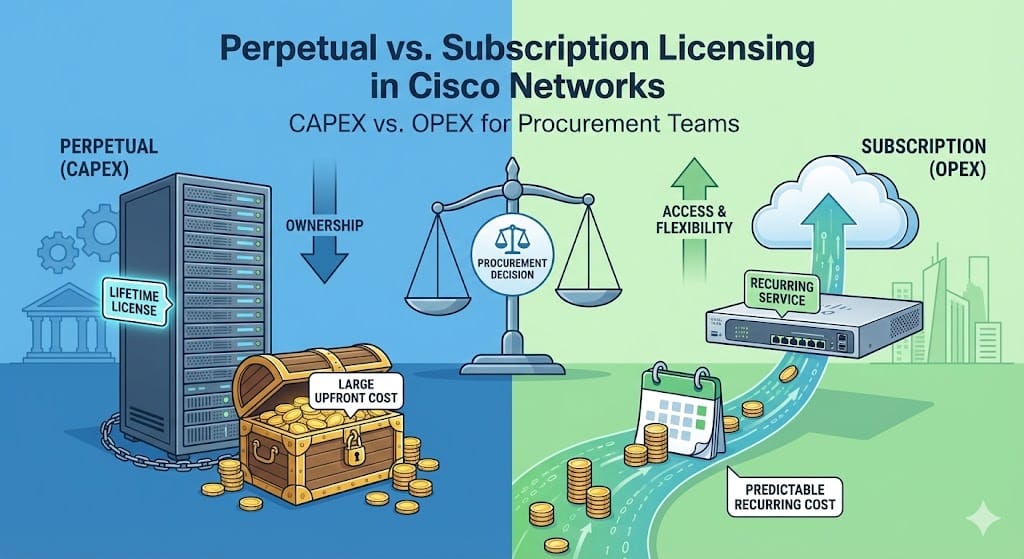
Perpetual vs. Subscription Licensing in Cisco Networks: CAPEX vs. OPEX for Procurement Teams
Ten years ago, buying Cisco infrastructure was a predictable capital event. You bought a Catalyst switch, depreciated it over five years, and ran it for ten. It was a classic “Buy and Hold” asset.
Today, a Cisco quote looks very different. Alongside the hardware, you see recurring line items for “DNA Subscriptions” or “Term Licenses.”
For many CFOs and procurement managers, this shift is jarring. The question we hear most often is: “Why are we renting our core infrastructure? Isn’t it cheaper to just buy it?”
The answer lies in the industry-wide shift from Perpetual (Ownership) to Subscription (Usership). This guide breaks down the financial mechanics of this transition, helping you explain the CAPEX vs. OPEX impact to your finance stakeholders.
Master Guide: To understand how these subscriptions fit into the wider Cisco ecosystem, start with our master pillar: The Ultimate Guide to Cisco Licensing.
The Definitions: Owning vs. Renting
To verify a quote, you must first distinguish between the two financial models appearing on your Bill of Materials (BOM).
Perpetual Licensing (The Old Way)
- Concept: You pay once upfront. You own the right to use the software version forever (e.g., LAN Base, IP Base).
- Financial Model: CAPEX (Capital Expenditure). The asset is placed on the balance sheet and depreciated over time.
- Pros: One-time cash outflow. No recurring “software” bills (only optional support contracts).
Subscription Licensing (The New Way)
- Concept: You pay for the right to use the software for a fixed term (3, 5, or 7 years). When the term ends, the right to use the advanced features expires.
- Financial Model: OPEX (Operating Expenditure). This is treated as a running operational cost, similar to electricity or cloud services (SaaS).
- Pros: Lower upfront entry cost (in some models), continuous access to innovation, and avoidance of “Zombie Hardware” (running unsupported gear).
The “Hybrid” Reality of Catalyst 9000
The biggest confusion comes from the belief that Cisco has gone “100% Subscription.” That is not entirely true for hardware.
When you buy a modern Catalyst 9300 switch, you are actually buying a Hybrid Asset:
- The Hardware (The Box): Perpetual. You buy it, you own it. It is CAPEX.
- The Network Stack (IOS XE): Perpetual. Basic switching and routing capabilities never expire.
- The DNA Software (The Intelligence): Subscription. Advanced automation, AI analytics, and security features are rented. It is OPEX.
Why this matters: Your Purchase Order (PO) will likely be a mix of CAPEX and OPEX. You need to code the General Ledger (GL) accounts correctly to avoid audit issues.
Risk Analysis: What happens if you stop paying the OPEX part? Does the Perpetual part keep working? Read More: What Happens When a Cisco DNA Subscription Expires?
The CFO’s Perspective: Selling the Shift
If your Finance Director hates the idea of “renting,” here are three arguments to help justify the model:
Argument 1: Predictability vs. Spikes Perpetual models create “Boom and Bust” cycles. You spend $1M in Year 1, then $0 for 5 years, then another massive $1M spike. Subscription models flatten the curve. The cost is predictable, smooth, and easier to forecast in quarterly budgets.
Argument 2: Tax Treatment Disclaimer: Consult your tax advisor. In many jurisdictions, OPEX is fully tax-deductible in the year it is spent (reducing taxable income immediately). CAPEX deductions must be spread over years (Depreciation), which delays the tax benefit.
Argument 3: Reducing Technical Debt Subscription forces a “Check-in” every 3-5 years. It prevents the dangerous habit of sweating assets for 10+ years until they become security liabilities.
TCO Analysis: Is Subscription Actually Cheaper?
Let’s be honest: Over a 10-year period, Subscription is often more expensive in raw dollar terms than the old “buy it and forget it” model.
However, the “Total Cost of Ownership” (TCO) calculation isn’t just about the purchase price.
- Old Model: You paid for the box + Software Support (SWSS).
- New Model: The Subscription often includes the software support entitlement.
The Break-Even Point: If your organization refreshes hardware every 5 years, the Subscription TCO is generally comparable to the old Perpetual + SWSS model. The premium only becomes painful if you try to stretch the hardware lifecycle beyond 7 years without renewing the software.
Strategic Procurement Tips
You can optimize this model to fit your company’s financial preference.
1. The “Prepaid” CAPEX Hack Even though it is a “Subscription,” Cisco allows you to prepay the entire 3, 5, or 7-year term upfront.
- Hack: Many finance teams will treat a multi-year prepaid subscription as a Capital Asset (CAPEX) on the books. This allows you to use your Capital Budget to buy a Subscription product.
2. Align Your Terms to Your Hardware Life Do not buy a 3-Year Subscription for a switch you plan to keep for 7 years.
- Why? You will face a renewal price hike in Year 4.
- Strategy: Buy the 5-year or 7-year subscription upfront. The initial discount is deeper, and you lock in the price against inflation.
3. Manage Your Entitlements Subscriptions are intangible. If you don’t track them, you will pay for software you aren’t using.
Management Note: You need a clean Smart Account to track which term expires when. Read More: Cisco Smart Licensing Explained.
Conclusion
The shift from Perpetual to Subscription is not just a Cisco trend; it is the standard for the entire IT industry. It shifts IT from being a “Utility” (keep the lights on) to a “Service” (continuously improving capabilities).
Your Strategy: Don’t fight the model. Optimize it.
- Separate the costs: Clearly identify CAPEX (Hardware) vs. OPEX (DNA) on your POs.
- Match the term: Align the subscription length to your hardware refresh cycle.
- Prepay if needed: Use upfront payment to utilize CAPEX budget.