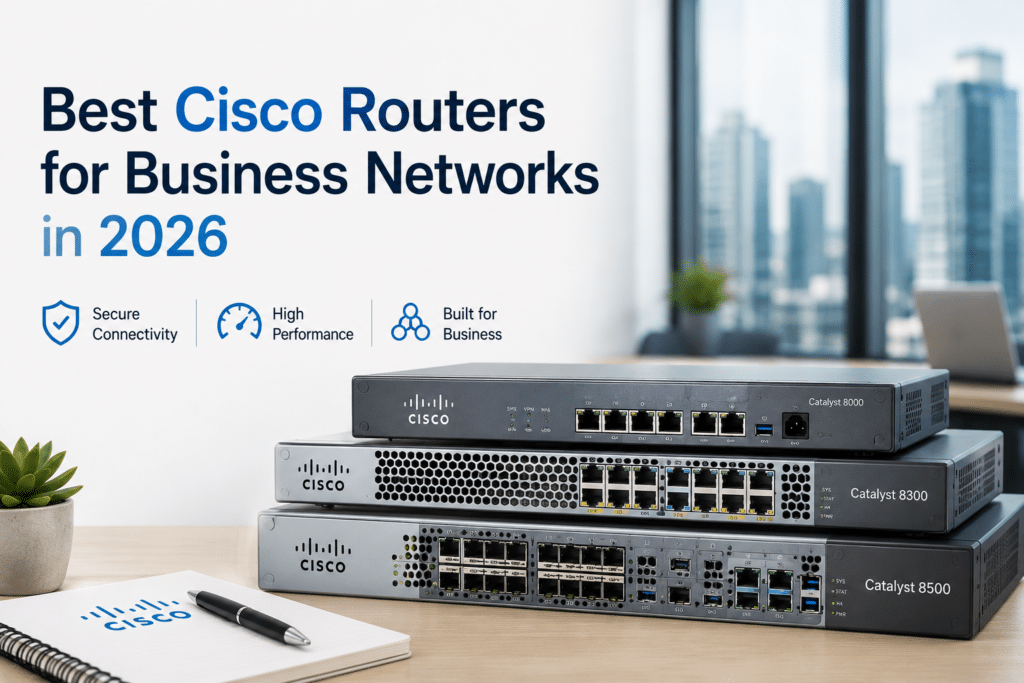
Best Cisco Routers for Business Networks in 2026
For most businesses in 2026, the best Cisco router comes down to branch size and whether you run SD-WAN. The Cisco ISR 1100 is the best pick for small business and small branches; the Catalyst 8200 suits mid-size SD-WAN branches; the Catalyst 8300 fits larger, high-throughput branches; the Catalyst 8500 handles large-business aggregation and the data-center edge; the ISR 4000 still fits existing modular estates; and the Catalyst 8000V covers virtual and cloud deployments.
This is a shortlist of recommendations, not a decision framework. For the full step-by-step selection logic and a side-by-side spec comparison, see the guides linked near the end — here we get straight to which router to buy for each business need.
Top Cisco Business Routers for 2026
| Best for | Cisco router | IPsec / SD-WAN throughput | Why it is the pick |
|---|---|---|---|
| Small business & small branch | Cisco ISR 1100 | Up to ~680 Mbps | Fanless all-in-one with integrated security, SD-WAN, LTE/5G |
| Mid-size SD-WAN branch | Catalyst 8200 | 1 Gbps | Current-generation Catalyst SD-WAN edge, strong value |
| Large, high-throughput branch | Catalyst 8300 | Up to 5 Gbps | Modular interfaces and throughput headroom |
| Existing modular ISR estate | Cisco ISR 4000 | Branch-class, modular | NIM/SM-X module continuity and voice |
| Large business & aggregation | Catalyst 8500 | Up to ~33 Gbps | Aggregation and data-center-edge performance |
| Virtual & cloud edge | Catalyst 8000V | Software-defined | Cloud and SASE routing |
Throughput shown is the IPsec/SD-WAN (encrypted) figure; it depends on the software license tier and the services you enable. Unencrypted routing (CEF) is higher on every model.
Why Cisco Routers Are a Safe Business Standard
Cisco’s branch and edge routers share one operating model: the same Cisco IOS XE software and Catalyst SD-WAN run from the smallest ISR 1100 to the Catalyst 8500, so a business can standardize policy, security, and management across every site size instead of stitching together different platforms. The routers also fold VPN, firewalling, and segmentation into the box, which cuts the number of separate appliances a branch has to run and support.
For a purchase you expect to keep for years, that consistency matters as much as raw speed. The Catalyst 8000 line is Cisco’s current platform with a clear roadmap, while the ISR line keeps existing estates fully supported — and a broad support ecosystem plus widely available engineering skills keep operational risk low. That combination is why Cisco remains the default business WAN choice rather than a cheaper point product.
Best Cisco Router for Small Business: Cisco ISR 1100
For small offices, retail sites, and small branches, the Cisco ISR 1100 Series is the best buy — a compact, fanless, all-in-one router that delivers WAN, VPN, and security without needing a rack.
Who it’s for:
- Small business HQ, retail, clinics, and remote or branch sites
- Sites that need cellular (LTE or 5G) as primary or backup WAN
- Anywhere a rack-mount router is overkill
Key facts:
- Up to ~680 Mbps IPsec throughput (the HSEC license unlocks the cap; lower software tiers limit it)
- Runs Cisco IOS XE SD-WAN, so it joins the same Catalyst SD-WAN fabric as the rest of the business
- LTE and 5G uplink models (dual-carrier, carrier aggregation, 5G standalone); Wi-Fi 6 on wireless models
- ISR 1100X variant doubles memory to 8 GB for heavier feature sets
Step up to the Catalyst 8200 when a busy branch outgrows it.
Catalyst 8200 for Mid-Size SD-WAN Branches
When a branch standardizes on Catalyst SD-WAN and needs more than a small-site router, the Catalyst 8200 Series is the value pick — a current-generation Catalyst 8000 Edge Platform, also available as a uCPE platform for hosting virtual network functions.
Who it’s for:
- Medium branches refreshing off older ISR onto the current WAN edge
- Sites standardizing on Catalyst SD-WAN and multicloud
- uCPE deployments hosting virtual network functions
Key facts:
- C8200-1N-4T: 1 Gbps IPsec/SD-WAN throughput, 3.8 Gbps unencrypted routing
- Compact, current-generation Catalyst 8000 edge platform
- The efficient, cost-effective choice for most mid-size branches
Best for High-Throughput Branches: Catalyst 8300
For large branches, campuses, and any site that needs modular interfaces with throughput headroom, the Catalyst 8300 Series is the best all-around branch router — the do-it-all platform in the Catalyst 8000 edge line.
Who it’s for:
- Large branches and campuses that need room to grow
- Sites that need modular WAN interfaces or on-box services
- A branch standard you expect to keep for years
Key facts:
- Up to 5 Gbps IPsec/SD-WAN and 12 Gbps routing on the top configurations
- C8300-1N1S-6T: 2 Gbps IPsec/SD-WAN, 10 Gbps routing
- C8300-1N1S-4T2X: 5 Gbps IPsec/SD-WAN, 12 Gbps routing
- Modular NIM slots plus a service-module slot for interfaces and services
Cisco ISR 4000 for Existing Modular Estates
If you already run a Cisco ISR estate, need specific NIM or SM-X modules, or depend on voice services, the Cisco ISR 4000 Series remains the practical buy.
Who it’s for:
- Brownfield branches standardized on the ISR 4000
- Deployments that need specific NIM/SM-X modules or voice
- Teams that want SD-WAN on a familiar platform
Key facts:
- Seven platforms — 4221, 4321, 4331, 4351, 4431, 4451, and 4461 — sized small to large
- Modular NIM and SM-X slots; Catalyst SD-WAN capable
- The forward path is the Catalyst 8000 — buy to match an installed standard, then plan the refresh
For how that transition works, see our guide on migrating from the ISR 4000 to the Catalyst 8000.
Best for Large Business: Catalyst 8500
For large-business aggregation, regional hubs, and the data-center edge, the Catalyst 8500 Series is the best pick — the top of the Catalyst 8000 edge line, built to aggregate many SD-WAN branches at a head-end rather than serve a single branch.
Who it’s for:
- Aggregation or head-end terminating many branch tunnels
- Regional hubs and the data-center edge
- Large enterprises needing high-density, high-throughput connectivity
Key facts:
- C8500L-8S4X: up to ~6.6 Gbps SD-WAN IPsec; 8x 1/10GE plus 4x 10GE ports
- C8500-12X4QC: up to 33 Gbps SD-WAN IPsec and 240 Gbps of aggregate traffic
- Aggregation- and cloud-edge-class headroom for large designs
Catalyst 8000V for Virtual and Cloud Edge
For virtual branches, cloud routing, and SASE-aligned designs, the Catalyst 8000V is the software pick — a virtual routing platform that runs the same Catalyst SD-WAN operating model as the hardware edge.
Who it’s for:
- Cloud routing and virtual branch designs
- SASE-aligned architectures
- Deployments on x86 servers, or on ENCS and CSP appliances in private or public cloud
Because it is delivered as software and licensing rather than an appliance, request a quote and our team will scope the right form and subscription.
Which of These Cisco Routers Should You Buy?
There is no single best Cisco router — the right one depends on branch size, encrypted throughput, the modules you need, and whether you run Catalyst SD-WAN or traditional routing. As a quick rule:
| If you need… | Buy |
|---|---|
| A small-site or small-business router | Cisco ISR 1100 |
| A mid-size SD-WAN branch | Catalyst 8200 |
| A large or high-throughput branch | Catalyst 8300 |
| Aggregation or a data-center edge | Catalyst 8500 |
| To match an existing ISR estate | Cisco ISR 4000 |
| A virtual or cloud router | Catalyst 8000V |
For the full decision framework — matching the network role to the platform step by step — see our Cisco router selection guide. For a detailed side-by-side of the edge platforms, see our Catalyst 8200 vs 8300 vs 8500 comparison.
Cisco Router Buying Mistakes to Avoid
Most Cisco router buying problems are commercial, not technical — the model is right, but the order is wrong. The mistakes that cost businesses later:
- Budgeting the box without the subscription. Catalyst SD-WAN, Cisco DNA, and support are recurring costs; quote them with the hardware or the real spend is understated and the project stalls at activation.
- Forgetting the HSEC license. Encrypted throughput is capped on lower software tiers — the HSEC license is what unlocks a model’s rated IPsec performance, so a “fast” router can under-deliver without it.
- Sizing for clear-text instead of encrypted traffic. A router that fits plain routing is often undersized once IPsec, SD-WAN, and inspection are enabled. Size on the encrypted (IPsec/SD-WAN) number, not the routing number.
- Buying gray-market or unverified stock. Units without a clean source carry no warranty, RMA, or license entitlement, and frequently fail to activate or register.
- Ignoring module and interface fit. Confirm the NIM/SM-X, SFP/SFP+, and LTE/5G modules match the platform before ordering — the usual trap when replacing an ISR with a Catalyst 8000.
- Overlooking lifecycle. For a multi-year standard, check that the model is not near end-of-sale before you commit.
Most of these disappear when you quote the full configuration — hardware, exact license, and support — against a verified, original source.
Why Do Cisco Router Quotes Vary for the Same Model?
Two quotes for the same Cisco part number can differ widely, and the chassis is rarely the reason. What actually moves the price:
- Software tier and term. The Cisco DNA or Catalyst SD-WAN subscription and its length often cost more than the hardware and are the biggest single swing.
- License add-ons. HSEC, security subscriptions, and throughput tiers all change the total.
- Bundle vs à la carte. Power supplies, modules, optics, and rack kits may be included in one quote and billed separately in another.
- Condition and source. New, original stock from a Cisco certified partner is not the same as gray-market or used hardware, even at an identical part number.
- Support level. The SmartNet or partner-support tier and duration are part of the quoted price.
- Region and logistics. Shipping, customs, and lead time vary by destination.
Compare quotes on the same configuration — hardware, exact license, and support — rather than on the model name alone, and confirm the stock is new and original before you weigh price.
Licensing, Support, and Total Cost of Ownership
For a procurement team, the appliance is only part of the cost. Budget these alongside the hardware:
- Cisco DNA / Catalyst SD-WAN subscription — choose the tier and term for the features you need
- Throughput and security entitlements — including the HSEC license to remove encrypted-throughput caps
- Support — SmartNet or equivalent, sized to the deployment
- Warranty and RMA — protected by buying new, original units
- License entitlement path — a clean transfer so the unit activates without a surprise
Quoting the box without the subscription and support understates the real spend and can stall a deployment at activation.
Where to Buy Cisco Business Routers
As a Cisco certified partner, Layer23-Switch supplies 100% new, original Cisco routers with warranty and RMA support, free pre-sales sizing from CCIE-certified engineers, and global logistics and customs support. We stock the branch and edge lineup across the Cisco routers range — from the ISR 1100 to the Catalyst 8500.
For an accurate quote, send:
- Site size and number of locations
- WAN bandwidth and required IPsec or VPN throughput
- SD-WAN plan (Catalyst SD-WAN or autonomous routing)
- Module and interface list (NIM/SM-X, SFP/SFP+, LTE/5G)
- License tier and term, plus support expectation
Request a Cisco router quote and we will confirm the platform and subscription before you order.
Frequently Asked Questions
What is the best Cisco router for a small business?
The Cisco ISR 1100 is the best Cisco router for most small businesses — a compact, fanless all-in-one with integrated security, IOS XE SD-WAN, and LTE or 5G options for sites with limited wired WAN. A busier small site that needs more headroom or modular interfaces should step up to the Catalyst 8200.
What is the best Cisco router for a large business or enterprise?
For large branches, the Catalyst 8300 is the best choice, with modular interfaces and up to 5 Gbps of IPsec/SD-WAN throughput. For aggregation, regional hubs, and the data-center edge — where one platform terminates many branch tunnels — the Catalyst 8500 is the right pick, scaling to tens of gigabits.
Should I buy a Cisco ISR or a Catalyst 8000 router in 2026?
The Catalyst 8000 Edge Platforms (8200, 8300, 8500) are Cisco’s current WAN-edge line and the forward-looking buy for new branch and SD-WAN designs. The ISR 4000 still makes sense when you are matching an existing ISR standard or need specific NIM/SM-X modules or voice. See our selection and migration guides to plan the path.
Which Cisco router is best for SD-WAN?
The Catalyst 8000 Edge Platforms are purpose-built for Catalyst SD-WAN and multicloud — the 8200 for medium branches, the 8300 for large branches, and the 8500 for aggregation. The ISR 1100 and ISR 4000 are also SD-WAN capable for small and existing-estate sites.
Are these Cisco routers new and covered by warranty?
Yes. Layer23-Switch supplies new, original Cisco routers with warranty and RMA support as a Cisco certified partner, with a clean software and license entitlement path so the unit activates without a licensing problem.
Final Buying Note
The best Cisco router for your business in 2026 is the one matched to the site, not the one with the biggest spec sheet: the ISR 1100 for small business, the Catalyst 8200 and 8300 for mid-size and large branches, the Catalyst 8500 for aggregation and the data-center edge, the ISR 4000 for existing modular estates, and the Catalyst 8000V for the cloud. Budget the license and support with the hardware, buy new and original to protect warranty and entitlement, and confirm the model against your throughput and module needs. Request a quote from Layer23-Switch with your site details and we will size it with you.