Cisco Stacking vs Chassis Switch: Modular vs Fixed Switch Architecture
Cisco stacking switches combine multiple fixed-configuration switches (such as the Catalyst 9300) into one logical unit using StackWise technology, sharing a single control plane. A chassis switch is a modular system (such as the Catalyst 9400) featuring a centralized backplane, dual supervisor engines, and hot-swappable line cards. Stacking is optimized for cost-effective access-layer port scaling, while modular chassis provide the strict high availability and throughput required for the campus core and distribution layers.
Executive Summary
Enterprise campus networks built on modern platforms face a fundamental design decision: deploy stackable fixed switches or invest in modular chassis switches. While both architectures provide port density, their underlying engineering drastically affects network redundancy, power consumption, and maintenance windows.
Technologies such as Cisco StackWise allow multiple fixed switches to operate as a single logical unit, simplifying management. However, modular platforms provide isolated, centralized supervisor modules that support hitless software upgrades. For most campus architectures, stackable switches are deployed at the access layer, while modular chassis switches are utilized in the distribution or core layers. This guide analyzes the engineering trade-offs, ASIC limitations, and real-world deployment strategies for the Cisco Catalyst 9000 portfolio.
For a broader overview of the exact hardware models mentioned in this guide, refer to our complete Cisco Catalyst 9000 Series Comparison
Fixed vs Modular Switch: What Is the Difference?
Before comparing stacking methodologies, network architects must understand the physical constraints of the two core switch form factors.
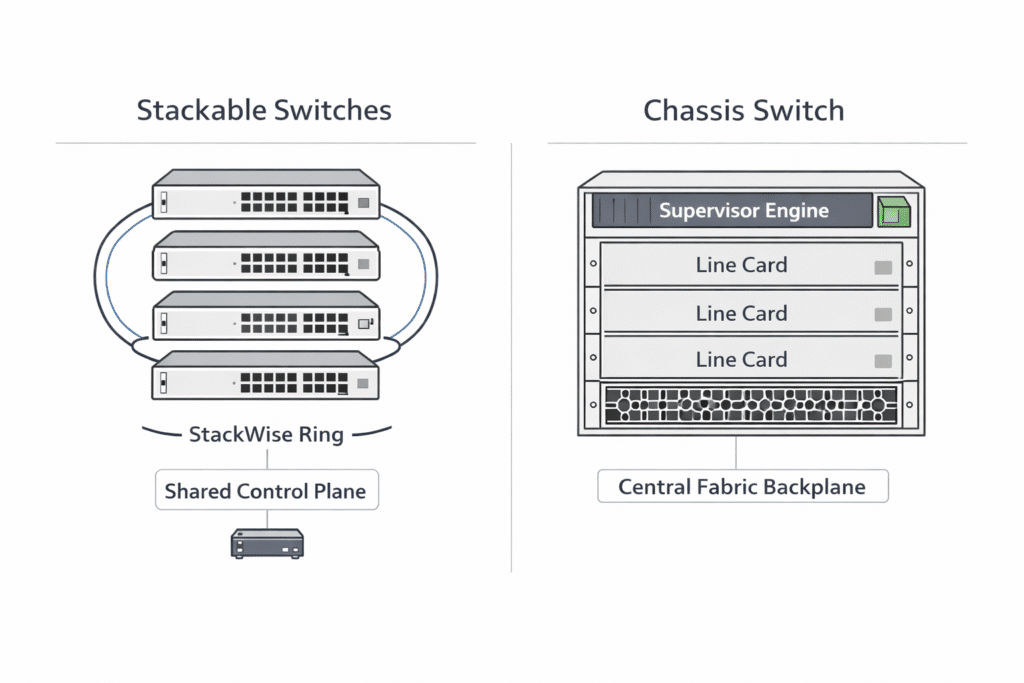
Fixed-Configuration Switches
A fixed switch is a standalone device with an immutable port count (typically 24 or 48 ports) permanently integrated into the primary circuit board. They cannot be expanded with additional line cards. To scale port density, administrators must purchase additional fixed switches and link them together.
- Typical Deployments: Campus access layer, branch office networks.
- Cisco Examples: Catalyst 9200, Catalyst 9300, Catalyst 9300X.
Modular Chassis Switches
A modular switch (or chassis switch) consists of a large metal enclosure containing a passive high-speed backplane. The intelligence and port density are provided by field-replaceable modules inserted into empty bays. A chassis requires at least one Supervisor Engine (the “brain” routing the traffic) and various line cards (the ports connecting to endpoints). Upgrading a chassis network often involves simply replacing the supervisor engine rather than ripping out the entire chassis frame.
- Typical Deployments: Enterprise core, large distribution layers, high-density aggregation.
- Cisco Examples: Catalyst 9400, Catalyst 9600.
Cisco Stacking vs Chassis Switch Architecture Comparison
While a stack of eight Catalyst 9300 switches might offer the same physical port density as a fully populated Catalyst 9400 chassis, their internal architectures operate entirely differently.
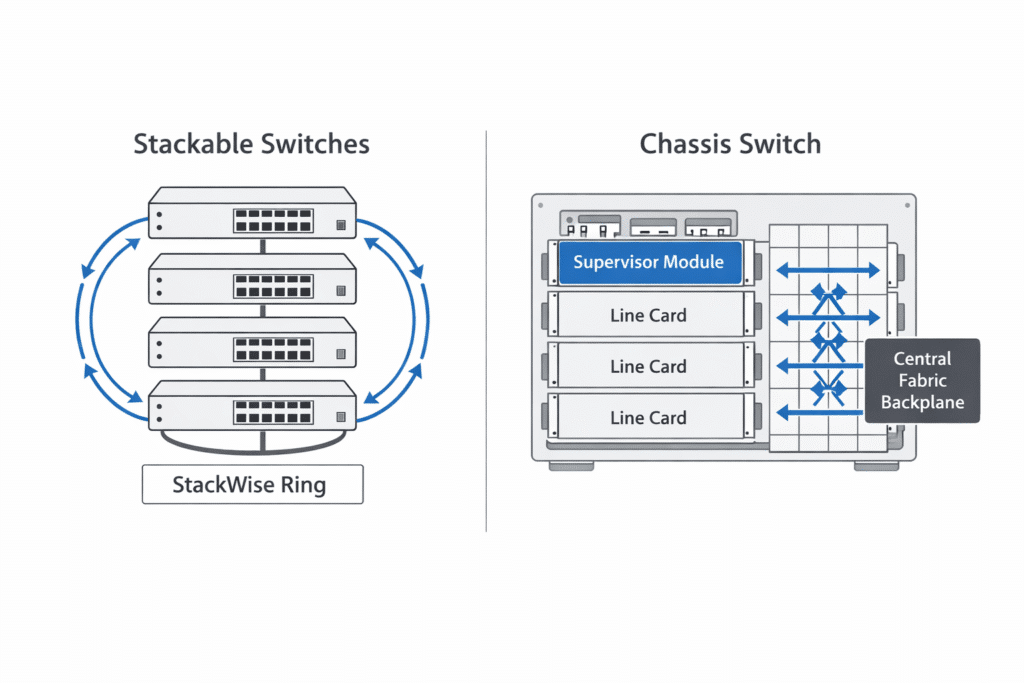
| Feature | Stackable Switches (Fixed) | Chassis Switches (Modular) |
| Control Plane | Shared (Single Stack Master) | Dual Independent Supervisors |
| Backplane Topology | Distributed Ring (via StackWise cables) | Centralized Crossbar Fabric |
| Hardware Redundancy | Stack master failover (SSO) | Full hardware redundancy (N+N) |
| Software Upgrades | Requires stack-wide reboot | Hitless ISSU (Zero Downtime) |
| Cooling & Power | Distributed (StackPower umbilical) | Centralized Power Supply Bays |
| Initial Cost (CapEx) | Lower (“Pay-as-you-grow”) | Higher (Requires chassis + supervisor investment) |
How Cisco StackWise Works in Stackable Switches
Cisco StackWise is the proprietary technology that allows up to eight fixed switches to be physically cabled together in a closed-loop ring topology. To the wider network, this stack appears as a single logical switch with a single management IP address.
StackWise-480 to StackWise-1T ASIC Evolution
The throughput of the stack ring is dictated by the Unified Access Data Plane (UADP) ASIC inside the switch. As enterprise bandwidth demands have scaled, so has StackWise capacity:
- Cisco Catalyst 9200: Utilizes StackWise-160, providing 160 Gbps of stacking bandwidth.
- Cisco Catalyst 9300: Utilizes StackWise-480, providing 480 Gbps of stacking bandwidth.
- Cisco Catalyst 9300X: Utilizes the advanced StackWise-1T, providing a massive 1 Terabit per second of backplane stacking throughput.
The Vulnerability of Shared Control Planes
The most significant operational reality of physical stacking is the illusion of high availability. While a stack contains multiple physical power supplies and CPUs, they all share a single control plane. One switch is elected the “Active” master, and another the “Standby.”
If a catastrophic software bug, memory leak, or corrupt routing table affects the Active switch, that corruption is instantly mirrored to the Standby switch. This shared fate means that logical software errors can frequently cause an entire stack of switches to reboot simultaneously, taking hundreds of endpoints offline.
Cisco StackWise Virtual (SVL) vs Physical Stacking
A major point of confusion in modern enterprise architecture is the difference between traditional physical stacking and logical core stacking.
Physical Stacking uses proprietary, thick copper umbilical cables over very short distances (less than 3 meters) to combine access switches within the same wiring closet.
StackWise Virtual (SVL) is the modern successor to the legacy Virtual Switching System (VSS). SVL is used strictly on high-end core and distribution switches (like the fixed Catalyst 9500 or modular Catalyst 9600). Instead of proprietary copper cables, SVL utilizes standard 10G, 40G, or 100G fiber optic transceivers to logically bind two core switches together. Because it uses standard optics, the two core switches can be located in entirely different buildings across a campus, providing massive geographic redundancy while maintaining a single logical control plane.
Switch Redundancy: Cisco StackPower vs Chassis Power
Power delivery and software maintenance are the primary reasons large enterprises transition from stacks to chassis systems.
StackPower vs Centralized Power Bays
In a stack of Catalyst 9300 switches, Cisco uses StackPower cables to pool the wattage of all individual power supplies. If one switch loses wall power, it draws electricity from the adjacent switches. While effective, it creates a messy web of umbilical cabling.
A modular chassis utilizes centralized, hot-swappable power supply bays. A chassis can be configured for strict N+N redundancy, connecting to entirely separate power grids and uninterruptible power supplies (UPS) without relying on neighboring line cards.
Stack Reboot vs In-Service Software Upgrade (ISSU)
When patching a security vulnerability on a physical stack of access switches, the entire stack typically must reboot, severing connectivity for all attached devices.
Modular chassis equipped with dual supervisor engines support In-Service Software Upgrades (ISSU). During an ISSU, the chassis upgrades the Standby supervisor to the new firmware, seamlessly fails over the traffic from the Active supervisor without dropping a single packet, and then upgrades the former Active supervisor. For core networks demanding 99.999% uptime, ISSU makes modular chassis architecture mandatory.
When to Use Stackable Switches vs Modular Switches
For modern enterprise campus architectures, the decision framework is heavily dictated by the specific layer of the network.
Access Layer: Stackable Fixed Switches
Deploy stackable switches (Catalyst 9300) at the network edge.
- Justification: The access layer connects end-user devices, VoIP phones, and wireless access points. Stacking allows an organization to purchase a single 48-port switch today, and simply cable a second switch into the stack next year as the office expands. This limits upfront Capital Expenditure (CapEx) while keeping management overhead low.
Campus Core and Distribution: Modular Chassis
Deploy modular chassis switches (Catalyst 9600/9400) at the network core.
- Justification: The core aggregates all traffic from the access layer and routes it to the data center or internet. A failure here brings the entire enterprise offline. The requirement for hitless ISSU firmware upgrades, massive multi-terabit crossbar fabrics, and total physical isolation of control planes necessitates a chassis architecture.
Frequently Asked Questions (FAQ)
What is the difference between stacking and chassis switches?
Stacking connects multiple fixed-configuration switches into one logical unit using external cables, sharing a single control plane. Chassis switches use a modular architecture with a centralized backplane, dual redundant supervisor engines, and field-replaceable line cards.
Are stackable switches cheaper than chassis switches?
Yes. Stackable switches utilize a “pay-as-you-grow” financial model, requiring lower upfront capital expenditure. Modular chassis platforms require a heavy initial investment in the metal chassis, fan trays, and supervisor engines before a single port is even added.
Can a single switch failure bring down an entire Cisco stack?
Yes. Because a physical switch stack shares a single logical control plane, a fatal software bug, spanning tree loop, or severe memory leak in the Active stack master can cause all switches in the stack to crash or reboot simultaneously.
Does Cisco Catalyst 9600 support stacking?
The modular Cisco Catalyst 9600 does not support traditional physical stacking via copper cables. Instead, it supports Cisco StackWise Virtual (SVL), which uses standard high-speed fiber optics to logically group two Catalyst 9600 chassis together across geographic distances.
Can stacked switches replace chassis switches?
In smaller branch networks, a high-performance stack (like the Catalyst 9300X) can act as a collapsed core. However, for large enterprise campus networks, the lack of true dual-supervisor redundancy and ISSU means stacks cannot safely replace modular chassis at the core layer.