Cisco C9500 vs C9600: Fixed vs Modular Core Switch
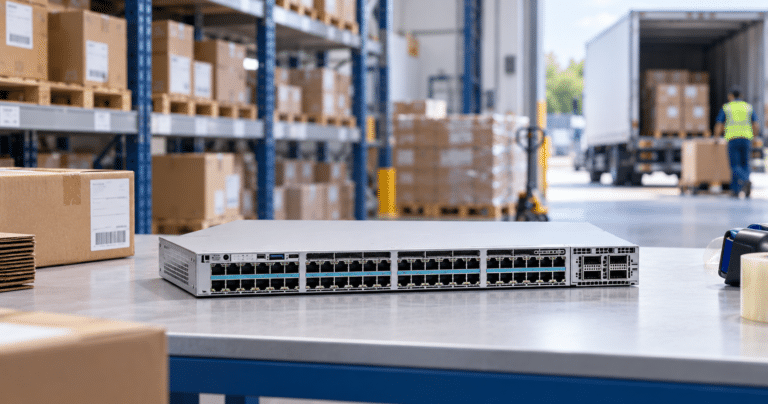
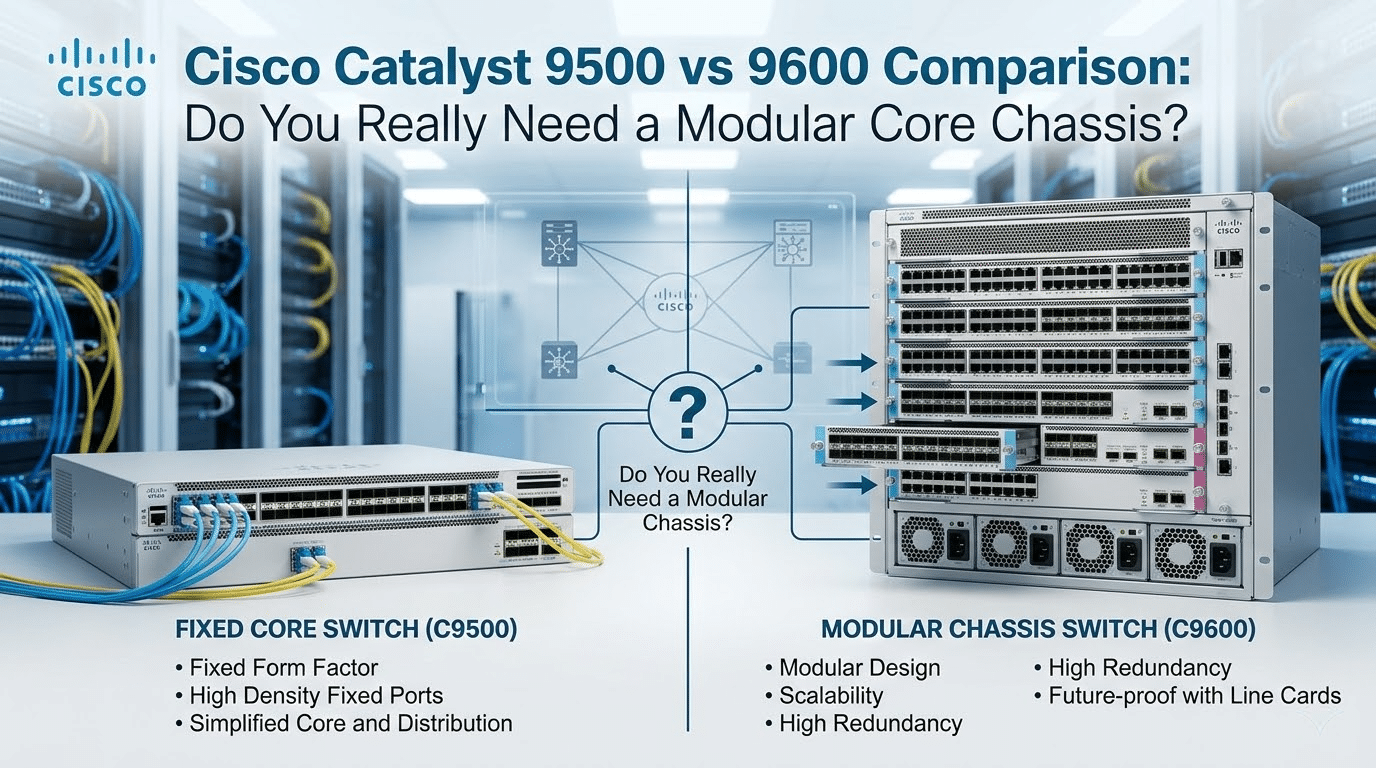
Cisco Catalyst C9500 fits campus distribution and core designs that can stay on fixed 1RU switches with known port counts, StackWise Virtual, and a simpler BOM. Cisco Catalyst C9600 fits campus cores that need an 8RU modular chassis, dual supervisors, line-card expansion, and a longer 100G/400G growth path.
The harder buying decision is C9500X versus C9600. A C9500X can deliver high 100G/400G density in a compact fixed platform; a C9600 scales through chassis slots, supervisors, power supplies, fan tray, and line cards. If predictable fixed-port aggregation is enough, start with C9500 or C9500X. If the core needs modular lifecycle control, start with C9600.
For the broader Catalyst family decision, use the Cisco Catalyst switch comparison. This page stays on one boundary: fixed Catalyst 9500 core and distribution versus modular Catalyst 9600 core.
Cisco C9500 vs C9600: Quick Answer
Choose Cisco C9500 when the design needs a fixed high-speed distribution or core switch, usually deployed as a pair with StackWise Virtual or a routed design. Choose Cisco C9600 when the design needs an 8RU modular chassis with supervisor redundancy, line-card expansion, large fiber aggregation, and a core BOM that can grow without replacing the entire chassis.
| Requirement | Better fit | Why it matters |
|---|---|---|
| Fixed 25G/100G aggregation | C9500 or C9500X | Fixed models are simpler to quote, rack, spare, and replace |
| Compact 400G fixed core | C9500X | C9500X provides 400G in a 1RU fixed platform |
| StackWise Virtual pair | C9500 or C9500X | The redundancy model is built from two fixed switches |
| Modular chassis core | C9600 | C9600 uses a chassis, supervisors, line cards, power supplies, and fan tray |
| Dual supervisors in one chassis | C9600 | Supervisor redundancy is inside the chassis rather than across two fixed switches |
| 100G/400G growth through added line cards | C9600 | Expansion can be handled by slot planning instead of replacing fixed switches |
| Strict chassis-level lifecycle planning | C9600 | Supervisors and line cards can be refreshed separately in supported designs |
| Lower BOM complexity | C9500 or C9500X | A fixed switch order has fewer moving parts than a chassis order |
The buying sequence should be role first, hardware format second, SKU third. If port count and speed requirements fit a fixed C9500 or C9500X pair, the chassis may be unnecessary. If the core will outgrow fixed ports, require in-chassis supervisor redundancy, or standardize on modular line-card expansion, C9600 is the cleaner direction.
Popular C9500 and C9500X Models Compared
C9500 purchasing should start with the exact fixed model. The wrong C9500 choice can create port-speed limits, breakout limits, lifecycle issues, or an upgrade path that forces a full switch replacement later.
| Model | Fixed port configuration | Switching capacity | Forwarding rate | Best-fit role | Buying note |
|---|---|---|---|---|---|
| C9500X-60L4D | 60 x 10/25/50G SFP56, 4 x 40/100/200/400G QSFP-DD | Up to 9.2 Tbps | 8 Bpps | Dense 25G/50G aggregation with 400G uplinks | Check exact license suffix and optics availability before quoting |
| C9500X-28C8D-E | 28 x 40/100G QSFP28, 8 x 40/100/200/400G QSFP-DD | Up to 12 Tbps | 8 Bpps | Compact high-speed fixed core | Strong C9500X option when 100G and 400G ports fit the fixed footprint |
| C9500-32C-A | 32 x 40/100G QSFP28 | Up to 6.4 Tbps | Up to 2 Bpps | 100G fixed core or distribution | Good fit when 32 fixed 100G ports are enough |
| C9500-48Y4C-A | 48 x 1/10/25G SFP28, 4 x 40/100G QSFP28 | Up to 3.2 Tbps | Up to 1 Bpps | 25G distribution with 100G uplinks | Common campus distribution and collapsed-core model |
| C9500-24Y4C-A | 24 x 1/10/25G SFP28, 4 x 40/100G QSFP28 | Up to 2.0 Tbps | Up to 1 Bpps | Smaller 25G distribution or core | Lower fixed-port count with the same 100G uplink direction |
| C9500-32QC-A | 32 x 40G QSFP+ or 16 x 100G QSFP28 | Up to 3.2 Tbps | Up to 1 Bpps | 40G-heavy or transitional core | Validate optics and 100G plan before selecting over C9500-32C |
| C9500-16X-A | 16 x 1/10G SFP/SFP+ with optional uplink module path | Up to 480 Gbps | Up to 360 Mpps | Legacy or low-density 10G replacement | Last-order timing has passed for new Cisco orders; treat as replacement or spare after lifecycle review |
C9500X makes the fixed-core decision more nuanced. It brings high 100G/400G density and Cisco Silicon One into a fixed switch, which can reduce the need for a chassis in space-constrained cores. It does not remove the main limitation of the 9500 family: capacity is tied to the fixed model purchased on day one. Older C9500-16X and network-module-based builds should be handled as lifecycle-sensitive replacement cases, not as default standards for new campus-core refreshes.
Common C9600 Chassis, Supervisors, and Line Cards Compared
A C9600 purchase is not a single-SKU decision. A usable order must include the chassis, supervisor path, line cards, power supplies, fan tray, optics, licenses, and support coverage.
| Component | Hardware role | Port or capacity direction | Best-fit role | Buying note |
|---|---|---|---|---|
| C9606R | 8RU chassis | 4 line-card slots, 2 supervisor slots | Modular campus core chassis | Start here only when fixed C9500 capacity or lifecycle model is not enough |
| C9600X-SUP-2 | Supervisor engine | Up to 25.6 Tbps chassis switching capacity, up to 6.4 Tbps per slot | High-scale C9600 and 400G growth | Required for several next-generation high-speed line-card designs |
| C9600-SUP-1 | Supervisor engine | Up to 9.6 Tbps chassis switching capacity, up to 2.4 Tbps per slot | Established C9600 core and distribution | Validate line-card support before mixing with newer cards |
| C9600X-LC-32CD | High-speed line card | 30 x 100/40G QSFP28, 2 x 400/200/100G QSFP-DD | 100G/400G campus backbone | Supervisor and optics planning are central to the quote |
| C9600X-LC-56YL4C | Combo line card | 56 x 50/25/10G SFP56, 4 x 100/40G QSFP28 | Dense 25G/50G aggregation | Good fit where many distribution links feed a modular core |
| C9600-LC-40YL4CD | Combo line card | SUP-1 path: 40 x 1/10/25G plus 2 x 40/100G; SUP-2 path adds 50G and 200G/400G uplink capability | Mixed-speed core or distribution | Confirm supervisor path before treating every listed speed as available |
| C9600-LC-24C | QSFP line card | SUP-1 path: 24 x 40G or 12 x 100G; SUP-2 path supports higher 100G density | 40G/100G modular core | Useful for 100G-heavy growth where chassis slots matter |
| C9600-LC-48YL | SFP line card | SUP-1 path: 48 x 25/10/1G; SUP-2 path adds 50G support, with 1G optics restrictions | High-density fiber aggregation | Check 1G optics and 50G support against supervisor and software release |
C9600 gives procurement flexibility, but it also increases BOM risk. A C9600 quote with only C9606R is incomplete. The buyer still needs supervisors, line cards, power supplies, fan tray, blanks where required, optics, cables, software subscription, support term, and spare strategy.
Cisco C9500 vs C9600 Key Differences
C9500 and C9600 both serve distribution and core roles, but they solve different operational problems. C9500 is a fixed-platform purchase. C9600 is a modular system build.
| Decision point | Cisco C9500 / C9500X | Cisco C9600 | Buying impact |
|---|---|---|---|
| Hardware format | Fixed 1RU switch | 8RU modular chassis | C9500 is simpler; C9600 requires a full chassis BOM |
| Redundancy model | Usually two fixed switches, StackWise Virtual, routed pair, or design-specific HA | Dual supervisors inside C9606R plus line-card and power redundancy planning | C9600 is stronger when in-chassis supervisor redundancy is required |
| Expansion model | Replace or add fixed switches | Add or change line cards in available slots | C9600 fits longer growth horizons |
| 400G path | C9500X fixed 400G models | 400G-capable line-card path with C9600X-SUP-2 | C9500X can be enough if fixed 400G density is known |
| Port-density planning | Locked to selected switch model | Chassis slot plan drives growth | C9500 needs accurate day-one and year-three port forecasts |
| Facility impact | Lower rack footprint and simpler power plan | More rack space, power, cooling, and service-access planning | C9600 needs facility validation earlier |
| Wrong-order risk | Buying too small a fixed model | Buying a chassis when fixed switches would be enough | The correct answer depends on port growth and resiliency requirements |
| Typical buyer | Campus distribution, smaller or medium core, fixed 100G/400G aggregation | Large campus core, multi-building aggregation, modular backbone | Keep the comparison at the core/distribution layer, not access switching |
Both platforms can be valid in the same campus. A common design uses C9500 switches for building distribution or smaller collapsed cores and C9600 at the central campus core where fiber concentration, supervisor redundancy, and future line-card expansion matter more.
Fixed Core vs Modular Core BOM
A C9500 BOM is easier to control because the switch contains the forwarding hardware and fixed ports. The order normally includes two switches for redundancy, power supply and fan choices where applicable, optics, licenses, support, virtual-link optics if using StackWise Virtual, and rack accessories.
A C9600 bill of materials is closer to a system build. The chassis by itself does not provide network connectivity. A deployable C9600 design must define supervisor engines, line cards, slot placement, power supplies, fan tray, optics, blanks, licenses, and support coverage. This is why C9600 quotes should be reviewed as complete systems rather than as chassis prices.
The fixed-versus-modular decision affects spares as well. C9500 spares are usually whole-switch spares or same-model replacements. C9600 spare planning may include supervisors, specific line cards, power supplies, fan tray, and critical optics. For large cores, that spare strategy can matter as much as the purchase price.
StackWise Virtual and Supervisor Redundancy
C9500 high availability is usually built by deploying two switches and using StackWise Virtual or a routed-pair design, depending on the architecture. StackWise Virtual can simplify downstream connectivity through multichassis EtherChannel, but the design still depends on inter-switch links, dual-active detection planning, IOS XE compatibility, and maintenance procedures.
C9600 high availability starts with the chassis model. C9606R supports two supervisor slots and can use Stateful Switchover, Non-Stop Forwarding, and full-image ISSU in supported software and hardware combinations. C9600 can also be used in StackWise Virtual designs between chassis when the supervisor, software release, and link design support it.
The distinction is operational. C9500 normally spreads redundancy across two fixed switches. C9600 can concentrate the core into a modular chassis with redundant supervisors, or extend the design across chassis where required. The better choice depends on whether the organization wants simpler fixed-switch redundancy or a chassis-level operating model.
C9500X vs C9600 for 100G and 400G Growth
C9500X makes the fixed-versus-chassis decision more nuanced. If the design needs a compact fixed platform with known 100G and 400G requirements, a C9500X model may be enough. C9500X-28C8D and C9500X-60L4D can carry high-speed backbone roles without moving to an 8RU chassis.
C9600 remains stronger when growth is uncertain or when the core will add line cards over time. If the site expects multiple waves of fiber growth, additional buildings, 25G/50G aggregation expansion, or a larger 400G roadmap, the ability to add or change C9600 line cards can protect the project from replacing fixed switches too early.
Port math should be done before budget approval. Count current links, planned links, spare ports, breakout use, redundant paths, StackWise Virtual links if using C9500, and optics availability. A C9500 pair that looks cheaper can become expensive if the next growth phase forces a full platform replacement.
When to Choose Cisco Catalyst C9500
Choose C9500 or C9500X when the port requirement is clear, the fixed model fits the growth window, and the team wants a simpler core or distribution BOM. It is often the better choice for smaller and mid-sized campuses where two fixed switches provide enough fiber density and resilience.
C9500 is usually the better fit when the project includes:
- Fixed 10G, 25G, 40G, 100G, or 400G requirements that match a specific model.
- A distribution layer or collapsed core where a fixed pair is operationally acceptable.
- Limited rack space or preference for 1RU switches.
- A repeatable design for multiple regional sites.
- Lower BOM complexity and simpler spare-unit planning.
- StackWise Virtual or routed-pair high availability rather than in-chassis supervisors.
- A budget that does not justify chassis, supervisor, line-card, and modular spare planning.
The main C9500 risk is underestimating future ports. If the design will outgrow the chosen fixed model before the refresh cycle ends, C9600 should be reviewed before the order is placed.
When to Choose Cisco Catalyst C9600
Choose C9600 when the core is large enough to justify chassis economics and modular operations. It fits multi-building campuses, large aggregation points, and backbone environments where supervisor redundancy, slot planning, line-card growth, and long-term lifecycle control matter.
C9600 is usually the better fit when the project includes:
- A central campus core serving many buildings or distribution blocks.
- Large 25G/50G aggregation with 100G or 400G uplinks.
- A requirement for dual supervisors inside the chassis.
- A preference to expand capacity by adding line cards instead of replacing fixed switches.
- A core room with enough rack, power, cooling, and service access.
- Optics-heavy growth where transceiver availability and fiber paths must be planned by phase.
- A long refresh window where supervisors and line cards may be upgraded separately in supported designs.
C9600 should not be chosen just because it is the larger platform. If the site can fit the required ports into a C9500X pair with acceptable resilience and growth headroom, the fixed design may be the more efficient purchase.
C9500X vs C9600 for 400G Core Designs
C9500X narrows the gap for buyers who need high-speed core ports but do not need a chassis. It is especially relevant when the project needs 400G uplinks in a compact rack footprint and the port count can be forecast with confidence.
C9600 remains different because it separates the core system into chassis, supervisors, line cards, and power. That matters when the organization expects staged growth, wants to add cards later, or needs a modular spare plan. C9500X can be the right answer for fixed 400G density; C9600 is the right answer for a modular 400G lifecycle.
The buyer should not compare only raw switching capacity. A C9500X may have enough performance on paper, while C9600 may still win because the project needs slots, supervisors, and a chassis-level operating model.
Deployment Scenarios and Selection Matrix
The cleanest C9500 vs C9600 decision comes from deployment context rather than model preference.
| Scenario | Recommended direction | Reason |
|---|---|---|
| Regional office core with 10G/25G distribution | C9500 | Fixed ports are usually enough and the BOM stays simple |
| Medium campus collapsed core with 25G access aggregation and 100G uplinks | C9500 or C9500X | A fixed pair can work if port growth is controlled |
| Compact 400G backbone with known port count | C9500X | Fixed 400G can avoid the cost and footprint of a chassis |
| Large university, healthcare, or enterprise campus core | C9600 | Modular slots, supervisors, and fiber growth matter more |
| Multi-building core with expected 100G/400G expansion | C9600 | Line-card growth reduces future replacement pressure |
| Existing chassis core replacement | C9600 | Chassis operations and spare strategy may already fit the organization |
| Distribution layer below a larger core | C9500 | Fixed aggregation often fits this role cleanly |
| Access-heavy building with PoE endpoints | Review C9300 or C9400 | Neither C9500 nor C9600 is an endpoint PoE access platform |
For access-to-core boundary questions, see the Cisco 9300 vs 9500 comparison. For modular access or chassis access decisions, use the Cisco C9400 vs C9600 comparison only when the project is comparing chassis access, building distribution, and modular core roles.
Procurement and BOM Checks Before Ordering
C9500 and C9600 quotes fail most often when the model looks correct but the supporting parts are incomplete. A fixed switch still needs a full operational BOM. A chassis needs even more validation.
For C9500 and C9500X, confirm:
- Exact switch SKU and license suffix.
- Required port speeds: 10G, 25G, 40G, 50G, 100G, 200G, or 400G.
- Whether the design uses StackWise Virtual, routed links, or another redundancy model.
- StackWise Virtual link and dual-active detection design if applicable.
- Optics, DACs, breakout cables, fiber type, and distance.
- Power supply type, airflow direction, rack depth, and accessory kit.
- IOS XE release requirement, especially for C9500X features.
- Lifecycle status for older C9500-16X and network-module-based builds.
- Support term, warranty expectation, spare switch policy, and delivery deadline.
- Whether future growth will force replacement before the refresh cycle ends.
For C9600, confirm:
- C9606R chassis.
- Supervisor path: C9600-SUP-1 or C9600X-SUP-2.
- Whether one or two supervisors are required at purchase.
- Line-card models, slot placement, and future empty-slot plan.
- 25G, 50G, 100G, 200G, and 400G port roadmap.
- Power supplies, input voltage, redundancy mode, and facility circuit plan.
- Fan tray, blanks, rack kit, service clearance, and cooling path.
- Optics and fiber distance for each uplink and downlink group.
- Software subscription, support level, and replacement SLA.
- Spare supervisor, line card, PSU, fan tray, and optics strategy.
Layer23-Switch can review C9500 and C9600 BOMs before quote when the order includes C9500X models, 400G optics, StackWise Virtual links, C9600X-SUP-2, mixed C9600 line cards, or a migration from an older chassis core.
Related Cisco Catalyst Comparison Pages
Use related pages to keep the decision in the right layer:
| Decision | Recommended page |
|---|---|
| Full Catalyst family placement | Cisco Catalyst switch comparison |
| High-end access vs fixed core/distribution | Cisco 9300 vs 9500 |
| Stackable access vs modular access | Cisco C9300 vs C9400 |
| Modular access/distribution vs modular core | Cisco C9400 vs C9600 |
| C9500 family models | Cisco Catalyst 9500 switches |
| C9600 family models | Cisco Catalyst 9600 switches |
FAQ: Cisco C9500 vs C9600
What is the main difference between Cisco C9500 and C9600?
C9500 is a fixed Catalyst core and distribution switch family. C9600 is a modular chassis family built around C9606R, supervisor engines, line cards, power supplies, fan tray, optics, and licenses. Choose C9500 when fixed ports are enough; choose C9600 when the core needs modular expansion and chassis-level planning.
Is Cisco C9500 a core switch?
Yes. C9500 and C9500X are used for fixed distribution and core roles in enterprise campus networks. They are not access switches for endpoint PoE, and they should be selected by fiber speed, route scale, redundancy model, optics, and growth plan.
Is Cisco C9600 better than C9500?
C9600 is better for large modular campus cores, high fiber growth, dual supervisors, and line-card expansion. C9500 is better when a fixed switch pair satisfies the port count, performance, space, budget, and redundancy requirements. The larger platform is not automatically the better purchase.
Does Cisco C9500 support StackWise Virtual?
Yes, C9500 supports StackWise Virtual in supported hardware and software combinations. Buyers should still validate IOS XE release, StackWise Virtual link design, dual-active detection, optics, and maintenance process before using it as the campus core redundancy model.
Does Cisco C9600 use StackWise Virtual?
Yes, C9600 can be used in StackWise Virtual designs between chassis when the supervisor, software release, and link design support it. For C9500 vs C9600 purchasing, the larger question is whether the core needs modular chassis, supervisor engines, line cards, and chassis spares, or whether a fixed C9500 pair is enough.
Can C9500X replace C9600?
C9500X can replace C9600 only when the project needs high-speed fixed 100G/400G ports and does not need modular line-card expansion or chassis supervisor planning. If future growth depends on adding line cards, C9600 remains the stronger platform.
Which is better for 400G, C9500X or C9600?
C9500X is better for compact fixed 400G deployments with known port requirements. C9600 is better when 400G is part of a modular core roadmap with line-card growth, chassis slots, supervisor planning, and a longer refresh cycle.
Should I buy C9500 or C9600 for a medium enterprise campus?
Most medium enterprise campuses should evaluate C9500 or C9500X first if the required ports fit the fixed models. Move to C9600 when the medium campus has large growth, strict chassis-level operations, multi-building aggregation, or a requirement for modular supervisor and line-card expansion.
What should be checked before quoting Cisco C9500 or C9600?
Check exact SKU, license suffix, port speeds, optics, software release, redundancy model, power supply, airflow, rack space, lifecycle status, support term, spare strategy, stock, lead time, and acceptable substitutions. For C9600, also confirm chassis, supervisor, line-card, fan tray, blanks, and slot plan.
Final Selection Takeaway
Choose Cisco C9500 or C9500X when the project needs fixed high-speed distribution or core switching with a clear port plan, compact rack footprint, simpler sparing, and manageable growth. C9500X should be reviewed carefully before moving to a chassis if fixed 100G/400G density is enough.
Choose Cisco C9600 when the project needs a modular campus core with C9606R chassis slots, dual-supervisor planning, line-card expansion, high fiber density, 100G/400G growth, and a spare strategy built around replaceable core components. The decision should be made from the five-year port roadmap and operations model, not from chassis size alone.