Cisco C9400 vs C9600: Modular Access vs Campus Core
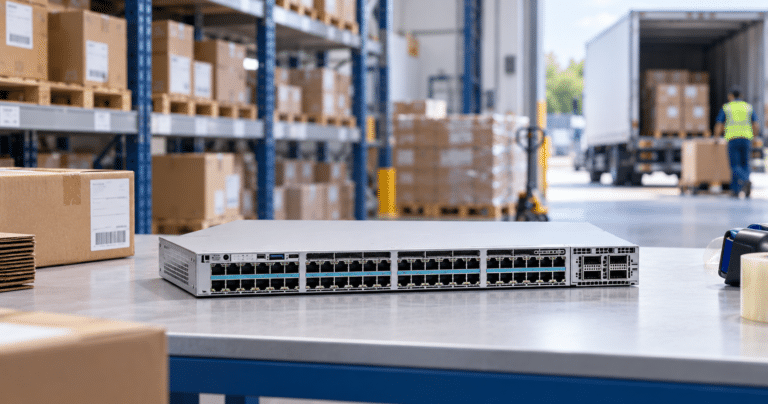
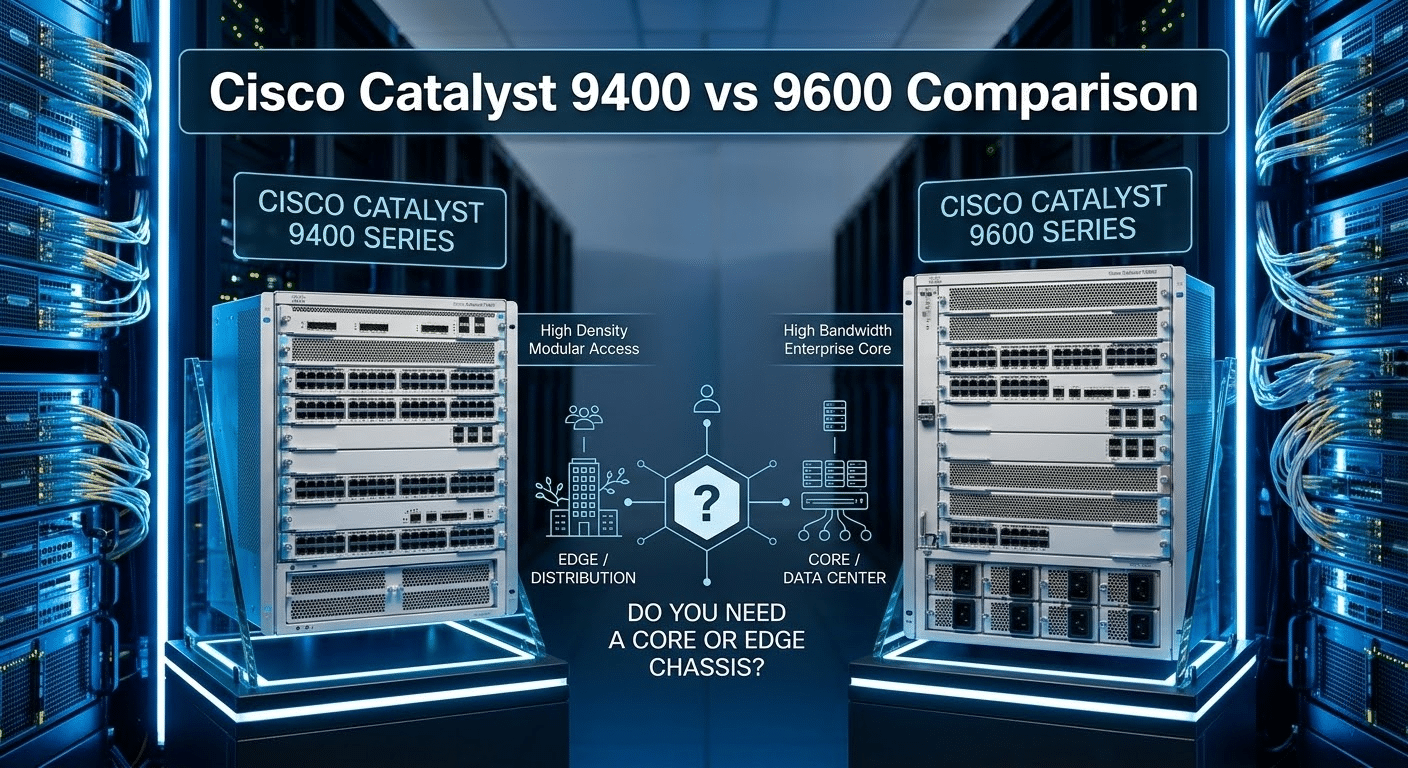
Cisco Catalyst C9400 belongs in designs where a modular chassis must still serve the access layer: PoE, UPOE, UPOE+, mGig copper, large endpoint counts, building distribution, or a smaller collapsed core that remains endpoint-facing. Cisco Catalyst C9600 belongs above that layer, where the design is driven by campus core scale, high-speed fiber, 100G/400G growth, supervisor resiliency, and backbone routing.
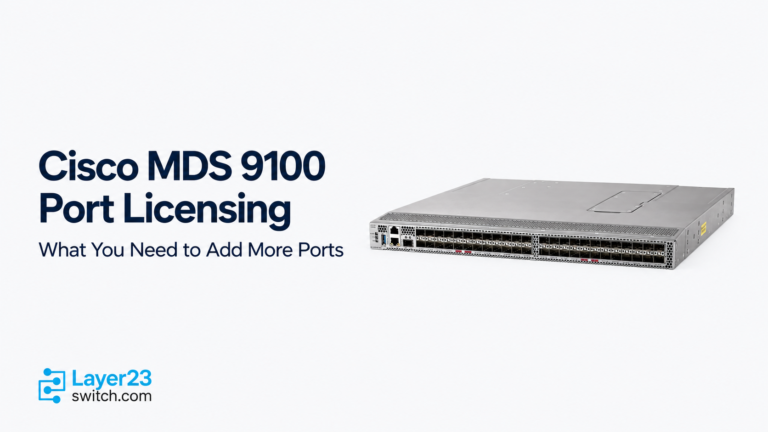
C9400 can be an access chassis, a building-distribution chassis, or a limited collapsed-core platform. C9600 is a modular core or high-scale distribution chassis. It includes selected copper data line cards, but it is not a PoE access platform for APs, phones, cameras, lighting, or IoT endpoints.
For broader Catalyst family placement, start with the Cisco Catalyst switch comparison. This comparison stays on the modular chassis boundary between C9400 and C9600.
Cisco C9400 vs C9600: Quick Answer
Choose C9400 when the project needs a modular access or building-distribution chassis with PoE, UPOE, UPOE+, mGig, large endpoint count, and long access-layer growth. Choose C9600 when the project needs modular core switching, large fiber aggregation, high route scale, 100G or 400G uplinks, and a backbone platform above the access layer.
| Requirement | Better fit | Why it matters |
|---|---|---|
| High-density PoE access | C9400 | C9400 supports PoE, UPOE, and UPOE+ access line cards |
| Large wiring closet or building access chassis | C9400 | The platform has multiple chassis sizes and high access-port density |
| Smart building endpoints, APs, phones, cameras, or IoT | C9400 | Endpoint power and copper access are central to the design |
| Building distribution with access aggregation | C9400 or C9600 | Use C9400 when access and PoE remain important; use C9600 when fiber and routing scale dominate |
| Smaller collapsed core with moderate scale | C9400 may fit | Validate routing, uplink, supervisor, and resilience requirements before quoting |
| Campus core or large aggregation | C9600 | C9600 is built for high-scale modular core and distribution roles |
| 100G/400G backbone growth | C9600 | C9600 has stronger high-speed fiber line-card options |
| PoE access from the chassis | C9400 only | C9600 should not be purchased as a powered endpoint access switch |
The decision should start with the network layer and endpoint power requirement. If the chassis must power access devices, C9400 is the platform to review. If the chassis sits above access blocks and concentrates high-speed fiber, C9600 is usually the stronger chassis direction.
Popular C9400 and C9600 Chassis Compared
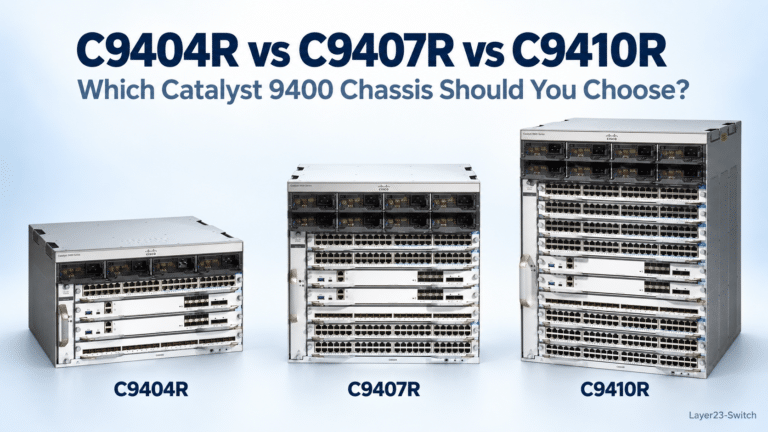
The chassis choice determines slot count, rack footprint, power design, supervisor placement, line-card capacity, and spare strategy. Buyers should compare the chassis before narrowing the order to supervisors and line cards.
| Chassis | Line-card slots | Supervisor slots | Rack units | Primary role | Buying note |
|---|---|---|---|---|---|
| C9404R | 2 | 2 | 6 RU | Smaller modular access or branch/building chassis | Good fit when a fixed stack is too limited but C9410R scale is unnecessary |
| C9407R | 5 | 2 | 10 RU | Large access or building distribution | Balanced C9400 option for larger wiring closets and building aggregation |
| C9410R | 8 | 2 | 13 RU | High-density modular access and large building distribution | Best C9400 fit when port density and PoE growth dominate |
| C9606R | 4 | 2 | 8 RU | Campus core or high-scale distribution | Modular core chassis for high-speed fiber, route scale, and backbone expansion |
Do not compare only the number of line-card slots. C9410R has more access slots than C9606R, but C9606R slots are built for a different job: high-capacity core and distribution line cards rather than access PoE density.
Cisco C9400 vs C9600 Key Differences
C9400 and C9600 are both modular Catalyst chassis platforms, but they are purchased for different reasons. C9400 is usually justified by access density, PoE, mGig, line-card flexibility, and building-level aggregation. C9600 is usually justified by high-speed fiber, core routing scale, supervisor performance, and longer campus backbone growth.
| Decision point | Cisco C9400 | Cisco C9600 | Buying impact |
|---|---|---|---|
| Primary role | Modular access, building distribution, limited collapsed core | Modular campus core, high-scale distribution, large aggregation | Role determines whether PoE or fiber scale drives the BOM |
| Endpoint PoE | Yes, with appropriate line cards and power design | No endpoint PoE access role | Do not quote C9600 for powered AP, camera, phone, or IoT access |
| Chassis options | C9404R, C9407R, C9410R | C9606R | C9400 offers multiple access chassis sizes; C9600 centers on one modular core chassis |
| Line-card direction | Copper, mGig, PoE, UPOE, UPOE+, SFP/SFP+/SFP28, QSFP options | SFP/SFP56, QSFP28, QSFP-DD, and selected data-only copper options | C9400 is endpoint-facing; C9600 is backbone-facing |
| Bandwidth per slot | Up to 480 Gbps per line-card slot with C9400X-SUP-2XL | Up to 6.4 Tbps per line-card slot with C9600X-SUP-2 | C9600 is much stronger for core fabric scale |
| Supervisor planning | C9400-SUP-1 family or C9400X-SUP-2/2XL | C9600-SUP-1 or C9600X-SUP-2 | Supervisor choice affects line-card speed, software release, and expansion path |
| Power planning | Driven heavily by PoE draw and redundancy mode | Driven by supervisors, core line cards, optics, and chassis power | C9400 power review is endpoint-driven; C9600 power review is backbone hardware-driven |
| Main wrong-order risk | Treating C9400 as a low-cost C9600 core substitute | Buying C9600 for access PoE | The two platforms solve different layers of the campus |
Both platforms can appear in distribution discussions. The difference is what the distribution layer must do. If distribution still includes large PoE access concentration, C9400 deserves review. If distribution is mostly high-speed fiber and routing scale, C9600 should be on the shortlist.
C9400 Supervisor Engines Compared
The C9400 supervisor determines bandwidth per slot, uplink direction, line-card compatibility, software minimums, and the life of the chassis. Procurement should not treat the supervisor as a generic accessory.
| Supervisor | Typical use | C9404R bandwidth per slot | C9407R bandwidth per slot | C9410R bandwidth per slot | Buying note |
|---|---|---|---|---|---|
| C9400-SUP-1 | Older or cost-controlled C9400 access designs | 80 Gbps | 80 Gbps | 80 Gbps | Entry supervisor for supported designs |
| C9400-SUP-1XL | Higher-bandwidth access and distribution | 240 Gbps | 120 Gbps | 80 Gbps | Check chassis-specific bandwidth limits |
| C9400-SUP-1XL-Y | Access/distribution with 25G uplink direction | 240 Gbps | 120 Gbps | 80 Gbps | Useful where the uplink plan needs the Y supervisor path |
| C9400X-SUP-2 | Newer high-speed access, aggregation, and campus designs | 240 Gbps | 240 Gbps | 240 Gbps | Required for some newer C9400 line cards |
| C9400X-SUP-2XL | Highest C9400 slot bandwidth and longer growth path | 480 Gbps | 480 Gbps | 480 Gbps | Strongest C9400 supervisor option for high-scale modular access |
Bandwidth is only part of supervisor selection. Newer C9400 line cards can have supervisor and IOS XE release requirements. A C9400 quote should pair the chassis, supervisor, line cards, power supplies, and software release before price is finalized.
C9600 Supervisor Engines Compared
C9600 supervisor selection is a core-design decision. It affects fabric capacity, route scale, line-card compatibility, 400G growth, and the type of backbone the chassis can support.
| Supervisor | Architecture direction | Performance direction | Best fit | Buying note |
|---|---|---|---|---|
| C9600-SUP-1 | UADP 3.0-based supervisor | Up to 9.6 Tbps and 3 Bpps | Campus distribution or collapsed core with medium L2/L3 scale | Validate 100G line-card and software requirements |
| C9600X-SUP-2 | Cisco Silicon One Q200-based supervisor | Up to 25.6 Tbps and 8 Bpps | Campus core, edge, high route scale, 100G/400G growth | Required for several newer high-speed C9600X line cards |
C9600X-SUP-2 changes the platform from a traditional modular campus chassis into a higher-scale core option. It is the supervisor to review when the design includes 400G, large route scale, high-speed border/spine roles, or a longer backbone upgrade runway.
Common C9400 Line Cards Compared
C9400 line-card planning usually starts with the endpoint schedule: port count, copper speed, PoE class, AP roadmap, camera load, fiber uplinks, and whether the chassis is serving access only or access plus building distribution.
| Line card | Port type | PoE role | Typical use | Buying note |
|---|---|---|---|---|
| C9400-LC-48U | 48 x 1G RJ45 | UPOE | High-density powered 1G access | Standard access closets with heavier power requirements |
| C9400-LC-48P | 48 x 1G RJ45 | PoE+ | Standard powered access | Offices, phones, cameras, and normal AP access |
| C9400-LC-48H | 48 x 1G RJ45 | UPOE+ | High-power 1G endpoint access | APs, smart building devices, and high-power edge endpoints |
| C9400-LC-48HN | 48 x 5G mGig RJ45 | Full 90W UPOE+ | Dense mGig and high-power access | Validate chassis power before assuming every endpoint can draw 90W |
| C9400-LC-48HX | 48 x 10G mGig RJ45 | Full 90W UPOE+ | Highest C9400 mGig access | Best fit for high-end wireless refreshes after power budget review |
| C9400-LC-48TX | 48 x 10G mGig RJ45 | No endpoint PoE | High-speed copper data access | Data-only mGig access where PoE is not required |
| C9400-LC-24XY | 20 x 25G SFP28, 4 x 10G SFP+ | No endpoint PoE | Fiber aggregation inside C9400 designs | Useful when C9400 is used beyond pure copper access |
| C9400-LC-12QC | 12 x 40G QSFP+ or 4 x 100G QSFP28 plus 4 x 40G QSFP+ | No endpoint PoE | Higher-speed uplink or aggregation line card | Requires SUP-2/2XL path and careful optics validation |
C9400 can handle substantial fiber and aggregation workloads, but the procurement reason is usually access density with modularity. When the design becomes mostly high-speed fiber core with little or no endpoint access, compare C9600 and C9500 before committing to C9400.
Common C9600 Line Cards Compared
C9600 line-card planning starts with the backbone: 25G/50G downlinks, 100G or 400G uplinks, route scale, optics cost, and supervisor compatibility. It is not a PoE access line-card portfolio.
| Line card | Port type | Supervisor boundary | Typical use | Buying note |
|---|---|---|---|---|
| C9600X-LC-56YL4C | 56 x 50/25/10G SFP56, 4 x 100/40G QSFP28 | C9600X-SUP-2 | High-density campus core or distribution with many SFP links | Dense fiber aggregation |
| C9600X-LC-32CD | 30 x 100/40G QSFP28, 2 x 400/200/100/40G QSFP-DD | C9600X-SUP-2 | High-speed core or edge designs | 100G/400G backbone expansion |
| C9600-LC-40YL4CD | SUP-1: 40 x 25/10/1G SFP plus 2 x 40/100G; SUP-2: 40 x 50/25/10/1G plus 2 x 40/100/200G and 2 x 400G | SUP-1 or SUP-2, with feature differences | Mixed SFP and QSFP core or distribution | Flexible high-speed aggregation; quote against the supervisor path |
| C9600-LC-24C | SUP-1: 24 x 40G or 12 x 100G; SUP-2: 24 x 100/40G QSFP28 | SUP-1 or SUP-2, with capacity differences | Medium-density 100G core | High-speed upstream and downstream connections |
| C9600-LC-48YL | 48 x 50/25/10/1G SFP ports | SUP-1 or SUP-2; 50G support requires SUP-2 | High-density fiber distribution | Check 1G optics support on SUP-2 before ordering |
| C9600-LC-48TX | 48 x 10G/5G/2.5G/1G/100M/10M RJ45 data ports | SUP-1 or SUP-2; SUP-2 supports 10G only | Data-only copper distribution or access-adjacent use | Not a PoE access line card |
| C9600-LC-48S | 48 x 100M/1G SFP | C9600-SUP-1 only | Legacy or lower-speed fiber aggregation | Verify supervisor path before quoting |
The C9600-LC-48TX can create confusion because it uses RJ45 copper ports. It does not make C9600 a PoE access chassis. If the project needs powered endpoints, keep the access decision on C9400 or another access platform.
When to Choose Cisco Catalyst C9400
Choose C9400 when modular access is the reason for buying a chassis. The platform fits buildings where fixed switches create too many stack members, too much cabling, or too little power and line-card flexibility.
C9400 is usually the better choice when the project includes:
- Hundreds of access endpoints in one building closet.
- APs, phones, cameras, lighting, terminals, or IoT devices that need PoE, UPOE, or UPOE+.
- 1G, 5G, or 10G mGig copper access.
- A chassis access refresh from older modular platforms.
- Building distribution where access concentration and PoE still matter.
- A smaller collapsed-core role with moderate routing and uplink requirements.
- A requirement for dual supervisors, modular line cards, redundant power, and field-replaceable components.
Use C9400 as a core only after scale review. It can serve smaller or moderate collapsed-core designs, especially where the same chassis also carries building access. It should not be treated as a lower-cost substitute for C9600 when the project requires high-speed campus backbone, very large route scale, or 100G/400G expansion.
When to Choose Cisco Catalyst C9600
Choose C9600 when the chassis is being purchased for the campus core, a large collapsed core, or high-scale distribution. The platform fits environments where fiber speed, supervisor scale, 100G/400G growth, routing tables, and backbone resiliency are more important than access port count.
C9600 is usually the better choice when the project includes:
- Multi-building campus core.
- Large distribution or aggregation above several access blocks.
- 25G/50G access aggregation with 100G or 400G uplinks.
- Core routing, route scale, ACL scale, and SD-Access border/spine requirements.
- Long-term modular core expansion rather than a fixed C9500 design.
- Supervisor and line-card redundancy planning in a core room or MDF.
- Optics-heavy BOMs where fiber type, distance, transceiver availability, and lead time are major risks.
C9600 should not be ordered to solve endpoint PoE. It may sit above C9400 in the architecture: C9400 powering access endpoints in buildings, C9600 aggregating those buildings in the campus core.
C9400 vs C9600 for Core and Distribution
The overlap between C9400 and C9600 appears in distribution and collapsed-core discussions. The deciding factor is whether the design is still access-heavy or has become backbone-heavy.
| Scenario | Recommended direction | Reason |
|---|---|---|
| Large hospital floor with APs, cameras, phones, and smart devices | C9400 | PoE, mGig, and access line-card density drive the project |
| University building access chassis | C9400 | Modular access and building distribution are the main requirements |
| Smaller campus collapsed core with moderate scale | C9400 may fit | Validate routing, uplinks, supervisor, and growth before quote |
| Large campus core connecting many buildings | C9600 | Fiber aggregation, routing scale, and backbone resiliency dominate |
| 100G/400G backbone upgrade | C9600 | C9600 line cards and C9600X-SUP-2 are stronger for this path |
| Fixed 100G core without chassis growth | Review C9500 | A fixed platform may satisfy the design with a simpler BOM |
| C9300 stacks are becoming too dense in a building closet | C9400 | Chassis access can reduce stack and cable complexity |
| Existing chassis core refresh | C9600 | Modular core replacement should be evaluated against supervisor and line-card path |
For a fixed-core comparison, use the Cisco C9500 vs C9600 comparison. For fixed stackable access versus chassis access, use the Cisco C9300 vs C9400 comparison.
Can C9400 Replace C9600?
C9400 can replace C9600 only when the requirement is not a true large campus core. It may be acceptable for a smaller collapsed-core or building aggregation design if route scale, uplink speed, supervisor capacity, and growth expectations fit the C9400 platform.
Do not substitute C9400 for C9600 when the project requires 100G/400G backbone growth, large campus routing scale, high-speed fiber concentration, or a modular core architecture. In those cases, C9400 may still be valuable below the core as the access or building-distribution chassis, while C9600 handles the backbone.
Can C9600 Replace C9400?
C9600 should not replace C9400 for high-density PoE access. It can provide high-speed fiber and data-only connectivity, but it does not provide the endpoint PoE line-card role that makes C9400 useful in large access closets.
C9600 can replace C9400 only when the original requirement was misclassified and the real need is core or high-scale distribution rather than powered access. If the BOM includes AP power, camera power, phones, lighting, or high-density mGig endpoint access, C9400 remains the correct chassis family to review.
Power, Rack, Optics, and Facility Planning
Both platforms require facility planning before a quote is considered complete. The difference is what drives the risk.
| Check | C9400 | C9600 |
|---|---|---|
| Power design | Driven by endpoint PoE draw, PSU count, and redundancy mode | Driven by supervisors, high-speed line cards, optics, and chassis power |
| Rack footprint | 6 RU, 10 RU, or 13 RU depending on chassis | 8 RU C9606R chassis |
| Cooling | Wiring closet, MDF, or building access environment | Core room, MDF, or backbone aggregation location |
| Optics cost | Important for uplinks and distribution links | Often a major portion of the BOM |
| Spare strategy | Supervisor, line card, PSU, fan tray, access spares | Supervisor, core line card, PSU, fan tray, optics, replacement SLA |
| Common mistake | Assuming 90W support means every endpoint can draw 90W without power design | Treating the chassis PID as enough without supervisor, line card, and optics planning |
For C9400, the power conversation must include endpoint class, total wattage, reserve margin, input circuits, UPS, power-supply model, and redundancy mode. A 90W-capable line card does not remove chassis-level power limits; a fully populated high-power C9400 design still needs a port-by-port PoE budget before purchase approval. For C9600, the conversation usually shifts to supervisor, line-card power, optics, thermal load, and core replacement SLA.
Procurement and BOM Checklist
A C9400 or C9600 order is never just a chassis order. The quote must define the complete system.
For C9400, confirm:
- Chassis: C9404R, C9407R, or C9410R.
- Supervisor model and whether single or dual supervisors are required.
- Line cards and slot placement.
- Endpoint count, PoE class, total PoE budget, and reserve margin.
- Power supplies, input voltage, redundancy mode, and UPS assumptions.
- Fan tray, airflow, rack depth, and rack-unit availability.
- Uplink optics, fiber distance, and distribution handoff.
- IOS XE software release and line-card compatibility.
- License tier, software subscription, support coverage, and spare strategy.
- Stock, lead time, and acceptable substitutions.
For C9600, confirm:
- C9606R chassis.
- C9600-SUP-1 or C9600X-SUP-2 supervisor path.
- Core or distribution line cards.
- 25G, 50G, 100G, 200G, or 400G port plan.
- Optics type, fiber distance, and transceiver availability.
- Power supplies, input circuits, and redundancy mode.
- Fan tray, airflow, rack placement, and service access.
- Routing scale, ACL scale, SDM template, and software release.
- Core support term, replacement SLA, and spare optics strategy.
- Whether a fixed C9500 design is sufficient before buying a modular core chassis.
Layer23-Switch can review C9400 and C9600 BOMs before quote when an order includes mixed supervisors, high-power C9400 access, 100G/400G C9600 optics, line-card substitutions, or an unclear access-versus-core boundary.
Related Cisco Catalyst Comparison Pages
Use the related pages to keep each decision in the right layer:
| Decision | Recommended page |
|---|---|
| Full Catalyst family placement | Cisco Catalyst switch comparison |
| Fixed stackable access vs modular access | Cisco C9300 vs C9400 |
| Fixed distribution/core vs modular core | Cisco C9500 vs C9600 |
| High-end access vs fixed core/distribution | Cisco 9300 vs 9500 |
| C9400 family models | Cisco Catalyst 9400 switches |
| C9600 family models | Cisco Catalyst 9600 switches |
FAQ: Cisco C9400 vs C9600
What is the main difference between Cisco C9400 and C9600?
C9400 is a modular chassis for access, building distribution, high-density PoE, and some smaller collapsed-core designs. C9600 is a modular campus core and high-scale distribution chassis built around fiber, routing scale, supervisor performance, and 100G/400G growth.
Is Cisco C9400 an access switch or a core switch?
C9400 is primarily a modular access and building-distribution chassis, but it can serve as a core in smaller or moderate collapsed-core designs when the scale, uplinks, and routing requirements fit. It should not be treated as a lower-cost substitute for C9600 in large campus core designs.
Is Cisco C9600 a core switch?
Yes. C9600 is best understood as a modular campus core or high-scale distribution chassis. It can aggregate access and distribution blocks, but it is not a PoE access switch for endpoint power.
Does Cisco C9600 support PoE?
C9600 should not be selected for endpoint PoE access. It has high-speed fiber and data-oriented line-card options, including selected RJ45 data connectivity, but it does not provide the PoE access role that C9400 provides.
Can Cisco C9400 replace C9600?
C9400 can replace C9600 only when the requirement is closer to modular access, building aggregation, or smaller collapsed core. It should not replace C9600 for large campus core, high route scale, dense 100G/400G fiber, or backbone expansion.
Can Cisco C9600 replace C9400?
C9600 can replace C9400 only if the real requirement is core or high-scale distribution rather than powered access. If the chassis must connect and power APs, phones, cameras, lighting, or IoT endpoints, C9400 remains the correct platform to evaluate.
What is the difference between C9410R and C9606R?
C9410R is a 13 RU C9400 chassis with 8 line-card slots for high-density modular access and building distribution. C9606R is an 8 RU C9600 chassis with 4 line-card slots for campus core and high-scale distribution; each slot is designed for much higher core-facing bandwidth.
Which is better for 100G and 400G campus backbone?
C9600 is the better platform for 100G and 400G campus backbone planning. C9400 has high-speed uplink and aggregation options, but C9600 has the stronger supervisor and line-card path for modular core growth.
What should be included in a C9400 or C9600 BOM?
A complete C9400 or C9600 BOM should include chassis, supervisors, line cards, power supplies, fan tray, optics, cables, licenses, software release requirements, support coverage, spare strategy, rack and power assumptions, and acceptable substitutions.
Final Selection Takeaway
Choose Cisco C9400 when the project is access-heavy: PoE, UPOE, UPOE+, mGig, many endpoints, large wiring closets, modular access, and building distribution. Consider C9400 for smaller collapsed-core designs only after routing scale, uplink speed, and growth have been validated.
Choose Cisco C9600 when the project is backbone-heavy: campus core, large distribution, dense fiber, 100G/400G expansion, high route scale, supervisor capacity, and modular core lifecycle. If the project needs PoE access, C9600 should not be selected; if the project needs a large modular core, C9400 is usually the wrong substitute.