
C9400-LC-12QC – 12x 40G QSFP+ or 4x 100G QSFP28 Ports – Supervisor 2 Required – Cat 9400 Line Card








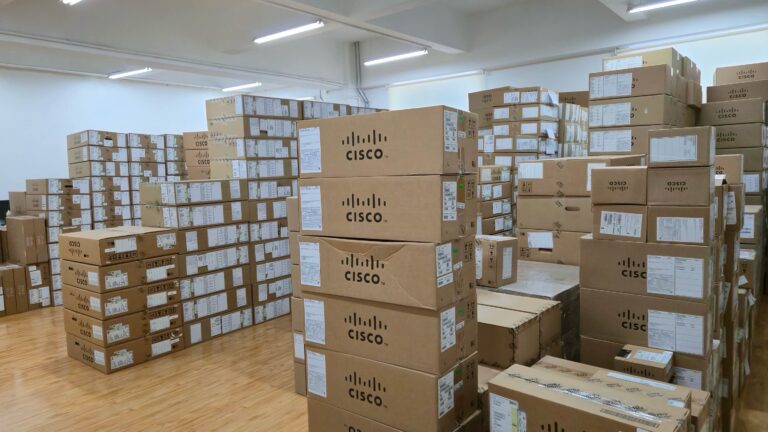
Established Global IT Distributor
With over a decade of industry experience, we are a certified Cisco Partner delivering genuine enterprise networking hardware and trusted services to system integrators, ISPs, and enterprises worldwide.
C9400-LC-12QC Description
The C9400-LC-12QC is the Cisco Catalyst 9400 Series 12-Port 40G (QSFP+) or 4-Port 100G (QSFP28) and 4-Port 40G (QSFP+) line card, the highest-speed single-slot module in the family. The card runs either as twelve 40 Gigabit Ethernet ports or as four 100 Gigabit Ethernet ports plus four 40 Gigabit Ethernet ports, with QSFP28 and QSFP+ modules usable together on the same card, which is how Cisco frames the phased migration path from 40G to 100G. It is positioned for high-performance and high-density 100G or 40 Gigabit Ethernet aggregation in the campus and as a core switch in small to medium-sized networks, and for enterprise backbone and collapsed access deployments. Like the other Supervisor 2 class modules it requires C9400X-SUP-2 or C9400X-SUP-2XL and will not operate on C9400-SUP-1, C9400-SUP-1XL or C9400-SUP-1XL-Y. Bandwidth per slot is stated for the 12x40G default mode at 480 Gbps and 1:1 oversubscription with C9400X-SUP-2XL and 240 Gbps at 2:1 with C9400X-SUP-2, identical across all three chassis. Maximum rated power is 200 W, MACsec-256 runs in hardware, jumbo frames reach 9216 bytes, and the card has shipped since Cisco IOS XE 17.12.1.
Quick Specs
|
Parameter |
Specification |
|---|---|
|
Product ID |
C9400-LC-12QC |
|
Ports |
Up to 12 ports of 40GE QSFP+, or 4 ports of 100GE QSFP28 plus 4 ports of 40GE QSFP+ |
|
Optic mixing |
QSFP28 and QSFP+ modules usable together on the same line card |
|
Supervisor requirement |
C9400X-SUP-2 or C9400X-SUP-2XL only; not supported on C9400-SUP-1, C9400-SUP-1XL or C9400-SUP-1XL-Y |
|
Bandwidth per slot |
480 Gbps at 1:1 with C9400X-SUP-2XL and 240 Gbps at 2:1 with C9400X-SUP-2, both stated for the 12x40G default mode |
|
Compatible chassis |
C9404R, C9407R and C9410R, scaling to 8, 20 and 32 ports at 100G respectively |
|
Security and frames |
IEEE 802.1AE MACsec-256 in hardware, jumbo frames to 9216 bytes |
|
Maximum rated power |
200 W |
|
Physical form |
Occupies one chassis slot, 1.6 x 14.92 x 14.57 in. (4.06 x 37.90 x 37.00 cm) |
|
Minimum software release |
Cisco IOS XE 17.12.1 |
Application Scenarios
Installed where inter-building or inter-floor backbone links run at 40G or 100G and terminate on the same modular chassis that carries campus routing.
Deployed in collapsed core designs where a single chassis both aggregates access switching and presents high-speed uplinks toward a data center or service provider handoff.
Racked where existing 40G QSFP+ trunks remain in service while the first 100G QSFP28 links are cut over, with both optic types populated on the same card.
Product Comparison
|
Parameter |
C9400-LC-12QC | ||
|---|---|---|---|
|
Maximum single-port speed |
100 GE |
25 GE |
10 GE |
|
Port layout |
12x 40G QSFP+, or 4x 100G QSFP28 plus 4x 40G QSFP+ |
20x 25G SFP28 plus 4x 10G SFP+ |
48x 10G SFP+ or 48x 1G SFP |
|
Optic family |
QSFP28 and QSFP+ |
SFP28 and SFP+ |
SFP+ and SFP |
|
Oversubscription with C9400X-SUP-2XL |
1:1 in 12x40G default mode |
1.125:1 |
1:1 |
|
Ports in a full C9410R |
32 at 100G or 96 at 40G |
160 at 25G |
384 at 10G |
|
Minimum software release |
Cisco IOS XE 17.12.1 |
Cisco IOS XE 17.12.1 |
Cisco IOS XE 17.8 |
|
Maximum rated power |
200 W |
200 W |
250 W |
|
Rated MTBF |
493,359 hours |
508,152 hours |
420,073 hours |
- C9400-LC-12QC is the only card of the three that reaches 100 GE on a single port, and it does so by giving up port count: four 100G ports per card against 20 ports at 25G on C9400-LC-24XY and 48 at 10G on C9400-LC-48XS, so it suits a small number of very fast trunks rather than a wide fan-out.
- Aggregate slot bandwidth tells the opposite story from port count. In 12x40G default mode this card runs 1:1 on C9400X-SUP-2XL, cleaner than the 1.125:1 of C9400-LC-24XY, because twelve 40G ports fit the 480 Gbps slot exactly while the mixed 25G and 10G layout does not.
- Optic economics diverge more than the cards do. QSFP28 and QSFP+ modules serve this card, SFP28 and SFP+ serve C9400-LC-24XY, and SFP+ and SFP serve C9400-LC-48XS, so an existing optics inventory can decide the card before any bandwidth figure is considered.
- For deciding which SKU to order, start with the highest single-link speed the design must carry, since only this card clears 25 GE, then check whether the port count that comes with it is enough, and treat maximum rated power as a non-factor because this card and C9400-LC-24XY both sit at 200 W.
Selection Guide
1. One Hundred Gigabit At Four Ports Per Slot
C9400-LC-12QC is the only route to a 100 GE port in this family, but it delivers just four of them per card alongside four at 40G; a design needing more than four 100G terminations consumes slots quickly, and one needing many mid-speed links is better served by the 25G or 10G cards.
2. Twelve Forty Gigabit Ports Fit The Slot Exactly
Running the card in its 12x40G default mode fills the 480 Gbps slot of C9400X-SUP-2XL at 1:1, which makes it the cleanest bandwidth match in the Supervisor 2 class group; splitting into 4x100G plus 4x40G changes that balance and should be planned against the traffic profile rather than assumed equivalent.
3. QSFP Optics Change The Cabling Plan
This card takes QSFP28 and QSFP+ modules rather than the SFP28 and SFP+ families used by the other aggregation cards, so an installed optics and patching inventory built around SFP form factors does not carry over and has to be budgeted alongside the card.
4. Two Hundred Forty Gbps Halves The Slot On Supervisor 2
Under C9400X-SUP-2 the card runs 2:1 oversubscribed at 240 Gbps per slot in 12x40G default mode, so twelve 40G ports contend two to one; a backbone sized on sustained 40G across every port needs C9400X-SUP-2XL rather than the smaller engine.
Ordering Checklist
|
Check Item |
What to Confirm |
Why It Matters |
|---|---|---|
|
Supervisor engine class |
Confirm the target chassis holds C9400X-SUP-2 or C9400X-SUP-2XL. |
The card is not supported on C9400-SUP-1, C9400-SUP-1XL or C9400-SUP-1XL-Y and will not come into service on those engines. |
|
Software image floor |
Confirm the chassis runs Cisco IOS XE 17.12.1 or later. |
A chassis staged below that release will not bring the card into service even with a supported engine. |
|
Port mode selection |
Confirm whether the design runs 12 ports at 40G or 4 ports at 100G plus 4 at 40G. |
The two modes present different port counts and different slot bandwidth behavior, and the choice affects how many cards the design needs. |
|
Free line-card slot |
Confirm an unused line-card slot exists in the target C9404R, C9407R or C9410R. |
The card takes one full slot, and supervisor slots cannot accept line cards. |
|
QSFP module line items |
Confirm the QSFP28 and QSFP+ optics are ordered separately and appear on the Cisco device support tables for this platform. |
The line card ships without optics, and an unlisted transceiver may be rejected by the host port. |
|
Fiber plant for QSFP reach |
Confirm the installed fiber supports the mode, lane count and reach of the chosen 40G and 100G optics. |
Parallel and duplex QSFP optics have different fiber requirements, and an existing 10G run may not carry either. |
|
Aggregate load against contention |
Confirm the planned traffic against 240 Gbps per slot if the chassis runs C9400X-SUP-2 rather than C9400X-SUP-2XL. |
The card is 2:1 oversubscribed on the smaller engine in its default mode. |
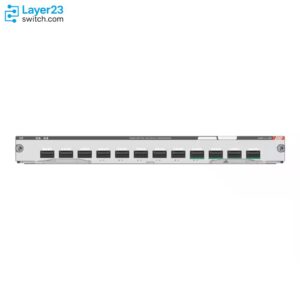
Front View
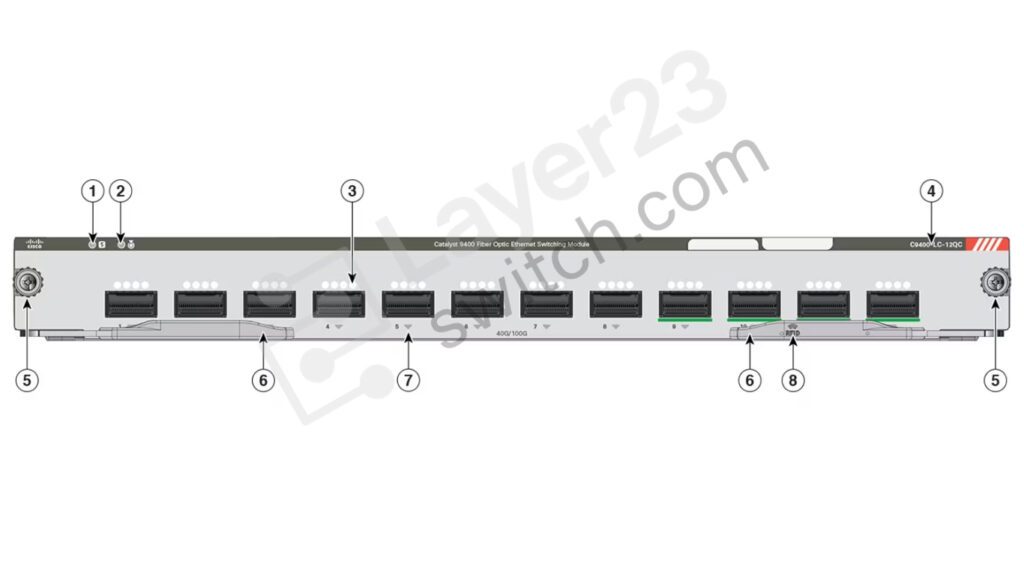
|
1 |
STATUS LED |
5 |
Captive installation screws |
|---|---|---|---|
|
2 |
LOCATE (blue beacon) LED |
6 |
Ejector levers |
|
3 |
Vent holes for the port cage |
7 |
PORT LINK LED |
|
4 |
Model or product number |
8 |
Line card Radio Frequency Identifier (RFID) |
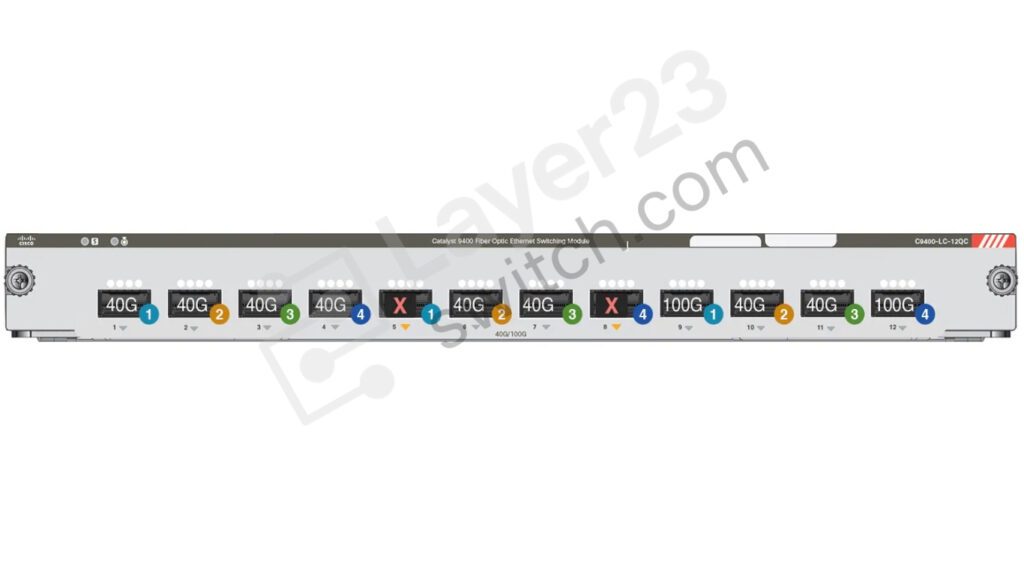
When 100 Gbps connectivity is configured on ports 9 and 12:
Alternatively, you can configure 100 Gbps on ports 10 and 11.
Specifications
| Parameter | Specification | Parameter | Specification |
|---|---|---|---|
| Product ID | C9400-LC-12QC | Cisco ordering description | Cisco Catalyst 9400 Series 12-Port 40G (QSFP+) or 4-Port 100G (QSFP28) and 4-Port 40G (QSFP+), spare part number C9400-LC-12QC= |
| Port count and modes | Up to 12 ports of 40GE QSFP+, or 4 ports of 100GE QSFP28 plus 4 ports of 40GE QSFP+ | Optic mixing | QSFP28 and QSFP+ can be used simultaneously on the same line card |
| Supervisor requirement | C9400X-SUP-2 or C9400X-SUP-2XL; not supported on C9400-SUP-1, C9400-SUP-1XL or C9400-SUP-1XL-Y | Compatible chassis | C9404R, C9407R and C9410R |
| Bandwidth per slot with C9400X-SUP-2XL | 480 Gbps at 1:1 oversubscription in 12x40G default mode, on all three chassis | Bandwidth per slot with C9400X-SUP-2 | 240 Gbps at 2:1 oversubscription in 12x40G default mode, on all three chassis |
| Port scaling by chassis | 4 to 8 ports at 100G and 12 to 24 at 40G in C9404R, 4 to 20 and 12 to 60 in C9407R, and 4 to 32 and 12 to 96 in C9410R | Positioned deployments | High-performance high-density 100G or 40 Gigabit Ethernet aggregation in the campus, core switching in small to medium-sized networks, and enterprise backbone and collapsed access deployments |
| Migration support | Ports usable at full 40 Gigabit Ethernet or as 100 and 40 Gigabit Ethernet to support phased migration from 40G to 100G | Encryption | IEEE 802.1AE MACsec-256 capability in hardware |
| Frame handling | Layer 2 to Layer 4 jumbo frame support up to 9216 bytes | Forwarding architecture | Functionally transparent; packet processing, queuing, buffering and QoS run on the supervisor engine, with dedicated bandwidth from each line-card slot to the supervisor |
| Maximum rated power | 200 W | Typical power draw | Approximately 40 to 75 percent of the maximum rated value |
| Rated MTBF | 493,359 hours | Minimum software release | Cisco IOS XE 17.12.1 |
| Physical dimensions (H x W x D) | 1.6 x 14.92 x 14.57 in. (4.06 x 37.90 x 37.00 cm), occupying one chassis slot | Standards | IEEE 802.3z, 802.3x, 802.3ab, 802.3bt, 802.3at, 802.3af, 802.3az, 802.3bz and 802.3an |
| EtherChannel | IEEE 802.3ad LACP and PaGP, 16 ports per tuple with LACP and 8 with PaGP, and EtherChannel across line cards | Operating temperature | 23 to 113 degrees F (-5 to +45 degrees C) up to 6,000 feet and 23 to 104 degrees F (-5 to +40 degrees C) up to 10,000 feet, with 0 degrees C minimum ambient for cold startup |
| Short-term exceptional conditions | 23 to 131 degrees F (-5 to +55 degrees C) up to 6,000 feet and 23 to 122 degrees F (-5 to +50 degrees C) up to 10,000 feet | Storage temperature | -40 to 158 degrees F (-40 to 70 degrees C) |
| Relative humidity | 10 to 95 percent, noncondensing | Operating altitude | -60 to 3000m |
| Safety certifications | UL 60950-1, CAN/CSA-C222.2 No. 60950-1, EN 60950-1, IEC 60950-1, AS/NZS 60950.1 and IEEE 802.3, with fiber optic lasers rated Class 1 | EMC certifications | 47 CFR Part 15, CISPR22 Class A, EN 300 386 V1.6.1, EN 55022 Class A, EN 55032 Class A, CISPR 32 Class A, EN61000-3-2, EN61000-3-3, ICES-003 Class A, TCVN 7189 Class A, V-3 Class A, CISPR24, EN55024 and TCVN 7317 |
| RoHS compliance | ROHS5 | Optics support reference | Supported optical modules and their minimum software releases are published in the Cisco transceiver module device support tables rather than in the line card data sheet |
Get More Information
Need pricing, stock, or shipping details for the C9400-LC-12QC ? Layer23-Switch can help you check current availability, lead time, and delivery options for this. Send us the part number, quantity, and destination country via live chat or email sales@layer23-switch.com for a fast quotation.
Quality Certifications
Customer Reviews
Questions & Answers
-
What is C9400-LC-12QC used for with 100G and 40G QSFP ports?
-
What port modes does C9400-LC-12QC support?
-
Does C9400-LC-12QC require SUP-2 or SUP-2XL for QSFP28?
-
Is C9400-LC-12QC for access endpoints?
-
How is C9400-LC-12QC different from C9400-LC-24XY?
-
What optics matter for C9400-LC-12QC?
-
When is C9400-LC-12QC the wrong line card?
-
What 100G QSFP28 and 40G QSFP+ details matter for C9400-LC-12QC?
Warranty
Layer23-Switch.com offers genuine, high-quality ICT products at competitive wholesale prices—ensuring exceptional value without compromising quality.
All items are brand new, original, and factory-sealed.
Upon request, each unit can be fully tested and verified by a Cisco CCIE-certified engineer to ensure perfect working condition before shipment.
Our Cisco CCIE-certified experts provide free professional support via phone, email, online chat, or remote login—helping you deploy and troubleshoot with confidence.
If you are not satisfied with your purchase, you may request an exchange or full refund. Our customer service team will guide you through the return process quickly and smoothly. Visit Return Policy page for more information.
We support multiple secure payment and logistics options, backed by industry-leading verification:












Visit How to Pay page for more information
Extended, Worry-Free Warranty Coverage Factory New Sealed Enterprise Hardware:
· 3 Years Factory New Sealed
Visit Warranty Policy page for more information
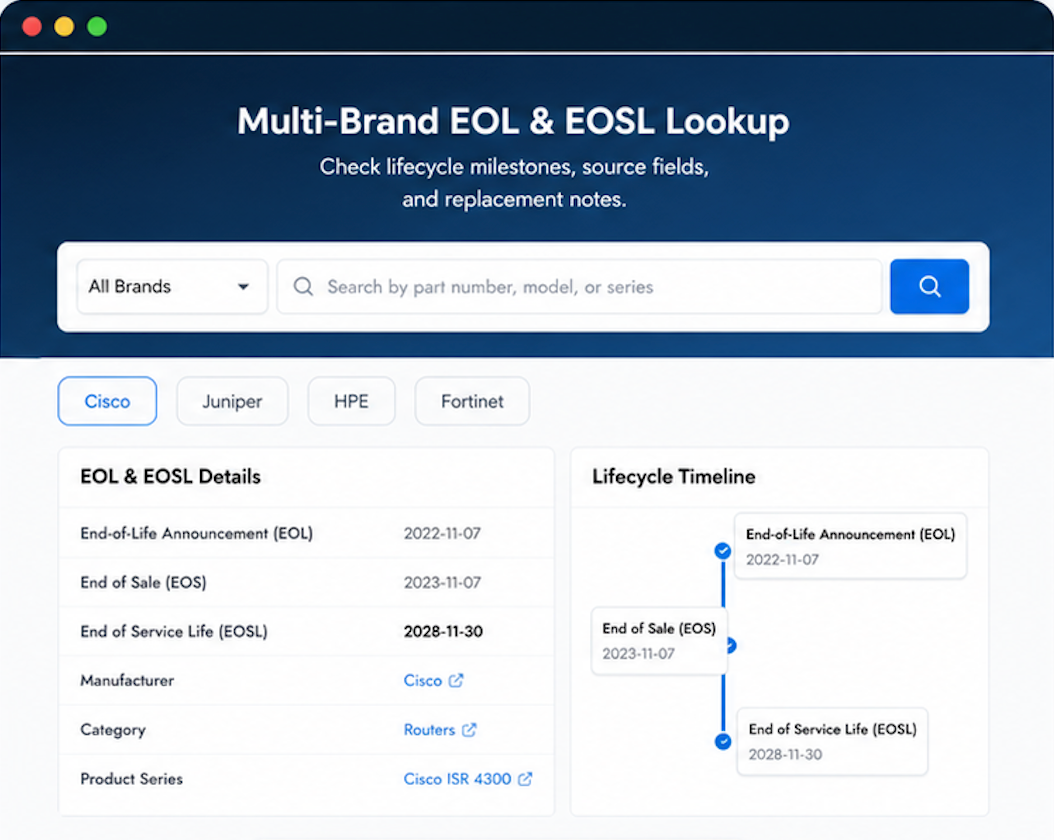
Verify, plan, and comparewith confidence
Use practical tools to check device details, review lifecyclemilestones, and compare hardware before you buy.

Standard Services
Personalized Service, Superior Product Maintenance for Ultimate Satisfaction.
- Projects and Technical Support
- Easy Purchasing Supply
- Product Lifecycle Protection
- Exclusive F3 Team Support
Customized Support for Your Needs with CCIE, HCIE, HPE ASE, etc.
Helpful with follow-up paperwork our accounting team requested.
Our operations team reported no incidents since deployment. Best compliment possible.
If the reviews seem too good to be true, they’re not. Layer23 delivers.
Walked right through customs without an issue. Good paperwork.
Item packed well in anti-static. Good handling.