Cisco C9300 vs C9400: C9300X Stackable vs Chassis Switch Comparison
Most enterprise access closets should start with Cisco Catalyst C9300X or C9300. These platforms keep the design close to a fixed 1RU switch standard, with StackWise expansion, straightforward spare units, and a BOM that procurement can repeat across sites. Catalyst C9400 enters the discussion when the building is being treated as a modular platform, with chassis slots, supervisor engines, line cards, centralized power, and a longer refresh window built into the design.
The practical Cisco C9300 vs C9400 decision is not a small-model comparison. C9300X and C9300 are fixed stackable switches. C9400 is a modular chassis system built from a chassis, supervisor engines, line cards, power supplies, fan tray, optics, licenses, and support coverage. Quoting C9400 as if it were a single switch SKU creates a weak BOM. Quoting C9300 stacks for a chassis-class requirement can create uptime, growth, and cabling problems later.
For broader Catalyst family placement across access, distribution, and core platforms, see the Cisco Catalyst switch comparison. This page stays on one boundary: C9300X/C9300 fixed stackable access versus C9400 modular access or building distribution.

Cisco C9300 vs C9400: Quick Answer
C9300X and C9300 are the safer starting point for most enterprise access closets that need fixed switching, mGig, UPOE or UPOE+, modular uplinks, and stack-based growth. C9400 is the better conversation for larger closets or MDF designs where line-card expansion, dual supervisor planning, centralized power, and chassis lifecycle matter more than entry cost.
| Requirement | Choose C9300X / C9300 | Choose C9400 |
|---|---|---|
| Standard IDF access closet | Yes | Only if chassis growth or uptime justifies it |
| 1RU fixed-switch standard | Yes | No |
| Physical StackWise stacking | Yes | No; use chassis slots, line cards, or a separate StackWise Virtual design where specified |
| C9300X StackWise-1T or C9300 StackWise-480 | Yes, by exact model family | No |
| Dual supervisor engines | No | Yes, with the correct C9400 chassis and supervisor BOM |
| Line-card growth | No | Yes |
| Centralized high-density PoE design | Limited by switch and StackPower design | Yes, with correct power supplies and line cards |
| Building MDF or large wiring closet | Sometimes | Better suited to this role |
| Simple spare switch replacement | Strong fit | More complex; depends on chassis component sparing |
| Long expansion window in one rack footprint | Limited | Better suited to this role |
A predictable access closet with known ports and uplinks rarely needs chassis complexity. A building platform expected to absorb new line cards, higher PoE loads, supervisor redundancy, or several refresh cycles should be checked against C9400 before the BOM is locked.
C9300X/C9300 vs C9400: Key Differences at a Glance
C9300X modular-uplink models use StackWise-1T, and C9300 modular-uplink models use StackWise-480. Catalyst 9400 uses chassis, supervisor, and line-card architecture. Price comes after that architectural decision, because the two platforms expand, fail, and get serviced in different ways.
| Decision point | Cisco C9300X / C9300 | Cisco C9400 | Buying impact |
|---|---|---|---|
| Hardware design | Fixed 1RU stackable switch | Modular chassis switch | Decide whether the site grows by adding switches or inserting line cards |
| Primary role | High-end access, small distribution, collapsed designs | Modular access, building distribution, large access blocks | Role determines whether a fixed stack is enough |
| Scale method | Add another switch to the stack | Add line cards to the chassis | A chassis can reduce long-term re-cabling in dense closets |
| Control-plane model | Stack-based control plane | Supervisor-engine model with 1+1 redundancy options | Strict uptime requirements often favor C9400 |
| Uplink planning | Network modules on C9300/C9300X | Supervisor uplinks and line-card options | C9400 uplinks depend on supervisor choice |
| Power design | Individual switch power supplies; StackPower on supported C9300/C9300X models | Chassis power supplies and centralized PoE planning | C9400 requires a power design, not just a switch SKU |
| PoE growth | Strong for access closets; model and PSU dependent | Strong for dense PoE/UPOE/UPOE+ when correctly built | High-power AP and smart-building projects need wattage review |
| Replacement strategy | Replace a failed switch or stack member | Replace supervisor, line card, power supply, fan tray, or chassis component | Spares and support contracts are different |
| Rack impact | More horizontal units and stack cables as scale grows | Taller chassis, deeper BOM, fewer separate switch bodies | Rack height, depth, power circuits, and service access matter |
| Procurement complexity | Moderate | High | C9400 quotes must include all required components |
C9300L is not the right baseline for a C9400 decision. It is a fixed-uplink access platform with a different scale boundary. In campus projects where C9400 is genuinely on the table, the fixed-switch alternative is usually C9300X or modular-uplink C9300.
When to Choose Cisco C9300X or C9300
C9300X and C9300 work well in access closets where the network team wants a repeatable fixed-switch standard. Office floors, branch campuses, education buildings, healthcare areas, and wireless-heavy access layers often fall into this pattern because each closet can be built as a stack with known uplinks, power supplies, optics, and spare-unit requirements.
C9300X becomes the fixed-switch path when the closet needs higher endpoint speed, 10G mGig access, UPOE+, larger power headroom, higher uplink options, or StackWise-1T. C9300 remains appropriate when StackWise-480, modular uplinks, PoE+/UPOE, mGig variants, and access-layer standardization meet the project requirement without moving to a chassis.
A C9300X/C9300 design is appropriate when the project includes:
- A fixed access closet with a defined 24-port or 48-port pattern.
- A campus standard based on stackable 1RU switches.
- A preference for switch-level spares and fast member replacement.
- mGig or UPOE requirements that can be met by exact C9300X or C9300 models.
- Uplink modules that match the distribution handoff.
- A maintenance model that does not require chassis supervisor redundancy.
- Several similar closets that benefit from repeatable BOMs.
Buyers can review the broader Cisco Catalyst 9300 switch category before narrowing to exact models such as C9300X-48HX-A, C9300X-48TX-A, C9300-48U-A, or C9300-48UXM-A.
When to Choose Cisco C9400 Chassis Switches
C9400 is a different buying motion. The site is no longer being treated as a set of access switches, but as a building platform with a chassis, supervisors, line cards, power supplies, and a service plan. That makes sense in large access closets, MDFs, building distribution, high-density PoE areas, and campus refreshes where the hardware may need to absorb more than one endpoint refresh cycle.
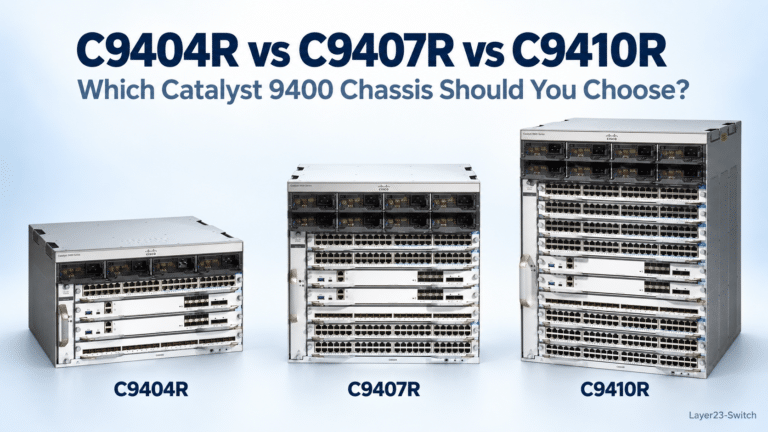
The chassis choice determines how much room the site has to grow. C9404R has two line-card slots, C9407R has five, and C9410R has eight. All three include dedicated supervisor slots and support supervisor redundancy when the correct supervisor pair is ordered.
A C9400 chassis design is appropriate when the project includes:
- A large wiring closet or building MDF that will grow over time.
- A requirement for dual supervisor engines and chassis-level resiliency.
- A high-density PoE, UPOE, or UPOE+ design with centralized power planning.
- Line-card flexibility across 1G copper, 10G mGig copper, 1G fiber, 10G fiber, 25G, 40G, or 100G options, with supervisor and software compatibility checked by line card.
- A refresh from an older modular access platform such as Catalyst 4500.
- A long deployment cycle where replacing the full switch stack would be disruptive.
- A building distribution role that needs modular ports and supervisor-based uplinks.
Use the Cisco Catalyst 9400 switch category as a starting point, not as a final order list. A C9400 quote needs chassis, supervisors, line cards, power supplies, fan tray, optics, software subscription, support, and installation assumptions checked together. High-speed line cards and newer 10G mGig line cards should be matched to the required supervisor family and minimum IOS XE release before ordering.
Popular C9300X/C9300 Models and C9400 Components Compared
C9300X and C9300 are ordered as switch models. C9400 is ordered as a system. For purchasing review, the comparison has to put complete C9300X/C9300 switches beside the C9400 chassis, supervisor, and line-card components that shape the final BOM.
| Item | Type | Typical role | Key selection point | Buying note |
|---|---|---|---|---|
| C9300X-48HX-A | Fixed stackable switch | High-end mGig/UPOE+ access | C9300X access with UPOE+ and StackWise-1T | Confirm PSU, uplink module, license, optics, and StackPower+ plan |
| C9300X-48TX-A | Fixed stackable switch | High-speed data access | 48-port 10G mGig data access without PoE output | Confirm uplink module, thermal load, and power assumptions |
| C9300-48U-A | Fixed stackable switch | UPOE access closet | 1G access with higher PoE demand than PoE+ | Validate endpoint wattage and power-supply sizing |
| C9300-48UXM-A | Fixed stackable switch | Mixed mGig/UPOE closet | Access closets with AP growth and mixed port speeds | Confirm mGig port distribution and uplink module |
| C9404R | C9400 chassis | Smaller modular access or MDF | 2 line-card slots and 2 supervisor slots | Good chassis entry point when two line cards are enough |
| C9407R | C9400 chassis | Medium building access or distribution | 5 line-card slots and 2 supervisor slots | Often the practical middle chassis for growth |
| C9410R | C9400 chassis | Large access block or MDF | 8 line-card slots and 2 supervisor slots | Requires rack, power, airflow, and cable-management review |
| C9400X-SUP-2 | Supervisor engine | Modern C9400 supervisor path | Higher-speed uplinks and newer line-card support | Validate line-card bandwidth and software release |
| C9400X-SUP-2XL | Supervisor engine | Higher-scale C9400 deployments | Up to 480 Gbps per line-card slot on supported designs | Match to high-density mGig or fiber line cards |
| C9400-LC-48HX | Line card | 48-port 10G mGig UPOE+ | High-power Wi-Fi 6/6E or smart-building access | Requires C9400X-SUP-2/2XL and IOS XE 17.8 or later; verify chassis power budget |
| C9400-LC-48TX | Line card | 48-port 10G mGig data | High-bandwidth copper without PoE output | Requires C9400X-SUP-2/2XL and IOS XE 17.13.1 or later |
| C9400-LC-48U | Line card | 48-port 1G UPOE | High-density 1G powered access | Confirm total PoE draw and power supplies |
| C9400-LC-48P | Line card | 48-port 1G PoE+ | Standard powered access line card | Confirm chassis slot count and power plan |
Before the quote is finalized, Layer23-Switch can check stock, acceptable substitutions, license suffixes, optics, supervisor and line-card compatibility, support coverage, and lead time.
Cisco StackWise vs C9400 Chassis Architecture
Architecture is the real dividing line. C9300X and C9300 grow by adding complete switches to a physical StackWise design. C9400 grows by adding line cards to a chassis that shares supervisors, power, cooling, and backplane resources. C9400 can also be used in StackWise Virtual designs between chassis, but that is separate from C9300 physical stacking.
| Architecture question | C9300X / C9300 direction | C9400 direction |
|---|---|---|
| How does the site add ports later? | Add another switch and physical stack cabling | Insert another line card if chassis slots remain |
| How are spares handled? | Stock complete switch models, power supplies, fans, modules, and cables | Stock or source supervisors, line cards, power supplies, fan trays, and chassis components |
| What happens to cabling as density grows? | More switch members and stack cabling | More front-facing line-card cabling inside one chassis |
| What is the main growth limit? | Stack member count, power, uplinks, rack units, and cable management | Chassis slot count, supervisor choice, line-card bandwidth, power supplies, and rack power |
| Which is easier to quote? | Usually C9300X / C9300 | C9400 requires a component-level BOM |
A stackable design suits distributed closets because each floor can use a repeatable switch standard. A chassis design suits rooms where many ports converge and the organization wants capacity to grow by line card rather than by replacing or adding full switches.
High Availability and Software Upgrade Planning
C9300X and C9300 provide access-layer resiliency through StackWise, redundant uplinks, supported power designs, field-replaceable components, and StackPower on supported modular-uplink models. They do not provide the same dual-supervisor chassis model as C9400, so maintenance behavior should be checked against the exact stack design, IOS XE release, and change-window requirement.
C9400 supports 1+1 supervisor-engine redundancy on C9404R, C9407R, and C9410R when the appropriate supervisor engines are installed. Cisco documentation describes NSF/SSO and ISSU behavior for redundant C9400 systems with dual supervisors, with the actual result depending on supported hardware, software release, and configuration.
For procurement, reliability is not a generic platform label. The useful test is whether the site can tolerate stack maintenance windows, whether the business requires supervisor switchover behavior, and whether the quote includes the components needed to deliver that availability target.
PoE, UPOE+, mGig, and Wireless Growth
Wireless-heavy closets need more than a port-count match. A C9300X or C9300 BOM should be built from the required mGig speed, PoE class, uplink module, and power-supply plan. A C9300X-48HX project is materially different from a standard 1G C9300 access project, especially when the AP roadmap includes higher-power devices.
C9400 becomes more compelling when high-power endpoints are concentrated in one building closet. Catalyst 9400 line cards cover 1G copper, 10G mGig copper, PoE+, UPOE, UPOE+, data-only copper, and fiber options. C9400-LC-48HX requires C9400X-SUP-2 or C9400X-SUP-2XL with IOS XE 17.8 or later, while C9400-LC-48TX requires C9400X-SUP-2 or C9400X-SUP-2XL with IOS XE 17.13.1 or later.
Before selecting either platform for APs, cameras, lighting, or building systems, verify:
- Number of powered endpoints.
- Required PoE class and per-port wattage.
- Total PoE budget and reserve margin.
- Wi-Fi 6, Wi-Fi 6E, or Wi-Fi 7 refresh expectations.
- mGig speed required on AP-facing ports.
- Uplink speed from the closet to distribution or core.
- Power circuits, UPS, and redundancy requirements.
- Whether growth is per closet or centralized in one chassis.
Do not assume that a line card supporting 90W per port means the full chassis can power every port at that draw without a power design. Chassis size, supervisor, line cards, power supplies, input circuits, and redundancy mode all affect the final result.
C9300 vs C9400 for Access, MDF, and Building Distribution
C9300X and C9300 are access-first platforms. They can handle small distribution or collapsed designs when routing scale, uplinks, resiliency, and growth remain within the boundary of a fixed switch stack. Smaller campuses, branch buildings, and floor-level IDFs are the common cases.
C9400 is the stronger candidate when the building requires modular access or building distribution. In an MDF, it can aggregate access blocks, support a larger port plan, and keep a modular growth path open. If the design is core-heavy, fiber-dense, or part of a large-campus backbone, Catalyst 9500 or Catalyst 9600 should also be reviewed.
| Campus scenario | Better starting point | Why |
|---|---|---|
| Standard office floor with repeatable 48-port closets | C9300 / C9300X | Fixed switch stacks are easier to standardize and replace |
| Wireless-heavy IDF with mGig and UPOE+ | C9300X or C9400 | Choose by port concentration, growth, and power design |
| Large MDF serving many access runs | C9400 | Modular line cards and supervisor planning fit the building role |
| Refresh from Catalyst 4500 modular access | C9400 | Chassis-to-chassis migration often preserves the operating model |
| Small building distribution with limited uplinks | C9300X / C9300 may fit | Validate routing, uplink, and maintenance requirements first |
| Building distribution with long growth window | C9400 | Line-card and supervisor planning reduce future forklift risk |
| Core or major aggregation decision | Usually not this page | Review Catalyst 9500 or Catalyst 9600 comparisons instead |
A C9300 versus Catalyst 9500 decision is a fixed distribution discussion. A C9400 versus Catalyst 9600 decision belongs in a modular distribution or core review, not in an access closet purchase.
C9300 vs C9400 Selection Matrix
Port concentration, growth, and operational risk should be settled before price comparison. The lowest hardware quote can still be the higher-risk design if it forces a stack into a chassis role or buys chassis capacity for a closet that will never use it.
| Project condition | Recommended direction | What to verify before quote |
|---|---|---|
| 2 to 4 fixed access switches per closet | C9300 / C9300X | Exact model, uplink module, power supply, stack cables, license |
| 5 to 8 fixed switches in one closet | Review C9300X/C9300 against C9400 | Rack cable density, StackPower design, uplinks, maintenance windows |
| One building room expected to add many future ports | C9400 | Chassis slot plan, supervisor pair, line-card roadmap |
| Strict supervisor redundancy requirement | C9400 | Dual supervisors, software release, SSO/ISSU support, topology |
| Many high-power APs or smart-building devices in one location | C9400 or C9300X | Total PoE draw, power input, UPS, line-card or PSU sizing |
| Many similar access closets across sites | C9300 / C9300X | Spare model standard, optics, stacking, support term |
| Refresh from old fixed access stacks | C9300 / C9300X | Endpoint speed, PoE, mGig, license, uplink needs |
| Refresh from old modular chassis access | C9400 | Chassis size, line-card mapping, power supplies, rack fit |
| Need the lowest entry BOM for a small closet | C9300 / C9300X | Avoid buying chassis capacity the site will not use |
| Need long chassis lifecycle and line-card flexibility | C9400 | Confirm compatible supervisors and current line-card support |
Procurement and BOM Checklist
A C9300X/C9300 quote is switch-centered. A C9400 quote is system-centered. Treating both as the same kind of order is the most common procurement error in this comparison.
For C9300X or C9300, confirm:
- Exact switch PID and license suffix.
- C9300X or C9300 family, not C9300L by accident.
- Access port type: 1G, mGig, data, PoE+, UPOE, or UPOE+.
- Uplink network module and optics.
- StackWise mode, cable length, and stack member compatibility.
- StackPower or StackPower+ plan where supported.
- Power-supply wattage and redundancy.
- Fan and airflow requirements.
- IOS XE release and feature requirements.
- Support coverage, spare unit plan, stock, and lead time.
For C9400, confirm:
- Chassis: C9404R, C9407R, or C9410R.
- Supervisor engines: single or dual; SUP-1/1XL/1XL-Y or SUP-2/2XL path.
- Line cards and slot placement.
- Line-card compatibility with supervisor and IOS XE release.
- Power supplies, input voltage, redundancy mode, and PoE budget.
- Fan tray and airflow assumptions.
- Uplink optics and supervisor uplink use.
- License and subscription requirements.
- Rack height, rack depth, cable management, and power circuits.
- Smart Net or warranty coverage for chassis and components.
- Delivery deadline and acceptable substitutions.
- Spare strategy for supervisors, line cards, power supplies, and fan tray.
Layer23-Switch can review a C9300X/C9300 or C9400 BOM before quoting, especially when the order includes mixed optics, high-power PoE, supervisor-dependent line cards, or a fixed-to-chassis migration.
FAQ: Cisco C9300 vs C9400
What is the main difference between Cisco C9300 and C9400?
Cisco C9300X and C9300 are fixed stackable switches that grow by adding complete switch members. Cisco C9400 is a modular chassis system that grows through chassis slots, supervisor engines, line cards, power supplies, and fan-tray planning.
Should I compare C9300X or C9300 against C9400?
Most real C9400 comparisons should use C9300X or modular-uplink C9300 as the fixed-switch side of the decision. C9300L is usually not the same class of comparison because it is a fixed-uplink access platform with a different scale boundary.
Is Cisco C9400 better than C9300?
C9400 is better when the site needs chassis-level growth, dual supervisor planning, line-card flexibility, centralized power, or large building access and distribution. C9300X or C9300 is better when the site needs repeatable fixed access closets, simpler spares, and a lower-complexity BOM.
Can a C9300 stack replace a C9400 chassis?
A C9300X or C9300 stack can replace a C9400 only when the project does not require chassis slots, supervisor redundancy, or a centralized modular power and line-card design. If the specification calls for a chassis architecture, a fixed stack should not be treated as an equal substitute without engineering approval.
When should I choose C9300X or C9300 instead of C9400?
Choose C9300X or C9300 for standard IDF access closets, repeatable campus access standards, fixed switch stacks, and deployments where switch-level replacement is preferred. It is usually the cleaner choice when the site has a known port plan and does not need modular chassis growth.
When should I choose C9400 instead of C9300?
Choose C9400 when a building needs modular access or distribution, line-card expansion, dual supervisor planning, centralized high-density PoE, or a longer growth runway. It is especially relevant for MDFs, large wiring closets, and chassis refresh projects.
Is Cisco C9400 an access switch or a distribution switch?
Cisco C9400 is commonly evaluated for modular access and building distribution. It can support access endpoints through line cards and can also serve as a building aggregation platform when routing, uplinks, and resiliency requirements match the design.
Does Cisco C9300 support StackWise Virtual?
No. C9300X and C9300 use StackWise physical stacking, such as StackWise-1T on C9300X and StackWise-480 on modular-uplink C9300 models. StackWise Virtual is a different architecture and should not be assumed for C9300 purchasing decisions.
Does Cisco C9400 support ISSU?
Cisco C9400 supports ISSU in redundant dual-supervisor designs when the hardware, software release, and configuration meet the relevant requirements. Procurement should validate the exact supervisor pair, IOS XE release, topology, and feature set before treating ISSU as guaranteed for a project.
Which is better for high-density PoE, C9300 or C9400?
C9300X and C9300 can be strong choices for PoE and UPOE access closets when the exact model and power supply match endpoint demand. C9400 is stronger for centralized high-density PoE or UPOE+ designs where line cards, chassis power supplies, input circuits, and growth planning are managed as one system.
What should be included in a C9400 BOM?
A C9400 BOM should include the chassis, supervisor engines, line cards, power supplies, fan tray, optics, software subscription, support coverage, rack and power assumptions, and any required spares. A chassis PID alone is not enough for a deployable order.
Final Buying Takeaway
Choose C9300X or C9300 for a fixed access closet, a repeatable campus access standard, or a stackable design where switch-level replacement and simpler BOMs matter. Choose C9400 for a modular building platform, high-density access block, MDF, or distribution point that needs line-card expansion, supervisor planning, centralized power, and a longer growth runway.
The purchasing sequence should start with the site role, then the growth model: stack members or line cards. After that, validate PoE, mGig, uplinks, supervisors, software release, power design, optics, support coverage, stock, lead time, and acceptable substitutions. That order prevents a fixed stack from being forced into a chassis role, and prevents a modular chassis from being purchased for a closet that only needed a well-built C9300X or C9300 stack.