Spine-Leaf vs Traditional Architecture: Data Center Network Design
Direct Answer Spine-leaf architecture is a modern two-tier data center network design where every leaf switch connects to every spine switch, creating a non-blocking fabric optimized for horizontal, server-to-server traffic. Traditional three-tier architecture relies on a vertical hierarchy of core, aggregation, and access layers, which inherently creates bandwidth bottlenecks and unpredictable latency due to Spanning Tree Protocol (STP) link blocking.
Executive Summary
The physical and logical foundation of the enterprise data center has reached a critical inflection point. For over two decades, network architects relied on the classic three-tier hierarchical model to build local area networks (LANs) and data center fabrics. While highly effective for legacy client-server communications, this legacy architecture now buckles under the extreme throughput demands of modern enterprise computing.
Driven by the explosive adoption of hardware virtualization, Kubernetes containerization, distributed NVMe storage, and Artificial Intelligence (AI) machine learning clusters, the modern data center requires massive, unhindered server-to-server communication. The legacy three-tier model fails to support this, introducing unpredictable latency hops, severe aggregation layer bottlenecks, and inefficient bandwidth utilization.
To survive the demands of cloud-native computing, enterprise IT teams are universally migrating to the spine-leaf architecture. By leveraging mathematical Clos topologies, Equal-Cost Multipath (ECMP) routing, and logical overlays like VXLAN and BGP EVPN, the spine-leaf fabric delivers a horizontally scalable, active-active network. This definitive engineering guide breaks down the technical mechanics of spine-leaf fabrics, compares hard architectural constraints against legacy cores, calculates exact oversubscription ratios, and outlines a step-by-step brownfield migration strategy.
What Is Spine-Leaf Architecture?
Spine-leaf architecture flattens the network topology from three tiers down to two, completely eliminating the traditional aggregation (distribution) layer. It is engineered to provide massive bandwidth, strict two-hop latency predictability, and infinite horizontal scalability.

The Clos Network Topology
The foundation of the spine-leaf fabric is based on the Clos network topology, mathematically formalized by American telephone engineer Charles Clos in 1952. Clos proved that by arranging switches in a specific multi-stage configuration, a network could achieve strictly non-blocking performance. This means a connection can always be established between any input and any output, regardless of the other traffic concurrently traversing the system.
Spine Switch and Leaf Switch Roles
In a modern IP data center, the Clos topology is physically implemented using two highly specialized hardware layers:
- Leaf Switches: These operate as the access layer, typically deployed as Top-of-Rack (ToR) or End-of-Row (EoR) switches. Every physical server, storage array, hardware firewall, and load balancer connects strictly to a leaf switch. A leaf switch provides the ingress and egress gateway into the network fabric.
- Spine Switches: These constitute the highly dense, ultra-fast transit backbone of the fabric. Spine switches do not connect to any servers or endpoints; they exist solely to interconnect the leaf switches.
The defining, unbreakable rule of a spine-leaf architecture is the physical cabling matrix: Every leaf switch must connect to every single spine switch. However, spine switches never connect to other spine switches, and leaf switches never connect to other leaf switches. This full-mesh bipartite graph guarantees mathematically predictable performance. No matter which rack a server is located in, it is always exactly two network hops away from any other server in the data center: one hop up to the spine layer, and one hop down to the destination leaf.
Spine-Leaf vs Traditional Three-Tier Architecture
To justify the capital expenditure (CapEx) of overhauling a data center network, one must first analyze the physical limitations of the legacy topology it is replacing.
Core, Aggregation, and Access Layers Explained
The traditional three-tier network is constructed using a strict, vertical hierarchy:
- Access Layer: Provides physical port connectivity to individual bare-metal servers.
- Aggregation (Distribution) Layer: Access switches uplink into aggregation switches. This layer defines the broadcast domains, establishes Layer 3 routing boundaries, and applies security access control lists (ACLs).
- Core Layer: The high-speed backbone that interconnects multiple aggregation blocks and routes traffic out to the internet or wide-area network (WAN).
Understanding the Differences Between Switches at Different Network Layers: Core vs Distribution vs Access Switches
North-South vs East-West Traffic
The three-tier model was engineered for North-South traffic. If an external user requested a web page, the traffic entered the core, moved down to the aggregation layer, hit the access layer, and reached the server. The data then reversed this exact vertical path.

However, modern applications are decoupled from physical hardware. A single web server VM must constantly pull data from a database VM located in an entirely different server rack. This server-to-server communication is known as East-West traffic. Today, East-West traffic accounts for over 80% of all data center bandwidth.
In a traditional three-tier network, if Server A in Rack 1 wants to talk to Server B in Rack 2, the traffic must travel up from the access switch, into the aggregation switch, across a potentially oversubscribed link to another aggregation switch, and back down to the destination access switch. This introduces “tromboning”—where traffic needlessly travels up and down the hierarchy, creating immense latency and saturating upstream bandwidth. Spine-leaf architecture solves this by allowing horizontal East-West traffic to flow directly across the unified spine layer.
ECMP vs Spanning Tree Protocol (STP) in Data Centers
The physical cabling of a data center network is only half of the equation. The true architectural revolution lies in the routing protocols utilized to push traffic across those cables.
Why STP Causes Network Bottlenecks
Traditional three-tier networks were built primarily on Layer 2 Ethernet switching. If a physical loop is created in a Layer 2 network, broadcast traffic will circulate infinitely, creating a “broadcast storm” that melts down switch CPUs in milliseconds.
To prevent this, legacy networks relied on the Spanning Tree Protocol (STP). STP dynamically detects physical loops and intentionally disables (blocks) redundant physical cables. If a data center architect provisions two 40Gbps uplinks between an access switch and an aggregation switch for redundancy, STP will actively block one of them. The enterprise pays for 80Gbps of bandwidth but only utilizes 40Gbps. Furthermore, when an active link fails, STP can take seconds to recalculate the topology, dropping thousands of packets.
ECMP (Equal-Cost Multipath) Load Balancing
Modern spine-leaf architectures push Layer 3 (IP routing) down to the Top-of-Rack leaf switches, entirely eliminating STP from the core fabric. Because every leaf connects to every spine via Layer 3 routed links, the network utilizes ECMP (Equal-Cost Multipath) load balancing.
ECMP allows a router to inject multiple paths to the same destination into its routing table simultaneously. If a leaf switch has four 100Gbps uplinks connected to four different spine switches, ECMP utilizes a complex hashing algorithm (based on the source/destination IP and TCP/UDP ports) to balance traffic flows across all four cables simultaneously. This results in a truly Active-Active network, achieving 100% link utilization and sub-millisecond failover times.
Overlay Networks: VXLAN and BGP EVPN Explained
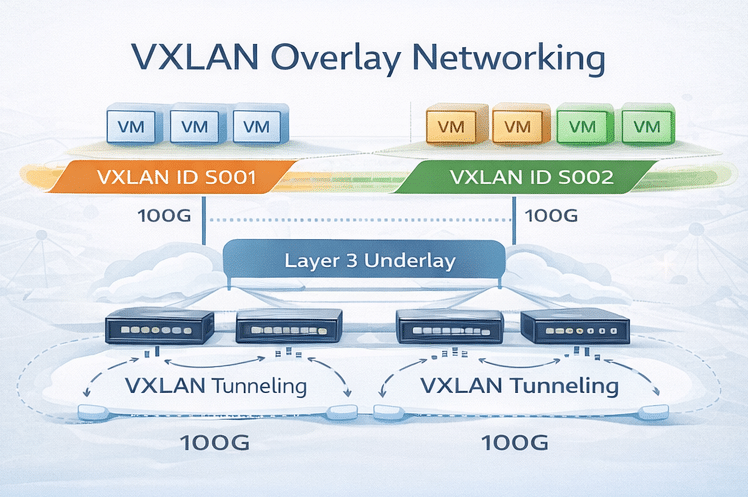
Pushing Layer 3 routing down to the leaf switches solves bandwidth and redundancy issues, but it breaks traditional virtualization. Virtual machines (VMs) frequently require Layer 2 adjacency (being in the same IP subnet/VLAN) to migrate between physical hosts via VMware vMotion. If every rack is a different Layer 3 routed subnet, you cannot stretch a VLAN across the data center. Spine-leaf solves this using Network Overlays.
Extending Layer 2 with VXLAN (MAC-in-UDP)
Virtual Local Area Networks (VLANs) rely on a 12-bit tag, which strictly limits a data center to 4,094 network segments. In a massive multi-tenant cloud environment, this is vastly insufficient.
VXLAN (Virtual Extensible LAN) solves this limitation using MAC-in-UDP encapsulation. It takes a standard Layer 2 Ethernet frame generated by a VM, wraps it inside a Layer 3 UDP packet, and routes it across the spine-leaf underlay. The devices performing this encapsulation are called VTEPs (VXLAN Tunnel Endpoints), which reside on the leaf switches. VXLAN uses a 24-bit identifier (the VNI), allowing for over 16.7 million unique network segments.
BGP EVPN Control Plane
Early implementations of VXLAN relied on inefficient multicast “flood-and-learn” mechanisms to locate MAC addresses. The industry has since standardized on BGP EVPN (Border Gateway Protocol – Ethernet Virtual Private Network) as the definitive control plane.
Instead of flooding the network, leaf switches use the highly scalable BGP protocol to actively advertise the MAC and IP addresses of their connected endpoints. BGP EVPN acts as a distributed, synchronized database. When a VM migrates to a different rack, the BGP EVPN control plane instantly updates the entire fabric, allowing traffic to route flawlessly without broadcasting.
Spine-Leaf Network Design and Calculations
Designing a spine-leaf network requires meticulous mathematical planning. You cannot arbitrarily connect cables; the architecture relies on strict physical ratios and hardware limitations.
Spine-Leaf Oversubscription Ratio Formula
Oversubscription is the ratio of downstream bandwidth (facing the servers) compared to upstream bandwidth (facing the spines). Because it is mathematically improbable that every single server in a rack will transmit data at 100% line rate at the exact same millisecond, networks are purposefully oversubscribed to save money on uplink optics.

The Formula: (Total Number of Server Ports × Port Speed) / (Total Number of Uplink Ports × Uplink Speed)
Example Calculation: A leaf switch has forty-eight 10Gbps ports connected to servers (480 Gbps downstream). It has four 100Gbps QSFP28 uplink ports connected to the spines (400 Gbps upstream). The oversubscription ratio is 480:400, simplified to 1.2:1.
For general-purpose enterprise computing, an oversubscription ratio of 3:1 is the industry standard. For high-performance storage or AI clusters, networks must be engineered with a strict 1:1 (Non-blocking) ratio.
Spine Switch Port Density Limits
The maximum physical size of your data center is strictly dictated by the port density (radix) of your spine switches. Because every leaf must connect to every spine, if you choose a 1RU spine switch with only 32 ports, your entire data center fabric can only support a maximum of 32 leaf switches. Therefore, selecting high-radix modular chassis for the spine layer is critical for future-proofing large-scale environments.
When to Use Spine-Leaf Architecture
While highly advanced, spine-leaf is not strictly necessary for a small office wiring closet. However, it becomes a strict architectural mandate for the following high-performance deployment scenarios.
AI and Machine Learning GPU Clusters
Training Large Language Models (LLMs) requires hundreds of GPUs constantly exchanging vast amounts of parameter data. These environments utilize RDMA over Converged Ethernet (RoCEv2), which is completely intolerant of packet loss or latency jitter. A non-blocking, 1:1 spine-leaf fabric is the only topology capable of supporting AI workloads.
Kubernetes and Cloud-Native Environments
Microservices architectures break monolithic applications into hundreds of tiny containers distributed across the data center. A single user API request might trigger 50 internal East-West container-to-container communications. Spine-leaf guarantees that these microservices can communicate with predictable, microsecond latency.
Hyperscale Data Centers
Organizations scaling beyond 100 physical racks require the horizontal scalability that only a BGP EVPN routed fabric can provide. When a spine-leaf pod reaches maximum capacity, architects simply add a “Super Spine” layer to interconnect multiple pods seamlessly.
Migration Strategy: From Three-Tier to Spine-Leaf
Replacing a production core network is a daunting operational challenge. Most enterprises must execute a highly orchestrated Brownfield migration with near-zero downtime.
Brownfield Data Center Migration Steps
Migrating to a spine-leaf architecture must be executed rack-by-rack, maintaining interoperability between the old and new networks throughout the transition.
- Fabric Instantiation: Build the physical spine-leaf topology parallel to the existing network. Configure the new leaf switches as VTEPs running BGP EVPN.
- Core Peering: Establish Layer 3 routing connections (eBGP or OSPF) between the new Spine switches and the existing legacy Core switches to bridge the routing domains.
- Decommissioning: Once all servers are migrated, the legacy access, aggregation, and core switches are powered down, leaving the spine-leaf fabric as the sole network.
Layer 2 Extension (DCI) and VM Migration
To allow virtual machines to migrate from the old network to the new network without changing their IP addresses, architects must extend the legacy VLANs into the new fabric. This is achieved by designating a “Border Leaf” to connect to the legacy aggregation switches. The Border Leaf maps the legacy 802.1Q VLAN tags directly into the new VXLAN VNIs. With the networks bridged, virtualization teams can utilize VMware vMotion to live-migrate VMs into the new fabric seamlessly.
Internet Edge and Firewall Placement in Spine-Leaf
In a traditional network, firewalls sat neatly at the core boundary. In a highly decentralized spine-leaf fabric, managing external connectivity and stateful inspection is more complex.
Border Leaf Configuration
External connections (Internet routers, MPLS WAN links) should never plug directly into the spine layer, as spines are strictly dedicated to high-speed packet transit. Instead, architects designate two or four specific switches as Border Leafs. These border leafs manage the complex BGP routing tables required to peer with Internet Service Providers (ISPs) and inject default routes down into the rest of the fabric.
Stateful Firewall Service Chaining
If a web server connected to Leaf A needs to communicate securely with a database connected to Leaf B, the traffic should be inspected by a firewall. Architects deploy high-throughput firewalls attached to designated Service Leafs. By utilizing VRF (Virtual Routing and Forwarding) leaking and Policy-Based Routing (PBR) within the BGP EVPN control plane, traffic is seamlessly forced out of the VXLAN tunnel, pushed through the centralized firewall on the Service Leaf for stateful inspection, and routed back into the fabric.
Spine-Leaf Hardware: Cisco, Arista, and Juniper
Transitioning to a spine-leaf architecture requires specialized hardware equipped with merchant silicon (Broadcom Tomahawk/Jericho) or custom ASICs capable of wire-speed VXLAN routing.
Cisco Nexus 9000 Series
The Cisco Nexus 9000 series is the industry standard for enterprise deployments. Nexus 9300 fixed switches operate as highly capable leafs, while modular Nexus 9500 chassis act as massive super-spines. They can be operated via standard NX-OS CLI or managed centrally via Cisco ACI (Application Centric Infrastructure), Cisco’s proprietary SDN controller tailored for spine-leaf environments.
Arista 7050X and 7800R
Heavily favored by financial high-frequency traders and hyperscalers, Arista Networks platforms run the Extensible Operating System (EOS). Arista offers unparalleled BGP EVPN stability, open-standards integration, and deep telemetry capabilities ideal for automated, massively scalable data centers.
Frequently Asked Questions (FAQ)
What is the difference between spine-leaf and three-tier architecture?
Three-tier architecture uses a vertical hierarchy (core, aggregation, access) designed for client-to-server traffic, which causes bottlenecks and unpredictable latency. Spine-leaf flattens the network into two tiers (spine and leaf) optimized for server-to-server (east-west) traffic, utilizing ECMP multipathing instead of STP blocked links.
Why is spine-leaf better for data centers?
Spine-leaf architecture ensures that every server is exactly two network hops away from any other server, guaranteeing predictable, microsecond-level latency. It eliminates spanning tree (STP) blocked links, allowing 100% of physical bandwidth to be utilized simultaneously via active-active ECMP routing.
What is a super spine in networking?
When a data center scales beyond the port density limit of a single spine-leaf cluster (a pod), a third layer called a “super spine” (or inter-pod transit layer) is added. Multiple individual spine-leaf pods connect to the super spine, allowing the topology to scale horizontally to hundreds of thousands of servers.
What is the ideal oversubscription ratio for spine-leaf?
For general-purpose enterprise computing and virtualization, a 3:1 oversubscription ratio is the industry standard balance between performance and uplink optic costs. For specialized workloads such as AI/ML GPU clusters or NVMe over Fabrics storage, networks must be engineered with a strict 1:1 (non-blocking) ratio.