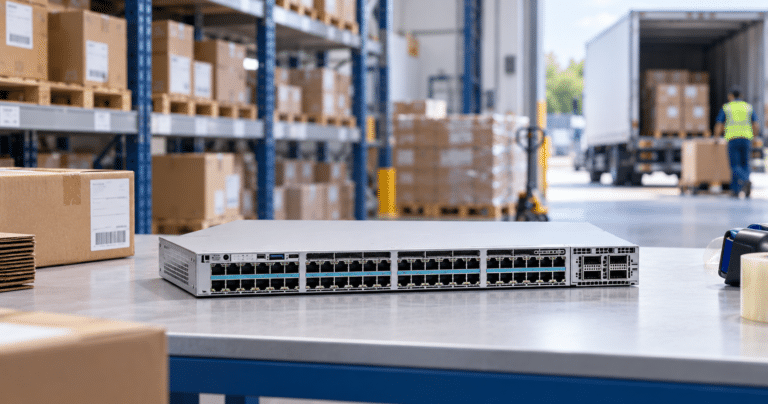
Cisco Industrial Switch Power Supply Guide: How to Tell AC from DC and Choose the Right Power Method
Most Cisco industrial switch power issues become easier once you identify the site first. If the cabinet only has normal mains power, treat it as an AC site. If it already provides DC terminals, treat it as a DC site. Then choose the correct Cisco power path, PSU, and PoE design.
If you are installing a Cisco industrial switch, the first thing to confirm is not the SKU. It is the site power condition. In real projects, most confusion starts with four questions: does the site only have normal AC mains, does the cabinet already have DC power, is there a DIN rail, and will the switch also power PoE devices? Cisco IE families do not all follow one identical power approach, so the right wiring method depends on the switch family and the site itself.
For newer DIN-rail platforms such as IE3100, IE3200, IE3300, and IE3400, the main power discussion usually revolves around redundant DC input, external industrial power supplies, and PoE planning where needed. Cisco’s industrial DIN-rail PSU portfolio covers 50W to 480W, which is why many Cisco industrial deployments are built around an external PSU plus a DC-input switch.
Different Cisco IE families have different power input requirements. Before finalizing your power plan, confirm which switch model fits your project — see our Cisco IE switch comparison guide for IE3100 to IE9300 specifications.
Quick Power Checklist for Cisco Industrial Switches
- Is the site AC or DC?
- Is there a DIN rail in the cabinet?
- Which Cisco IE series is being installed?
- Does the switch need an external power supply?
- Will the switch power PoE endpoints?
- Is redundant power required?
- Which official Cisco PSU PID matches the site?
Start Here: What Does an AC Site or a DC Site Actually Mean?
Most buyers are not sure whether their site is AC or DC, and that is normal.
An AC site usually means the power you can directly access is normal mains power. In practice, that often means a wall outlet, a rack PDU, or a standard AC feed inside a room or cabinet. If that is what the installer sees first, treat the site as an AC environment. Cisco’s industrial PSU family includes AC-input models such as PWR-IE50W-AC=, PWR-IE50W-AC-IEC=, PWR-IE50W-AC-L=, PWR-IE65W-PC-AC=, PWR-IE170W-PC-AC=, PWR-IE240W-PCAC-L=, and PWR-IE480W-PCAC-L= for this kind of deployment.
A DC site usually means the cabinet already has DC distribution inside it. This is common in factory control cabinets, automation panels, roadside cabinets, power sites, and utility enclosures. Instead of a normal outlet being the last power handoff before the switch, the installer sees DC terminals or a DC bus already available. Cisco’s IE3200 and IE3400 datasheets both describe these platforms around redundant DC input voltage: 9.6 to 60VDC, which is why they fit naturally in DC-style industrial installations. For low-voltage DC power conversion, Cisco’s relevant industrial PSU PIDs include PWR-IE65W-PC-DC= and PWR-IE170W-PC-DC=.
A simple rule helps:
- If you see a normal socket, PDU, or standard mains feed, start by treating it as AC.
- If you see labeled DC terminals or an existing DC distribution path, start by treating it as DC.
- If an external industrial power supply converts AC before feeding the switch, then the switch side is still DC.

Why Cisco IE Family Matters Before You Talk About Wiring
Not every Cisco industrial switch family should be explained the same way.
For most modern Cisco DIN-rail projects, the key families are IE3100, IE3200, IE3300, and IE3400. These are the platforms where the power discussion usually centers on dual or redundant DC input, external industrial power supplies, and PoE planning. Cisco states that IE3200 and IE3400 support redundant DC input voltage: 9.6 to 60VDC, and on PoE-capable models Cisco also specifies 48VDC for PoE and 54VDC for PoE+.
Other Cisco IE families can use a different power model. For example, Cisco’s IE5000 supports combinations such as single low-voltage DC, single high-voltage AC or DC, two high-voltage AC or DC, two low-voltage DC, and one high-voltage AC or DC plus one low-voltage DC. The relevant Cisco IE5000 PSU module product IDs are PWR-RGD-AC-DC-H, PWR-RGD-AC-DC-250, and PWR-RGD-LOW-DC-H.
So before asking how to wire power, identify the Cisco IE family first. That step prevents a lot of confusion.

Real Scenario 1: The Cabinet Has a DIN Rail
This is one of the most common Cisco industrial switch deployment scenarios.
Think of a normal industrial control cabinet: DIN rail, terminals, relays, power devices, and structured wiring. In that kind of panel, the cleanest Cisco design is often:
site power → Cisco industrial DIN-rail PSU → Cisco IE switch DC input
That is exactly the type of environment Cisco’s industrial DIN-rail PSU family is built for. If the cabinet only has AC mains, the usual Cisco choices start with official PIDs such as PWR-IE50W-AC= for basic non-PoE, PWR-IE65W-PC-AC= or PWR-IE170W-PC-AC= for lighter or standard PoE, and PWR-IE240W-PCAC-L= or PWR-IE480W-PCAC-L= for higher-PoE deployments. If the site already has low-voltage DC, the more relevant Cisco PIDs are PWR-IE65W-PC-DC= and PWR-IE170W-PC-DC=.
This is usually the best method when the project is in a factory cabinet, an automation panel, or any site where structured installation and easier maintenance matter.
Real Scenario 2: There Is No DIN Rail and Only Normal AC Power Is Available
This is also a very real customer situation.
Typical examples include a small equipment room, a simple rack, a basic weak-current room, or a cabinet that only has normal AC mains and no DIN rail. The mistake many people make here is assuming the switch can simply take AC directly at the switch power connector.
That is not the right default assumption for Cisco’s newer rugged DIN-rail families. Cisco’s IE3200 and IE3400 documentation frames these switches around redundant DC input, not direct AC input at the switch itself.
The correct way to think about this is simple:
If the site only has AC, and the switch expects DC, then the project first needs an AC-to-DC power stage.
In practical Cisco terms, that usually means adding a Cisco industrial PSU such as PWR-IE50W-AC=, PWR-IE65W-PC-AC=, PWR-IE170W-PC-AC=, PWR-IE240W-PCAC-L=, or PWR-IE480W-PCAC-L=, depending on whether the deployment is non-PoE, standard PoE, or high-PoE. So “no DIN rail” does not automatically mean “cannot use Cisco IE.” It means the project must solve power conversion and mounting differently.
Real Scenario 3: The Site Already Uses DC Power
For many Cisco industrial switches, this is actually the easier case.
This usually happens in factory control panels, roadside cabinets, utility cabinets, and other industrial enclosures where DC power is already available. In those environments, the site is often already closer to the native power logic of modern Cisco IE switches. That is especially true for IE3100, IE3200, IE3300, and IE3400, which are designed around redundant DC input.
If the site already uses low-voltage DC, the Cisco product IDs to check first are usually PWR-IE65W-PC-DC= and PWR-IE170W-PC-DC= if an external Cisco PSU is still needed. If the site is an IE5000 deployment with a different power architecture, the relevant Cisco PSU modules are PWR-RGD-LOW-DC-H for low-voltage DC or PWR-RGD-AC-DC-H / PWR-RGD-AC-DC-250 for high-voltage AC/DC scenarios.
Even in a DC site, three checks still matter:
- Is the voltage in the supported range?
- Is polarity and terminal planning correct?
- If PoE is needed, is the power source strong enough for both the switch and the powered devices?
Real Scenario 4: The Switch Must Power PoE Devices
This is where many power plans become too small.
A switch powering on is not the same as a switch being ready for PoE service. Once the switch must also feed cameras, access points, phones, or other powered edge devices, the power design changes.
Cisco’s IE3200 and IE3400 datasheets make this clear by explicitly stating the required DC levels for PoE and PoE+. Cisco’s industrial DIN-rail PSU family is also designed to support higher-capacity PoE use cases, which is why the PSU lineup includes PWR-IE170W-PC-AC=, PWR-IE170W-PC-DC=, PWR-IE240W-PCAC-L=, and PWR-IE480W-PCAC-L=.
The simplest way to explain this is:
Basic power planning answers whether the switch can run.
PoE power planning answers whether the switch can run and also power other devices.
That is why a non-PoE cabinet might be fine with PWR-IE50W-AC=, while a real PoE deployment may need PWR-IE170W-PC-AC=, PWR-IE240W-PCAC-L=, or PWR-IE480W-PCAC-L= instead.
Real Scenario 5: The Site Needs Redundant Power
This is not a rare edge case. It is normal in industrial networking.
In plain language, redundant power means the switch is not relying on just one feed. If one source fails, the second source can keep the switch up. Cisco documents this dual or redundant DC-input design on modern industrial families such as IE3200 and IE3400. On IE5000, Cisco also documents one- or two-supply module combinations across low-voltage DC and high-voltage AC/DC.
For buyers, the practical takeaway is that redundant power should not be treated as a decorative spec. If the site is operationally important, dual-feed planning is often worth doing correctly from day one. For IE5000 specifically, that planning may involve combinations of PWR-RGD-AC-DC-H, PWR-RGD-AC-DC-250, and PWR-RGD-LOW-DC-H.
How to Choose the Right Cisco Power Method by Site Condition
The easiest way to make the decision is to work from the site condition first.

If the site has a DIN rail, a structured industrial cabinet, and standard cabinet power devices, the cleanest Cisco approach is usually an IE switch plus a Cisco industrial DIN-rail PSU.
If the site only has normal AC mains and no DIN rail, first solve AC-to-DC conversion if the switch is a DC-input model. The official Cisco product IDs most commonly involved here are PWR-IE50W-AC=, PWR-IE65W-PC-AC=, PWR-IE170W-PC-AC=, PWR-IE240W-PCAC-L=, and PWR-IE480W-PCAC-L=.
If the site already has a DC system, check voltage range, polarity, and whether PoE changes the requirement. The Cisco PIDs most relevant for low-voltage DC conversion are PWR-IE65W-PC-DC= and PWR-IE170W-PC-DC=.
If the switch must support PoE devices, size the power path for both the switch and the PoE load. That is where PWR-IE170W-PC-AC= / PWR-IE170W-PC-DC=, PWR-IE240W-PCAC-L=, and PWR-IE480W-PCAC-L= become much more relevant than the basic 50W PSU models.
If the site requires stronger uptime or uses IE5000, base the discussion on the appropriate IE5000 PSU modules: PWR-RGD-AC-DC-H, PWR-RGD-AC-DC-250, or PWR-RGD-LOW-DC-H.
A good rule is this:
Do not ask, “How do I wire this switch?” until you first ask, “What kind of power environment does this site really have?”
Five Common Cisco Industrial Power Wiring Mistakes
The first mistake is assuming every Cisco industrial switch can take normal AC mains directly. That is not the right starting assumption for families like IE3200 and IE3400.
The second mistake is not knowing whether the site is AC or DC in the first place.
The third mistake is using vague descriptions like “AC-to-DC power supply” instead of checking the actual Cisco power-supply PID needed for the project. For many Cisco IE deployments, the difference between PWR-IE50W-AC= and PWR-IE480W-PCAC-L= is not cosmetic. It changes whether the project can support PoE or not.
The fourth mistake is sizing power only for switch startup and forgetting PoE load. Cisco’s PoE-capable IE platforms make it clear that powered endpoints change the electrical requirement.
The fifth mistake is ignoring redundant power on sites where uptime matters. On Cisco IE families designed around redundant DC input, that feature exists for a reason.
Conclusion: Identify the Site First, Then Choose the Cisco Power Method
For Cisco industrial switches, the right power design starts with the site, not the SKU.
First identify whether the environment is AC or DC, whether there is a DIN rail, whether PoE devices must be powered, and whether redundant input is required. Once those are clear, the right Cisco power method becomes much easier to define. And whenever the design requires an added power stage, use the official Cisco product ID, not a generic phrase.
For IE1000 / IE3200 / IE3300 / IE3400 style deployments, the most important Cisco PSU product IDs to know are:
- PWR-IE50W-AC=
- PWR-IE50W-AC-IEC=
- PWR-IE50W-AC-L=
- PWR-IE65W-PC-AC=
- PWR-IE65W-PC-DC=
- PWR-IE170W-PC-AC=
- PWR-IE170W-PC-DC=
- PWR-IE240W-PCAC-L=
- PWR-IE480W-PCAC-L=
For IE5000, the key PSU module product IDs are:
- PWR-RGD-AC-DC-H
- PWR-RGD-AC-DC-250
- PWR-RGD-LOW-DC-H
For more Cisco industrial networking guides and product selection resources, visit Layer23-Switch.
FAQ
How do I know if my site is AC or DC?
If the last power handoff before the equipment is a normal socket, PDU, or mains feed, treat it as AC first. If the cabinet already has DC terminals or DC distribution, treat it as DC first.
Can a Cisco industrial switch be connected directly to normal AC power?
Sometimes no. On modern rugged families like IE3200 and IE3400, the official power model is redundant DC input, so many projects need an external AC-to-DC stage first. Common Cisco PSU PIDs used for that include PWR-IE50W-AC=, PWR-IE65W-PC-AC=, PWR-IE170W-PC-AC=, PWR-IE240W-PCAC-L=, and PWR-IE480W-PCAC-L=.
What if there is no DIN rail in the cabinet?
The switch may still be usable. The project just needs to solve mounting and AC-to-DC conversion differently if the switch itself expects DC input.
Why does PoE make power planning more complicated?
Because the power path now has to support both the switch and the powered endpoints. That is why Cisco offers higher-capacity PSU options such as PWR-IE170W-PC-AC=, PWR-IE170W-PC-DC=, PWR-IE240W-PCAC-L=, and PWR-IE480W-PCAC-L=.
When is redundant power really worth it?
When the site is important enough that a single power failure should not take the switch down. On IE5000, that may also mean planning around the correct PSU module combination such as PWR-RGD-AC-DC-H or PWR-RGD-LOW-DC-H.