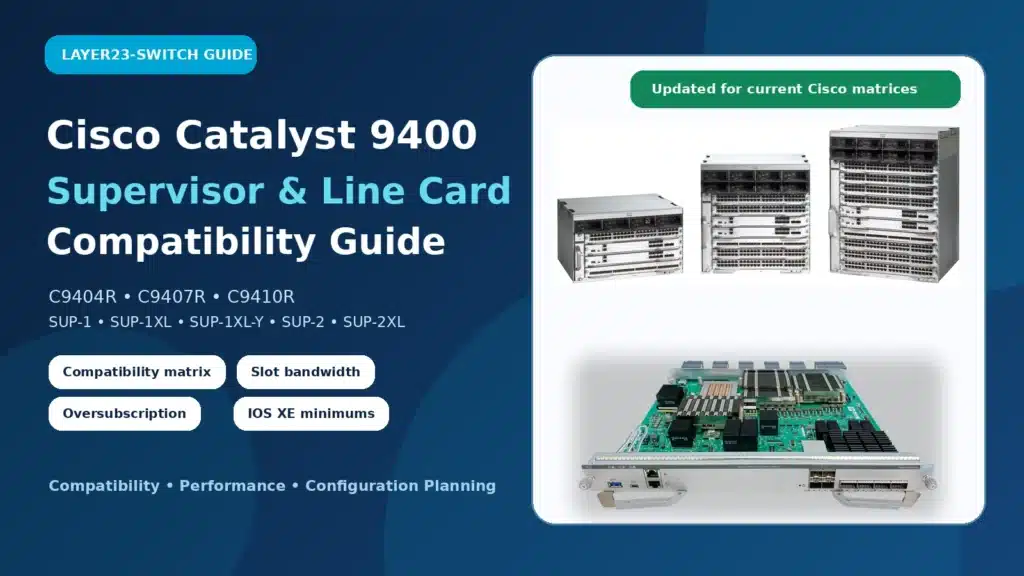
Cisco Catalyst 9400 Supervisor and Line Card Compatibility
C9400-LC-12QC, C9400-LC-24XY, C9400-LC-48HX, C9400-LC-48TX and C9400-LC-48XS require C9400X-SUP-2 or C9400X-SUP-2XL. The other nine line cards in the matrix below support all five listed supervisors. A supported pairing still needs the right IOS XE release and enough bandwidth for the intended traffic.
Start with the exact line-card PID and supervisor model. This guide covers their hardware compatibility in a single C9404R, C9407R or C9410R chassis; feature-specific designs such as StackWise Virtual require additional validation.
Catalyst 9400 Supervisor and Line Card Compatibility Matrix
Yes indicates hardware support. Confirm the software and performance limits in the sections below before approving the combination.
| Line-card PID | Port profile | C9400-SUP-1 | C9400-SUP-1XL | C9400-SUP-1XL-Y | C9400X-SUP-2 | C9400X-SUP-2XL |
|---|---|---|---|---|---|---|
| C9400-LC-12QC | 12×40G or 4×100G + 4×40G | No | No | No | Yes | Yes |
| C9400-LC-24S | 24×1G SFP | Yes | Yes | Yes | Yes | Yes |
| C9400-LC-24XS | 24×1/10G SFP/SFP+ | Yes | Yes | Yes | Yes | Yes |
| C9400-LC-24XY | 20×25G + 4×10G | No | No | No | Yes | Yes |
| C9400-LC-48H | 48×1G UPOE+, up to 90W/port | Yes | Yes | Yes | Yes | Yes |
| C9400-LC-48HN | 48×5G mGig UPOE+, up to 90W/port | Yes | Yes | Yes | Yes | Yes |
| C9400-LC-48HX | 48×10G mGig UPOE+, up to 90W/port | No | No | No | Yes | Yes |
| C9400-LC-48P | 48×1G PoE+, up to 30W/port | Yes | Yes | Yes | Yes | Yes |
| C9400-LC-48S | 48×1G SFP | Yes | Yes | Yes | Yes | Yes |
| C9400-LC-48T | 48×1G data only | Yes | Yes | Yes | Yes | Yes |
| C9400-LC-48TX | 48×10G mGig data only | No | No | No | Yes | Yes |
| C9400-LC-48U | 48×1G UPOE, up to 60W/port | Yes | Yes | Yes | Yes | Yes |
| C9400-LC-48UX | 24×mGig up to 10G + 24×1G UPOE | Yes | Yes | Yes | Yes | Yes |
| C9400-LC-48XS | 48×1/10G SFP/SFP+ | No | No | No | Yes | Yes |
Similar model names can have different support requirements
C9400-LC-24XS and C9400-LC-48XS are the easiest pair to confuse. Both provide 1/10G fiber ports, but only C9400-LC-24XS works with C9400-SUP-1, C9400-SUP-1XL and C9400-SUP-1XL-Y. Moving to C9400-LC-48XS requires C9400X-SUP-2 or C9400X-SUP-2XL and a supported IOS XE release.
For copper cards, the suffix identifies a different speed or power capability: C9400-LC-48H is 1G UPOE+, C9400-LC-48HN is 5G UPOE+, C9400-LC-48HX is 10G UPOE+, and C9400-LC-48TX is 10G data only. C9400-LC-48H and C9400-LC-48HN support all five supervisors in the matrix; C9400-LC-48HX and C9400-LC-48TX require C9400X-SUP-2 or C9400X-SUP-2XL. A similar front panel or a free chassis slot does not establish compatibility.
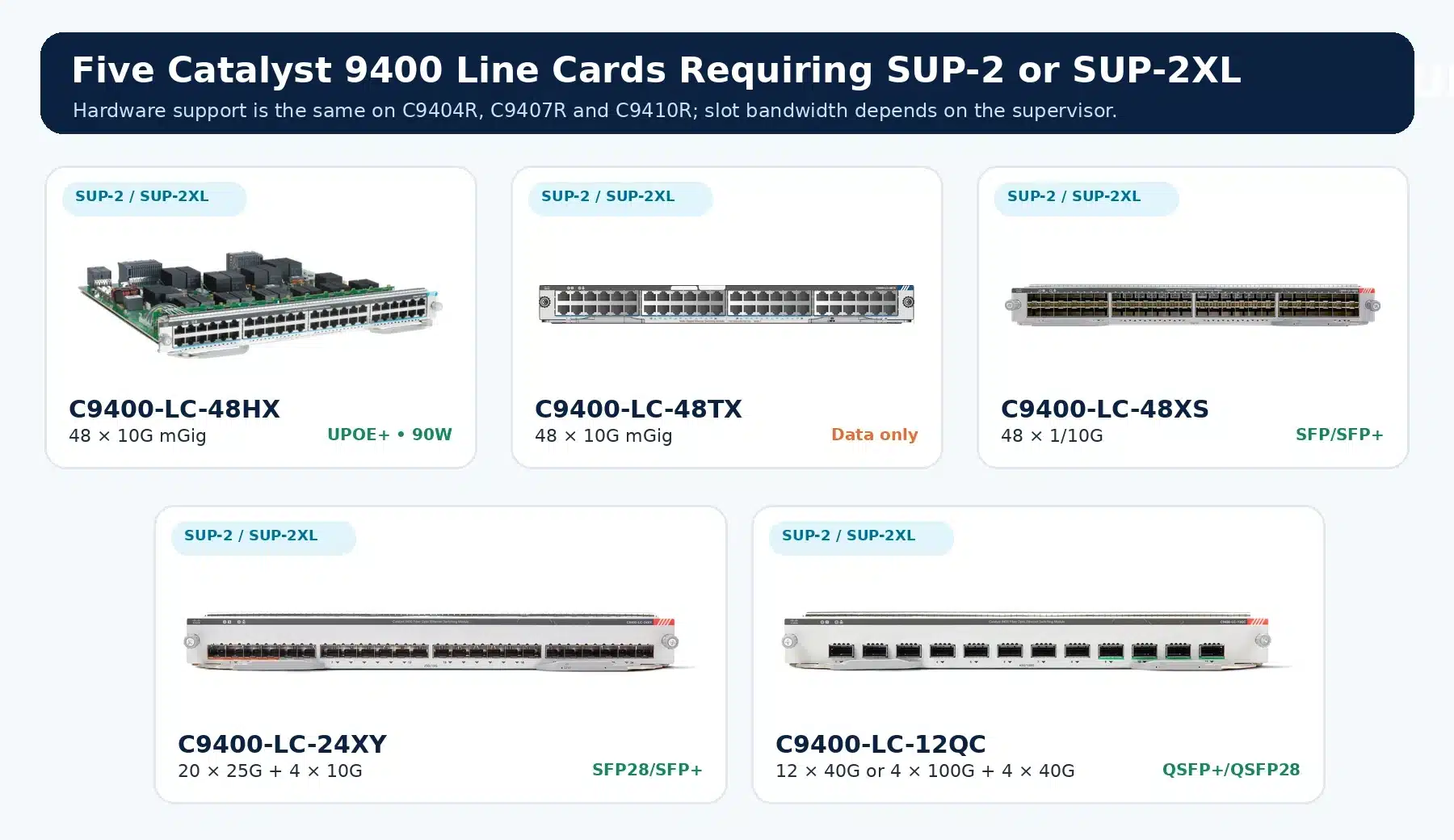
These five line cards require C9400X-SUP-2 or C9400X-SUP-2XL in all three Catalyst 9400 chassis.
How Chassis and Supervisor Affect Line-Card Bandwidth
The C9404R, C9407R and C9410R support the same supervisor and line-card families. Their slot layouts differ, and the chassis changes the bandwidth available from C9400-SUP-1XL and C9400-SUP-1XL-Y.
| Chassis | Supervisor slots | Line-card slots | Maximum line cards |
|---|---|---|---|
| C9404R | 2 and 3 | 1 and 4 | 2 |
| C9407R | 3 and 4 | 1, 2 and 5–7 | 5 |
| C9410R | 5 and 6 | 1–4 and 7–10 | 8 |
A single supervisor can occupy either designated supervisor slot. Line cards use the remaining slots shown above.
Available bandwidth per line-card slot
| Supervisor | C9404R | C9407R | C9410R |
|---|---|---|---|
| C9400-SUP-1 | 80 Gbps | 80 Gbps | 80 Gbps |
| C9400-SUP-1XL | 240 Gbps | 120 Gbps | 80 Gbps |
| C9400-SUP-1XL-Y | 240 Gbps | 120 Gbps | 80 Gbps |
| C9400X-SUP-2 | 240 Gbps | 240 Gbps | 240 Gbps |
| C9400X-SUP-2XL | 480 Gbps | 480 Gbps | 480 Gbps |
These are per-slot limits. A redundant supervisor pair does not double the figures. A line card may also have a lower bandwidth limit of its own.
C9400X-SUP-2 vs. C9400X-SUP-2XL: supported does not always mean line rate
C9400X-SUP-2 and C9400X-SUP-2XL support the same line cards. Their 240 Gbps and 480 Gbps slot limits produce different oversubscription ratios when all ports run at their maximum speeds.
| Line card | Front-panel load | C9400X-SUP-2 | C9400X-SUP-2XL |
|---|---|---|---|
| C9400-LC-48HX | 48×10G = 480G | 2:1 | 1:1 |
| C9400-LC-48TX | 48×10G = 480G | 2:1 | 1:1 |
| C9400-LC-48XS | 48×10G = 480G | 2:1 | 1:1 |
| C9400-LC-24XY | 20×25G + 4×10G = 540G | 2.25:1 | 1.125:1 |
| C9400-LC-12QC | 12×40G = 480G, default mode | 2:1 | 1:1 |
For example, a C9400-LC-48HX works with C9400X-SUP-2, but its 480G maximum port load shares 240G of slot bandwidth. C9400X-SUP-2XL provides the 480G slot bandwidth needed for 1:1 operation. Whether 2:1 is acceptable depends on how much traffic the connected devices must carry simultaneously.
The C9400-LC-12QC ratios apply to its default 12×40G mode. Mixed 100G/40G operation changes the load within each port group; see the port-mode restrictions. On C9400-LC-24XY, even C9400X-SUP-2XL remains oversubscribed when all ports run at maximum speed.
Bandwidth limits on older line cards
C9400-LC-24XS and C9400-LC-48HN each present up to 240G of port traffic. Both run at 3:1 with C9400-SUP-1. With C9400-SUP-1XL or C9400-SUP-1XL-Y, the ratio is 1:1 in C9404R, 2:1 in C9407R and 3:1 in C9410R. Both C9400X-SUP-2 and C9400X-SUP-2XL provide the 240G needed for 1:1 operation in all three chassis.
C9400-LC-48UX has a 240G card limit against 264G of maximum port traffic. Its ratio is 3.3:1 on an 80G slot, 2.2:1 on a 120G slot and 1.1:1 on a 240G slot. It stays at 1.1:1 with C9400X-SUP-2XL: the faster supervisor cannot remove the card’s own limit.
The six 1G cards—C9400-LC-48T, C9400-LC-48P, C9400-LC-48U, C9400-LC-48H, C9400-LC-24S and C9400-LC-48S—have 24G or 48G of front-panel capacity. Their slot bandwidth is sufficient for 1:1 operation with every supervisor in the matrix. These ratios describe the line-card path; uplinks need their own capacity check.
IOS XE Requirements and Hardware-Version Exceptions
Use the highest introduction release required by the chassis, supervisor, line cards and features as an initial software lower bound. Then check the exact target release for hardware revisions, restrictions and required patches. A numerically later release alone does not prove compatibility.
Supervisor and chassis introduction releases
| Supervisor | C9404R | C9407R | C9410R |
|---|---|---|---|
| C9400-SUP-1 | 16.9.1 | 16.6.1 | 16.6.1 |
| C9400-SUP-1XL | 16.9.1 | 16.6.2 | 16.6.2 |
| C9400-SUP-1XL-Y | 16.9.1 | 16.9.1 | 16.9.1 |
| C9400X-SUP-2 | 17.7.1 | 17.7.1 | 17.7.1 |
| C9400X-SUP-2XL | 17.7.1 | 17.7.1 | 17.7.1 |
Line-card introduction releases
| Line card | Base minimum IOS XE | Additional condition |
|---|---|---|
| C9400-LC-48U | 16.6.1 | Apply the installed supervisor and chassis minimum. |
| C9400-LC-48T | 16.6.1 | Apply the installed supervisor and chassis minimum. |
| C9400-LC-48UX | 16.6.2 | Apply the installed supervisor and chassis minimum. |
| C9400-LC-24XS | 16.6.2 | Apply the installed supervisor and chassis minimum. |
| C9400-LC-48P | 16.8.1 | Apply the installed supervisor and chassis minimum. |
| C9400-LC-24S | 16.8.1 | Hardware version 9.0+ has additional restrictions below. |
| C9400-LC-48S | 16.8.1 | Hardware version 9.0+ has additional restrictions below. |
| C9400-LC-48H | 16.12.1 | C9400X-SUP-2 or C9400X-SUP-2XL raises the base minimum to 17.7.1. |
| C9400-LC-48HN | 17.5.1 | C9400X-SUP-2 or C9400X-SUP-2XL raises the base minimum to 17.7.1. |
| C9400-LC-48HX | 17.8.1 | Requires C9400X-SUP-2 or C9400X-SUP-2XL. |
| C9400-LC-48XS | 17.8.1 | Requires C9400X-SUP-2 or C9400X-SUP-2XL. |
| C9400-LC-24XY | 17.12.1 | Requires C9400X-SUP-2 or C9400X-SUP-2XL. |
| C9400-LC-12QC | 17.12.1 | Requires C9400X-SUP-2 or C9400X-SUP-2XL. |
| C9400-LC-48TX | 17.13.1 | Requires C9400X-SUP-2 or C9400X-SUP-2XL. |
For C9407R + C9400X-SUP-2 + C9400-LC-48U, the supervisor raises the base software requirement to 17.7.1. Substitute C9400-LC-48HX, and the card raises it to 17.8.1. For C9404R + C9400-SUP-1 + C9400-LC-48U, the chassis raises it to 16.9.1. These examples establish the lower bound; target-release checks still apply.
Exceptions that can override the base minimum
- C9400-LC-24S and C9400-LC-48S, hardware version 9.0 or later: IOS XE 17.15.1 and 17.15.2 are unsupported; Cisco directs users to 17.15.3. For 17.12.4, Cisco requires SMU CSCwk60354 and a procedure that shuts down the affected cards during installation. Check the hardware revision as well as the PID.
- Redundant C9400-SUP-1: support begins at 16.6.2, rather than the 16.6.1 single-supervisor minimum. The higher C9404R chassis minimum still applies.
- C9400-PWR-3200ACT: this power supply has an IOS XE 17.13.1 requirement, so the line-card list alone may not establish the software lower bound for the complete chassis.
- Downgrades: check removal requirements for installed cards before moving below their introduction releases. Cisco explicitly lists such restrictions for C9400-LC-48XS, C9400-LC-24XY, C9400-LC-12QC and C9400-LC-48TX, among others.
The tables record hardware introduction releases, not recommended production versions. Use the target release notes and current recommended-release guidance to choose the image. Our Cisco IOS XE upgrade guide covers upgrade paths, validation and rollback.
Mixing Line Cards and Reusing Existing Hardware
Different copper and fiber line cards can share one Catalyst 9400 chassis. Each card must be supported by the installed supervisor and target software release. Check each card’s slot bandwidth and optics, then size the shared system and PoE power budget for the whole chassis.
For example, C9407R + C9400X-SUP-2 + C9400-LC-24XS + C9400-LC-48HX passes the hardware matrix. The C9400-LC-48HX sets the base IOS XE minimum at 17.8.1. The C9400-LC-24XS has 1:1 slot bandwidth; the C9400-LC-48HX is 2:1 at its maximum port load. The combination is supported, but the two cards have different performance limits.
All nine line cards shown as compatible with C9400-SUP-1 in the matrix are also supported by C9400X-SUP-2 and C9400X-SUP-2XL. They can therefore be retained when changing supervisor generations, subject to the software and hardware-revision checks above. Existing optics and required features also need validation for the final configuration.
Redundant supervisors must be the same model
Both supervisors in a redundant chassis must be the same model. A C9400-SUP-1XL cannot form a supported redundant pair with C9400X-SUP-2, and C9400X-SUP-2 cannot be paired with C9400X-SUP-2XL.
When changing generations, plan for a matching final pair and a validated migration procedure. Support for the existing line cards does not establish a hitless supervisor upgrade path.
Port-Mode, Optics and PoE Restrictions
A Yes in the hardware matrix establishes supervisor support for the card. The following conditions can still prevent the intended ports or powered devices from working.
C9400-LC-12QC and C9400-LC-24XY port limits
C9400-LC-12QC: the default profile is 12×40G. Ports 9–12 can instead operate at 100G, or at 25G through a supported QSA adapter, with the required port-mode configuration. Each such change disables the corresponding port in the 5–8 group. The maximum mixed profile is therefore 4×100G plus 4×40G. Inserting a QSFP28 optic alone does not enable 100G operation.
Each of its four port groups has a 120G allocation. A group carrying one 100G and one 40G port presents 140G of potential traffic, so the default-mode 1:1 ratio must not be applied to this mixed profile.
C9400-LC-24XY: ports 1–4 support up to 10G, while ports 5–24 support up to 25G. The four groups each contain one 10G port and five 25G ports, with 120G available per group. Their 135G maximum load explains the 1.125:1 ratio on C9400X-SUP-2XL. Check traffic within each port group as well as the total card load.
Optics and PoE need separate checks
For fiber connections, validate the exact transceiver or adapter PID, line-card port, speed mode and target IOS XE release. Matching form factor and nominal speed are insufficient. If a module is rejected after installation, the Cisco unsupported transceiver guide explains how to distinguish rejection from other link failures.
For PoE cards, per-port ratings such as 90W do not establish how many endpoints the chassis can power simultaneously. Check system consumption, PSU models, input voltage and redundancy mode against the actual endpoint load. The Cisco PoE budget planning guide covers that calculation.
There is also a device-compatibility exception: Cisco identifies legacy 7910, 7940 and 7960 IP phones and AP350 access points as incompatible with the IEEE 802.3bt Type 4 power sourcing equipment used by C9400-LC-48H, C9400-LC-48HN and C9400-LC-48HX. A supported supervisor/card pairing does not resolve that endpoint restriction.
Frequently Asked Questions
Can an IOS XE upgrade make C9400-LC-48HX work with C9400-SUP-1XL?
No. Cisco lists C9400-LC-48HX as unsupported on C9400-SUP-1XL, C9400-SUP-1XL-Y and C9400-SUP-1. It requires C9400X-SUP-2 or C9400X-SUP-2XL. Updating software alone does not satisfy that hardware requirement.
Is C9400X-SUP-2XL required for C9400-LC-48XS?
C9400-LC-48XS is supported by both C9400X-SUP-2 and C9400X-SUP-2XL, with a base IOS XE minimum of 17.8.1. C9400X-SUP-2XL is required for 1:1 slot bandwidth with all 48 ports running at 10G; C9400X-SUP-2 provides 240G per slot and a 2:1 ratio at that load.
Does moving a line card to a larger chassis change supervisor compatibility?
The Yes/No support matrix is the same for C9404R, C9407R and C9410R. A larger chassis adds line-card slots. With C9400-SUP-1XL or C9400-SUP-1XL-Y, it also reduces the available bandwidth per slot: 240G in C9404R, 120G in C9407R and 80G in C9410R. Recheck performance and the chassis software minimum when moving hardware.
Check Your Catalyst 9400 Configuration Before Ordering
Record the chassis, exact supervisor and line-card PIDs, hardware revisions, current and target IOS XE releases, required port speeds, optics and PoE load. These details establish whether a combination is supported and which restrictions affect it.
Request a Catalyst 9400 BOM review from Layer23-Switch, or browse Catalyst 9400 chassis, supervisors and line cards.